Blog
Why Choose Bulk Drug Tests for Cost Efficiency


Finding reliable, cost-effective ways to screen large groups for substance use is a daily challenge for laboratory managers and procurement officers in American treatment centers. Bulk drug testing offers an efficient solution, yet persistent myths about test reliability and detection can complicate the decision process. This article clears up common misconceptions and explains how modern bulk drug testing methods are designed to be comprehensive, accurate, and difficult to circumvent, helping your organization meet compliance needs while maximizing budget efficiency.
Table of Contents
- Defining Bulk Drug Tests And Common Myths
- Key Types And Panel Options Explained
- How Bulk Drug Testing Improves Compliance
- Major Financial And Operational Benefits
- Risks, Legal Issues, And Alternatives Compared
Key Takeaways
| Point | Details |
|---|---|
| Bulk Drug Testing Efficiency | Bulk drug testing streamlines the screening process, ensuring accurate detection of substances across large groups while minimizing costs. |
| Panel Selection Importance | Choosing the right drug test panel is crucial for effective screening, catering to specific organizational needs and compliance standards. |
| Legal Considerations | Organizations must balance safety objectives with legal rights, requiring well-defined policies to mitigate legal risks associated with drug testing. |
| Financial Benefits | Implementing bulk drug testing can lead to significant financial savings, increase productivity, and enhance overall operational efficiency. |
Defining Bulk Drug Tests and Common Myths
Bulk drug testing represents a systematic approach for efficiently screening large groups of individuals for substance use. At its core, drug testing involves detecting specific substances in biological samples like urine, blood, or hair across various professional settings including workplaces, treatment centers, and legal environments.
Understanding the fundamental mechanics of bulk drug testing requires dispelling several persistent myths. Many people mistakenly believe that all drug tests are identical, operate the same way, or can be easily manipulated. However, modern drug testing technologies have sophisticated safeguards and nuanced detection methodologies:
- Different types of drug tests have unique detection windows
- Tests can identify multiple substances simultaneously
- Advanced screening methods reduce chances of false positives
- Specific cutoff levels help differentiate between incidental and intentional substance use
Professional drug testing goes far beyond simple pass/fail scenarios. Sophisticated testing methods include multiple verification steps to ensure accuracy and reliability. These might include initial screening tests followed by confirmatory tests using more precise techniques like gas chromatography-mass spectrometry.
Modern bulk drug testing methods are designed to be comprehensive, accurate, and difficult to circumvent.
Drug Test Panel Variations include:
- 5-panel tests (most common workplace screenings)
- 10-panel tests (more comprehensive substance detection)
- Extended panels detecting synthetic and prescription medications
Contrary to popular belief, second-hand exposure or consuming certain foods will not typically trigger a positive result. Professional drug tests have specific thresholds and confirmation protocols that distinguish between passive exposure and actual substance consumption.
Pro tip: Always work with certified laboratories that follow strict chain-of-custody procedures and use CLIA-waived, FDA-approved testing methodologies to ensure the highest testing accuracy and reliability.
Key Types and Panel Options Explained
Drug test panels are comprehensive screening tools that detect multiple substances in a single test, with configurations ranging from basic to highly specialized. Drug test panels vary widely in substance coverage, typically ranging from 4 to 18 different substance types.
Understanding the nuanced landscape of drug test panels helps organizations select the most appropriate screening method for their specific needs. Different panel configurations serve distinct purposes across various professional environments:
- 4-panel tests: Basic screening for fundamental substances
- 5-panel tests: Standard workplace and compliance screenings
- 9-panel tests: Comprehensive professional and medical screenings
- 12-panel tests: Advanced detection for complex monitoring scenarios
- 18-panel tests: Extensive screening with maximum substance coverage
Each panel type offers unique advantages depending on the specific testing requirements. Workplace screenings, legal compliance, medical assessments, and rehabilitation programs might require different levels of substance detection.
Here’s a comparison of popular drug test panel types and their appropriate use cases:
| Panel Type | Substances Detected | Typical Use Case |
|---|---|---|
| 4-panel | Most common illicit drugs | Basic workplace entry screening |
| 5-panel | Illicit and prescription | Standard employment compliance |
| 9-panel | Wider drug classes covered | Professional, clinical settings |
| 12-panel | Extensive illicit/prescription | Legal and rehabilitation programs |
| 18-panel | Maximum expanded detection | High-security or regulated sectors |
The right drug test panel depends on your specific organizational needs and regulatory requirements.
Key Substances Typically Screened include:
- Marijuana (THC)
- Cocaine
- Amphetamines
- Opiates
- Benzodiazepines
- Barbiturates
- Synthetic drugs
- Prescription medications
The selection process involves carefully evaluating the testing environment, potential substance risks, and legal or institutional guidelines. Factors like detection window, substance sensitivity, and panel comprehensiveness play crucial roles in determining the most effective screening approach.
Pro tip: Consult with certified drug testing professionals to customize panel selections that precisely match your organization’s specific screening requirements and compliance standards.
How Bulk Drug Testing Improves Compliance
Bulk drug testing serves as a critical mechanism for organizations to maintain rigorous compliance standards. By implementing systematic screening processes, companies can proactively address substance abuse risks while meeting complex regulatory requirements across multiple industries.
Compliance improvement through bulk drug testing encompasses several key strategic advantages:
- Standardized testing protocols
- Consistent documentation
- Reduced legal liability
- Comprehensive risk management
- Objective performance monitoring
Professional organizations benefit from structured drug testing approaches that go beyond simple screening. These comprehensive methods create transparent, defensible processes that protect both employee rights and organizational integrity.
Effective bulk drug testing transforms compliance from a bureaucratic requirement into a strategic risk management tool.
Compliance Benefits include:
- Demonstrating commitment to workplace safety
- Meeting industry-specific regulatory standards
- Creating clear, documented screening procedures
- Establishing uniform testing methodologies
- Reducing potential workplace incidents
The systematic nature of bulk drug testing allows organizations to develop robust, repeatable processes that can withstand potential legal scrutiny. By implementing standardized protocols, companies create a defensible framework for substance screening that protects both organizational and individual interests.
Pro tip: Develop a comprehensive drug testing policy that clearly outlines testing procedures, employee rights, and potential consequences to ensure maximum compliance and transparency.
Major Financial and Operational Benefits
Bulk drug testing delivers substantial financial advantages that extend far beyond simple screening procedures. Bulk testing strategies reduce overall operational costs by creating economies of scale that significantly minimize per-test expenses for organizations across multiple industries.
The financial implications of implementing comprehensive bulk drug testing are multifaceted and profound:
- Reduced individual test pricing
- Lower administrative overhead
- Minimized workplace accident expenses
- Decreased insurance premium rates
- Enhanced workforce productivity
- Streamlined testing infrastructure
Organizations can achieve remarkable cost savings by implementing strategic bulk drug testing approaches. The economies of scale inherent in large-volume testing create substantial financial efficiencies that traditional individual testing models cannot match.
Bulk drug testing transforms screening from a cost center into a strategic financial optimization tool.
Key Financial Benefits include:
- 20-40% reduction in per-test expenses
- Significant decrease in workplace incident-related costs
- More predictable budgeting for screening programs
- Enhanced risk management capabilities
- Improved long-term organizational financial health
Operational improvements accompany these financial advantages. Standardized bulk testing processes create consistent, reliable screening methodologies that reduce administrative complexity and minimize potential compliance-related financial risks.

This table summarizes the main financial and operational benefits of bulk drug testing:
| Benefit Category | Practical Impact | Long-Term Outcome |
|---|---|---|
| Cost Savings | Lower per-test pricing, less admin workload | Healthier profit margins |
| Compliance Efficiency | Reliable protocols, reduced legal risks | Greater regulatory confidence |
| Productivity Increase | Fewer workplace interruptions | Improved employee performance |
| Incident Reduction | Decreased on-site accidents and claims | Safer, more stable workforce |
Pro tip: Calculate your organization’s potential cost savings by comparing individual test pricing against bulk testing rates, factoring in both direct testing expenses and potential indirect cost reductions.
Risks, Legal Issues, and Alternatives Compared
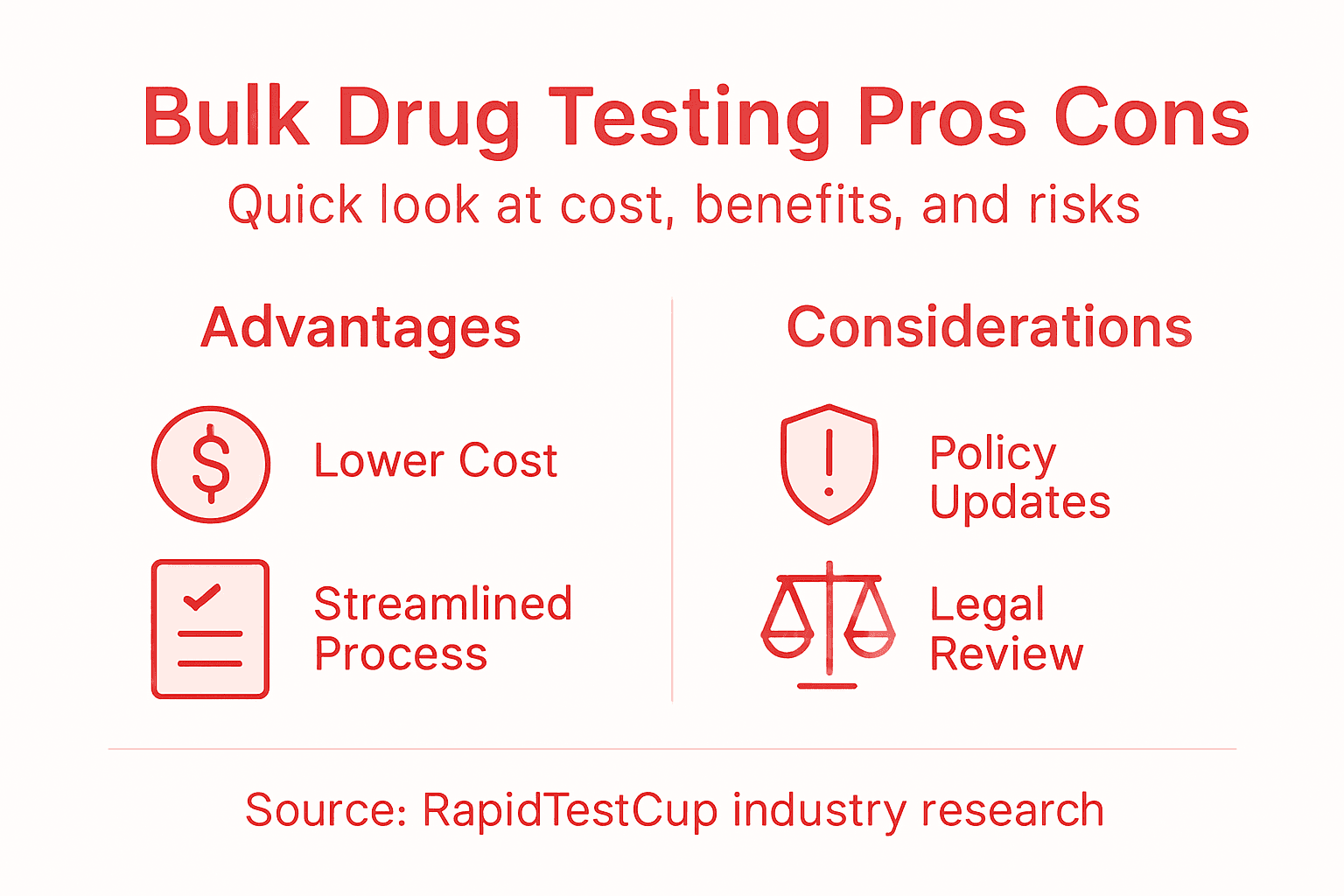
Navigating the complex landscape of drug testing requires a nuanced understanding of potential legal risks associated with testing protocols. Organizations must carefully balance safety objectives with individual privacy rights and regulatory compliance.
Key legal considerations in drug testing encompass multiple critical dimensions:
- Constitutional privacy protections
- Employment discrimination risks
- Consent and notification requirements
- Medical confidentiality standards
- Potential liability for testing procedures
Mandatory drug testing presents a multifaceted challenge for organizations, requiring sophisticated approaches that protect both institutional interests and individual rights. Complex legal frameworks vary significantly across different jurisdictions, necessitating careful policy development.
Effective drug testing strategies balance organizational safety with individual rights and legal compliance.
Alternative Testing Approaches include:
- Targeted reasonable suspicion testing
- Voluntary screening programs
- Post-incident investigation protocols
- Comprehensive rehabilitation-focused approaches
- Consent-based periodic screening
Understanding the potential legal vulnerabilities is crucial for implementing an effective drug testing strategy. Organizations must develop nuanced policies that minimize legal exposure while maintaining workplace safety and individual dignity.
Pro tip: Consult with legal professionals specializing in employment law to develop drug testing policies that are legally defensible and tailored to your specific organizational context.
Maximize Cost Efficiency with Bulk Drug Testing Solutions
The article highlights the challenge organizations face in managing high costs and complex logistics when implementing bulk drug testing programs. Key pain points include finding affordable, reliable test kits that deliver consistent accuracy while meeting compliance standards and reducing per-test expenses. To address these concerns, embracing bulk drug testing panels and streamlined purchasing strategies can provide substantial financial benefits and operational ease.
At RapidTestCup, we understand your need for CLIA waived, FDA-approved testing kits that combine quality with affordability. Our extensive catalog offers a wide range of drug test cups, dip cards, and specimen collection supplies designed specifically for organizations requiring high-volume screening. Enjoy the benefits of bulk discounts alongside quick shipping and comprehensive product details tailored for professional, forensic, and clinical use.
Ready to transform your substance screening process and cut costs today?
Explore our bulk testing options now at RapidTestCup and discover how easy it is to improve compliance while lowering expenses. Check out our detailed drug test panel selection to find customized solutions that fit your exact needs and start saving immediately.
Frequently Asked Questions
What are bulk drug tests?
Bulk drug tests are systematic screening procedures used to efficiently test large groups of individuals for substance use by analyzing biological samples such as urine or blood.
How do bulk drug tests provide cost savings?
Bulk drug tests deliver cost savings by reducing individual test pricing and administrative overhead due to economies of scale, ultimately leading to a significant decrease in overall operational costs.
What types of substances can bulk drug tests detect?
Bulk drug tests can detect a variety of substances, including illicit drugs like marijuana, cocaine, and amphetamines, as well as prescription medications and synthetic drugs, depending on the selected test panel.
What are the compliance benefits of using bulk drug testing?
Compliance benefits include standardized testing protocols, reduced legal liability, objective performance monitoring, and a clear commitment to workplace safety that meets industry-specific regulatory standards.