

Blog
Staff Training for Drug Testing: HR Compliance Guide


TL;DR:
- Proper staff drug testing training is essential for reducing liability risks, including discrimination claims and fines, through role-specific education grounded in clear policies. Regular updates, detailed documentation, and scenario-based exercises ensure compliance with evolving regulations, while ongoing verification maintains program effectiveness. Building a culture of continuous learning and utilizing reliable testing tools support a legally defensible and operationally sound drug testing program.
Getting staff training for drug testing wrong is not a paperwork problem. It is a liability problem. One supervisor who documents a referral incorrectly, one collector who mishandles a specimen, or one HR manager who skips confidentiality protocols can expose your organization to discrimination claims, contested terminations, and regulatory fines. The good news: a properly structured drug testing training program, grounded in clear policy and role-specific content, eliminates most of those risks before they materialize.
Table of Contents
- Key takeaways
- Staff training for drug testing: building the right foundation
- How to conduct effective drug testing training sessions
- Common mistakes that undermine drug testing training
- Verifying and maintaining training effectiveness over time
- What I have learned about making drug testing training actually stick
- Build your program on reliable testing tools
- FAQ
Key takeaways
| Point | Details |
|---|---|
| Start with a written policy | A documented drug testing policy is the legal and procedural foundation every training program must be built on. |
| Train by role, not by group | Supervisors, collectors, and HR staff each need distinct modules covering their specific responsibilities and legal boundaries. |
| Documentation is your defense | Supervisors trained to record objective, contemporaneous observations dramatically reduce legal exposure in disputed cases. |
| Regulations keep changing | DOT specimen collection requirements evolved significantly in 2024, meaning annual refresher training is no longer optional. |
| Measure training effectiveness | Post-training assessments and incident reviews identify gaps before they become compliance failures or safety incidents. |
Staff training for drug testing: building the right foundation
Before any training session happens, the underlying structure needs to be solid. SAMHSA’s employer resources identify five components that define a successful federal drug-free workplace program: a written policy, supervisor training, employee education, an Employee Assistance Program, and drug testing. Notice that policy comes first. You cannot train staff on procedures that do not exist in writing yet.
Your written policy should define which employees are subject to testing, under what circumstances (pre-employment, random, post-accident, reasonable suspicion, return-to-duty), and what consequences follow a confirmed positive result. It should also reference the specific regulations your organization operates under, whether that is DOT, FAA, FMCSA, or state law.
Once the policy is documented, the next step is mapping roles to training obligations:
- Supervisors: Must learn to recognize behavioral and physical signs of impairment, document observations accurately, initiate reasonable suspicion referrals, and handle those conversations without violating ADA or confidentiality rules.
- Specimen collectors: Need hands-on training in chain-of-custody procedures, collection protocols for both urine and oral fluid specimens, and how to identify and respond to potential adulteration.
- HR staff: Should understand federal and state compliance frameworks, how to manage drug test results within legal parameters, and how to maintain training records for audit readiness.
| Role | Primary training focus | Regulatory reference |
|---|---|---|
| Supervisor | Reasonable suspicion, ADA, documentation | SAMHSA, DOT |
| Collector | Chain-of-custody, specimen integrity | DOT 49 CFR Part 40 |
| HR staff | Policy administration, recordkeeping | Federal/state law |
Pro Tip: Before scheduling any training sessions, request documentation of your current policy from legal counsel for a compliance review. Outdated language around medical marijuana or prescription drug use is the most common gap that undermines an otherwise solid program.
How to conduct effective drug testing training sessions
Execution is where most programs either deliver results or quietly fail. The difference usually comes down to whether training is generic or role-specific. Role-based training separates what supervisors need to know from what collectors need to do, which produces measurably better compliance outcomes than one-size-fits-all awareness sessions.
Here is a practical sequence for rolling out your drug testing training program:
- Assess your workforce segments. Identify how many supervisors, collectors, and HR staff need training. Safety-sensitive roles under DOT regulations require separate treatment from general staff.
- Select or develop role-specific modules. The FTA offers 60-minute drug awareness videos and separate supervisor training resources for reasonable suspicion decisions. These are solid starting points, especially for transportation employers, and can be adapted for non-DOT workplaces.
- Cover confidentiality and ADA standards explicitly. Training for drug screening must include how to handle medical review information, what supervisors can and cannot say to coworkers, and how disability-related defenses under the ADA are evaluated. Supervisor training modules typically pair these legal boundaries with documentation practice.
- Run scenario-based simulations. Have supervisors walk through a realistic reasonable suspicion scenario: they observe an employee slurring speech and struggling with basic tasks. What do they document? What do they say? Who do they call? Simulation turns policy into muscle memory.
- Integrate documentation drills. Practical training programs that include scenario-based procedural exercises build the consistency that supervisors need when situations are stressful and stakes are high.
- Use video and interactive formats strategically. Video works well for foundational awareness. Interactive case discussions are better for reasonable suspicion and post-accident testing scenarios where judgment calls matter.
- Track and document completion. Every employee who completes training should have a signed acknowledgment in their file. For supervisors, track the specific modules completed, the date, and the format.
Pro Tip: For supervisor reasonable suspicion training, never rely solely on a video. Pair it with a live debrief where supervisors can ask “What would I actually do if…” questions. That conversation is where the real learning happens.
Scheduling matters too. New supervisors should complete their initial training before they have direct oversight of safety-sensitive employees, not after. Annual refreshers for all covered roles should align with your policy review cycle.
Common mistakes that undermine drug testing training
Even well-intentioned programs develop blind spots. These are the most common failures that HR professionals encounter, and how to address each one.
- Vague policy language in training materials. When training reflects ambiguous policy (“employees may be tested at the company’s discretion”), supervisors hesitate to act or act inconsistently. Revise the policy before distributing training content.
- Skipping documentation discipline. Supervisor training that reduces HR risk depends entirely on objective, contemporaneous documentation. Supervisors who write general notes like “seemed off” weeks after an incident lose the legal defensibility that structured observation provides.
- Ignoring evolving specimen collection requirements. DOT regulations now mandate directly observed urine collection when oral fluid testing is designated but no certified laboratory is available, a change effective June 2024. Collectors whose training predates this rule are operating with outdated procedures.
- Treating confidentiality as optional. One supervisor who mentions a colleague’s drug test result to another employee can trigger a lawsuit. Confidentiality and ADA compliance must be covered in every supervisor module, not just the HR-specific one.
- Failing to address resistance during training. Employees and supervisors who feel drug testing policies are invasive or punitive are less likely to follow them carefully. Address the “why” in training. Safety, legal liability, and employee protection are concrete reasons that resonate with most workforces.
The absence of FDA-certified laboratories has delayed full oral fluid testing implementation, creating a transition period where collectors must be trained on both legacy urine protocols and the interim directly observed collection requirements. Programs that have not updated collector training since 2023 are almost certainly non-compliant.
You can review current workplace drug testing compliance guidance to cross-check your program against current legal standards before your next training cycle.
Verifying and maintaining training effectiveness over time
Training that happened once, two years ago, with no follow-up is not a training program. It is a checkbox. Real compliance requires ongoing verification, structured refreshers, and systems for capturing what is not working.

| Verification method | When to use | What it reveals |
|---|---|---|
| Post-training written assessment | Immediately after each module | Knowledge gaps in policy and procedures |
| Practical evaluation | After collector training | Procedural errors in specimen handling |
| Incident review debrief | After any positive or challenged test | Training failures that contributed to the outcome |
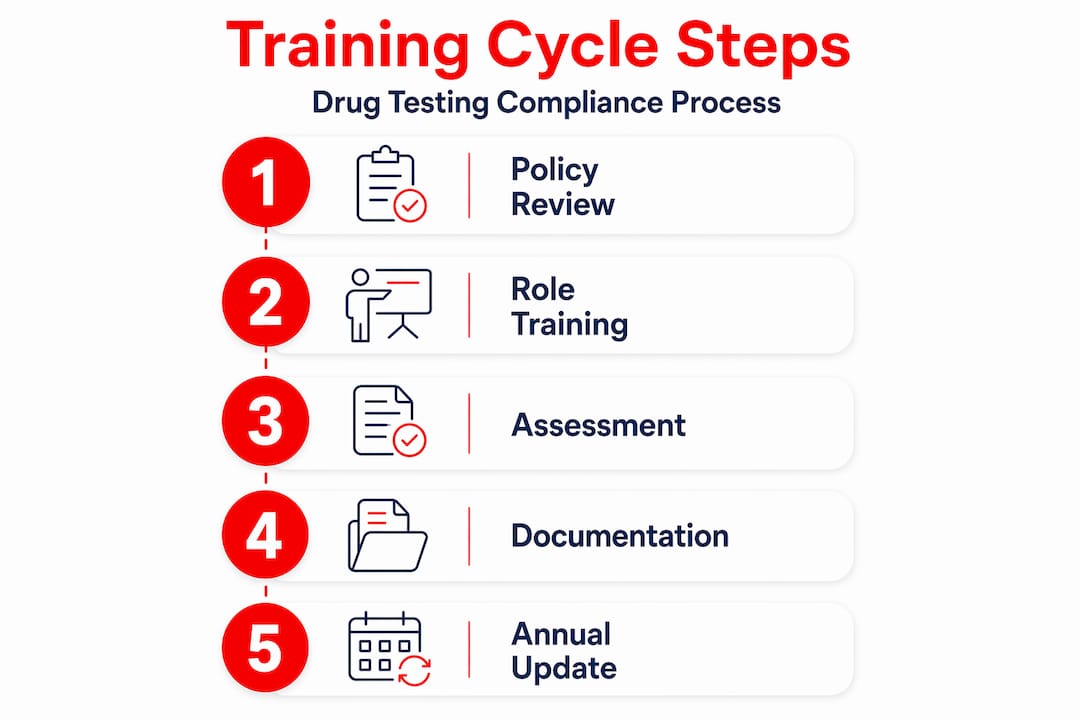
| Annual refresher session | Once per year minimum | Regulatory changes staff were not updated on |
| Employee feedback surveys | After training and quarterly | Gaps in clarity, tone, or relevance of content |
Beyond formal assessments, the most revealing data often comes from real incidents. When a reasonable suspicion referral gets challenged, trace it back: Was the supervisor trained? Did they document contemporaneously? Did HR follow the correct protocol for notification and testing? Each contested case is a diagnostic tool for your training program.
Audit readiness should drive your recordkeeping habits. Maintain a training log that captures:
- Employee name and role
- Module title and content version
- Completion date and delivery format
- Trainer or platform name
- Signed acknowledgment
Regulations change on a pace that makes annual refreshers a baseline, not a best practice. The DOT specimen collection changes of 2024 are a prime example. Programs that missed those updates have collectors who are technically non-compliant even if they completed training in 2022. Build a regulatory monitoring step into your annual training review so you catch those changes before an audit does.
Pro Tip: Designate one person, usually a compliance officer or senior HR staff member, as your training program owner. Without clear ownership, refresher sessions get deprioritized and recordkeeping drifts. One person with explicit accountability changes that dynamic.
What I have learned about making drug testing training actually stick
I have reviewed a lot of drug testing training programs across different industries, and the ones that hold up legally and operationally share one trait: they treat documentation as the product of training, not the byproduct.
Most programs teach supervisors what to look for. Fewer teach supervisors how to write it down in a way that withstands scrutiny six months later in a legal proceeding. That gap is where employers lose cases they should have won. When I see programs built around practical documentation drills, not just recognition checklists, the outcomes are meaningfully different.
The other thing I have found consistently underrated is the dignity piece. Training that balances enforcement with employee dignity produces supervisors who handle reasonable suspicion conversations without humiliating employees. That matters legally under ADA, and it matters practically because how a conversation goes often determines whether an employee cooperates or immediately involves an attorney.
My honest advice: stop treating workplace drug testing education as a one-time compliance obligation. Organizations that build a continuous learning culture around their drug testing policies have fewer disputes, better documentation, and staff who understand the program well enough to follow it under pressure.
— Justin
Build your program on reliable testing tools
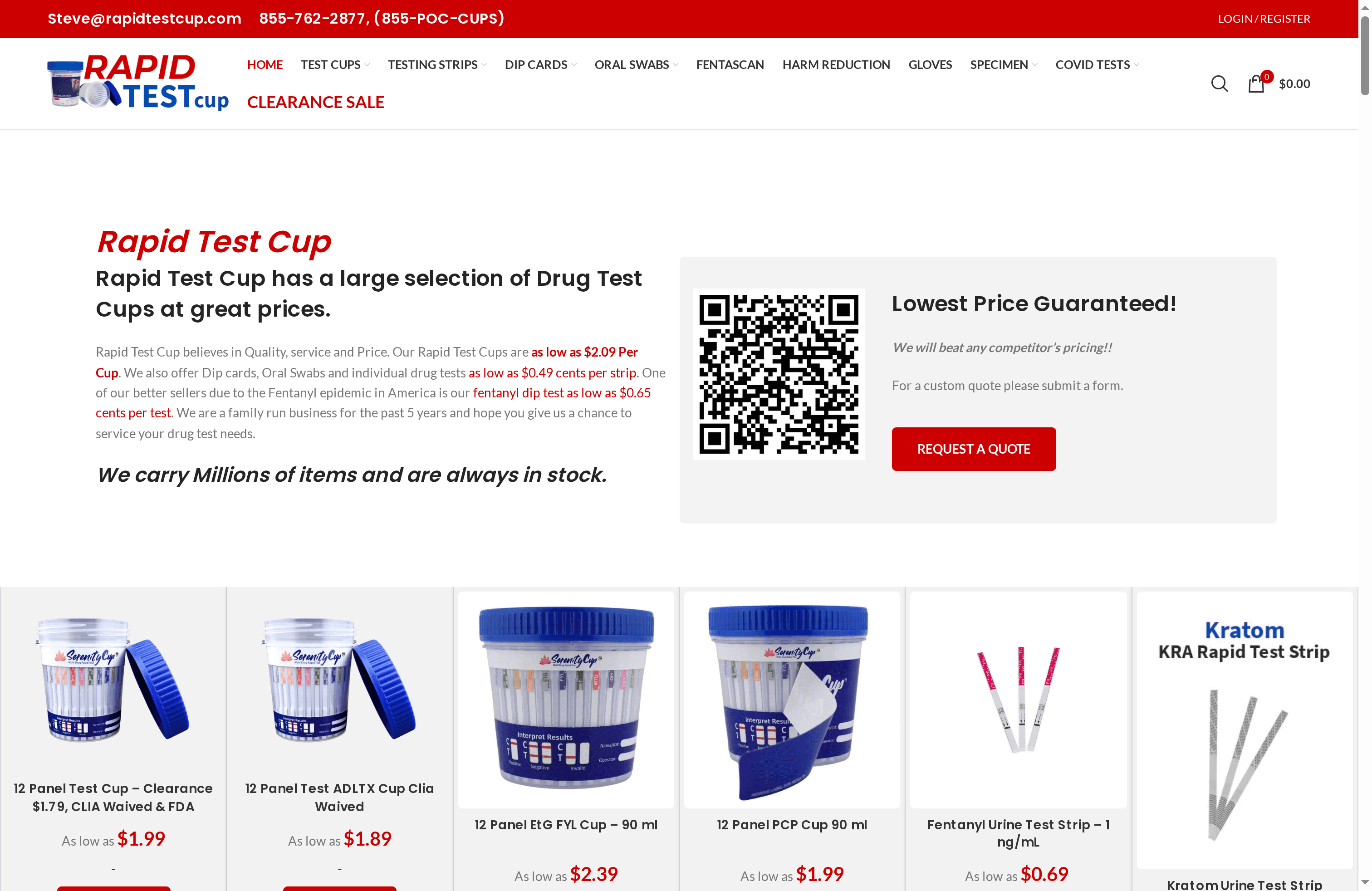
Your training program is only as credible as the testing products supporting it. If collectors are working with unreliable cups or strips, even the best-trained staff will produce results that can be questioned. Rapidtestcup offers CLIA-waived, FDA-approved testing products built for professional workplace programs, including the 12-panel ADLTX test cup designed for accurate, defensible results in compliance-driven environments. For programs that need broader detection coverage, the 22-panel test with adulterant detection is available with bulk pricing options. Pair your trained staff with products that hold up to audit scrutiny.
FAQ
What does staff drug testing training need to cover?
Effective training must address policy review, role-specific procedures, documentation practices, confidentiality rules, and ADA compliance. SAMHSA identifies supervisor training and employee education as two of the five pillars of a compliant drug-free workplace program.
How often should drug testing training be refreshed?
Annual refreshers are the minimum, and they should incorporate any regulatory changes from the prior year. The DOT specimen collection rule changes effective June 2024 are a recent example of why programs cannot rely solely on initial training.
Do supervisors need different training than collectors?
Yes. Supervisors focus on reasonable suspicion recognition, documentation, and ADA boundaries, while collectors need hands-on procedural training in chain-of-custody and specimen integrity. Combining both into one generic session produces neither competence.
What records should employers keep from training sessions?
Document each employee’s name, role, module completed, delivery format, date, and a signed acknowledgment. These records support audit readiness and demonstrate due diligence in any contested termination or compliance review.
How do you handle drug testing training for changing regulations?
Assign a designated compliance owner who monitors regulatory updates from DOT, SAMHSA, and applicable state agencies. Build a structured annual review of all training materials into your compliance calendar so updates are captured before they create gaps.