Blog
Presumptive Positive: What It Means and What to Do


A presumptive positive is an initial screening result that strongly suggests the presence of a pathogen, drug, or other substance — but has not yet been confirmed by a reference laboratory. Think of it as a well-founded suspicion, not a final verdict. Public-health practice in the U.S. treats it as actionable: you act as though the result is real while confirmation is pending.
If you just received one, here is what to do right now:
- Isolate if the test is for an infectious disease and you have been advised to do so by your provider or local health department.
- Contact your provider or testing site to understand what happens next and get written documentation of the result.
- Expect confirmatory testing — a second, more specific test will either confirm or rule out the initial finding before any final decisions are made.
Key Takeaways
A presumptive positive is a preliminary screening result that triggers immediate precautionary action but requires confirmatory testing before any legal, clinical, or disciplinary decision can be made.
| Point | Details |
|---|---|
| Definition | A presumptive positive is an initial screening finding, not a final identification of a substance or pathogen. |
| Treat it as precautionary | Public-health and workplace practice requires acting on the result (isolate, notify) while confirmation is pending. |
| Confirmation is required | No legal, disciplinary, or definitive clinical action should proceed without a confirmatory result from GC-MS, LC-MS/MS, or an equivalent reference method. |
| Timelines vary | Screening results arrive in minutes; confirmatory results typically take one to three business days under normal lab conditions. |
| False positives are possible | Screening assays prioritize sensitivity, so cross-reactive compounds can trigger a positive that confirmatory testing rules out. |
Table of Contents
- What does a presumptive positive actually mean?
- How does a presumptive result differ from a confirmed one?
- What should you do after getting a presumptive positive?
- How long does confirmation usually take?
- Presumptive positives in drug testing: what patients, HR, and clinics need to know
- Why clear communication around presumptive results matters more than most people realize
- Sources
What does a presumptive positive actually mean?
The phrase comes from a two-stage testing model used in both public health and clinical diagnostics. A presumptive positive is an initial local or state public-health lab finding that indicates the likely presence of a pathogen, but awaits validation by a central reference laboratory such as the CDC or a certified reference clinical lab.
Local and state public-health labs run screening tests because speed matters. During a disease outbreak, waiting days for a reference lab result before taking action could cost lives. So local labs issue a presumptive positive to trigger immediate precautionary measures — isolation, contact tracing, provider notification — while the specimen travels to a reference lab for definitive confirmation.
The COVID-19 pandemic made this workflow visible to the general public. In early 2020, local health departments across the U.S. routinely announced presumptive positive cases of COVID-19 while awaiting CDC confirmation. Mono County, California, for example, publicly reported a presumptive positive case and described the confirmation process in plain language — a pattern repeated in counties nationwide. As lab capacity expanded and turnaround times shortened, the CDC’s reporting guidance evolved, and the explicit phrase “presumptive positive” became less common in federal messaging. The concept, however, remains central to any screening-confirmation workflow.
How does a presumptive result differ from a confirmed one?
The core difference is purpose. A screening assay is designed to catch as many true positives as possible — it prioritizes sensitivity. A confirmatory assay is designed to rule out false positives — it prioritizes specificity. NIST defines a presumptive test as a screening test and explicitly warns that a positive presumptive result does not constitute identification of the substance in question.
| Feature | Screening assay | Confirmatory assay |
|---|---|---|
| Primary goal | High sensitivity — catch all positives | High specificity — identify definitively |
| Common methods | Immunoassay, rapid antigen, lateral flow | GC-MS, LC-MS/MS, PCR confirmation |
| Turnaround | Minutes to hours | Hours to several days |
| Legal/clinical weight | Preliminary — triggers precaution | Definitive — supports legal or clinical action |
| False positive risk | Higher | Very low |
A false positive on a screening test happens when the assay reacts to something other than the target substance — a cross-reactive compound, for instance. A false negative is less common with well-designed screening tests but can occur with very low analyte concentrations. Neither outcome is the final word. Only the confirmatory result carries the weight needed for legal, disciplinary, or definitive clinical decisions. See examples of confirmatory tests used by lab professionals for a breakdown of which methods apply to which scenarios.
What should you do after getting a presumptive positive?
The sequence below applies whether the test was for an infectious disease or a drug screen.
- Isolate or limit exposure if the test is for a communicable disease. Follow your provider’s or local health department’s specific instructions — not general guidance from the internet.
- Contact your provider or testing site the same day. Ask for written documentation of the result, the test method used, and the next steps in the confirmation process.
- Request confirmatory testing. Ask specifically what confirmatory method will be used, which laboratory will run it, and the expected turnaround time.
- Notify relevant parties as required. For infectious disease, this may mean your employer or close contacts. For a drug screen, workplace notification rules vary by employer policy and state law — confirm before disclosing.
- Hold off on irreversible decisions. No disciplinary action, termination, or legal proceeding should move forward on a presumptive result alone. Wait for confirmation.
- Keep records. Save every document: the initial result, any communications with your provider, and the confirmatory result when it arrives.
Pro Tip: Ask your provider or public-health contact three specific questions: What confirmatory test will be used? What is the realistic turnaround time given current lab capacity? And should this preliminary result be shared with my employer before confirmation? Getting clear answers upfront prevents a lot of confusion later.
For a practical guide on communicating these results to patients or staff, Rapidtestcup’s resource on handling positive test results covers documentation and communication templates.
How long does confirmation usually take?
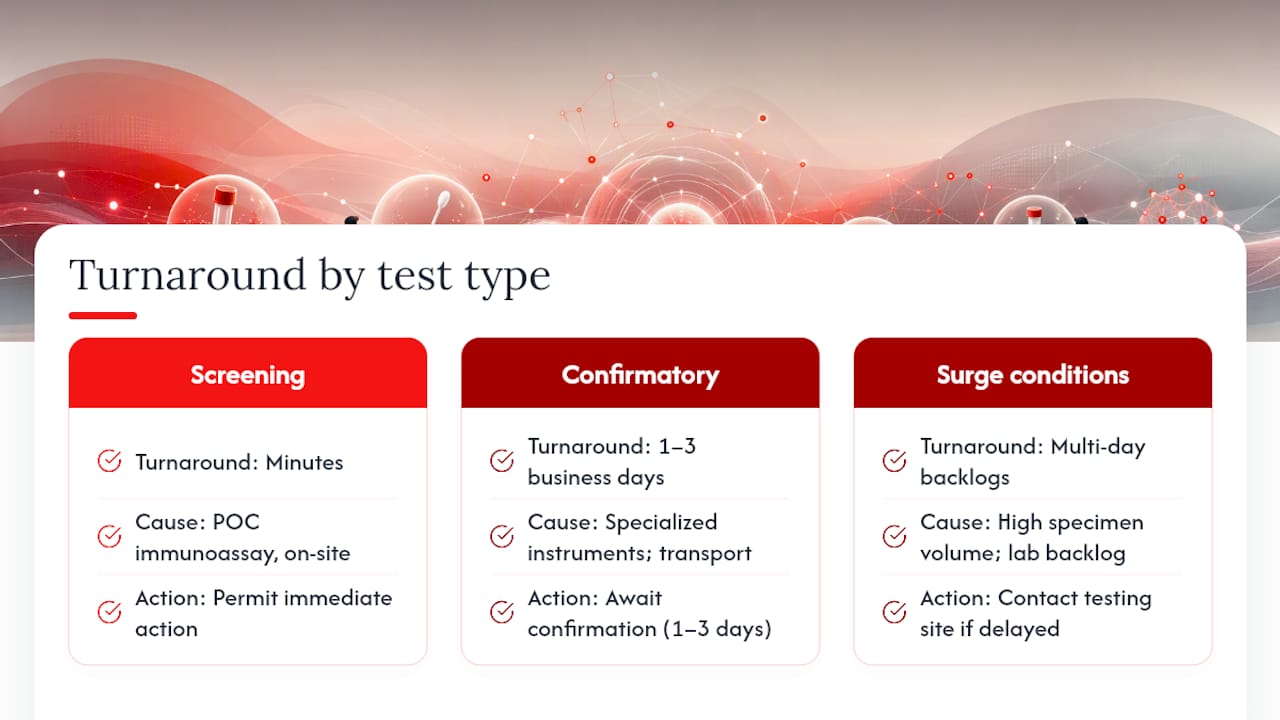
Screening results come back fast — a point-of-care immunoassay can return a result in minutes. Confirmatory testing takes longer because it requires specialized instrumentation, trained analysts, and often specimen transport to a reference lab.
Under normal conditions, confirmatory results from a reference lab typically arrive within one to three business days. Factors that stretch that window include specimen transport logistics, lab backlog, the complexity of the analyte being confirmed, and whether the lab requires a second analyst review for quality control.
During the early months of the COVID-19 pandemic, CDC testing workflows were strained by unprecedented specimen volume. Labs that normally returned confirmatory results within 24 hours faced multi-day backlogs, which is precisely why the “presumptive positive” designation became so operationally important — it allowed public-health action to proceed without waiting for a confirmation that might take days.
Surge conditions — pandemics, mass-casualty events, or large workplace testing programs — are the most common cause of extended confirmation timelines. If you are waiting longer than expected, contact the testing site directly rather than assuming the delay signals a problem with your result.
Presumptive positives in drug testing: what patients, HR, and clinics need to know
In workplace and clinical drug testing, the same two-stage logic applies. A presumptive drug screen is typically an immunoassay — the kind run on a multi-panel urine test cup or dip card at a clinic or collection site. It is fast, inexpensive, and sensitive enough to flag most positive specimens. A negative result on a well-designed screening test generally ends the process.

A positive screening result is a different matter. It must be followed by a definitive analytical method — GC-MS or LC-MS/MS — before any employment, legal, or treatment decision is made. These instrumental methods identify and quantify the specific substance, eliminating the cross-reactivity that can cause a false positive on an immunoassay.
Key points for anyone involved in a drug-testing workflow:
- Chain of custody matters. From the moment a specimen is collected, documentation must be unbroken. A gap in chain of custody can invalidate a confirmatory result in a legal or regulatory proceeding.
- CLIA waiver status matters. Point-of-care screening devices used in clinical settings should carry CLIA waiver status. Ask your testing provider to confirm this before relying on results for clinical decisions.
- Confirmatory testing is not optional for adverse action. Federal workplace drug-testing programs require GC-MS or equivalent confirmation before a result can be used to discipline or terminate an employee.
Pro Tip: Before a drug-testing program goes live, ask your lab or testing provider to specify the confirmatory method in writing, confirm their CLIA certification, and clarify the chain-of-custody procedure. That documentation protects both the employer and the person being tested if a result is ever challenged.
For a deeper look at how presumptive and confirmatory drug testing differ in practice, Rapidtestcup’s primer covers the technical and procedural distinctions clinics and HR teams need.
Why clear communication around presumptive results matters more than most people realize
The word “presumptive” does real psychological work — and not always in a helpful direction. Patients who hear it often assume it means “probably positive,” which is accurate, but they rarely hear the equally important second half: “and we are not done yet.” That gap in understanding is where anxiety spikes and premature decisions get made.
Biology Insights notes that the term’s psychological impact is a known challenge, and that communicating clearly — stating explicitly that the result is preliminary and that precautionary action is not the same as a final diagnosis — meaningfully reduces both patient distress and institutional liability.
The most effective framing I have seen in practice is simple: “This result is preliminary. We are treating it seriously and taking precautions now, but we will have a confirmed answer within [specific timeframe].” That one sentence does more to maintain trust than any amount of technical explanation.
Sources
These U.S.-focused resources cover definitions, official guidance, and practical drug-testing procedures:
- Presumptive positive | Association of Health Care Journalists
- Presumptive Test | NIST
- What Does Presumptive Positive Mean? – Biology Insights
- Presumptive and definitive testing: make the right choice by understanding the differences | Quest Diagnostics
This article provides general educational information about presumptive positive test results. It is not a substitute for advice from a licensed medical provider, public-health official, or qualified legal professional. Confirm current guidance with your provider or the relevant primary source.