Blog
Drug Testing Evidence Handling Workflow: 2026 Compliance Guide


Your specimen collection chain-of-custody follows six non-negotiable steps: collect the specimen, assign a unique identifier, witness and seal in the donor’s presence, complete the Federal Custody and Control Form (CCF), secure storage and packaging, and hand off to the lab with full documentation. Miss any one of these, and a legally defensible result becomes a legally challenged one.
Three absolute requirements anchor the entire process:
- The donor watches the collector pour the specimen into the bottle(s), cap it, and affix the tamper-evident seal before initialing it.
- The collector records the exact date and time on the CCF at the moment of sealing
- Temperature is checked within 4 minutes of collection; the acceptable range is 90–100°F.
Pro Tip: Print a laminated one-page checklist covering these three steps and post it at every collection station. The most common invalidations trace back to a missed initial or a temperature check that ran over the 4-minute window.
Table of Contents
- What does a compliant collection-to-lab-handoff workflow look like?
- How do you assign and verify specimen identifiers?
- What are the exact witnessing and sealing requirements?
- How should you store and ship specimens to preserve integrity?
- What does the receiving lab need to verify on receipt?
- How do you complete the Federal CCF correctly?
- What causes most evidence-handling failures, and how do you prevent them?
- What supplies does every compliant collection site need?
- What should you budget for turnaround time and per-collection costs?
- Who does what, and how do you keep the workflow reliable?
- How do you handle a compromised or contaminated specimen?
- What are the legal and regulatory requirements for 2025 drug testing workflows?
- How do data security and privacy rules apply to specimen records?
- Can RFID and blockchain improve your chain-of-custody integrity?
- Key Takeaways
- What the workflow looks like when volume gets real
- Stock your collection site with compliant supplies from Rapidtestcup
- Authoritative U.S. sources to bookmark for regulatory readiness
What does a compliant collection-to-lab-handoff workflow look like?
Step 1: Prepare the collection area
Before the donor arrives, disable water sources or add a bluing agent to the toilet tank to deter substitution. Remove any potential adulterants from the restroom. If you cannot secure the water source, conduct a monitored collection instead. Process one donor at a time.
Step 2: Donor arrival and ID verification
Verify the donor’s photo ID. Instruct the donor to wash hands under observation, then escort them to the collection area. No bags, coats, or personal items enter the restroom.
Step 3: Specimen provision
The donor must provide an adequate volume sufficient for testing. If the donor cannot provide sufficient volume, document the attempt and follow your program’s shy-bladder protocol. A second directly observed collection is required when the initial specimen temperature falls outside the 90–100°F range.
Temperature is the first line of defense against substitution. A reading outside 90–100°F is not a minor anomaly — it triggers a second directly observed collection and routes both specimens to an HHS-certified laboratory. Check it within 4 minutes, every time, with a device that does not contact the specimen.
Step 4: Immediate specimen checks
Inspect the specimen’s color and clarity. Measure temperature immediately using a temperature strip or thermometer that does not contaminate the specimen. Record the result in Step 2 of the Federal CCF.
Step 5: Splitting and sealing in donor’s presence
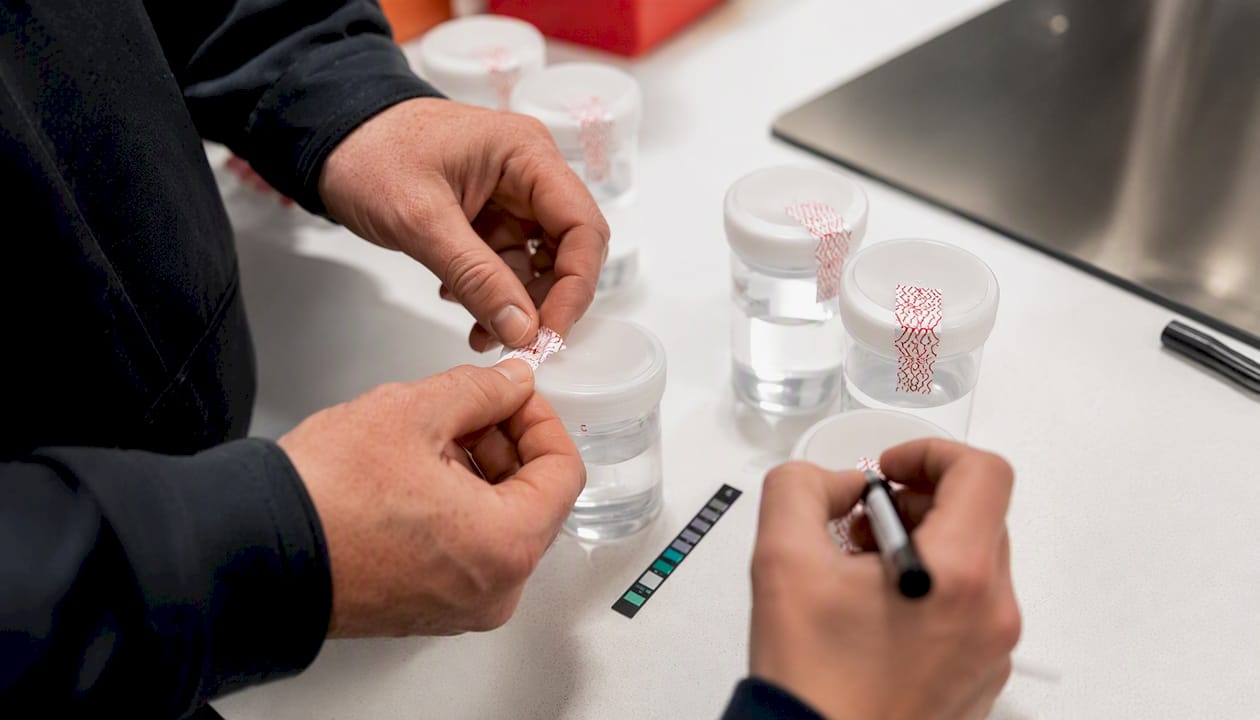
Pour the specimen into the A and B bottles in the donor’s direct line of sight. Cap both bottles, affix tamper-evident seals across the cap and bottle neck, and have the donor initial each seal. The collector then dates the seals and signs Step 3 of the CCF.
Step 6: Packaging for release
Place sealed bottles in a leak-resistant bag with absorbent material. Complete Step 4 of the CCF, recording the delivery service name, date, and time. Log the seal serial numbers before the package leaves your hands.
Pro Tip: Photograph the sealed bottles and completed CCF together before packaging, when your site policy allows it. That image has resolved more custody disputes than any verbal account.
| CCF Step | Action Required | Who Completes |
|---|---|---|
| Step 1 | Specimen ID, donor demographics | Collector |
| Step 2 | Temperature check, remarks | Collector |
| Step 3 | Seal affixed, donor initials, date | Collector + Donor |
| Step 4 | Chain-of-custody release, delivery service | Collector |
| Step 5 | Donor certification signature | Donor |
How do you assign and verify specimen identifiers?
Poor labeling is one of the most common failure points in biological specimen workflows. Assign a unique specimen ID at the moment of collection. That same ID must appear on the bottle label, the tamper-evident seal, and Step 1 of every CCF copy.
- Print the ID on the manufacturer bottle label before affixing it
- Affix the tamper-evident seal so it bridges the cap and bottle neck; the ID must remain legible after sealing
- Record donor demographics and employee ID in Step 1; avoid using Social Security Numbers unless your program’s policy explicitly requires them
- If a donor refuses to provide identifying information, document the refusal in the Remarks field and continue collection
Pro Tip: Use scan-ready barcoded labels generated from your collection management system. Manual transcription of specimen IDs is where most identifier mismatches originate.
| Identifier Field | Location | Required? |
|---|---|---|
| Unique specimen ID | Bottle label, seal, CCF Step 1 | Yes |
| Collector name/ID | CCF Step 2 | Yes |
| Donor employee ID | CCF Step 1 | Program-dependent |
| Seal serial number | Packaging log | Yes |
What are the exact witnessing and sealing requirements?
Witnessing is not optional and not a formality. The donor must watch every pour, cap, and seal application before initialing. Here is the exact sequence:
- Collector pours specimen into bottle(s) in the donor’s direct line of sight
- Collector caps each bottle
- Collector affixes tamper-evident seal across cap and bottle neck
- Donor initials each seal
- Collector dates each seal and signs Step 3 of the CCF
If the donor refuses to initial the seals, document that refusal in the Remarks section of the CCF and continue. Refusal to initial is not a refusal to test, but it does create legal exposure that your Medical Review Officer (MRO) needs to know about.
For observed collections, the observer must not touch the collection container. Gender-match rules apply: the observer must be the same gender as the donor. The observer’s role is to watch, not to handle.
Pro Tip: Walk new collectors through a mock collection with a trainer acting as the donor. Muscle memory on the pour-cap-seal-initial sequence prevents the most common witnessing gaps.
How should you store and ship specimens to preserve integrity?
Ship specimens to the IITF or HHS-certified laboratory within 24 hours of collection. If a weekend or holiday delays shipment, place the sealed package in secure refrigerated storage and document the storage conditions, including temperature and who placed it there.
- Use manufacturer-sealed specimen bottles inside a leak-resistant bag with sufficient absorbent material to contain the full specimen volume if the bottle breaks
- Record the courier or delivery service name on the CCF before the package leaves
- Log seal serial numbers and package contents in your site’s shipping log
- Keep the package in a locked, access-controlled area until pickup
Pro Tip: Assign one person per shift to verify that all packages scheduled for pickup are logged and secured. Missed pickups left in unsecured areas are a chain-of-custody break, even if the seals are intact.
| Condition | Required Action |
|---|---|
| Ship within 24 hours | Standard courier, CCF delivery service recorded |
| Delayed shipment | Refrigerated, locked storage; document conditions |
| Weekend hold | Secure refrigeration; log who stored and when |
What does the receiving lab need to verify on receipt?
Lab intake staff must complete these checks before accessioning any specimen:
- Confirm the specimen ID on the bottle matches the ID on the CCF
- Inspect tamper-evident seals for integrity; document any broken or missing seals
- Verify the seal date and collector signature on Step 3
- Check packaging integrity and absorbent condition
- Log the accession number onto the CCF and sign the receiving custody block
If seals are broken or IDs do not match, quarantine the specimen immediately. Document the condition in detail, and follow your laboratory’s written policy on whether to test, reject, or flag for MRO review. Completing the Federal CCF correctly at every transfer point is what makes the audit trail defensible.
How do you complete the Federal CCF correctly?
The Federal CCF is the legal backbone of every specimen transfer. SAMHSA and OMB updated the CCF in 2025, with revisions to Step fields and data collection requirements; the current OMB-approved form carries an expiration date of August 31, 2026. Use only the current version.
- Step 1: Specimen ID, donor demographics, collection site information
- Step 2: Collector remarks, temperature result, specimen type
- Step 3: Seal affixed, donor initials, collector date and signature
- Step 4: Collector chain-of-custody release, delivery service, date/time
- Step 5: Donor certification signature
For electronic CCF (eCCF) systems, the system must carry SAMHSA/NLCP approval before use. Retain all CCF records per your program’s retention policy, typically a minimum of two years for federal workplace programs.
Pro Tip: Keep a laminated field-by-field CCF completion guide at every collection station. Collectors under time pressure skip fields; a visual reference prevents it.
| CCF Field | Common Error | Prevention |
|---|---|---|
| Step 2 temperature | Recorded after 4-minute window | Set a timer at specimen handoff |
| Step 3 donor initials | Donor initials missing | Verbal prompt before sealing |
| Step 4 delivery service | Left blank | Pre-fill courier name on collection kit |
What causes most evidence-handling failures, and how do you prevent them?
Labeling errors and witnessing gaps account for the majority of invalidated specimens. Here is how to close each failure point:
- Labeling: Use barcoded, scan-ready unique IDs generated at collection. Never handwrite specimen IDs.
- Witnessing gaps: Train collectors on the pour-cap-seal-initial sequence as a single uninterrupted routine. Use a supervisor sign-off checklist for observed collections.
- Seal failures: Use only manufacturer-supplied tamper-evident seals. Log serial numbers. Photograph seal placement when policy allows.
- Temperature failures: Set a physical timer at the moment of specimen handoff. Out-of-range results require a second directly observed collection routed to an HHS-certified lab.
- Handler proliferation: Limit the number of people who touch unsealed specimens. The collector should be the only person handling the unsealed specimen until it is sealed in the donor’s presence.
Pro Tip: Review signs of drug test tampering before each collection shift. Collectors who know what substitution and adulteration look like catch problems before they reach the lab.
What supplies does every compliant collection site need?
Stock these categories before your first collection of the day:
- Manufacturer-sealed specimen bottles (A and B split bottles)
- Tamper-evident seals with pre-printed or scannable serial numbers
- Federal CCF forms (current OMB-approved version) or an approved eCCF system
- Leak-resistant shipping bags with absorbent inserts
- Temperature strips calibrated for the 90–100°F range
- Chain-of-custody label printer or pre-printed barcode labels
- Bluing agent for toilet tanks or water-disabling tools
Rapidtestcup carries multi-panel drug test cups, urine specimen cups, and specimen collection tools suited to both routine and monitored collections. Bulk pricing is available for programs running high collection volumes.
Pro Tip: Maintain two kit configurations: a standard kit for routine collections and a monitored-collection kit that includes bluing agent and a second bottle set. Pre-kitting reduces setup time and prevents supply gaps under pressure.
| Supply Category | Purpose | Reorder Trigger |
|---|---|---|
| Specimen bottles (A/B) | Primary collection | Below 2-week supply |
| Tamper-evident seals | Chain-of-custody | Below 2-week supply |
| Temperature strips | 90–100°F verification | Below 1-week supply |
| Leak-resistant shipping bags | Transport integrity | Below 2-week supply |
What should you budget for turnaround time and per-collection costs?
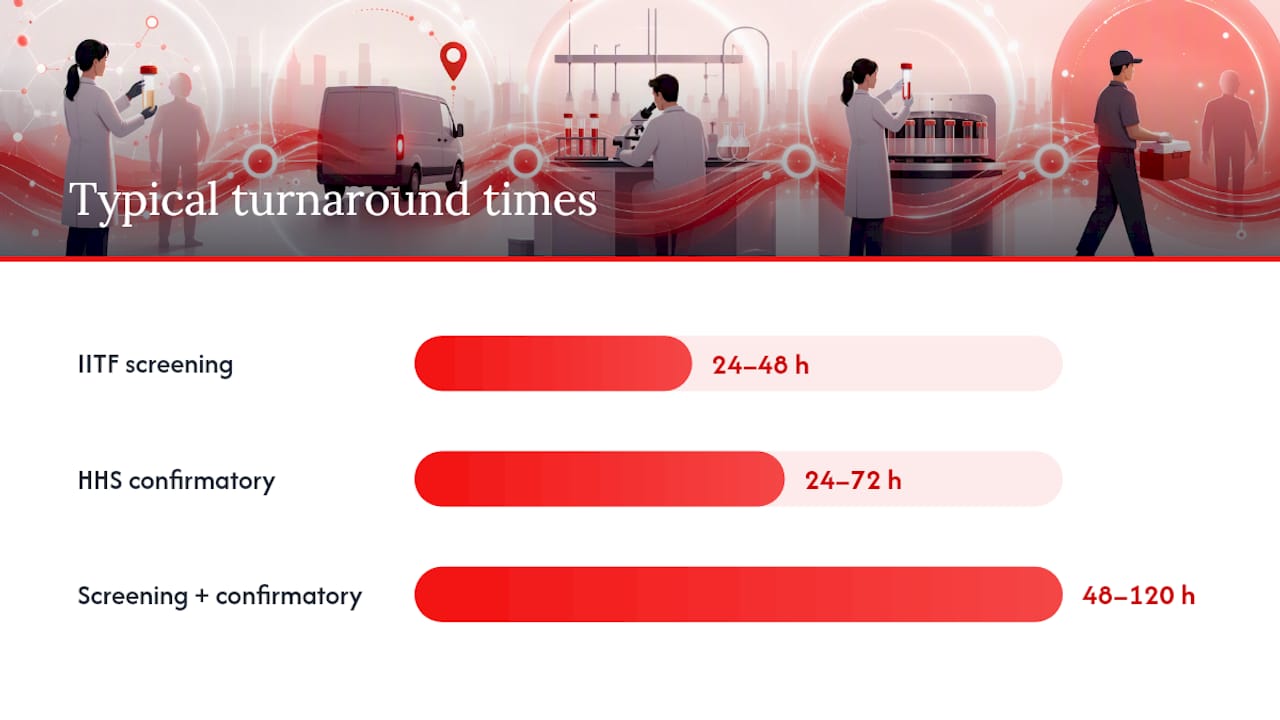
Screening results from an Instrumented Initial Test Facility (IITF) typically return within 24–48 hours of receipt. Confirmatory testing at an HHS-certified laboratory adds 24–72 hours, depending on the analyte and lab workload. Temperature failures or specimen integrity questions extend that timeline further because both specimens must be routed to an HHS-certified lab.
- Multi-panel cups cost more per unit than dip cards but consolidate multiple analytes into a single collection, reducing labor
- Seal and label costs are small per unit but add up at scale; buying in bulk cuts per-test cost meaningfully
- Courier fees vary by distance and urgency; programs near a certified lab can negotiate standing pickup schedules
- Split-specimen retention adds storage cost; factor refrigerated storage into your per-collection budget
Pro Tip: Calculate your true per-collection cost including labor, supplies, courier, and lab fees. Programs that switch from individual supply purchasing to bulk specimen collection kits consistently reduce per-test cost.
| Cost Driver | Lower-Cost Option | Higher-Cost Scenario |
|---|---|---|
| Collection device | Dip cards | Multi-panel cups |
| Lab routing | IITF screening only | HHS-certified confirmatory |
| Shipping | Scheduled pickup | On-demand courier |
| Storage | Same-day shipment | Weekend refrigerated hold |
Who does what, and how do you keep the workflow reliable?
Roles:
- Collector: Prepares site, verifies ID, witnesses provision, checks temperature, seals, and completes CCF Steps 1–4
- Supervisor/Site Manager: Reviews completed CCFs, authorizes observed collections, signs off on chain-of-custody transfers
- Observer (monitored/observed collections): Watches provision only; does not touch the container
- Lab Certifying Technician: Verifies receipt, checks seals and IDs, accessions specimen, signs receiving custody block
Training checkpoints:
- Documented practice on Federal CCF completion, including all five steps
- Observed collection protocol drills, including gender-match rules and observer role limits
- Temperature-check timing drills with a physical timer
- Seal application practice on mock bottles
QA activities:
- Periodic audits of randomly selected collection records against CCF copies
- Seal and label inventory reconciliation monthly
- Mock collection drills quarterly
- Incident reporting for any broken seal, ID mismatch, or temperature failure
A laboratory drug testing checklist gives supervisors a ready-made audit tool that maps directly to these QA checkpoints.
How do you handle a compromised or contaminated specimen?
When a specimen arrives with a broken seal, mismatched ID, or visible contamination, the receiving lab quarantines it immediately. Document the condition photographically if possible, then record the discrepancy in the CCF Remarks field and in the lab’s internal incident log.
The lab’s written policy governs whether to test, reject, or hold for MRO review. For federal workplace programs, a broken seal typically results in the specimen being reported as rejected. The MRO then contacts the collector and site to determine whether a recollection is warranted.
At the collection site, if a specimen shows signs of adulteration (unusual color, odor, or temperature) before sealing, document the observation in Step 2 Remarks and initiate a second directly observed collection per your program’s protocol. Adulteration prevention controls at the collection site are the first line of defense.
What are the legal and regulatory requirements for 2025 drug testing workflows?
Federal workplace drug testing programs operate under 49 CFR Part 40 for DOT-regulated employers and under SAMHSA’s Mandatory Guidelines for non-DOT federal programs. Both frameworks require use of the current Federal CCF, HHS-certified or NLCP-approved laboratories, and a qualified MRO for result review.
State programs vary. Some states impose additional chain-of-custody requirements, shorter retention windows, or specific observer rules. Confirm your state’s requirements with your legal counsel or state health department before finalizing your SOP.
The 2025 Federal Register update to the CCF introduced field-level revisions that affect how collectors record certain data points. Programs using printed CCF stock should verify they are using the current OMB-approved version before the August 31, 2026 expiration date.
This article provides general compliance information, not legal advice. Confirm current regulatory requirements with SAMHSA, DOT, or a qualified compliance professional.
How do data security and privacy rules apply to specimen records?
Chain-of-custody records contain protected health information (PHI) and personally identifiable information (PII). Under HIPAA, covered entities must restrict access to CCF records to authorized personnel only and maintain audit logs of who accessed or modified records.
For electronic CCF systems, access controls, encryption at rest and in transit, and role-based permissions are baseline requirements. Paper CCF copies must be stored in locked, access-controlled filing systems. Retention periods for federal workplace programs are typically two years minimum; confirm your program’s specific requirement.
Donor information, including employee ID and test results, must never be transmitted via unsecured email or stored on shared drives without access controls. Train staff on these rules as part of initial collector certification and annual refresher training.
Can RFID and blockchain improve your chain-of-custody integrity?
RFID tags embedded in specimen bottles allow real-time location tracking from collection through lab receipt, eliminating manual handoff logs for high-volume programs. Each scan creates a timestamped record tied to the specimen ID, which feeds directly into an electronic chain-of-custody system.
Blockchain-based custody logs offer tamper-evident audit trails: each custody transfer writes an immutable record to a distributed ledger, making retroactive alteration detectable. Several laboratory information management systems (LIMS) are piloting blockchain integration for federal and forensic programs.
Both technologies reduce human transcription errors and create audit trails that hold up under legal scrutiny. The practical barrier is cost and integration complexity. For most clinics and employer programs, a well-configured eCCF system with barcode scanning delivers most of the integrity benefit at a fraction of the implementation cost.
Key Takeaways
A compliant drug testing evidence handling workflow requires six sequential steps, three non-negotiable checks, and complete Federal CCF documentation at every transfer point.
| Point | Details |
|---|---|
| Temperature window | Check specimen temperature within 4 minutes; 90–100°F is the only acceptable range. |
| Witnessing requirement | Donor must watch every pour, cap, and seal before initialing; no exceptions. |
| CCF currency | Use only the current OMB-approved Federal CCF; the 2025 revision expires August 31, 2026. |
| Handler limits | Restrict unsealed specimen handling to the collector only until sealing is complete. |
| Rapidtestcup supplies | Multi-panel cups, specimen cups, and seal kits are available with bulk pricing for high-volume programs. |
What the workflow looks like when volume gets real
The six-step framework is clean on paper. In a busy clinic running 30 collections a day, the friction points are predictable: collectors rushing the temperature check, donors left unattended between steps, and CCF copies that go missing between collection and shipping.
The fix is not more rules. It is structural. Assign one accessions clerk whose only job is to verify CCF completeness before any package is sealed for shipping. Pre-kit your collection supplies the night before so collectors are not hunting for seals mid-collection. Batch your courier pickups to a fixed daily window so the “ship within 24 hours” rule is never a scramble.
Supervisor-level monitoring does not need to be intensive to be effective. A 10-minute end-of-shift CCF audit, checking that every Step 3 has donor initials and every Step 4 has a delivery service recorded, catches the majority of documentation gaps before they become legal problems.
Rapidtestcup’s pre-configured supply options reduce procurement friction for exactly this kind of high-volume environment. Ordering specimen cups, seals, and temperature strips as a bundled kit means one purchase order instead of three, and consistent lot numbers across a collection cycle.
Stock your collection site with compliant supplies from Rapidtestcup
Fewer supply gaps mean fewer collection delays, and fewer collection delays mean fewer chain-of-custody problems. Rapidtestcup offers CLIA-waived, FDA-approved multi-panel drug test cups built for the collection volumes that labs, clinics, and employer programs actually run.
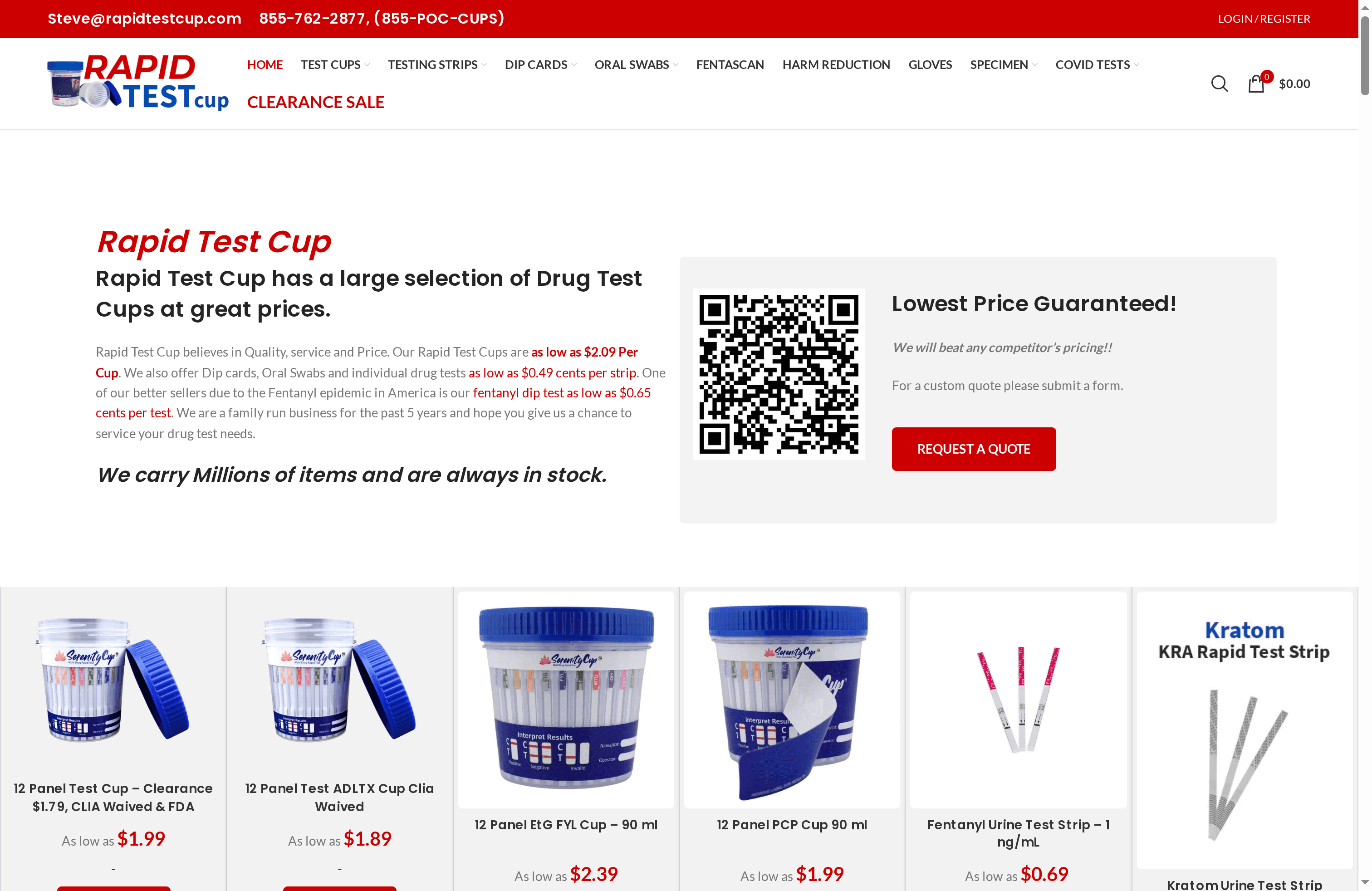
The catalog covers 12-panel and 14-panel cups with adulterant detection, high-sensitivity fentanyl strips, urine specimen cups, and the collection accessories your workflow requires. Bulk pricing scales with order volume, and custom quotes are available for programs with specific panel or packaging requirements. Place your order at Rapidtestcup and have compliant supplies on-site before your next collection cycle.
Authoritative U.S. sources to bookmark for regulatory readiness
Inspectors typically request your current CCF stock, your SOP, and your training records. Keep these sources linked directly in your SOP documents:
- SAMHSA Urine Specimen Collection Handbook 2024
- SAMHSA Urine Collection Site Manual 2024
- Federal CCF Completion Instructions (Reginfo)
- DOT Urine Specimen Collection Guidelines
- NIST Biological Evidence Preservation Handbook
Save PDF copies of each document and date-stamp them in your SOP folder. When an inspector asks for your regulatory basis, you hand them the folder.