

Blog
How to Test Pills for Fentanyl: Strips, Limits and Next Steps


You can test a pill for fentanyl with a fentanyl test strip. You dissolve the pill (or a sample of it) in water, dip the strip, and read the result in a few minutes. A positive means fentanyl was detected. A negative lowers your risk but does not make a pill safe, because strips can miss some analogs and fentanyl is often unevenly spread through a pill. This guide covers the method, the pitfalls, and how pill testing differs from testing a person’s urine with a fentanyl panel.
TL;DR
- Fentanyl test strips detect the presence of fentanyl in pills, powders and injectables. They do not tell you how much is there, and results usually come in about 5 minutes.
- Fentanyl can sit in hot spots inside a pill, so testing only a piece can mislead you. Dissolving the whole pill is the more reliable approach.
- A negative result is not a guarantee. Use testing alongside naloxone, never using alone and smaller doses.
- Testing a pill and testing a person are different jobs. Pills need harm reduction strips. Urine screening needs a cleared test with a defined cutoff.
- Labs, clinics, employers and treatment programs can buy urine fentanyl tests and multi-panel cups from us.
Table of Contents
- Two different tests with two different jobs
- How to test a pill for fentanyl, step by step
- What a negative result does and does not mean
- Best fentanyl test strips: what to look for
- Testing a person: urine fentanyl tests and cutoff levels
- Who can legally buy and use what
- Perspective: what we see from the supply side
- Other steps that lower overdose risk
- Stocking fentanyl tests for your organization
- FAQ
- Sources
Two different tests with two different jobs
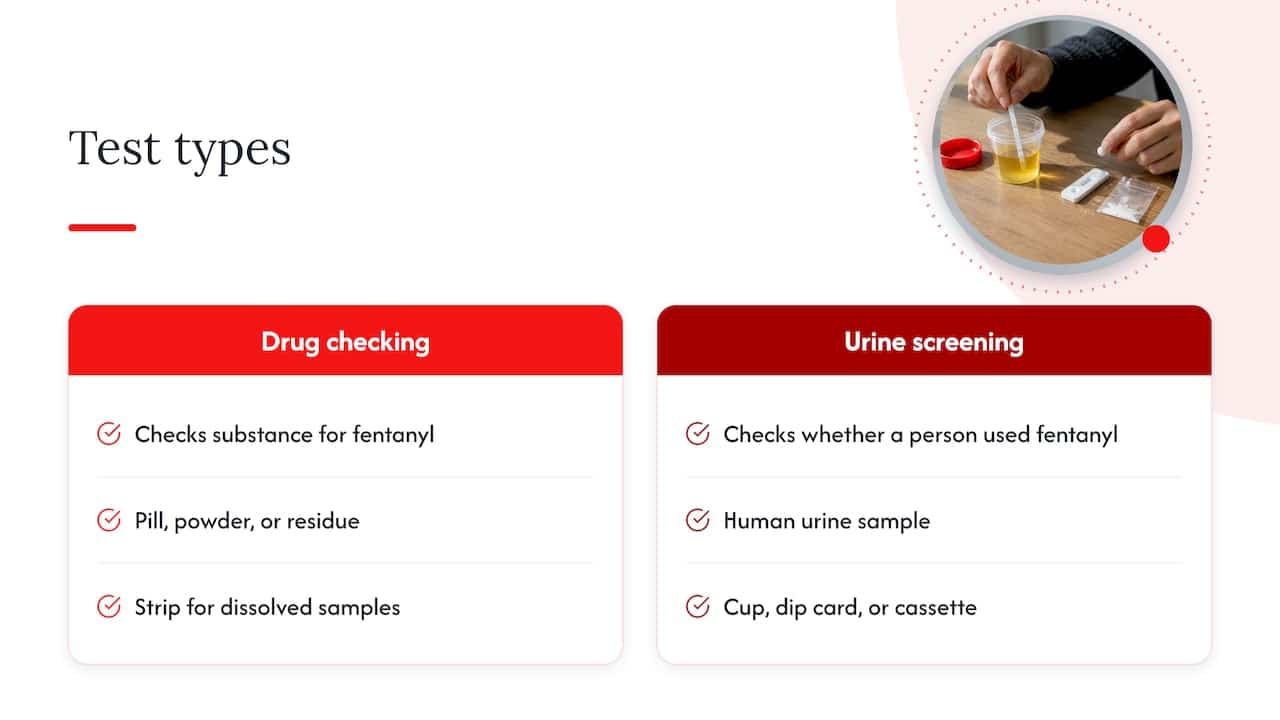
People searching for a fentanyl test usually want one of two things.
Checking a drug sample. You have a pill, powder or other substance and want to know if it contains fentanyl. This is drug checking, and the tool is a fentanyl test strip made for drug residue and dissolved samples.
Checking a person. You want to know if someone has used fentanyl. This is a urine drug screen, run on a cup, dip card or cassette cleared for human urine.
The two are not interchangeable. The FDA has cleared instrument-based and lab-grade fentanyl tests for professional clinical use, but visually read strips meant for consumer drug checking had not received FDA clearance as of 2026. They are treated as harm reduction tools, not diagnostic devices. Dropping a pill strip into urine, or dipping a urine cassette into a dissolved pill, gives results nobody has validated.
How to test a pill for fentanyl, step by step
Brands differ slightly, so read the instructions in your own box first. The steps below follow the common method described by public health agencies and harm reduction groups.
- Gather supplies. You need a strip, a clean container, clean water, and something to stir. Harm reduction professionals recommend kits that also include educational material, sterile water, a mixing container, a stir stick and naloxone.
- Prepare the sample. The New York City health department’s brochure says dissolving all the drugs you plan to use is the most accurate way to test. Crush the pill and mix it into the water until it is dissolved or evenly suspended.
- Dip the strip. Place the wavy-lined end into the liquid for the time your instructions state, then lay the strip flat.
- Wait, then read. Strips should be read within a specific window, usually 2 to 5 minutes after you set them on a flat surface. Reading too early can give a false positive. Reading after about 10 minutes can give an invalid result.
- Interpret the lines. Most strips work in reverse of what people expect. One line generally means fentanyl was detected, and two lines generally means it was not. Check your packaging, because a misread is the most common user error.
- Act on the result. A positive means do not assume the pill is what it was sold as. A negative still calls for caution (see below).
Why a partial test can mislead you
Illicit pills rarely have an even mix. Fentanyl can cluster in concentrated spots, sometimes called the chocolate chip cookie effect, so a sample from one part can read negative while the rest of the pill carries a dangerous amount. The CDC’s guidance notes that testing the whole pill is the only way to be fully certain of what that pill contains. The catch is that dissolving the whole pill uses it up, so the test only tells you about the pills in the batch that look and feel the same. Each pill is a separate gamble, which is why harm reduction workers urge consistent testing of every supply, not one test.
Dilution matters for some drugs
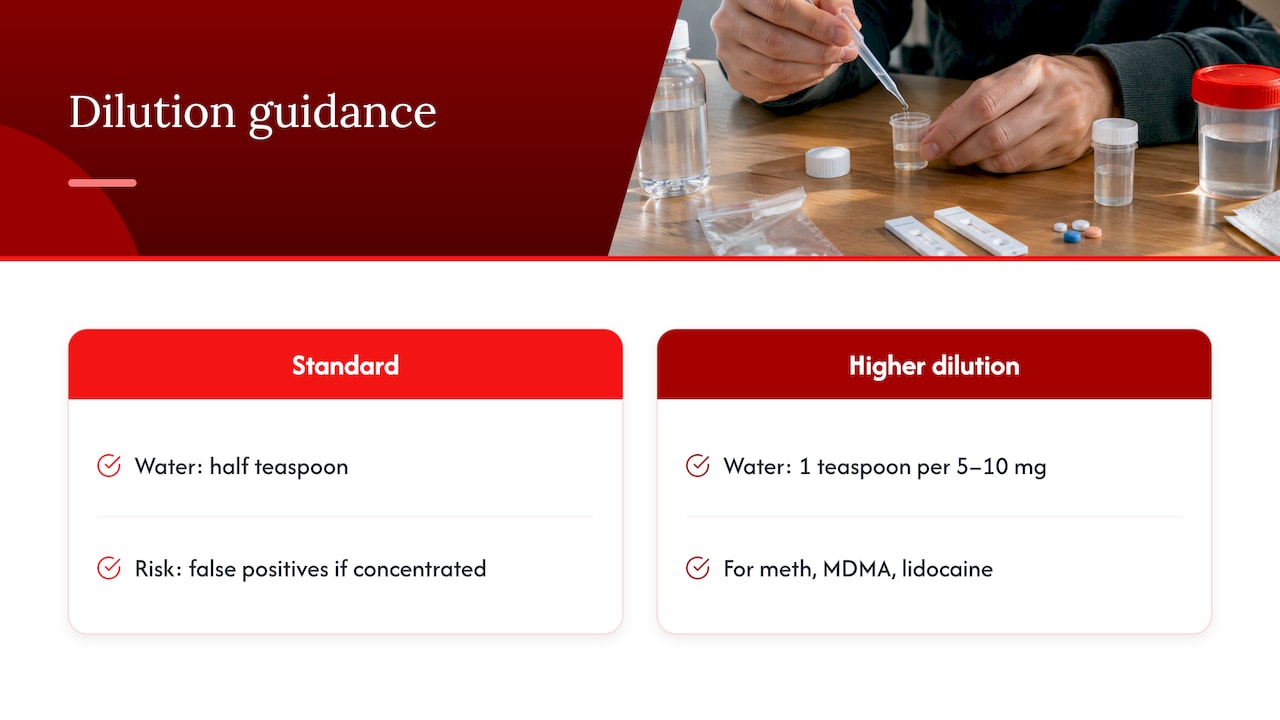
Strips can react to other substances when the sample is too concentrated. Methamphetamine, MDMA and cutting agents like lidocaine can produce false positives if the sample is not diluted enough. For those substances, the guidance is a higher dilution, typically 1 teaspoon of water per 5 to 10 mg rather than the standard half teaspoon. A milligram scale helps. DanceSafe’s printed instructions walk through weighing a sample before you dissolve it.
What a negative result does and does not mean
A negative strip means that particular sample did not trigger the test at its sensitivity. It does not mean the pill is safe. Three reasons:
- Analogs. Strips cannot detect every fentanyl analog, and the CDC specifically names carfentanil as one they may miss. We have written about this on our own site: a share of analogs go undetected by test strips.
- Other dangerous drugs. A fentanyl strip says nothing about xylazine, nitazenes or any other adulterant. Some state health departments, such as Wisconsin’s, also point to separate xylazine strips and advise checking all drugs not bought from a licensed pharmacy.
- Uneven mixing. A single sample can miss a hot spot, as covered above.
Public health experts stress that strips are one of several harm reduction strategies: carrying naloxone, avoiding use when alone, and starting with a smaller dose.
Best fentanyl test strips: what to look for
There is no single winner, but these criteria separate a good strip from a poor one.
| Criterion | Why it matters |
|---|---|
| Stated cutoff (ng/mL) | Lower cutoffs are more sensitive but can react more to cross-reactive substances. |
| Intended use | Drug residue and dissolved sample strips are different from urine strips. Do not mix them up. |
| Clear instructions | Read time, dilution and line interpretation should be on the box. |
| Lot consistency | Buying from one source with consistent batches reduces surprises. |
| Included extras | Water, a container and a stir stick make testing easier to do every time. |
For harm reduction use, we stock Fentanyl Test Strips 10 ng/ml and a Fentanyl Powder 10ng Kit. Always follow the directions that ship with the lot you receive, because dilution and timing can differ.
Testing a person: urine fentanyl tests and cutoff levels
If your goal is to find out whether a person has taken fentanyl, you need a urine test, not a pill strip. This is what clinics, treatment programs, employers and labs use.
A urine fentanyl test is a rapid lateral flow immunoassay that qualitatively detects fentanyl in human urine at a set cutoff concentration. An example is the FDA’s published clearance letter for a fentanyl urine test cassette, which describes the test as a competitive binding assay for qualitative detection.
What the cutoff means
The cutoff is the concentration at or above which the test reads positive. A lower cutoff, like 1 ng/mL, catches lower concentrations and a longer window after use. A higher cutoff, like 20 ng/mL, flags only higher concentrations. Neither tells you how much someone took or when. Our own guide to reading fentanyl cutoffs correctly goes deeper for clinicians.
We carry urine strips at several cutoffs:
Confirm presumptive positives
Immunoassays are screens. Clinical laboratory experts note that a presumptive positive should ideally be confirmed by mass spectrometry such as LC-MS/MS, because interference from other medications can cause false positives and some emerging analogs may not be detected. If a result will affect employment, custody, treatment or legal status, send the specimen for confirmation. We cover the practical side in fentanyl test strip accuracy for U.S. labs.
Fentanyl on a multi-panel drug test
Many standard panels do not include fentanyl unless the product name says so. Several of our cups include a fentanyl line, often written FEN/20 for a 20 ng/mL cutoff. Examples include the 15 panel cup with KRA/500, KET/1000, FEN/20, ETG/300 and adulterants, the 16 panel cup and the 18 panel cup. There is also a 13 panel cup with FYL. Check the exact panel list before ordering so the cup matches your policy.
Who can legally buy and use what
Rules around test strips vary by state and by who is buying. One federal detail matters for organizations. SAMHSA’s updated funding guidance, as of mid-2025, prohibits federal grant money from being used to buy or distribute fentanyl test strips for people who use drugs. The restriction does not apply to law enforcement, emergency medical services, or healthcare professionals using the technology in the regular course of their duties. If you manage grant funds, confirm your program’s rules with your funder before ordering. State law on possession of testing supplies also differs, so check your state health department.
Perspective: what we see from the supply side
We are a family business that sells drug testing supplies to labs, clinics, treatment centers, law enforcement and individual buyers. The most common mistake we see is a mismatch between the product and the question. Someone wants to check a pill and orders a urine cassette. Or a clinic wants a screening tool for patients and buys a strip designed for dissolved residue. Both are avoidable by asking one thing first: am I testing a substance or a person?
The second mistake is treating a negative as permission. A strip is a quick, cheap signal. It is not a lab, and we do not describe it as one. For professional buyers, we recommend choosing the cutoff to match the decision you are making, and building in confirmation for any result with consequences. For harm reduction users, we would rather you test every time and keep naloxone close than rely on one clean strip.
— Justin
Other steps that lower overdose risk
Testing is one layer. The others matter as much.
- Keep naloxone where you and the people around you can reach it, and make sure someone knows how to use it.
- Do not use alone. Ask someone you trust to check on you.
- Start with a smaller amount than usual, especially with a new supply.
- Be wary of any pill not obtained from a licensed pharmacy. The CDC fentanyl fact sheet says you cannot see, taste or smell fentanyl in drugs.
- If pills started as a way to manage pain, talk to a clinician about alternatives. The risks of opioid painkillers for chronic pain are one reason some people explore non-opioid options with a provider.
If you or someone you know needs help with substance use, SAMHSA’s National Helpline is free, confidential and open 24/7 at 1-800-662-4357.
Stocking fentanyl tests for your organization
If you run a lab, clinic, treatment program, workplace testing program or agency, we make ordering simple. Our shop lists test cups, dip cards, urine strips, oral swabs, urine specimen cups and our FentaScan line, with bulk pricing and custom quotes available for larger orders. For an instrument-read option, see the FentaScan fentanyl cartridge, FDA approved and CLIA waived. If you are still deciding on format, our comparison of cups versus dip cards explains the trade-offs.
FAQ
Is there a way to test a pill for fentanyl?
Yes. Fentanyl test strips can check pills, powders and injectables. You dissolve the pill in water, dip the strip and read it within the window on your instructions. A negative is not a guarantee, since strips can miss some analogs and fentanyl can be unevenly spread.
Can I use a urine fentanyl test on a pill?
No. Urine tests are validated for human urine, not for dissolved pills. Use a strip made for drug checking for pills, and use a urine test only on a urine specimen.
Does a fentanyl test strip show how much fentanyl is in a pill?
No. Strips show presence or absence, not quantity. A positive could mean a trace or a lethal dose, so treat any positive as a serious warning.
What cutoff level should a fentanyl urine test have?
It depends on the decision. A 1 ng/mL cutoff is more sensitive than a 20 ng/mL cutoff. Whatever you choose, confirm any presumptive positive with laboratory testing before acting on it.
Sources
- CDC: What You Can Do to Test for Fentanyl
- CDC: The Facts About Fentanyl
- SAMHSA and FDA: IVD Fentanyl Testing update
- SAMHSA: updated funding guidance letter
- Fentanyl and Fentanyl Test Strips FAQ
- San Miguel County: Fentanyl test strip detailed instructions
- DanceSafe: Fentanyl test strip instructions
- NYC Health Department: Using Fentanyl Test Strips
- Wisconsin DHS: Drug Checking Technologies
- FDA 510(k) letter: fentanyl urine test cassette
- Journal of Applied Laboratory Medicine: fentanyl immunoassays