Blog
Oral Fluid THC Detection Window: What Saliva Tests Catch


For most people, THC is detectable in oral fluid for a few hours up to about a day or two after use. Heavy, frequent users can test positive longer, and one study followed frequent users for up to 8 days. The window is short because a saliva test is built to answer one question: did this person use cannabis recently? It is not built to answer whether they ever used it.
Below, we cover what the research shows, what the federal cutoffs mean, and how consumption method and frequency change the picture. We also cover secondhand smoke, contact exposure and hemp oil, and how to treat a result from an on-site swab.
TL;DR
- Typical oral fluid THC window: hours to roughly 1 to 2 days. Chronic heavy use can stretch it to several days.
- Detection is most reliable in the first 3 hours after smoking or vaping. Concentrations then fall sharply in most people.
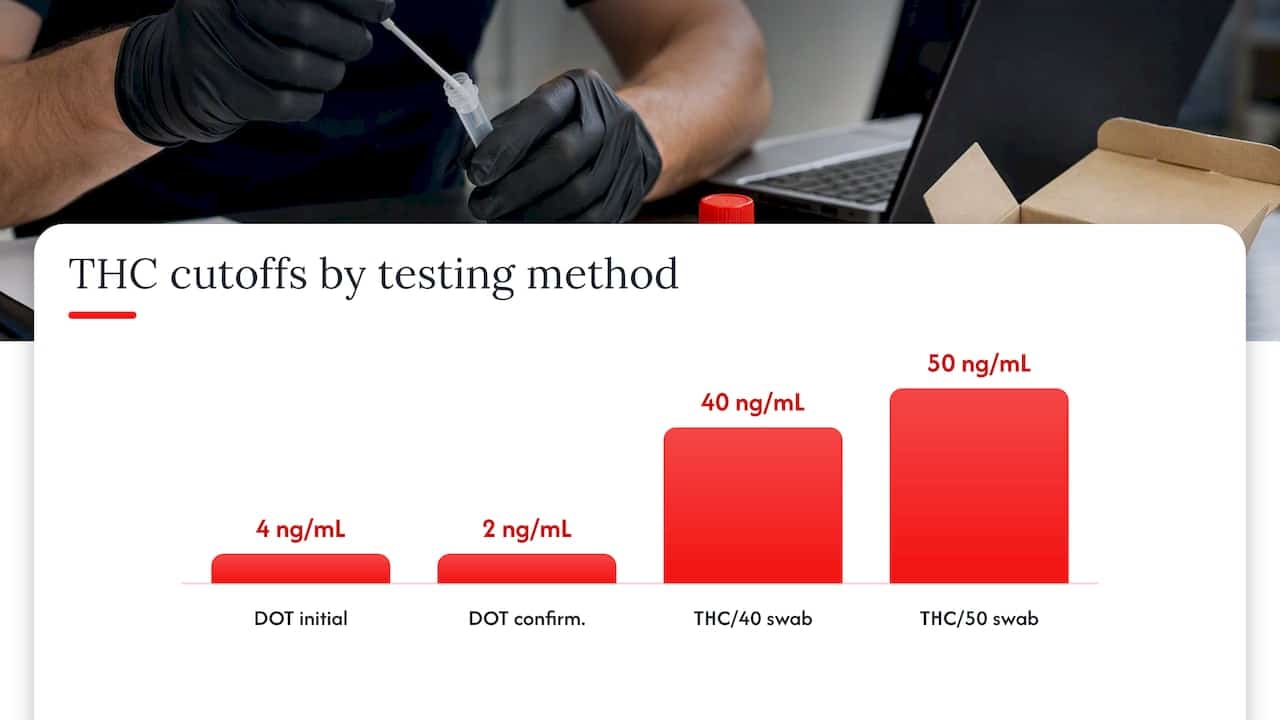
- The federal (DOT) oral fluid THC cutoffs are 4 ng/mL for the initial test and 2 ng/mL for confirmation. Cutoffs are set to filter out trace passive exposure.
- An on-site swab is a presumptive screen. A positive should be confirmed by laboratory mass spectrometry before anyone acts on it.
- Pure hemp oil rarely causes a positive at standard cutoffs, but products vary, and some contain more THC than the label suggests.
Table of Contents
- Why “detection window” is a slippery term for saliva
- What the research says about timing
- Cutoffs decide the result, not just the clock
- Does the way you consume THC change the window?
- Secondhand smoke and contact high: can they cause a positive?
- Hemp oil, CBD and positive tests
- Why on-site results need confirmation
- Perspective: how we think about oral fluid testing
- Choosing an oral swab that fits the question
- FAQ
- Sources
Why “detection window” is a slippery term for saliva
Urine and hair tests look for metabolites that accumulate and linger. Oral fluid mostly reflects parent THC that is physically present in the mouth and absorbed through the oral tissues soon after consumption. A meta-analysis of individual participant data found that oral fluid THC concentrations were highly dispersed at every time point, skewed toward a few very high values, and declined over time.
That has two practical consequences:
- The window is not a fixed number. It depends on how much was used, how, how often, and when the sample was collected.
- A negative swab does not prove the person is unimpaired, and a positive does not prove current impairment. Saliva is a good marker of recent exposure, and that is all it is.
Researchers who study cannabis pharmacokinetics describe oral fluid as a tool for identifying recent use, the period when psychoactive effects are most likely present, not past or chronic use. Urine and hair are better at the latter. If you want the longer-lookback picture, see our guide to THC detection time in urine, and our comparison of urine vs saliva drug tests.
What the research says about timing
The first 3 hours
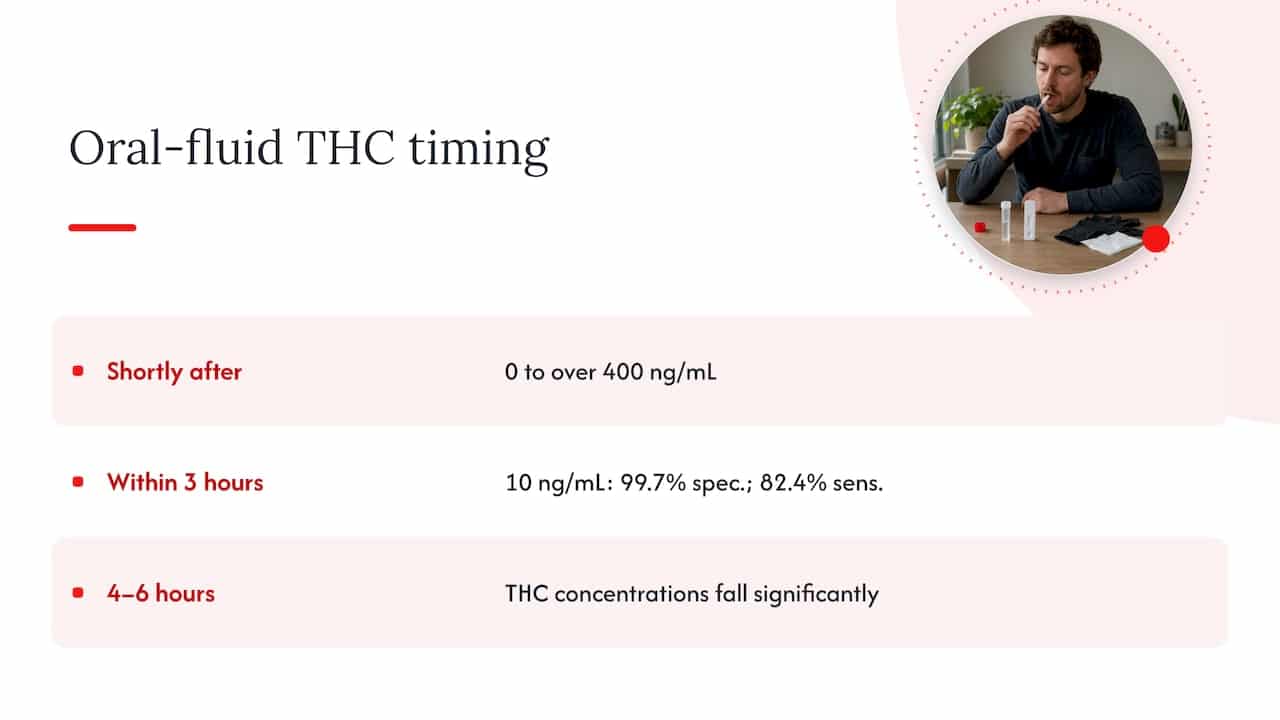
A study of biomarkers of recent cannabis use in blood, oral fluid and breath found that oral fluid THC concentrations ranged from 0 to over 400 ng/mL shortly after intake. They dropped rapidly afterward. With a 10 ng/mL oral fluid cutoff, the test performed very well for detecting use within 3 hours: 99.7% specificity and 82.4% sensitivity. That accuracy is transient, because in most people THC concentrations fall significantly within 4 to 6 hours after inhalation.
Beyond the first day
The same meta-analysis noted that many positive oral fluid THC results were still found after 24 hours in one of the included studies. A Norwegian study of frequent, high-dose users reported THC in oral fluid for up to 8 days is not what that page says, so treat the figure as the outer edge seen in a small group of heavy users under supervised abstinence, not as a typical result. For planning purposes, the honest answer is a range:
| Pattern of use | Typical oral fluid picture |
|---|---|
| Single use, occasional user | Highest in the first hours, usually falling below standard cutoffs within about a day |
| Regular use | Can remain above a cutoff for longer, often 1 to 2 days |
| Daily, heavy use | Longest and most variable, with occasional positives lasting days |
These are ranges, not guarantees. Lower cutoffs and more sensitive lab methods find THC for longer than the cutoffs used on a typical quick test. A systematic review of THC detection times in oral fluid by mass spectrometry used a 5 ng/mL cutoff to make studies comparable, which shows how much the answer depends on the threshold chosen.
Cutoffs decide the result, not just the clock
Two people can use cannabis at the same time and get different results on the same day because of the cutoff. For federally regulated transportation testing, the DOT oral fluid rule sets the THC cutoffs at 4 ng/mL for the initial test and 2 ng/mL for the confirmation test. Those numbers apply to laboratory testing under 49 CFR Part 40, and our DOT oral fluid testing checklist for employers explains where that program stands in practice.
Non-regulated employers, clinics and treatment programs choose their own on-site device cutoffs. Many oral swabs use a THC cutoff in the tens of ng/mL, such as THC/40 or THC/50 on product labels. A higher cutoff shortens the effective window and lowers the chance of a positive from trace exposure. A lower cutoff lengthens it.
The same logic applies to any saliva assay. Accuracy depends on the cutoff, the device and whether a mass spectrometry method confirms the result, as an example of how LC-MS/MS confirmation affects saliva test accuracy for a different analyte shows.
Does the way you consume THC change the window?
Yes, mainly at the start.
- Smoking or vaping: THC lands directly in the mouth and throat, so early oral fluid concentrations are highest. They then fall quickly.
- Edibles, oils and tinctures: There is less direct residue from smoke, but products held under the tongue or swallowed can leave THC in the mouth for a time. Data on swallowed products in oral fluid are more limited than for smoking, so do not carry smoking timelines over to edibles.
- Frequency: Regular users store THC in body fat and release it slowly, which is why daily users have a longer and less predictable tail.
The research also shows that concentrations are not a measure of impairment. Someone can be impaired with a low reading, and someone can have a reading well after effects have ended.
Secondhand smoke and contact high: can they cause a positive?
This is a common worry, and the evidence is reassuring at standard cutoffs. Toxicologists and occupational researchers describe the risk of failing a test from secondhand smoke as often exaggerated in popular media. That study looked at law enforcement officers providing security at outdoor concerts, where exposure to cannabis smoke is real but diffuse.
A controlled study in which non-smokers sat with heavy smokers found that extreme, unventilated conditions could produce positive results on sensitive screens, while ordinary exposure did not. Note that this study measured urine, not saliva, so it speaks to cutoff design rather than to oral fluid directly.
For saliva specifically, the practical points are:
- Passive exposure mostly leaves THC on the surface of the mouth, and it clears quickly.
- A sealed car or a small closed room with heavy smoking is the realistic worst case. An open-air concert or a neighbor’s balcony is not.
- If a result is disputed, the confirmation test and the collection details (time of collection, any observed use) matter more than a debate about the room.
If you are an employer or program director, write the passive exposure question into your policy. Say what happens after a presumptive positive, and who requests confirmation.
Hemp oil, CBD and positive tests
People ask whether hemp oil can cause a positive drug test. A 2026 systematic review of CBD and hemp oil use and drug test results found that five of the twelve included studies reported that these oils did not create a positive result above the limit of quantification or cutoff for THC. Trace levels near the detection limits were found in several. The review also notes that a positive is more likely when a hemp-derived product does not meet the legal limit of less than 0.3% THC set by the 2018 Farm Bill.
So the picture is:
- Food-grade hemp seed oil, properly made, is low risk.
- Full-spectrum CBD products contain some THC, and labels are not always accurate.
- Heavy daily dosing of a full-spectrum product is the scenario that deserves caution. If your job or your treatment program tests, ask the prescriber or the medical review officer before you start.
The ingredient matters more than the word “hemp” on the label. Look for a recent third-party certificate of analysis from the batch you bought.
Why on-site results need confirmation
Point-of-collection devices differ a lot. A study of roadside oral fluid devices reported sensitivity as low as 13% for some devices, against up to 96.8% for a well-calibrated instrument-based one. The authors treat these devices as presumptive screens. Mouth dryness, time since last use and the specific device all influence what an on-site swab shows.
That leads to a simple rule for anyone using an oral swab:
- Collect the sample as the instructions say, and note the time of collection and the time of any observed use.
- Read the result inside the stated time window and not after.
- Treat a positive as presumptive and send a split sample to a laboratory for mass spectrometry confirmation when the consequences are legal, employment-related or clinical.
- Treat a negative as “no THC above the device cutoff at this moment”, not as proof of abstinence.
Perspective: how we think about oral fluid testing
We sell drug testing supplies to labs, clinics, treatment programs, employers and individuals, so we see the same mistake often: people choose a sample type by habit, not by the question they have. If the question is whether someone used in the last day, a swab is a good fit. If it is whether someone has been using over the past weeks, urine is the better tool, and a swab will miss a lot.
Our advice is to match the cutoff to the decision. A THC/40 or THC/50 swab makes sense for a recent-use screen where trace exposure should not trigger a result. Save lower cutoffs for situations where you will confirm every positive in a lab. And never skip confirmation when a job, a custody case or a treatment plan hangs on the answer.
— Justin
Choosing an oral swab that fits the question
If you screen for recent use, start from the panel you need and the THC cutoff on the label. Our catalog includes the 5 panel oral swab with THC/50, the 5 panel oral swab drug test and the 10 panel oral swab drug test. For programs that also want fentanyl coverage, there is the 12 panel oral swab with FEN/20 and THC/40. If you need a longer lookback, our urine cups and dip cards are in the shop, and our guide on cup vs dip card tests helps you choose between them. We offer bulk pricing and custom quotes for programs that test regularly.
FAQ
How long does THC stay in saliva?
For most people, hours to about 1 to 2 days after use. Concentrations are highest in the first few hours and fall quickly. Frequent heavy users can stay positive longer, and some studies have found THC in oral fluid for several days.
Can secondhand smoke cause a positive saliva test?
At standard cutoffs, it is unlikely. Researchers describe the risk as often exaggerated, though extreme, unventilated exposure has produced transient positives on sensitive screens in a urine study. A positive should be confirmed by a laboratory.
Can hemp oil cause a positive drug test?
Usually not at standard cutoffs, according to a systematic review, but products that exceed the legal THC limit can. Full-spectrum CBD products carry more risk than refined hemp seed oil. Ask your employer’s medical review officer if you are tested.
Can a swab tell if someone is high right now?
Not reliably. It shows recent THC exposure, and concentrations do not map neatly onto impairment. Researchers use oral fluid as a marker of recent use, not as a measure of how impaired someone is.
Sources
- Concentrations of THC in oral fluid at different time points after use: an individual participant meta-analysis
- Biomarkers of recent cannabis use in blood, oral fluid and breath
- Delta-9-tetrahydrocannabinol detection times using mass spectroscopy in oral fluid: a systematic review
- DOT 49 CFR Part 40, Section 40.91: oral fluid cutoff concentrations
- Occupational exposure to secondhand cannabis smoke among law enforcement officers
- Non-smoker exposure to secondhand cannabis smoke: urine screening and confirmation
- Reliability of roadside oral fluid testing devices for THC detection
- Impact of CBD and hemp oil use on drug test results: a systematic review