Blog
Fentanyl Urine vs Saliva Tests: Which Specimen to Use


For most fentanyl screening, urine is the specimen to start with. It carries the metabolite norfentanyl, it has the widest choice of validated assays, and its cutoffs are the best established. Saliva (oral fluid) answers a different question: who used fentanyl very recently, under direct observation. At Rapidtestcup we stock both formats, so you can match the specimen to the decision you need to make: urine strips and cups for routine screening, and oral swabs with a fentanyl panel for recent-use checks.
TL;DR
- Urine is the preferred fentanyl matrix in most U.S. laboratories: assays are more available, concentrations are higher and collection is straightforward.
- Saliva has a shorter detection window and can be collected under direct observation, which suits recent-use questions.
- Federal workplace cutoffs: 1 ng/mL in urine, 4 ng/mL screening and 1 ng/mL confirmation in neat oral fluid (HHS, 2025).
- Any rapid screen is preliminary. A positive that drives a consequence needs laboratory confirmation by LC-MS/MS.
Table of Contents
- What each specimen actually measures
- Cutoffs and sensitivity side by side
- Where each specimen is used
- Choosing by decision, not by habit
- Collection details that affect the result
- What a positive screen means
- Matching the cutoff to the product
- Our perspective
- Stock the right format
- FAQ
- Sources
What each specimen actually measures
Fentanyl is broken down in the body into norfentanyl, its main metabolite. Urine collects both compounds as the kidneys clear them, so a urine screen can pick up use after the parent drug has dropped away. Oral fluid mostly reflects the parent drug that has passed from blood into the mouth, which is why it tells you about recent exposure rather than the past few days.
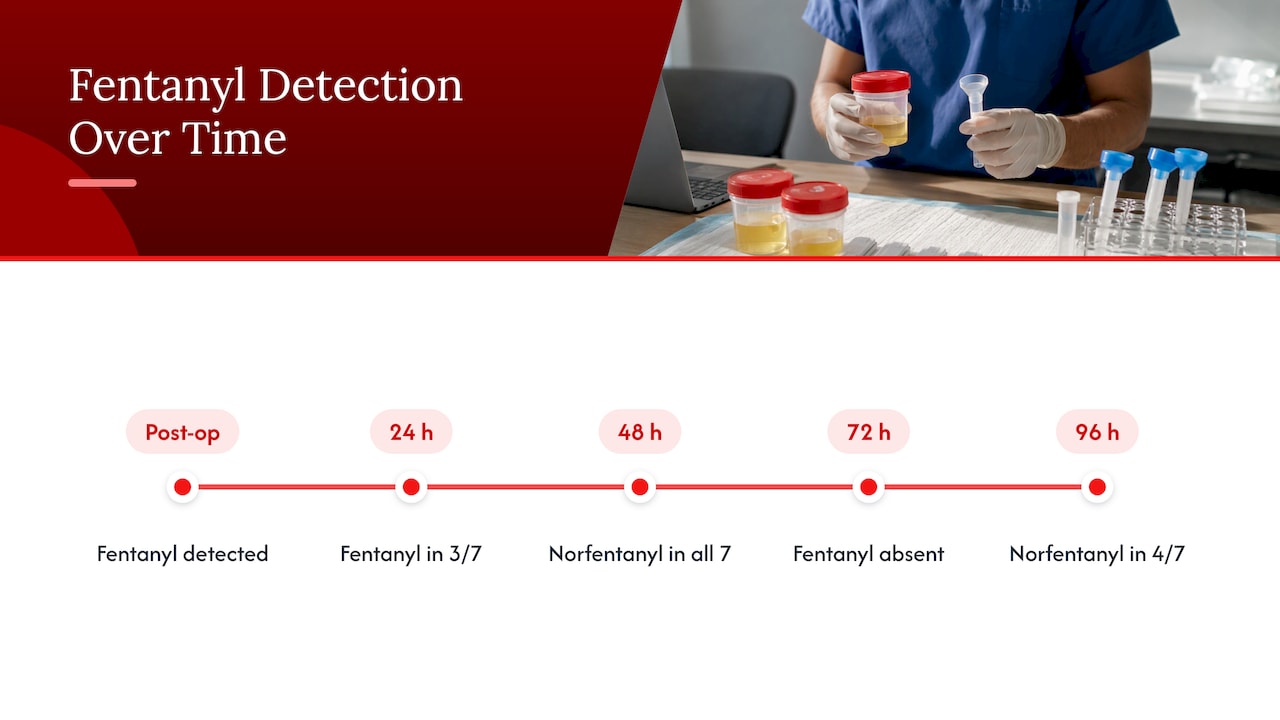
A 1993 study of seven surgical patients shows the pattern. Unchanged fentanyl was found in urine right after surgery and in three of seven patients at 24 hours, and was gone by 72 hours. Norfentanyl was present in all patients at 48 hours and in four of seven at 96 hours. Saliva results in that small study were not consistent. The study used one low-dose clinical setting, so treat it as an illustration of the metabolite effect, not a universal timetable. Detection time also depends on dose, frequency of use, body composition and the assay cutoff.
The 2026 ADLM laboratory guidance adds the practical side: oral fluid can be witnessed and is noninvasive, and its shorter window can help separate recent exposure from remote use. For a broader look at windows across substances, see our guide to substance detection windows.
Cutoffs and sensitivity side by side
The federal workplace program gives the clearest published benchmarks. In its January 2025 final rule, HHS added fentanyl to the authorized panels, effective July 7, 2025, with these cutoffs (Federal Register):
| Specimen | Initial (screening) cutoff | Confirmatory cutoff |
|---|---|---|
| Urine | 1 ng/mL fentanyl (assay must show at least 5% norfentanyl cross-reactivity) | 1 ng/mL for both fentanyl and norfentanyl |
| Oral fluid (neat) | 4 ng/mL | 1 ng/mL |
Two points follow from the table. First, the urine screen is set at a low concentration, so it catches lower levels of use. Second, the oral fluid screening cutoff is four times higher than its confirmation cutoff, so a saliva screen is working with a narrower margin.
Laboratory confirmation limits show the same gap. A SAMHSA presentation from a reference laboratory reports LC-MS/MS limits of 0.05 ng/mL for fentanyl in urine and 0.4 ng/mL in oral fluid. The same document notes that results from one common oral fluid collector are diluted 1:2 and must be multiplied by 3 to match the HHS neat reporting standard. If you send saliva samples out, ask the lab which standard it reports against.
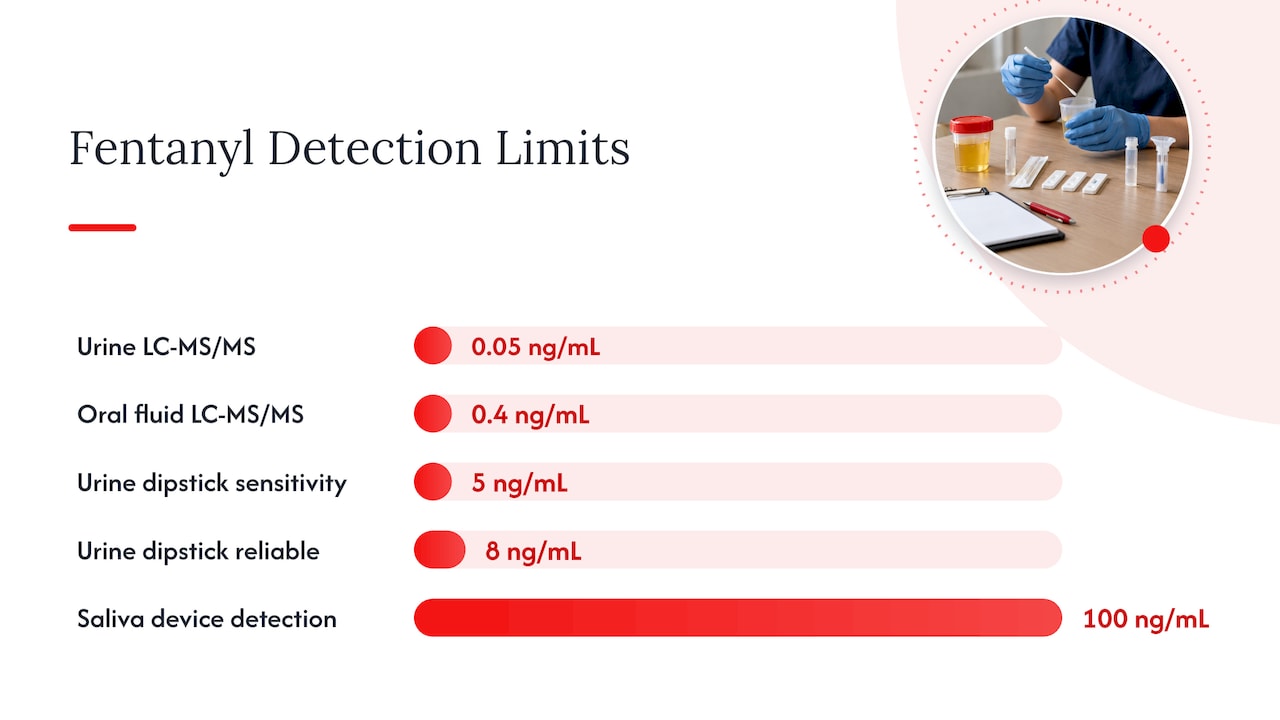
Field-style lateral flow devices follow the same logic. A 2019 peer-reviewed evaluation found a commercial urine dipstick reliably positive at 8 ng/mL and sensitive down to 5 ng/mL, while the saliva devices it tested detected every sample only at 100 ng/mL. Device designs have changed since then, so read the cutoff printed on the exact product you buy.
Immunoassay availability
Urine assays are also the more mature product class. A SAMHSA assay update lists urine fentanyl immunoassays with 1 ng/mL cutoffs and 510(k) status, while FDA-cleared fentanyl oral-fluid immunoassays are lacking, though some labs run validated lab-developed tests. That availability is a large part of why the ADLM guidance names urine as the default.
Where each specimen is used
Urine fits clinics, treatment programs, probation and pretrial programs and employers that run routine panels. It is easy to collect in volume and gives you enough liquid for validity checks. Mayo Clinic Laboratories’ urine fentanyl screen, for example, needs as little as 0.5 mL of random urine, with 2 mL preferred.
Saliva fits situations where a collector must watch the donor: roadside or post-incident checks, or any program where a restroom collection is impractical. The 2021 toxicology recommendations for drug-impaired driving set fentanyl cutoffs of 0.5 ng/mL in urine and 1 ng/mL screening with 0.5 ng/mL confirmation in oral fluid.
Positivity data from non-regulated workplace testing, reported in the 2025 rule, shows both matrices turn up fentanyl. About 1% of urine specimens were positive versus about 4% of oral fluid specimens, and in urine norfentanyl concentrations ran about four times higher than fentanyl (Federal Register). That is population data from different testing programs, not a head-to-head comparison.
When both were collected from the same people, the agreement was close. In a 2017 study of 30 emergency department patients after a reported heroin overdose, mass spectrometry found fentanyl in 29 urine and 27 oral fluid specimens, with 93.3% overall agreement. Hospital labs still rely mainly on urine, and oral fluid is rarely used in U.S. emergency departments.
For patients who screen positive and move into care, medication-assisted treatment for fentanyl addiction is the clinical path, and ongoing urine monitoring is a common part of treatment programs.
Choosing by decision, not by habit
| Your question | Better-fit specimen |
|---|---|
| Routine screening in a clinic or treatment program | Urine |
| Lowest screening cutoff, broad assay choice | Urine |
| Use in the last hours or day, observed collection | Oral fluid |
| Multi-drug panel with fentanyl in one device | Either: urine cup or oral swab panel |
| Confirming a result that has consequences | Laboratory LC-MS/MS on the retained specimen |
If you are unsure, collect urine for the screen. It gives you the longer window, the lower cutoff and the broadest range of devices.
Collection details that affect the result
Urine collection is straightforward, though a few habits keep the result usable:
- Use a clean, dry cup and note the collection time.
- Check the specimen for temperature and appearance at the time of collection, and use a cup with adulterant checks where validity matters.
- Read the screen inside the time window printed in the device instructions, and do not read it later.
- Keep the specimen sealed and refrigerated if it may go to a lab. Mayo’s protocol lists refrigerated stability of 14 days and ambient stability of 72 hours.
For oral fluid, follow the device instructions on collection time and on avoiding food, drink or tobacco in the minutes before the swab, and keep a second specimen when confirmation might be needed.
Our urine cups with built-in adulterant strips put the fentanyl screen and the validity check in a single collection, so the specimen is checked at the moment it is handed over.
What a positive screen means
A rapid screen is an immunoassay: it reacts to a molecular shape, not to a measured concentration. Mayo states that its immunoassay gives only a preliminary analytical result and that a more specific method such as LC-MS/MS must be used for a confirmed result. ARUP’s urine screen uses a 1 ng/mL cutoff and automatically adds LC-MS/MS confirmation and quantitation when the screen is positive.
Reference laboratory data shows why the second step matters. One laboratory reports that most fentanyl analogs cross-react with its assay at 20 to 83%, and that it confirms 87% of screen-positive samples. In practice:
- A non-negative screen is a reason to act: repeat, retain the specimen or send it to a lab.
- Employment, legal or clinical decisions should rest on the confirmed result.
- Someone who tests positive should speak with their physician or treatment provider about next steps and any prescribed medicines, since medical fentanyl also produces positive results.
Our reference on reading fentanyl cutoffs correctly and on strip accuracy for labs goes further into interpretation.
Matching the cutoff to the product
Cutoff choice sets what a negative actually means. Our catalog includes a 1 ng/mL fentanyl urine strip, labeled CLIA waived, which sits at the same concentration as the federal urine cutoff. Cups such as our 18 panel cup carry fentanyl at 20 ng/mL alongside the other drugs on the panel, and there is a 20 ng/mL strip for programs that screen at that level. Choose the cutoff your policy or protocol names, and write it into the protocol.
Our perspective
We sell both urine and oral fluid tests, and the question we get most is which one to buy. Our answer starts with the decision you are making. If you need the broadest window, the lowest screening cutoff and the most established assay base, urine is where we point clinics, treatment centers and employers.
If you need to know about very recent use and you can watch the collection, an oral swab with a fentanyl panel does that job, and we stock it for that reason.
Whichever you choose, write the cutoff into your protocol, read the device inside its time window, and send anything that matters to a lab for confirmation. We are a family business, and we keep a large inventory in stock so programs can reorder without gaps. If you need volume, we offer bulk pricing and custom quotes.
Justin
Stock the right format
If you run routine screening, start with the urine cups and strips in our shop, where fentanyl is available on single-drug strips and on multi-panel cups. For programs that want fentanyl read by an instrument, see the FentaScan analyzer, listed as CLIA waived and FDA approved. For observed, recent-use checks, the 10 panel oral swab with fentanyl is the match.
Bulk discounts and custom quotes are available for larger programs.
FAQ
Which is better for fentanyl, urine or saliva?
For general screening, urine. It has the lower screening cutoff in the federal program, more validated assays and a metabolite that lengthens the window. Saliva is the choice when you need to detect very recent use under observed collection.
How long does fentanyl show up in saliva?
It is shorter than in urine, and it varies with dose and use pattern. Published data is limited, and in a small 1993 postoperative study saliva was not consistently positive. If your question is about the last few hours, oral fluid fits. For anything longer, urine is the better match.
Is there a urine test for fentanyl?
Yes. Rapid urine strips and cups screen for fentanyl and norfentanyl at set cutoffs such as 1 ng/mL, and laboratories run immunoassay screens with LC-MS/MS confirmation. The FDA has also cleared an over-the-counter urine fentanyl test for preliminary detection.
Does a positive rapid test need confirmation?
Yes, when the result will affect employment, legal status or treatment decisions. A rapid result is preliminary, and a laboratory using LC-MS/MS gives the confirmed result.
Sources
- ADLM Guidance Document on Laboratory Testing for Drugs of Abuse
- Analysis of the duration of fentanyl and its metabolites in urine and saliva (1993)
- Federal Register: Mandatory Guidelines for Federal Workplace Drug Testing Programs, Authorized Testing Panels (2025)
- SAMHSA: CRL Testing Experience for Fentanyl in Urine and Oral Fluids
- SAMHSA: Fentanyl Immunoassay Updates
- Evaluation of a lateral flow immunoassay for fentanyl detection (2019)
- A Novel Oral Fluid Assay (LC-QTOF-MS) for fentanyl detection (2017)
- Mayo Clinic Laboratories: Fentanyl Screen, Random, Urine
- ARUP Laboratories: Fentanyl, Urine Screen with Reflex to Quantitation
- Recommendations for Toxicological Investigation of Drug-Impaired Driving (2021)