Blog
Forensic Use Only vs. CLIA Waived Drug Tests: Which Do You Need?


The difference comes down to what you do with the result. A CLIA waived drug test is cleared for settings where results may inform health care decisions, such as clinics and treatment centers. A Forensic Use Only (FUO) test is labeled for legal and law enforcement purposes, where the result establishes a violation of law and is not used to guide treatment. Choose the label that matches the decision your result will support, and you stay on the right side of both the FDA and CLIA.
TL;DR
- Forensic Use Only means the device is labeled for legal or enforcement purposes, not for clinical diagnosis or treatment.
- CLIA waived means the FDA has determined a test is simple enough, with a low enough risk of a wrong result, to be run under a Certificate of Waiver.
- CLIA turns on the purpose of the testing, not the cup. Results used to refer, offer or make treatment available call for a CLIA certificate.
- FDA clearance and CLIA waiver are separate decisions. A test can have the first without the second.
- Clinics, treatment centers and occupational health providers should buy CLIA waived products. Law enforcement and legal programs should buy products labeled for their use.
Table of Contents
- What “Forensic Use Only” means on a drug test
- What “CLIA waived” means
- The difference at a glance
- The purpose of testing decides whether CLIA applies
- FDA clearance and CLIA waiver are not the same thing
- Forensic vs. clinical drug testing: how the decisions differ
- Which one fits your setting
- A worked example
- How to choose a product label
- Perspective
- Stock the right tests for your program
- FAQ
- Sources
What “Forensic Use Only” means on a drug test
Every drug of abuse test sold in the U.S. carries an intended-use statement in its labeling. A federal presentation to SAMHSA’s Drug Testing Advisory Board lists the categories: prescription use in central clinical laboratories, point-of-care use, over-the-counter use, workplace use, and forensic use only. The same source notes that labeling under 21 CFR 809.10 must include the intended use, directions, warnings, limitations, interpretation of results, cross-reactivity and interferences, and a performance summary.
A Forensic Use Only label tells you the manufacturer did not design, test or label the device for clinical diagnosis or for other settings. Per the same FDA presentation, the agency exercises enforcement discretion for devices labeled to be used only by law enforcement, so it does not actively regulate them. The FDA also says it generally does not review drugs of abuse tests intended for employment and insurance testing when the labeling states they are intended solely for that use.
In plain terms: an FUO test is a tool for establishing facts in a legal context. It is not marketed as a basis for medical decisions.
What “CLIA waived” means
CLIA is the Clinical Laboratory Improvement Amendments, the federal program that sets quality standards for laboratory testing on human specimens. CMS explains that if a facility performs even one test on human samples to assess health or to diagnose, prevent or treat disease, it is a laboratory under CLIA and must obtain a certificate.
Tests come in tiers of complexity. Waived tests are the simplest tier. A Certificate of Waiver lets a laboratory perform only waived tests, as long as it follows the manufacturer’s instructions. The CDC describes waived tests as simple tests with an insignificant risk of an erroneous result. It adds that waived-only sites have no routine oversight and no personnel requirements, but must hold the certificate, pay the biennial certificate fee and follow the manufacturer’s instructions.
Two points often get tangled:
- A waiver belongs to a specific test system. It is not a general approval for a brand or a category.
- A waived test can still support serious decisions. The CDC notes that waived results are used to adjust medication dosages, which is exactly why the program exists.
For a deeper look at how the designation works in practice, see our guide to what CLIA waived means and why it matters.
The difference at a glance
| Forensic Use Only | CLIA waived | |
|---|---|---|
| Intended purpose | Legal proceedings, law enforcement, determining a violation of law | Health assessment, diagnosis, prevention or treatment support |
| FDA status | Enforcement discretion for devices labeled for law enforcement use | FDA marketing authorization plus a separate FDA waiver determination |
| CLIA certificate for the user | Not required when the testing is only for forensic purposes | Certificate of Waiver required for clinical testing |
| Typical users | Law enforcement, forensic programs, legal settings | Clinics, treatment centers, health practitioners, occupational health |
| Results guide treatment? | No | Yes, within the manufacturer’s instructions |
The purpose of testing decides whether CLIA applies
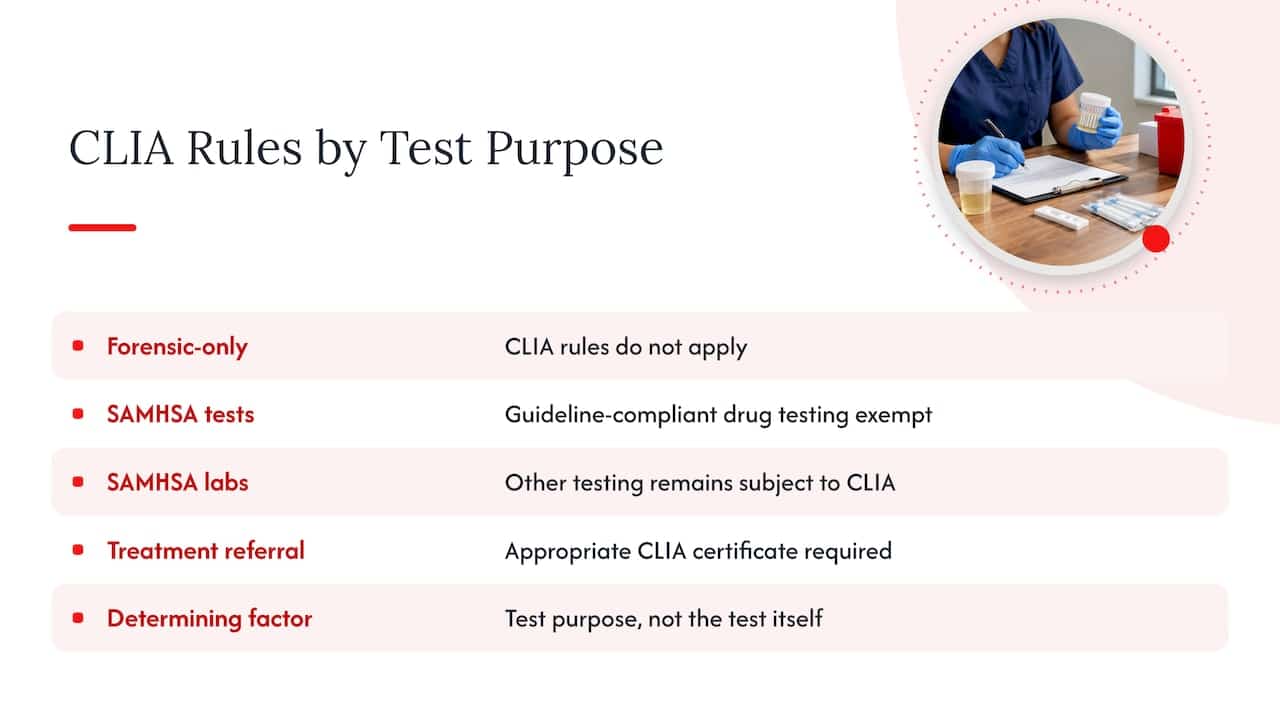
The regulation is direct. Under 42 CFR 493.3(b)(1), CLIA rules do not apply to a facility or component of a facility that only performs testing for forensic purposes. The same section also exempts laboratories certified by SAMHSA for drug testing that meets SAMHSA guidelines, but any other testing those laboratories do remains subject to CLIA.
CMS’s own survey guidance explains the logic. In forensic testing, results are generated to detect illegal substances or amounts relevant to legal proceedings, with no concern for giving data to health care professionals for diagnosis or treatment. That guidance, quoting the 1992 Federal Register preamble, says the determining factor is the purpose for which the test is conducted, not the test itself.
The flip side matters just as much. The same CMS memorandum states that entities performing drug testing where results are used to refer, offer or make treatment available must hold an appropriate CLIA certificate. A single urine cup can therefore be on either side of the line, depending on what happens after the result.
CMS’s “Getting Started with CLIA” page also lists pre-employment drug testing and forensic testing among the exceptions to the certificate requirement. A state agency can be stricter or clearer on edge cases. Hawaii’s health office, for example, notes that CLIA applies to everyone in the U.S. including entities that do not charge for testing, and gives forensic alcohol or drug testing for employment or sports as an exception. Check your state agency if your program sits near the line.
FDA clearance and CLIA waiver are not the same thing
Buyers often treat “FDA approved” and “CLIA waived” as one claim. They are two decisions:
- FDA clearance or authorization says the device may be marketed for a stated intended use. Most drugs of abuse tests are Class II devices that require 510(k) clearance before marketing.
- A CLIA waiver is an additional FDA determination, made on application, that a specific test system is simple and low risk. A Congressional Research Service report explains that a CLIA-waived test needs FDA marketing authorization plus a waiver granted on application.
The same report shows why the distinction is real. It notes that a late-2022 FDA-cleared point-of-care fentanyl assay was moderate complexity and had to be run by trained laboratorians, so clearance did not make it usable under a Certificate of Waiver. Under the Food and Drug Administration Modernization Act of 1997, FDA-cleared home-use tests are automatically waived, which is another route to waived status.
Our overview of why FDA-cleared tests matter in substance abuse programs covers the clearance side in more detail.
Forensic vs. clinical drug testing: how the decisions differ
The real contrast is the decision the result supports.
Forensic testing establishes whether a substance was present for a legal purpose: a probation condition, a law enforcement screen, an investigation. CMS describes it as excluded from CLIA because it is conducted to determine a violation of law, not for remedial treatment. Chain of custody, documentation and confirmation testing carry the weight in these settings. For background on how medical and forensic evidence work together in investigations, read the role of medical forensics in investigations. Our own pages on what a forensic drug test is and its legal impact and forensic testing in drug investigations go further.
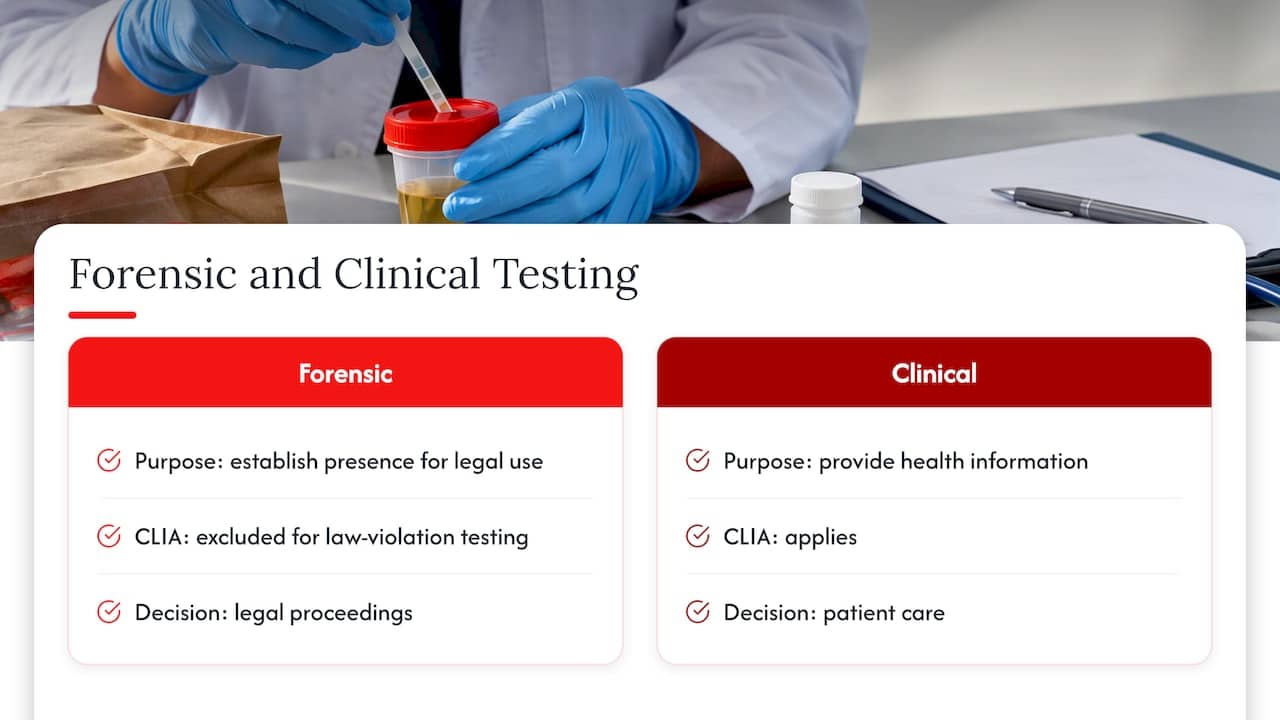
Clinical testing gives information used for the health of the person tested: whether a patient in treatment is using, whether a substance may explain symptoms, whether a care plan needs adjusting. Because those results shape care, CLIA applies, and so does the manufacturer’s labeled use.
Billing adds a practical layer for clinics. A North Carolina Medicaid reminder from November 2025 explains that CPT 80305, a presumptive visual-read test, may be performed in waiver laboratories when the test is FDA-approved as waived and billed with the QW modifier. Instrument-based presumptive tests (80306, 80307) need moderate- or high-complexity certification, and definitive testing (G0480 to G0483) cannot be done in waiver labs. Payer rules differ, so confirm with your own payer.
Which one fits your setting
Clinics, treatment centers and health practitioners
If results inform care, plan around CLIA. A visual-read, CLIA waived cup or dip card lets a practice with a Certificate of Waiver screen on site and act on the result the same visit. Our clinical guide to drug test kits for treatment centers walks through panel choice, and the compliance guide for CLIA regulations covers the paperwork side.
Employers and occupational health providers
Pre-employment drug testing sits among the CMS-listed exceptions, and the FDA generally does not review tests labeled solely for employment and insurance use. If your occupational health provider also reviews results for medical purposes, the CLIA analysis changes. Decide the purpose first, then buy the matching product.
Law enforcement and forensic programs
A test labeled for law enforcement use fits a program whose results go to legal proceedings. Keep the purpose consistent: if the same results begin feeding referrals to treatment, the CMS guidance on treatment referral applies. Our forensic drug testing tips for law enforcement professionals cover field handling.
Individuals testing at home
Personal testing is a different case from laboratory testing. The CDC notes that FDA-cleared home-use tests are automatically waived. Read the product’s labeled intended use, follow the directions, and take any positive or unexpected result to a physician. A home screen is not a diagnosis.
A worked example
A substance abuse treatment center screens each patient at intake and weekly. Counselors use the results to adjust the care plan. This is clinical use. The center needs a Certificate of Waiver and should use test systems that are CLIA waived, run per the manufacturer’s instructions.
Now take a county supervision office that screens people on court-ordered conditions, where a positive result goes to the court. This is forensic use. CLIA does not apply to facilities testing only for forensic purposes, and a product labeled for that use fits.
If that office starts referring positive cases to a treatment provider, CMS guidance says the testing is no longer only forensic. The office should confirm its status with its state CLIA agency before it continues.
How to choose a product label
- Write down the decision. Legal outcome, employment decision, or care decision?
- Read the intended-use statement in the package insert, not the marketing page.
- Match the certificate. Clinical use needs a Certificate of Waiver at minimum, with waived test systems.
- Check the panel and cutoffs. Confirm the drugs and concentrations your program needs. Fentanyl, for example, is offered at 1 ng/mL as a CLIA waived strip.
- Plan confirmation. Presumptive results often go to laboratory confirmation, especially in legal and employment settings.
Perspective
We are a family business, and the question we hear most from buyers is some version of this one. Our answer is always to start with the purpose, not the price. If your results will help a clinician decide what happens next, a CLIA waived, FDA-cleared product is the right foundation, and that is where our catalog is deepest.
Our selection runs from multi-panel cups and dip cards to oral swabs, urine strips and fentanyl detection, with CLIA waived and FDA-approved options and bulk pricing for programs that test every week. We keep a large inventory in stock and ship the same day, so a program does not have to stop testing while it waits on supplies.
The label is not fine print. It is the manufacturer telling you what the device was built and reviewed to do. Buy the one that matches your program and you protect your patients, your staff and your certificate.
Justin
Stock the right tests for your program
If you run a clinic, treatment program or occupational health service, our CLIA waived cups are built for that work. Examples include the CLIA waived 14 panel cup with fentanyl at 1 ng/mL and EDDP and the 15 panel version that adds NFYL. Bulk discounts apply, and you can request a custom quote for larger programs.
Browse every cup, dip card, strip and swab in the Rapidtestcup shop.
FAQ
Does a Forensic Use Only test need a CLIA certificate?
Not when the testing is only for forensic purposes. 42 CFR 493.3(b)(1) says CLIA rules do not apply to a facility that only performs forensic testing. If results are used to refer or make treatment available, CMS guidance says a CLIA certificate is required.
Can a CLIA waived test be used for forensic purposes?
The regulation looks at purpose, not the device, so a waived test used only for a legal purpose is not made subject to CLIA by that use. Check the product’s labeled intended use and any rules set by the court, agency or employer that receives the result.
Is an FDA-cleared drug test automatically CLIA waived?
No. Clearance and waiver are separate FDA decisions. A waiver is granted on application for a specific test system, and some FDA-cleared tests are moderate complexity and cannot be run under a Certificate of Waiver.
What does a Certificate of Waiver allow a clinic to do?
It lets the laboratory perform only CLIA waived tests, following the manufacturer’s instructions. Per the CDC, waived-only sites have no routine oversight or personnel requirements, but must pay certificate fees and follow the instructions exactly.
Sources
- FDA Regulation of Drugs of Abuse Tests (SAMHSA DTAB presentation, 2016)
- Drugs of Abuse Tests (FDA)
- CLIA Certification (CMS)
- Good Laboratory Practices for Waived Testing Sites (CDC MMWR, 2005)
- 42 CFR 493.3 Applicability (eCFR)
- CMS survey memorandum SCLetter08-35 (2008)
- Getting Started with CLIA (CMS)
- Clinical Laboratories in Hawaii (Office of Health Care Assurance)
- Clinical Fentanyl Testing (CRS, 2023)