Blog
Glutaraldehyde Urine Adulteration: Detection and Next Steps


Glutaraldehyde is a disinfectant that someone can add to a urine specimen to interfere with a drug screen and produce a false negative. It is caught by validity testing: an initial aldehyde screen, then a confirmatory test on a second portion of the specimen. At the collection site, the practical answer is a cup or card that checks adulterants at the moment of collection, so a tampered specimen is flagged while the donor is still present. Our 15-panel cup with adulterants is built for that job.
TL;DR
- Glutaraldehyde is a sterilizing disinfectant that, when added to urine, can interfere with immunoassays and cause false negative drug results.
- A federally regulated lab reports a specimen as adulterated only after an initial test and a different confirmatory test, on separate aliquots (portions), both indicate it.
- Oxidant tests (nitrite, chromium VI, halogens) are screens. Their cutoffs sit above normal urine levels but below tampering levels.
- An invalid result is never proof of cheating. The medical review officer (MRO) reviews it and can direct a re-collection under direct observation.
- Collection-site adulterant strips give an immediate flag, but they do not replace laboratory confirmation.
Table of Contents
- What glutaraldehyde does to a urine specimen
- How glutaraldehyde is tested and reported
- Oxidant adulterant tests: what they detect
- Why adulterants are easy to miss
- What strips and cups check at the point of collection
- What to do when a specimen flags for glutaraldehyde or oxidants
- Choosing a cup with adulterant checks
- FAQ
- Sources
What glutaraldehyde does to a urine specimen
Adulteration means adding something to urine to mask drugs or interfere with testing. Household cleaners, nitrite and glutaraldehyde are typical examples.
Glutaraldehyde is a clear, colorless liquid with a pungent odor, used as a sterilant and disinfectant and in leather tanning, according to the SAMHSA MRO Manual. The same RTI guide notes it is sold over the counter as a wart treatment and used in hospitals, which is why donors can get it. It disrupts the antibody reactions that immunoassay screens rely on, so a specimen containing drugs can read negative.
The effect is not uniform. The MRO Manual explains that an adulterant can cause a false negative for one drug class with one reagent while leaving other drugs or reagents unaffected. That is one reason a single clean-looking panel is not enough evidence that a specimen is intact.
How glutaraldehyde is tested and reported
For federally regulated testing under the Nuclear Regulatory Commission rules, 10 CFR 26.161 sets the logic:
- The first aliquot gets an initial aldehyde test or shows a characteristic immunoassay response.
- A different confirmatory test on a second aliquot must show glutaraldehyde at or above the limit of quantitation (LOQ), the lowest amount the method measures reliably.
- If the same aldehyde test or immunoassay response is positive on both aliquots, the specimen is reported as invalid rather than adulterated.
A laboratory may use a validated characteristic immunoassay response as the initial test, but it must confirm with a definitive method such as GC-MS. The same RTI newsletter notes SAMHSA has not defined cutoffs for glutaraldehyde, halogens or pyridinium chlorochromate, so laboratories use their own validated LOQ. The SAMHSA MRO Manual states that glutaraldehyde at any concentration at or above the confirmatory LOQ is evidence of adulteration.
Sites that do on-site testing have a role too. Under 10 CFR 26.131, licensee testing facilities must test each urine specimen for creatinine, pH and at least one oxidizing adulterant. Specimens showing possible glutaraldehyde go to an HHS-certified laboratory for additional testing.
Oxidant adulterant tests: what they detect
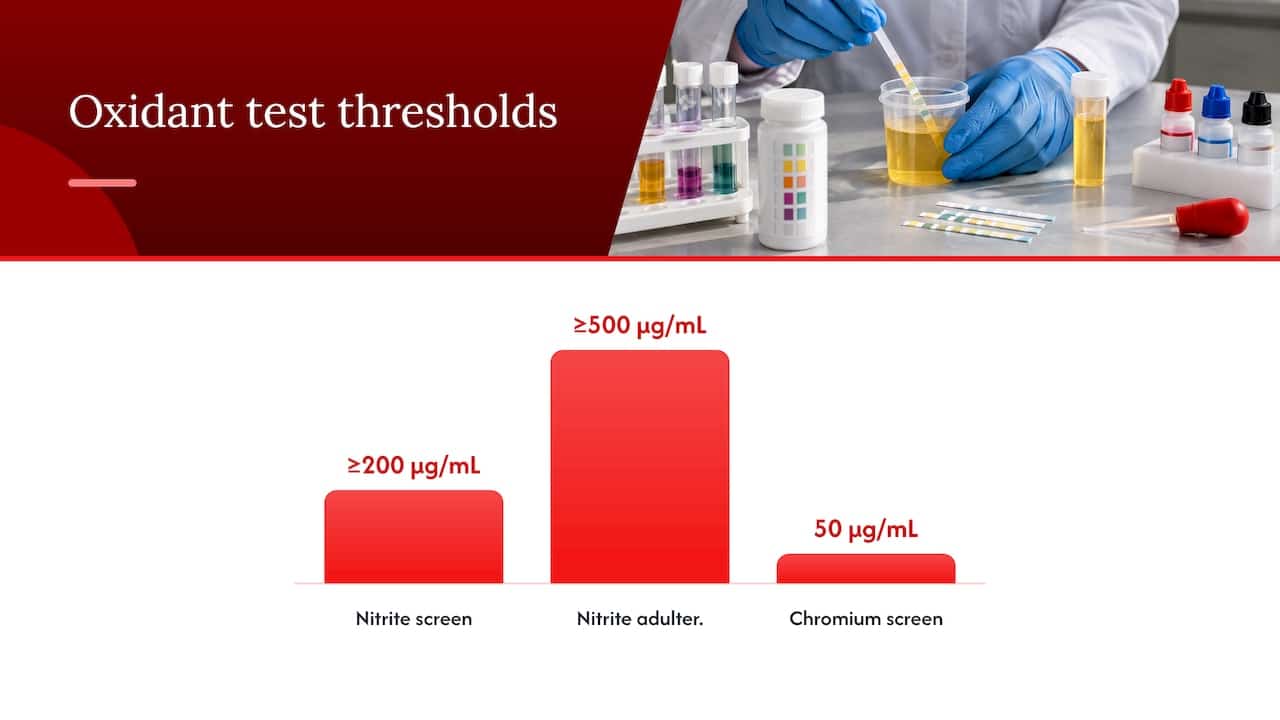
Oxidants are a family: nitrite, chromium (VI) compounds such as pyridinium chlorochromate, and halogens such as bleach. The general oxidant test runs on an autoanalyzer and identifies an oxidizer without saying which one. It is semiquantitative, calibrated with nitrite and reported in µg/mL nitrite equivalents. A peer-reviewed comparison describes the chemistry: a substrate (TMB) reacts with the oxidant to produce a color read at 660 nm.
| Oxidant | Adulterated | Invalid or screening threshold |
|---|---|---|
| Nitrite | 500 µg/mL or more on initial and confirmatory tests | 200 µg/mL or more (SAMHSA cutoff) |
| Chromium (VI) | 50 µg/mL or more initially, at or above LOQ on confirmation | 50 µg/mL screen |
| Halogen | At or above LOQ on confirmation after a positive colorimetric initial test | Lab-defined LOQ |
The figures come from the RTI/NLCP 2025 guide and 10 CFR 26.161. The general oxidant cutoff is deliberately set above the nitrite that occurs naturally from dietary nitrates but below tampering levels, which makes it a screening tool, not a specific identification. Our guide to nitrite cutoffs and when to confirm walks through the 200 and 500 µg/mL levels in more detail.
10 CFR 26.161 also requires confirmatory testing for at least one oxidizing adulterant, and SAMHSA’s 2024 MRO case studies note that the same nitrite cutoffs (200 and 500 µg/mL) apply to both the primary and split specimens, because low nitrite can occur in normal urine.
Why adulterants are easy to miss
Adulteration tests are screens with limits. A 2023 review by Wissenbach and Steuer reports that in one study, two commercial strip systems could detect and semi-quantify creatinine, nitrite and glutaraldehyde, but neither caught every adulterant at low concentrations that could still affect an ELISA screen. Immunoassay initial tests are generally more sensitive to adulterants than confirmatory methods, so the screen is where interference does its damage.
The practical lesson for collection programs: layer your controls. Check temperature and appearance at collection, use a cup with built-in adulterant pads, and send anything doubtful for laboratory confirmation. Our checklist for test administrators covers the collection-side routine, and our overview of urine specimen validity explains the parameters involved.
What strips and cups check at the point of collection
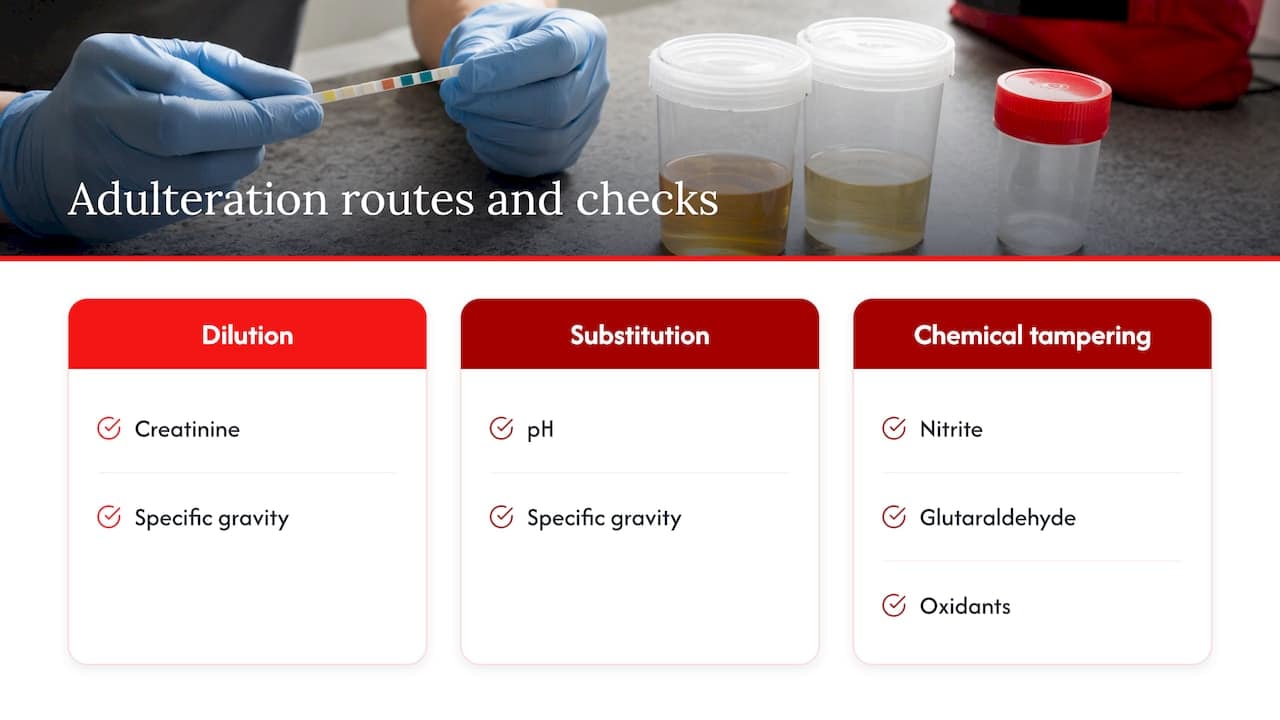
Common adulteration strips read several characteristics by color comparison. One evaluation of a commercial strip system describes six characteristics: pH, specific gravity, nitrite, glutaraldehyde, creatinine and pyridinium chlorochromate. Those cover the main routes: dilution (creatinine, specific gravity), substitution (pH, specific gravity), and chemical tampering (nitrite, glutaraldehyde, oxidants).
Collection-site results are a trigger for action, not a final finding. In a regulated program the specimen goes to a certified laboratory. In an employer, clinic or treatment setting, a flagged cup tells you to document the observation, preserve the specimen and recollect or confirm according to your policy.
For a deeper walk-through of the methods, see our guides to adulterant detection methods and detecting adulterants step by step.
What to do when a specimen flags for glutaraldehyde or oxidants
A positive validity result starts a review process, not a verdict.
- The laboratory contacts the MRO. Per the SAMHSA MRO Manual, when validity tests suggest a possible unidentified adulterant, the lab must reach the MRO before reporting the specimen invalid, to discuss whether further testing at the same or another certified lab could give a definitive answer.
- The MRO considers the donor’s explanation. The MRO can evaluate donor comments, medications and medical conditions that could account for oxidative activity. Only a legitimate medical explanation changes the outcome.
- Diet is not a defense for high nitrite. In Case #10 of the 2024 case studies, SAMHSA concluded that cured meats and other nitrite-containing foods could not push urine nitrite to the 500 µg/mL adulteration cutoff, so the result stood.
- Re-collection may follow. In Case #11, with oxidant activity at 50 µg/mL chromium (VI) equivalents or more, the MRO directed an immediate re-collection under direct observation.
Invalid is not the same as cheating. The RTI guide says invalid results can come from biological or medical causes, such as abnormal pH from storage conditions, and that oxidant levels reported as adulterated can come from tampering or a substitution product. Treat an invalid result as a reason to recollect and review, not as proof of subversion.
Donors who face a reported result often want to know what the process looks like from their side. This overview of what to expect during drug tests explains the steps they may go through after a flagged result.
Our view from the supply side
Most adulteration problems are caught or missed in the first two minutes of collection. A lab can confirm glutaraldehyde with GC-MS, but only if the specimen reaches the lab with the right flag and the right chain of custody. That is why we think the cup in your hand matters.
We built our catalog so programs can choose the level of protection they need: panels with adulterant pads, dip cards, strips and specimen cups in the same place, with bulk pricing and custom quotes for larger programs. Our family business keeps a large inventory in stock and ships the same day, so a clinic or employer does not have to run a program without controls while waiting on supplies.
Our position is simple: screen the specimen for validity every time, confirm what flags, and keep records. Strips and cups do the first job well, and the laboratory does the second.
Justin
Choosing a cup with adulterant checks
If your program tests at the point of collection, pick a cup that pairs the drug panel with adulterant pads. We carry the 15-panel cup with adulterants and the 18-panel cup with adulterants, among others. Our products include CLIA-waived and FDA-approved options, and we offer bulk discounts and custom quotes.
Browse the full range of test cups, dip cards, strips and specimen supplies to match the panel to your program.
FAQ
What is adulteration in drug testing?
It is adding a substance to a urine specimen to mask drugs or interfere with the test. Household cleaners, nitrite and glutaraldehyde are common examples. Validity testing exists to detect it.
Can glutaraldehyde cause a false negative?
Yes. The RTI/NLCP guide notes that glutaraldehyde added to urine can interfere with immunoassays and produce false negative drug results. That is why labs run an aldehyde test and confirm it on a second aliquot.
Is an invalid result proof of tampering?
No. Invalid results can have biological or medical causes, and the MRO reviews the donor’s explanation. If no legitimate explanation is found, a re-collection is usually directed, sometimes under direct observation.
What cutoffs make a specimen adulterated for nitrite?
Nitrite at 500 µg/mL or more on both the initial and confirmatory tests is adulterated. Values at 200 µg/mL or more are invalid under the SAMHSA cutoffs described in the 2024 MRO case studies.
Sources
- RTI/NLCP: An Introduction to Specimen Validity Testing (December 2025)
- eCFR: 10 CFR 26.161
- eCFR: 10 CFR 26.131
- SAMHSA: Medical Review Officer Manual
- SAMHSA: 2024 MRO Case Studies, Urine
- Mina et al.: Comparison of methods used in drugs of abuse testing
- Wissenbach and Steuer: Advances in testing for sample manipulation