Blog
Urine Specimen Validity: Ensure Integrity in Drug Testing


TL;DR:
- Urine specimen validity testing ensures samples are genuine and unaltered, essential for reliable drug testing. It checks parameters like creatinine, specific gravity, and pH to detect tampering methods such as dilution, adulteration, or substitution. Advancements in detection, including molecular profiling, aim to stay ahead of evolving evasion tactics, emphasizing the importance of trained staff and proper protocols.
Not every urine sample that arrives at your collection site is what it appears to be. Tampering is far more common than most programs assume, and the consequences of missing it range from a compromised workplace safety record to a failed legal case. Urine specimen validity testing (SVT) is a structured laboratory process designed to confirm that a sample is genuine human urine, free from adulteration, dilution, or substitution, before any drug analyte result is reported. This article breaks down how SVT works, what each parameter means, and how your lab or agency can apply it with confidence.
Table of Contents
- What is urine specimen validity and why does it matter?
- Key parameters and detection methods for specimen validity
- Common urine specimen validity outcomes and their implications
- Challenges and advances: Handling edge cases and future trends
- The reality of specimen validity: Lessons beyond the guidelines
- Ensure every sample counts: Advanced solutions for specimen validity
- Frequently asked questions
Key Takeaways
| Point | Details |
|---|---|
| SVT deters tampering | Urine specimen validity testing helps ensure drug test reliability by detecting adulteration, dilution, and substitution. |
| Standard parameters matter | Creatinine, specific gravity, and pH are core markers that flag abnormal test results in SVT. |
| Outcomes guide action | Knowing whether a sample is dilute, invalid, or substituted shapes protocols for next steps in testing. |
| Technology is evolving | Advanced methods like proteomics and LC-MS are increasingly important in catching synthetic and tampered specimens. |
What is urine specimen validity and why does it matter?
Specimen validity testing is the set of checks performed on a urine sample to verify it is suitable for drug testing. It goes beyond simply running an immunoassay panel. SVT asks a more fundamental question: is this sample actually human urine, and has it been tampered with?
The regulatory foundation is firm. SVT is mandated in federal and Department of Transportation programs under 49 CFR Part 40 and SAMHSA guidelines specifically to catch dilution, adulteration, and substitution. If your program operates under these frameworks, SVT is not optional.
Tampering takes three main forms:
- Dilution: The donor drinks excessive fluids or adds water to the sample to reduce drug concentrations below detectable thresholds.
- Adulteration: A chemical agent such as bleach, vinegar, or a commercial masking product is introduced to destroy or interfere with drug metabolites.
- Substitution: The donor submits a sample that is not their urine at all, whether it is someone else’s clean urine or a synthetic product.
“Specimen validity testing is a laboratory process to determine if a urine sample for drug testing is human, unadulterated, undiluted, and unsubstituted, ensuring reliable drug test results.”
The real-world stakes are significant. A diluted sample that goes undetected might produce a false negative for an employee operating heavy machinery. An adulterated specimen in a child custody case could free someone who poses a genuine risk. The benefits of urine testing only hold up when the specimen itself is valid.
SVT applies across a wide range of professional settings:
- Federally regulated workplace programs (DOT, military, federal agencies)
- Law enforcement and probation monitoring
- Clinical substance abuse treatment programs
- Pre-employment and random testing in safety-sensitive industries
- Forensic and legal proceedings
Understanding interpreting urine drug test results starts with knowing whether the specimen itself is trustworthy. Without SVT, every result you report carries an asterisk.
Key parameters and detection methods for specimen validity
SVT relies on a core set of biochemical markers. Each one tells a specific story about the sample’s authenticity.
The primary parameters are:
- Creatinine: A metabolic byproduct of muscle activity, always present in genuine human urine at predictable levels.
- Specific gravity (SG): Measures the concentration of dissolved solutes; pure water reads 1.000.
- pH: Reflects the acidity or alkalinity of the sample; normal urine falls within a defined range.
- Color and odor: Visual and sensory checks that can immediately flag obvious substitution or adulteration.
Normal reference ranges are creatinine 20 to 300 mg/dL, specific gravity 1.003 to 1.030, and pH 4.5 to 8.0. Deviations from these ranges trigger further review.
| Parameter | Normal range | Flagging threshold | Likely issue |
|---|---|---|---|
| Creatinine | 20 to 300 mg/dL | Below 20 mg/dL | Dilution or substitution |
| Specific gravity | 1.003 to 1.030 | Below 1.001 or above 1.030 | Dilution or adulteration |
| pH | 4.5 to 8.0 | Below 3.0 or above 11.0 | Adulteration |
| Color/odor | Yellow, mild | Unusual color, strong odor | Substitution or adulterant |
A typical validity assessment follows this sequence:
- Visual inspection for color, clarity, and odor at the point of collection.
- Dipstick or reagent strip screening for creatinine, SG, and pH.
- Confirmatory testing using a second method if any parameter flags.
- Advanced analysis (liquid chromatography-mass spectrometry, or LC-MS) for suspected adulterants that dipsticks cannot identify.
- Documentation and reporting of the validity outcome alongside the drug test result.
For routine screening, adulteration test strips cover most cases efficiently. For labs handling high-volume forensic work, understanding the full range of types of urine test strips ensures you select the right tool for each testing context.
Pro Tip: Reagent strips can occasionally produce false pH flags in samples from donors with certain medical conditions or unusual diets. Always correlate the pH result with creatinine and SG before escalating to a full invalid determination.
Common urine specimen validity outcomes and their implications
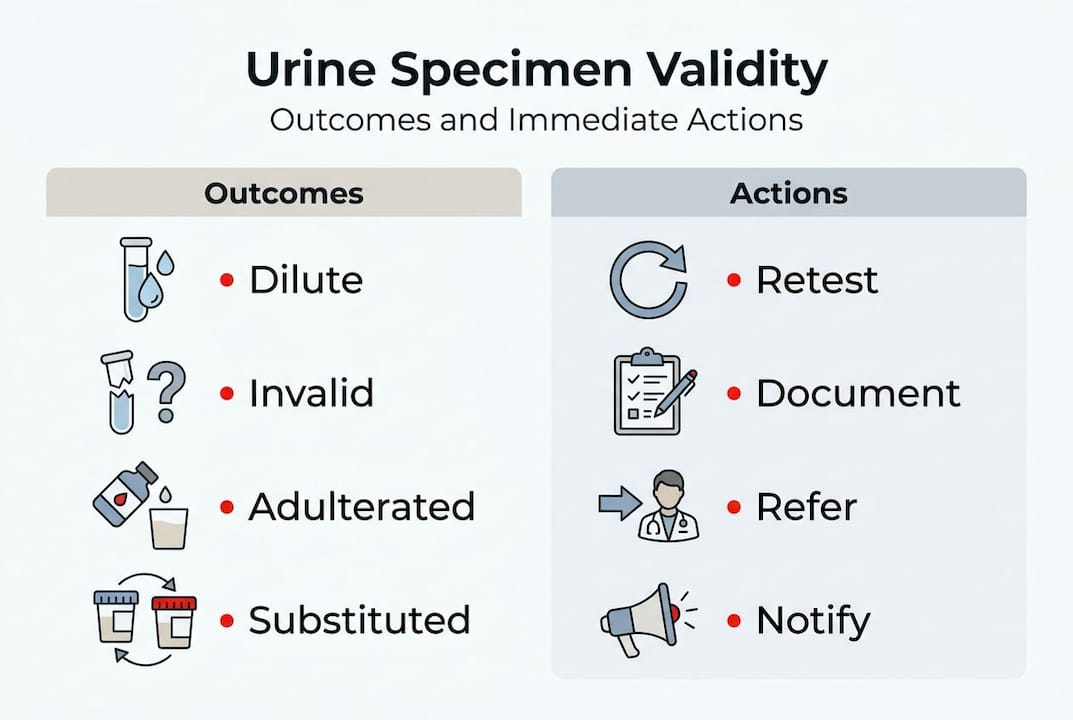
Once you understand the parameters, the next step is knowing what to do with each result. Four outcomes are defined under federal guidelines, and each requires a distinct response.
Dilute: A dilute specimen has creatinine below 20 mg/dL and specific gravity below 1.003, or creatinine between 2 and 5 mg/dL. This may reflect intentional water loading or simply heavy fluid intake before the test. The result is typically reported as negative-dilute, and a repeat collection under direct observation may be ordered.

Invalid: An invalid specimen shows abnormal color or odor, reactions consistent with an adulterant, or characteristics that interfere with the testing process entirely. The lab cannot report a drug result. A new collection is required.
Adulterated: The specimen contains a substance not expected in human urine, confirmed by the presence of a known adulterant or a pH outside the 3.0 to 11.0 range. This is treated as a refusal to test in federal programs.
Substituted: Creatinine is below 2 mg/dL and specific gravity is below 1.001 or above 1.020. The sample is not consistent with normal human urine. Like adulteration, this is treated as a refusal in DOT-regulated settings.
| Outcome | Key markers | Immediate action | Program consequence |
|---|---|---|---|
| Dilute | Low creatinine, low SG | Report negative-dilute, consider retest | Possible observed retest |
| Invalid | Abnormal characteristics | Cancel result, request recollection | Recollection required |
| Adulterated | Adulterant confirmed | Report adulterated | Treated as refusal |
| Substituted | Creatinine below 2, SG out of range | Report substituted | Treated as refusal |
For labs following a step-by-step urine test guide, having a clear decision tree for each outcome reduces errors and keeps your program legally defensible. The benefits of urine testing are maximized when every validity result triggers the correct downstream action without hesitation.
Pro Tip: When a donor claims a medical explanation for a dilute or substituted result, document the claim and refer it to the Medical Review Officer (MRO) before taking any adverse action. Skipping this step creates legal exposure.
Challenges and advances: Handling edge cases and future trends
The tampering landscape does not stand still. As detection methods improve, so do the products and strategies donors use to evade them. Staying current is not just best practice; it is a compliance obligation.
Synthetic urine is the clearest example of this arms race. Modern commercial products are formulated to mimic creatinine levels, specific gravity, and pH within normal ranges. However, synthetic urine is detectable by the absence of human biomarkers, abnormal creatinine or SG patterns, and increasingly by proteomics and LC-MS analysis that identifies the molecular fingerprint of genuine human urine.
Current and emerging challenges include:
- Commercial synthetic urine kits that closely replicate standard validity parameters
- Urine heating devices designed to deliver samples at body temperature, defeating temperature checks
- Oxidizing adulterants (such as nitrites and chromates) that destroy immunoassay antibodies without obviously altering pH
- Biocide additives that preserve substituted urine during transport
- Delayed submission of samples collected off-site, exploiting stability windows
On the pre-analytical side, specimen stability holds for up to 96 hours under refrigeration, with centrifugation and underfilling having minimal impact on validity markers. This matters for chain-of-custody programs where samples travel between collection sites and central labs.
Future SVT technology is moving toward molecular profiling. Metabolomics and proteomics can identify hundreds of compounds unique to human urine, making substitution nearly impossible to conceal. Labs investing in LC-MS platforms now will be positioned to adopt these methods as they become standardized.
For a deeper look at what your program is up against, the synthetic urine guide covers the science and risks in detail. The urine drug test advantages remain strong, but only when paired with validity testing that keeps pace with evolving evasion tactics.
The reality of specimen validity: Lessons beyond the guidelines
Regulatory compliance sets the floor, not the ceiling. The labs and agencies that catch the most tampering are not necessarily the ones with the most advanced instruments. They are the ones that train staff to stay curious and treat every anomaly as worth investigating.
Here is the uncomfortable truth: instrumentation alone misses things. A sample that passes every automated validity check can still look wrong to an experienced collector who notices that it is too clear, too warm, or smells faintly of bleach. Those sensory observations are not anecdotal; they are data. Protocols that dismiss visual and olfactory inspection as subjective are leaving a detection gap.
Tampering also evolves faster than guidance documents are updated. By the time a new adulterant appears in a federal advisory, it has often been in use for months. The labs that catch it early are the ones that interpret results in practice with a questioning mindset rather than a checkbox mentality. Building that culture, where every technician feels empowered to flag something that seems off, is worth more than any single instrument upgrade.
Ensure every sample counts: Advanced solutions for specimen validity
Your SVT protocol is only as strong as the tools behind it. Whether you are running a high-volume clinical lab or managing compliance for a law enforcement agency, having validated, up-to-date testing products is what separates a defensible result from a contested one.
At rapidtestcup.com, you will find everything needed to build a robust validity workflow. Start by reviewing our compare leading urine drug test kits resource to match the right panel to your program’s needs. Use the selecting the right drug test kit guide to navigate CLIA-waived and FDA-approved options. For programs where adulteration is a persistent concern, our adulteration strips for accuracy deliver the sensitivity your protocol demands. Bulk pricing and fast shipping mean your supply chain stays as reliable as your results.
Frequently asked questions
What does a ‘dilute’ urine specimen mean in drug testing?
A dilute result indicates low creatinine and specific gravity in the sample, which may stem from excessive fluid intake before the test. Depending on the program, it is reported as negative-dilute and may trigger a supervised repeat collection.
How long is a urine specimen stable for validity testing?
Urine specimens remain stable for validity testing for up to 96 hours when properly refrigerated, giving labs adequate time for transport and processing without compromising marker integrity.
How do labs detect synthetic or substituted urine specimens?
Labs flag synthetic urine by identifying missing human biomarkers, abnormal creatinine or specific gravity patterns, and increasingly use LC-MS or proteomics to confirm substitution with molecular-level precision.
What happens if a urine specimen is labeled ‘invalid’?
An invalid designation means the sample’s characteristics prevented reliable testing, often due to an adulterant or abnormal properties. A new specimen collection is required, and in federal programs, the MRO reviews the case before any action is taken.