

Blog
Federal Contractor Marijuana Testing: What the Rules Require


Most federal contractors are not required by federal law to test employees for marijuana. The Drug-Free Workplace Act requires a written policy, an awareness program and prompt reporting of workplace drug convictions, but not testing. Testing becomes mandatory only when a specific rule or contract clause says so, mainly for DOT-regulated safety-sensitive jobs and some DOD positions with access to classified information. The practical question for your organization is which of those situations you are in, and then choosing a screening program that fits it. For employers who do screen, we supply multi-panel test cups, dip cards and oral swabs, including CLIA-waived and FDA-approved options, with bulk pricing and custom quotes.
TL;DR
- The Drug-Free Workplace Act of 1988 requires a drug-free workplace policy and awareness program for covered contracts, not drug testing.
- Testing is mandatory for DOT-regulated safety-sensitive employees and for DOD contractors with access to sensitive, classified information. Marijuana is one of the tested drug classes.
- State medical or recreational marijuana laws do not change DOT rules, and some states limit when private employers can test.
- The federal HHS testing guidelines cover federal employees, not contractor staff in general. Your own policy sets the rest.
- If you screen voluntarily, document the policy first, then match the test panel and format to the jobs involved.
Table of Contents
- Do federal contractors get drug tested?
- What the Drug-Free Workplace Act actually requires
- When testing is mandatory: DOT, DOD and contract-specific terms
- State marijuana laws and your policy
- What happens after a positive marijuana result
- Building a screening program that fits your contract
- Our perspective
- Stock your program with the right supplies
- FAQ
- Sources
Do federal contractors get drug tested?
It depends on the contract and the job, not on the word “federal.” Two separate layers apply.
Layer one: the drug-free workplace requirement. FAR subpart 26.5 applies the requirement to contracts above the simplified acquisition threshold, including 8(a) contracts. It exempts contracts at or below the threshold (except contracts awarded to individuals), commercial product and commercial service contracts, contracts performed outside the United States, certain law-enforcement undercover operations, and contracts inconsistent with U.S. international obligations. For contracts of 30 days or more, you generally have 30 days after award to comply unless the contracting officer agrees in writing to longer.
Layer two: testing mandates. These come from sector rules or specific contract terms. SAMHSA, the federal substance-use agency, explains that the Omnibus Transportation Employee Testing Act requires safety-sensitive transportation employees to be tested before employment, on reasonable suspicion, after accidents and before return to duty, with random testing, HHS-certified labs and a panel that includes marijuana metabolites. It also says DOD contractors with access to sensitive, classified information must maintain a controlled and monitored testing policy.
The federal Mandatory Guidelines you may hear about are narrower than people assume. SAMHSA’s FAQ states they do not cover non-federal employees. They govern federal agency programs and the certified labs that serve regulated testing.
What the Drug-Free Workplace Act actually requires
The statute, 41 U.S.C. § 8102, says a non-individual contractor is not a responsible source for a covered contract unless it agrees to provide a drug-free workplace. Its text contains no testing requirement. The clause that carries this into your contract, FAR 52.226-7, asks you to:
- Publish a statement prohibiting unlawful manufacture, distribution, dispensing, possession or use of a controlled substance in the workplace, and say what actions follow a violation.
- Run an ongoing awareness program covering the dangers of drug abuse, your policy, available counseling, rehabilitation and employee assistance programs, and penalties.
- Give a copy of the statement to each employee working on the contract.
- Tell employees in writing to follow the statement and to report any workplace drug conviction to you within 5 days.
- Notify the contracting officer within 10 days of learning of such a conviction.
- Within 30 days, take personnel action up to termination, or require the employee to complete an approved rehabilitation program.
Non-compliance can lead to suspended payments, termination for default, and suspension or debarment, according to the same clause and FAR 26.505. SAMHSA’s contractor resource page summarizes the same duties and notes that the threshold is $100,000 for contracts and that grants of any size are covered.
A conviction is not a positive test. The Act’s triggers are workplace conduct and criminal convictions, so a policy built only around testing can miss the paperwork the clause actually demands.
When testing is mandatory: DOT, DOD and contract-specific terms
If your employees hold safety-sensitive transportation jobs, such as commercial drivers, you are testing under DOT rules. The Department of Transportation’s employee handbook states that even where a state allows medical marijuana, federal law and DOT policy recognize no legitimate medical use, and DOT regulations treat marijuana like any other illicit drug.
This kind of regulated testing follows prescribed collection procedures and HHS-certified laboratories. It is a separate track from an employer’s own screening program, and your compliance team or designated employer representative should confirm exactly which procedures your contract requires.
The Department of Labor’s contractor rules point the same way. Under 41 CFR 60-300.24, a test for illegal drug use is not a medical examination, and nothing in that part encourages, prohibits or authorizes contractors to test applicants or employees. It also preserves the lawful authority of DOT-jurisdiction contractors to test safety-sensitive positions. In short, outside mandates, testing is your decision.
State marijuana laws and your policy
Contractors often assume federal status overrides state law. It does not, automatically. The relevant question is whether a federal law or contract term actually requires the action you want to take.
New York is a useful example. Its Department of Labor’s cannabis FAQ says an employer may act where required by state or federal law, where it would otherwise violate federal law or lose a federal contract or funding, or where an employee shows specific, articulable symptoms of impairment while working. It adds that an employer cannot test for cannabis merely because federal law permits it, and notes mandatory testing for commercial motor vehicle drivers under 49 CFR Part 382.
An academic review in the Fordham Urban Law Journal reaches a similar conclusion: some federal contractors and positions require testing by regulation, but the Drug-Free Workplace Act does not, and contractors are not barred from employing someone who uses marijuana off duty unless specifically required.
The takeaway is to write your policy by job category and by state. A driver covered by DOT rules, a cleared employee under a DOD contract and an office administrator in a state with employee cannabis protections may all be treated differently. Marijuana’s federal classification has also been the subject of recent rulemaking activity, so check the DEA and SAMHSA pages for your current obligations before updating a policy.
What happens after a positive marijuana result
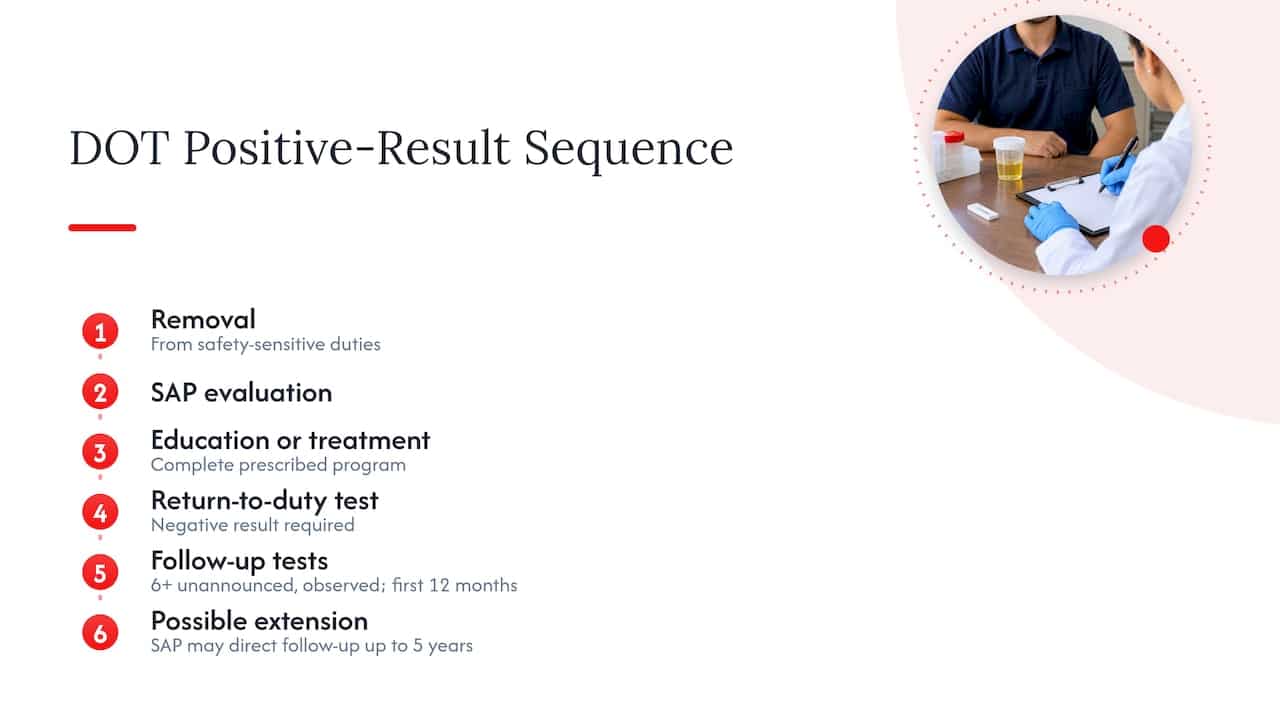
For DOT-regulated employees the path is fixed. The DOT handbook describes immediate removal from safety-sensitive duties, evaluation by a Substance Abuse Professional, completion of the prescribed education or treatment, a negative return-to-duty test, and at least six unannounced, observed follow-up tests in the first 12 months (up to five years at the SAP’s direction). Hiring and firing remain the employer’s decision.
For other employees the policy you wrote controls. Document the steps in advance: who is notified, what confirmation follows a screening result, what support the employee can access, and who decides on discipline. Keep it consistent across similar roles. The FAR clause gives you a clear anchor for conviction cases: personnel action or required rehabilitation within 30 days.
Building a screening program that fits your contract
When you test beyond what is mandated, the program should be simple to run and easy to defend. A workable sequence:
- Map the roles. Mark which jobs fall under DOT, DOD or another mandate and which are covered only by your own policy.
- Write the policy. Include the circumstances for testing (pre-employment, reasonable suspicion, post-incident), the consequences, and the support available. Have counsel review it against your state’s cannabis law.
- Choose the panel. Marijuana (THC) is usually one analyte in a multi-panel screen. Most employers pick a 5-, 10- or 12-panel format depending on the job. Our workplace multi-panel comparison walks through the options.
- Choose the format. A urine test cup gives an on-site result and keeps the specimen in one device. Dip cards and oral swabs suit other settings. Our guide to cups versus dip cards covers the differences.
- Train whoever collects. Consistent collection steps protect both the employee and the employer. Training on collecting specimens for drugs of abuse testing shows what that skill set covers.
- Plan the follow-up. Decide in advance how results are recorded, how confidentiality is protected, and how any non-negative result is handled under your policy.
A note on oral fluid: HHS revised its federal oral-fluid guidelines in 2023, and the Federal Register notice allows oral fluid for any type of testing in federal agency programs. That governs federal agency programs, but it shows oral specimens are a recognized option. See our 5-panel oral swab if you want a collection method without a restroom visit.
For pre-employment screening in field-based trades, an overview of pre-employment physicals for construction contractors lays out how urine drug testing fits alongside other screening.
Our perspective
The most common mistake we see in this topic is treating “federal contractor” as a synonym for “must test.” It is not. The Drug-Free Workplace Act asks for a policy, education and reporting. Testing comes from specific mandates or from your own decision.
That is good news for employers, because it means you can fit the program to the job. A multi-panel cup with a THC line gives a supervisor a quick, on-site answer for roles where you have chosen to screen. A dip card keeps costs low for high-volume hiring. An oral swab suits observed collection.
We built our catalog around that range: test cups, dip cards, strips, oral swabs, specimen cups, with CLIA-waived and FDA-approved options and bulk discounts for organizations that test regularly. Our family business stands behind low prices and same-day shipping, and we will work up a custom quote for larger programs.
Start with the policy, then pick the panel. The product follows from the program, not the other way around.
Justin
Stock your program with the right supplies
Once your policy names the roles and panels, ordering is the easy part. Our shop carries multi-panel urine test cups, 10- and 12-panel dip cards, oral swabs and urine specimen cups, with bulk pricing and custom quotes for employers testing at volume. If you want a starting point, our 12-panel urine test cup and 10-panel dip card are common choices for workplace programs. Browse the full test cup and dip card range to compare formats.
FAQ
Do federal contractors have to drug test employees for marijuana?
Not as a general rule. The Drug-Free Workplace Act requires a policy, awareness program and conviction reporting, with no testing requirement in its text. Testing is required where a specific rule applies, such as DOT safety-sensitive positions or certain DOD contracts involving classified information.
Can a federal contractor employee use medical marijuana?
For DOT-regulated safety-sensitive employees, no: DOT treats marijuana like any other illicit drug regardless of state law. For other employees it depends on your contract terms, your policy and your state’s law. Have counsel review your policy for the states where you operate.
Does the HHS testing guidance apply to my company?
The HHS Mandatory Guidelines apply to federal agency testing programs. SAMHSA states that they do not cover non-federal employees. Your obligations come from your contract, DOT or DOD rules, and your own written policy.
What should a drug-free workplace policy include?
A statement prohibiting unlawful controlled substance activity in the workplace and the actions for violations, an ongoing awareness program, a copy for each contract employee, a 5-day employee conviction report, a 10-day notice to the contracting officer, and action within 30 days of a conviction.
Sources
- Subpart 26.5, Drug-Free Workplace (Acquisition.GOV)
- SAMHSA: Drug-free workplace FAQs
- SAMHSA: Drug testing for safety and security-sensitive industries
- SAMHSA: Employer resources for federal contractors and grantees
- 41 U.S.C. § 8102
- 48 CFR 52.226-7, Drug-Free Workplace
- 41 CFR 60-300.24, Drugs and alcohol
- DOT: What employees need to know about DOT drug and alcohol testing
- New York State DOL: Adult use cannabis and the workplace
- Fordham Urban Law Journal: Marijuana use by employees
- Federal Register: Mandatory Guidelines for Federal Workplace Drug Testing Programs