

Blog
Why Labs Use On-Site Drug Testing Solutions


Choosing the right drug testing method can make or break your laboratory’s workflow, especially when turnaround time is critical. For forensic laboratories serving law enforcement, corrections, and workplace safety programs, finding solutions that balance efficiency and reliability is nonnegotiable. This guide explains how portable, on-site drug testing technologies deliver rapid results and cost efficiency while ensuring your operations stay compliant and ready for immediate action.
Table of Contents
- Defining On-Site Laboratory Drug Testing
- Types of On-Site Drug Testing Methods
- Operational and Compliance Benefits for Labs
- Cost, Efficiency, and Safety Implications
- Comparing On-Site and Off-Site Drug Testing
Key Takeaways
| Point | Details |
|---|---|
| Rapid Results | On-site drug testing provides results within minutes, enhancing workflow efficiency in various settings. |
| Presumptive Testing | Initial results from on-site tests require confirmatory laboratory analysis for legal defensibility and accuracy. |
| Operational Benefits | On-site testing reduces transport logistics and testing backlogs, allowing labs to operate efficiently and serve more clients. |
| Cost Efficiency | By minimizing infrastructure needs and processing time, on-site testing typically costs significantly less than traditional laboratory methods. |
Defining On-Site Laboratory Drug Testing
On-site laboratory drug testing refers to portable, compact instruments and self-contained test kits that analyze biological specimens for drugs and their metabolites outside traditional laboratory settings. These tests deliver results in minutes rather than hours or days, making them invaluable for your lab’s workflow efficiency.
The core concept emerged from workplace safety needs but has expanded significantly across multiple sectors. Your forensic laboratory likely encounters on-site testing applications in law enforcement, correctional facilities, drug court monitoring, and workplace compliance programs.
What On-Site Testing Actually Involves
Portable test instruments for drug screening use rapid immunoassay technology to detect substances in urine, saliva, or oral fluids. The results appear within minutes, allowing for immediate preliminary decisions.
On-site testing operates as presumptive testing—meaning it provides initial screening results that flag potential positives or negatives. Your lab staff trained in these procedures can operate them efficiently outside formal laboratory environments.
Key Characteristics of On-Site Solutions
These systems share several defining features:
- Rapid turnaround: results within 2-5 minutes
- Minimal specimen requirements: small volumes of urine or saliva
- Portability: compact enough for roadside, workplace, or detention settings
- Cost efficiency: economical screening compared to laboratory analysis
- Ease of use: trained professionals can conduct testing without advanced equipment
- Immediate specimen collection verification: tests occur where samples are obtained
The Critical Confirmation Step
Presumptive on-site testing requires confirmatory laboratory analysis for legal defensibility and accuracy. This two-tier approach protects your organization from liability and ensures compliance with forensic standards.
On-site tests have sensitivity and specificity limitations. False positives and false negatives occur, particularly with cross-reactive substances or medications that mimic drug metabolites.
Where Your Lab Applies On-Site Testing
Common applications in forensic work include:
- Workplace screening programs requiring immediate results
- Roadside driver assessment prior to formal testing
- Correctional facility inmate monitoring
- Drug court compliance verification
- Substance abuse program intake screening
Each scenario demands different operational considerations and confirmatory protocols.
On-site testing accelerates your lab’s screening capacity, but confirmatory testing remains legally and scientifically non-negotiable for forensic cases.
Pro tip: Maintain detailed chain-of-custody documentation for every on-site test result, even if preliminary, to establish foundation for confirmatory testing and satisfy regulatory audit requirements.
Types of On-Site Drug Testing Methods
On-site drug testing uses several distinct methodologies, each designed for rapid screening across different specimen types. Your laboratory likely operates multiple systems depending on the testing scenario, population, and specimen availability.
The most common approaches involve immunoassay-based screening technologies that detect drug metabolites in urine, saliva, or oral fluid. These methods differ significantly in execution speed, accuracy, and operational complexity.
Urine-Based Immunoassay Tests
Urine testing remains the dominant on-site method for workplace and forensic applications. Lateral flow assays and enzyme-linked immunosorbent assays provide rapid results within minutes using portable test cups or dip cards.
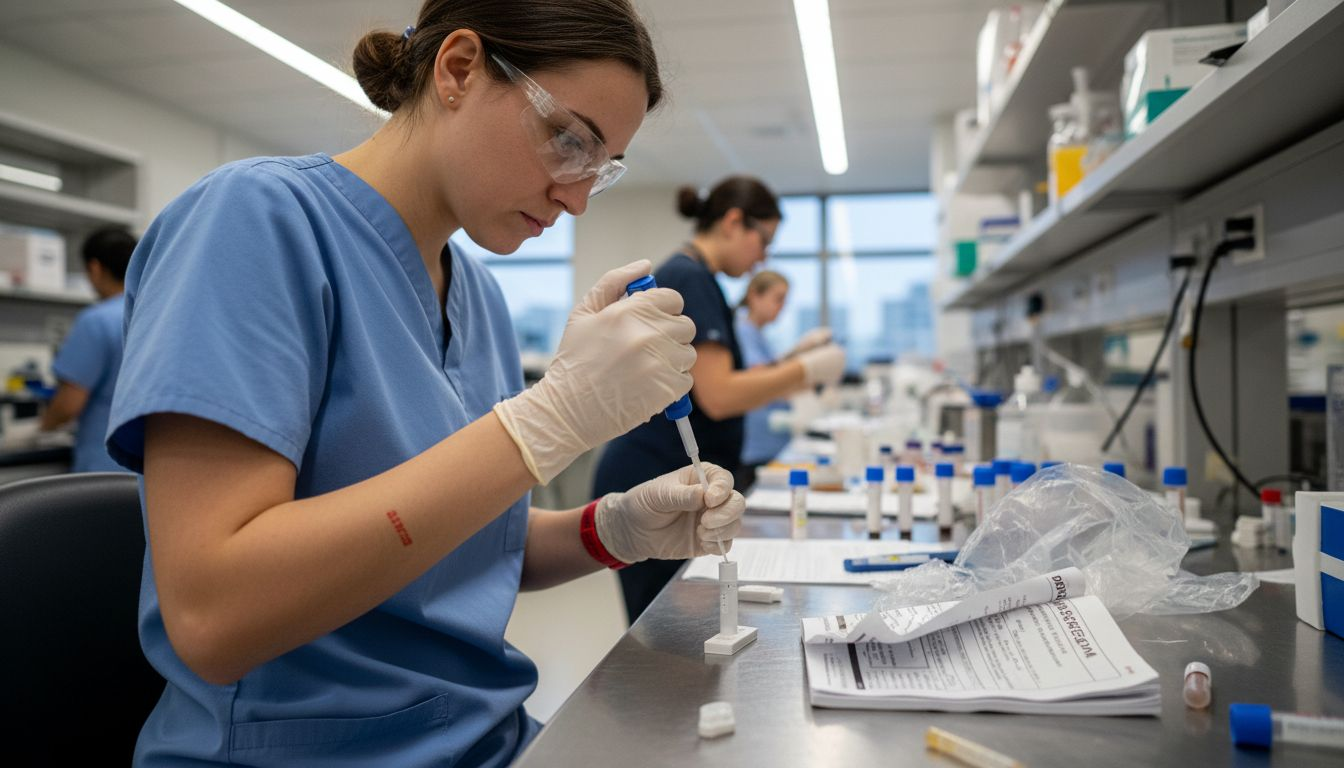
Your lab staff operates these by adding urine specimen to test devices that display results visually. Most modern systems use multi-panel testing cups that screen for 5 to 14 drug classes simultaneously.
Key advantages of urine testing:
- Highest specimen volume for testing
- Established chain-of-custody procedures
- Longer detection windows (24 hours to 3 days depending on substance)
- Cost-effective per test
- Minimal training requirements for operators
Oral Fluid and Saliva Testing
Oral fluid testing has gained traction in roadside screening and workplace programs. Immunoassay test strips and handheld analyzers detect drugs directly from saliva specimens collected non-invasively.
These methods work when witnesses are present, eliminating privacy concerns associated with urine collection. Results typically appear in 5 to 10 minutes.
Practical considerations for oral fluid testing:
- Non-invasive collection reduces subject resistance
- Shorter detection window (6 to 24 hours)
- Visible collection prevents specimen substitution
- Portable devices fit roadside screening workflows
- Slightly higher cost per test than urine
Breath and Other Specimen Types
Breath testing specifically targets alcohol detection and appears in DUI roadside screening. This method provides immediate results and requires no biological specimen handling.
Some laboratories also employ hair, sweat patch, and blood specimen testing for specialized applications, though these require more sophisticated equipment.
Here is a side-by-side comparison to clarify where each on-site specimen type excels:
| Specimen Type | Best Use Scenario | Main Advantage | Primary Limitation |
|---|---|---|---|
| Urine | Workplace, corrections | Long detection window | Requires privacy for collection |
| Oral Fluid | Roadside, on-site workplace | Non-invasive, easy collection | Shorter detection window |
| Breath | DUI and alcohol assessment | Instant alcohol detection | Detects alcohol only |
| Hair/Sweat/Blood | Specialized forensic needs | Extended history, detailed analysis | Not suitable for rapid screening |
Different specimen types serve different purposes—urine for comprehensive screening, oral fluid for non-invasive point-of-care, and breath for alcohol assessment.
Confirmatory Testing Requirements
All on-site screening results require confirmatory testing through gas chromatography-mass spectrometry or liquid chromatography-mass spectrometry for legal defensibility. This two-step approach protects your laboratory from liability and ensures forensic admissibility.
Pro tip: Stock multiple specimen collection types in your facility since different scenarios demand different methods—urine cups for workplace programs, oral fluid swabs for roadside assessment, and breath devices for DUI cases ensure operational flexibility.
Operational and Compliance Benefits for Labs
On-site drug testing transforms your laboratory’s operational capacity and regulatory standing. The benefits extend beyond speed—they reshape how your lab manages workflow, staffing, and risk exposure.
Integrating on-site screening fundamentally changes your testing infrastructure. Your team gains ability to test larger populations, reach remote locations, and generate actionable results immediately rather than waiting for confirmatory analysis.
Workflow Efficiency Gains
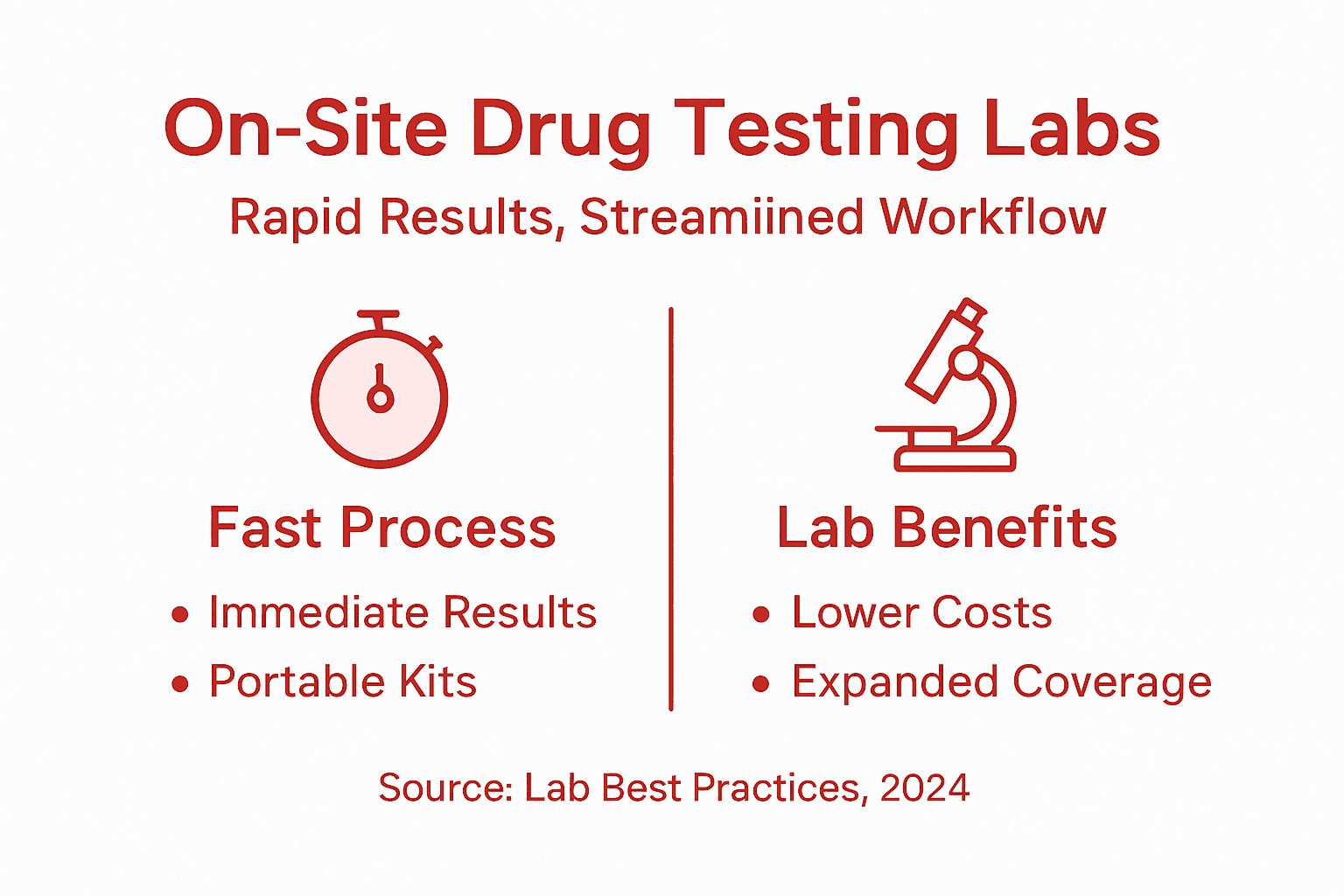
Rapid results delivery and reduced specimen transport logistics eliminate bottlenecks that plague traditional laboratory models. Testing happens where specimens are collected, minimizing delays.
Your lab staff processes fewer transport requests and chains of custody for preliminary screening. This operational streamlining frees resources for confirmatory testing and administrative tasks.
Concrete efficiency improvements:
- Eliminate specimen transport time (typically 24 to 48 hours)
- Reduce preliminary screening backlog by 40 to 60 percent
- Enable testing in mobile or remote settings without centralized infrastructure
- Decrease cold storage requirements for initial screening results
- Improve staff deployment flexibility across multiple testing sites
Compliance and Legal Defensibility
Immediate decision-making capabilities enable timely safety and legal interventions that support regulatory adherence. Quick presumptive results let workplace safety officers, law enforcement, and treatment providers act immediately.
On-site testing strengthens your lab’s compliance posture when implemented correctly. Quality control protocols, cut-off standards, and documentation procedures protect against legal challenges.
Risk Mitigation
On-site screening reduces your laboratory’s liability exposure significantly. Testing outside your facility transfers specimen security responsibility to the collection location.
Your lab maintains defensibility by enforcing strict confirmatory testing protocols. Never allow on-site results to drive clinical or legal decisions without laboratory confirmation.
Key compliance protections:
- Documented chain of custody for all preliminary results
- Immediate confirmatory testing for positive screens
- Training documentation for all operators
- Quality assurance records for testing devices
- Adherence to manufacturer specifications and cut-off values
Testing Coverage Expansion
On-site capabilities let your laboratory serve populations previously inaccessible. Roadside assessments, workplace programs, correctional facilities, and treatment centers become viable testing environments.
This expanded reach increases revenue opportunities while supporting public health and safety objectives.
On-site screening accelerates your workflow and strengthens compliance—but only when combined with rigorous confirmatory testing and documentation protocols.
Pro tip: Establish a standardized on-site testing protocol that includes device calibration verification, operator training records, and automatic flagging for confirmatory testing to ensure your laboratory maintains defensibility while maximizing operational efficiency.
Cost, Efficiency, and Safety Implications
On-site drug testing reshapes your laboratory’s financial model and operational speed. The cost savings and efficiency gains directly impact your bottom line while improving workplace and public safety outcomes.
Your lab experiences measurable cost reduction through eliminated specimen transport, reduced processing time, and decreased infrastructure demands. Safety improvements follow naturally when results arrive in minutes rather than days.
Cost Reduction Mechanisms
Rapid results that reduce time from sample collection to decision eliminate expensive logistics pipelines. Specimen transport, refrigeration, and multi-day processing cycles disappear from preliminary screening workflows.
On-site testing reduces your laboratory’s infrastructure burden significantly. You need fewer technicians, less equipment, and minimal storage space for initial screening operations.
Direct cost savings your lab realizes:
- Eliminate courier and transport fees for preliminary results
- Reduce cold storage and specimen handling overhead
- Decrease technician labor for initial screening by 30 to 50 percent
- Lower equipment maintenance costs through distributed testing
- Minimize consumable waste from batch processing delays
Efficiency Gains in Real Operations
Turnaround time improvement is your most visible operational benefit. Results arrive in 5 to 10 minutes instead of 24 to 48 hours, letting decision-makers act immediately.
Your lab staff processes higher testing volumes without proportional staffing increases. One trained operator manages multiple on-site locations simultaneously.
Safety Enhancement Through Speed
Immediate detection of drug use enables quicker interventions, lowering workplace incidents and risks. Workplace supervisors remove impaired workers before accidents occur. Law enforcement detects impaired drivers immediately at roadside stops. Treatment programs identify relapse cases within minutes of testing.
This speed translates directly into prevented injuries, reduced liability, and better outcomes.
The Accuracy Tradeoff
On-site testing has sensitivity and specificity limitations compared to laboratory methods. False positives create compliance issues while false negatives miss actual drug use.
This critical limitation requires confirmatory testing for all presumptive positives. Your laboratory must enforce this two-tier protocol to maintain safety and legal defensibility.
Balancing speed with accuracy:
- Use on-site results for immediate decision-making only
- Require laboratory confirmation for employment, legal, or clinical decisions
- Document all presumptive results and confirmatory findings
- Train staff on interpreting limitations of screening results
- Establish automatic confirmatory testing for positive screens
Cost efficiency and safety go hand in hand, but only when on-site screening feeds into rigorous confirmatory testing—never allow preliminary results to become final decisions.
Pro tip: Calculate your actual cost per test by dividing device costs, training, and quality assurance expenses by projected annual testing volume—on-site testing typically costs 40 to 60 percent less than full laboratory processing, making bulk purchasing increasingly valuable as testing volume grows.
Comparing On-Site and Off-Site Drug Testing
On-site and off-site testing serve fundamentally different purposes in your laboratory’s testing strategy. Understanding the distinctions helps you allocate resources effectively and choose the right method for each scenario.
Neither approach replaces the other. Your lab needs both to deliver comprehensive, defensible results while maintaining operational efficiency and safety.
Speed Versus Accuracy
On-site drug testing offers rapid presumptive results adaptable for use in the field or workplace, supporting immediate action. Off-site laboratory testing provides more comprehensive, sensitive, and specific analyses with confirmatory capacity but requires longer turnaround times.
This tradeoff shapes every decision about where and when to test. On-site methods answer “Is this person likely positive?” Laboratory methods answer “What substances are actually present and at what concentrations?”
On-Site Testing Strengths
On-site methods excel in specific operational contexts. Your team uses them for preliminary screening when speed matters more than absolute certainty.
When on-site testing makes sense:
- Workplace safety checks requiring immediate decisions
- Roadside driver assessment at traffic stops
- Intake screening for treatment programs
- Correctional facility monitoring
- Initial drug court compliance verification
- Mass testing events with limited infrastructure
On-site testing reduces your infrastructure burden and testing costs significantly. One operator can conduct hundreds of tests across multiple locations weekly.
Off-Site Laboratory Advantages
Laboratory testing delivers definitive results with advanced analytical techniques essential for confirmation. Your certified lab conducts sophisticated analysis using gas chromatography-mass spectrometry or liquid chromatography-mass spectrometry.
Laboratory results withstand legal challenges. Courts admit confirmed laboratory findings as evidence, while on-site results remain preliminary.
Laboratory testing is necessary for:
- Employment decisions with legal implications
- Criminal justice proceedings
- Custody or child welfare determinations
- Clinical diagnoses requiring specificity
- Regulatory compliance documentation
- Confirmation of all positive on-site screens
The Integrated Approach
Laboratories must integrate both strategies to optimize testing programs, ensuring reliable drug detection complemented by the speed needed for operational decisions. This two-tier model maximizes efficiency while protecting against liability.
Your workflow should route all presumptive positive on-site results to the laboratory for confirmatory testing. This approach captures speed benefits while maintaining legal defensibility.
On-site and laboratory testing form a partnership—use on-site methods for rapid preliminary screening, then confirm critical decisions with laboratory analysis.
Practical decision matrix:
The following table summarizes the optimal testing approach for common lab situations:
| Scenario | On-Site Testing Use | Must Confirm In Lab? |
|---|---|---|
| Workplace incident | Immediate screen | Always |
| Roadside stop | Immediate screen | Always |
| Pre-employment | Preliminary screen | Always |
| Drug court compliance | Initial check | Always |
| Clinical diagnosis | Not recommended | Laboratory only |
- Use on-site for: Initial screening, mass testing, operational decisions, safety checks
- Use laboratory for: Legal decisions, employment actions, clinical diagnoses, confirmations
- Always: Confirm on-site positives in the laboratory before final decisions
Pro tip: Establish a policy requiring automatic laboratory confirmation for all on-site positive results within 24 hours, preventing delays that undermine the speed advantage of on-site testing while ensuring your final determinations meet legal and scientific standards.
Enhance Your Lab’s On-Site Drug Testing with Trusted Solutions
On-site drug testing offers rapid, presumptive results that are essential for timely decisions in workplace safety, roadside assessments, and correctional monitoring. Yet, as the article highlights, these tests require high-quality materials and strict confirmatory protocols to ensure accuracy and compliance. Your lab’s challenge is to strike the right balance between speed, reliability, and legal defensibility. Choosing dependable, CLIA waived, FDA-approved testing kits with detailed chain-of-custody support is critical.
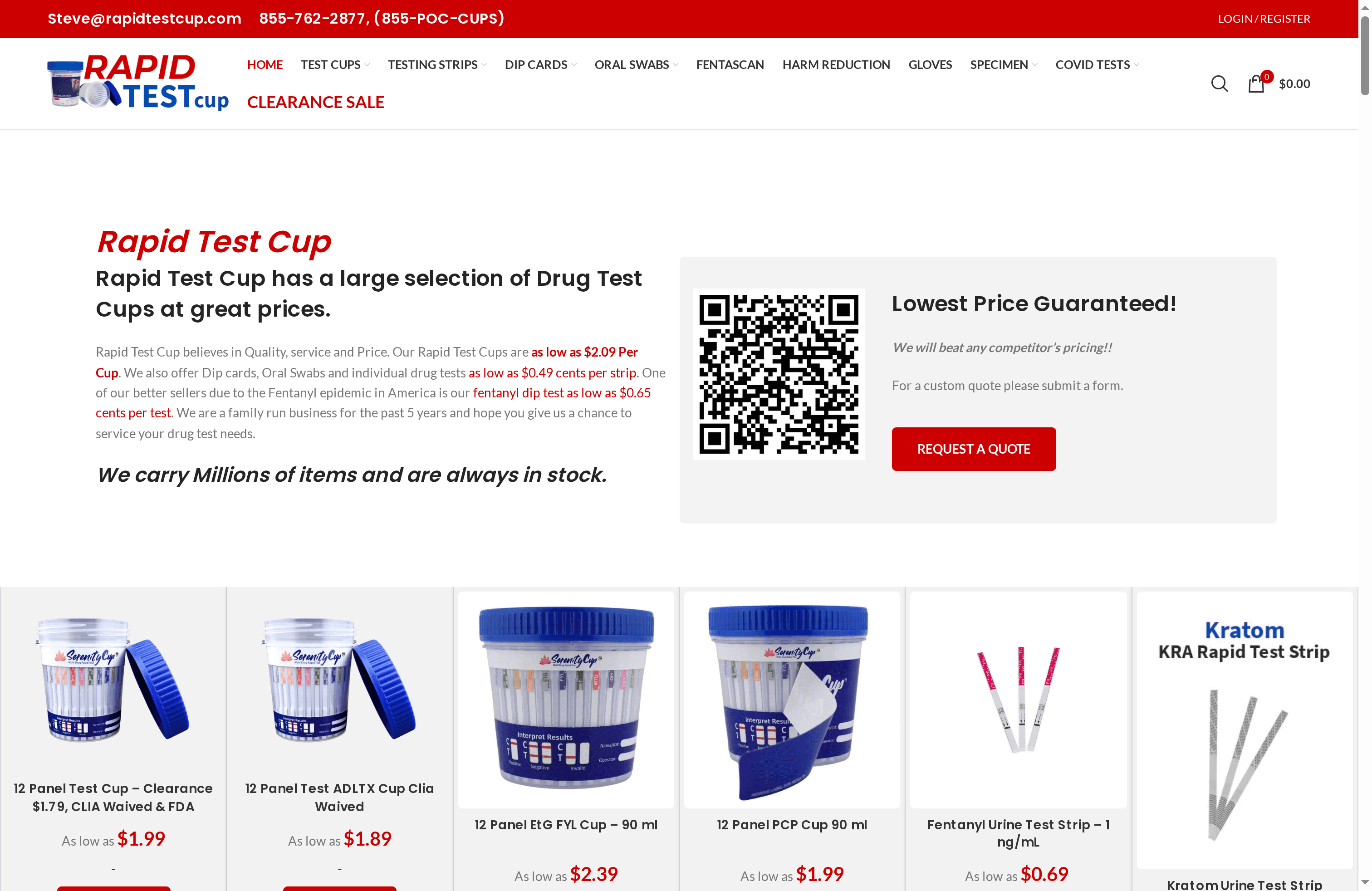
Discover how RapidTestCup.com can empower your laboratory with a comprehensive selection of on-site testing supplies including drug test cups, dip cards, and specimen collection kits tailored for professional and forensic use. Our products are designed to minimize false results and ease operator training, helping your lab maintain rigorous quality assurance while accelerating workflow efficiency. Explore our catalog today and take advantage of bulk discounts and fast shipping to stay ahead in your testing programs. Visit RapidTestCup.com now and secure the tools your lab needs for accurate, fast, and compliant on-site drug screening.
Frequently Asked Questions
What is on-site laboratory drug testing?
On-site laboratory drug testing involves the use of portable instruments and test kits that analyze biological specimens for drugs outside of traditional laboratory settings, providing results in minutes rather than hours or days.
How does on-site drug testing differ from laboratory testing?
On-site drug testing provides rapid presumptive results for preliminary screening, while laboratory testing offers comprehensive, sensitive, and specific analysis with confirmatory capabilities, essential for legal and clinical decisions.
What are the benefits of using on-site drug testing solutions?
The benefits include rapid results, minimal specimen requirements, portability, cost efficiency, ease of use, and immediate verification of specimen collection, significantly enhancing workflow and compliance in various applications.
What types of specimens are used in on-site drug testing?
Common specimen types for on-site drug testing include urine, saliva, and breath. Urine testing is predominant for workplace screenings, while oral fluid testing is gaining traction for roadside assessments. Breath testing is specifically used for alcohol detection.