

Blog
Adulteration test strips: ensure accurate drug testing


A negative drug test result feels conclusive. But if the sample was tampered with, that result is worthless. Adulteration, the deliberate manipulation of a urine specimen to mask or alter drug presence, is a real and persistent challenge in laboratory and healthcare drug testing. Adulterants can produce false negatives in drug tests, directly impacting compliance and patient safety. Adulteration test strips are the frontline tool that catches these attempts before they compromise your results, your program, and your regulatory standing.
Table of Contents
- Why adulteration matters in drug testing
- What are adulteration test strips?
- How adulteration test strips work
- Choosing the right adulteration test strips
- Integrating adulteration test strips for compliance and quality assurance
- Troubleshooting and interpreting adulteration test strip results
- Find effective adulteration detection solutions
- Frequently asked questions
Key Takeaways
| Point | Details |
|---|---|
| Adulteration undermines accuracy | Even small amounts of adulterants can cause misleading drug test results and increase compliance risks. |
| Test strips detect multiple adulterants | Quality adulteration strips screen for common markers like pH, oxidants, and nitrites to help safeguard results. |
| Workflow integration is critical | Adulteration detection works best when built into standard collection, analysis, and recordkeeping protocols. |
| Choose validated solutions | Using the right strip panels matched to your risk setting ensures reliable, defensible test outcomes. |
Why adulteration matters in drug testing
Adulteration means someone has intentionally introduced a foreign substance into a urine sample to interfere with the test outcome. Common adulterants include household bleach, oxidizing agents like nitrites, glutaraldehyde-based cleaners, and commercially sold “detox” tablets. Synthetic urine products are also widely available and specifically designed to defeat standard immunoassay panels.
The stakes in professional settings are significant. In healthcare, a missed positive can affect treatment decisions and patient safety. In workplace programs, it creates legal exposure. In forensic contexts, it can undermine court-admissible evidence. Drug test accuracy is not just a quality metric; it is a compliance requirement in most regulated industries.
Risks of missed adulteration include:
- Patient harm from incorrect clinical decisions based on falsified results
- Regulatory violations and loss of accreditation in CLIA-certified labs
- Legal liability when tampered results are used in employment or forensic proceedings
- Wasted resources retesting or investigating downstream discrepancies
- Erosion of program credibility with stakeholders and oversight bodies
Detecting adulterants in drug tests is not optional in high-stakes settings. It is a core quality control step that protects everyone involved.
What are adulteration test strips?
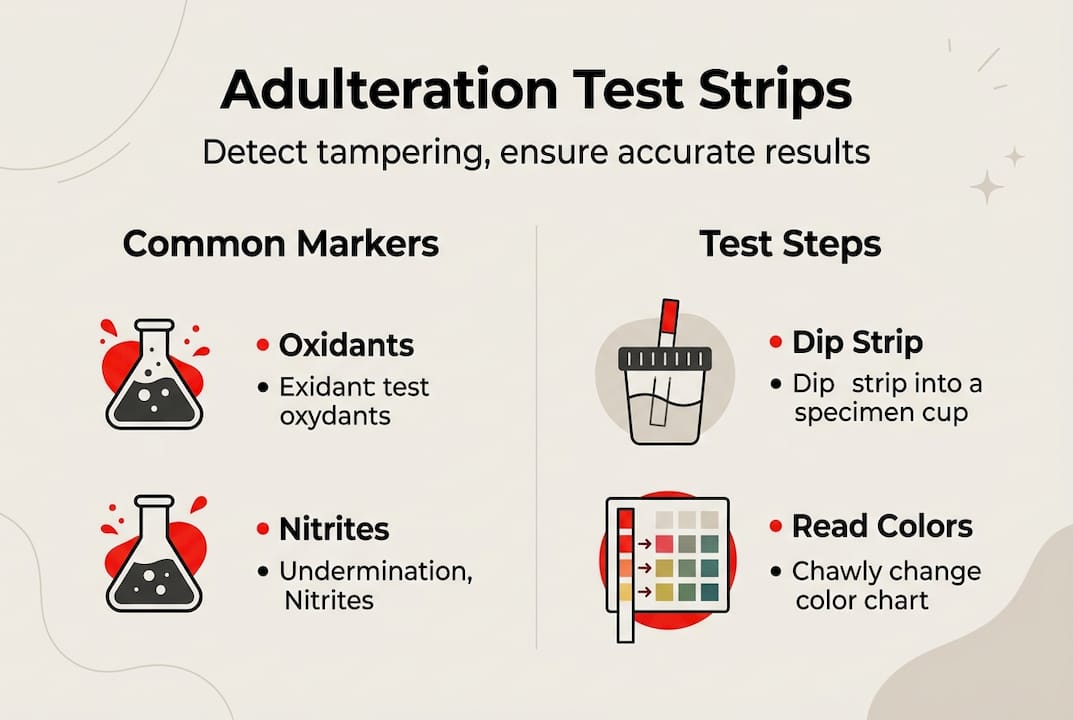
Adulteration test strips are single-use diagnostic strips designed to detect the presence of specific interfering substances in a urine specimen before or alongside the drug panel test. They work by reacting chemically with adulterant compounds and producing a visible color change that indicates whether the sample is valid.
These strips are used across healthcare clinics, occupational health programs, substance abuse treatment facilities, and forensic laboratories. Their appeal is practical: they deliver results in minutes, cost far less than confirmatory lab testing, and integrate easily into existing collection workflows. The types of urine test strips available today cover a wide range of adulterant markers, giving labs flexibility to match their testing population.
“Adulteration test strips quickly detect substances meant to mask or alter drug test results, making them an essential component of any validity-focused testing protocol.”
Pro Tip: Always verify that your adulteration test strips are compatible with the specific drug test cup or panel system you are using. Mismatched formats can create workflow gaps and documentation inconsistencies.
Speed and simplicity are real advantages here. A collector can run an adulteration check at the point of collection, flag a suspicious specimen immediately, and prevent a compromised sample from moving further into the testing chain.
How adulteration test strips work
Most adulteration test strips screen for several key validity markers simultaneously. Multiple markers including pH, specific gravity, oxidants, nitrites, glutaraldehyde, and creatinine are the standard parameters. Each marker targets a different category of tampering attempt.
Step-by-step use in sample processing:
- Collect the urine specimen in a standard collection cup at the point of donation.
- Check sample temperature immediately (valid range is 90°F to 100°F within 4 minutes of collection).
- Dip the adulteration test strip into the specimen for the time specified by the manufacturer, typically 30 to 60 seconds.
- Remove the strip and lay it flat on a non-absorbent surface.
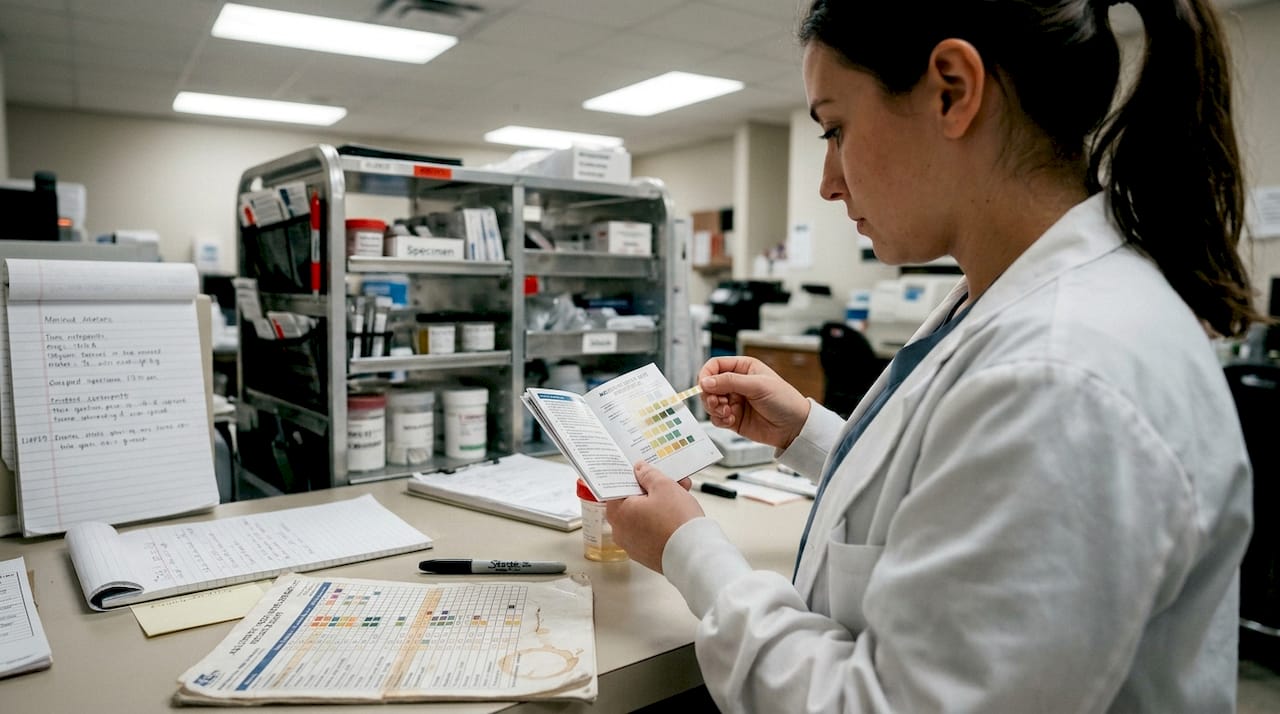
- Read the color reactions at the time interval specified, usually 2 minutes. Do not read results after the window closes.
- Compare each pad’s color to the reference chart provided with the strips.
- Document findings and proceed to the drug panel test only if the specimen passes validity checks.
Color interpretation is straightforward but requires attention. Each reagent pad on the strip corresponds to one marker. A color match within the normal range indicates a valid specimen. An out-of-range result signals possible adulteration and requires escalation per your protocol.
| Adulterant | Detection marker | What it indicates |
|---|---|---|
| Bleach / oxidizers | Oxidant pad | Oxidizing agent added to sample |
| Nitrite salts | Nitrite pad | Commercial adulterant product used |
| Glutaraldehyde | Glutaraldehyde pad | Preservative-based adulterant detected |
| Dilution with water | Specific gravity + creatinine | Specimen too dilute to be valid |
| pH-altering agents | pH pad | Acid or base added to alter chemistry |
| Synthetic urine | Creatinine + specific gravity | Abnormal biochemical profile |
For labs running expanded panels, a 15-panel drug test with adulterants integrates these validity checks directly into the cup format, streamlining the entire process. Ensuring test integrity at the collection stage is far more efficient than discovering problems after the fact.
Choosing the right adulteration test strips
Not all adulteration test strips cover the same markers. Selection depends on your testing population, regulatory requirements, and the adulterants most likely to appear in your setting. A substance abuse treatment program serving a high-risk population has different needs than a pre-employment screening clinic.
Different brands and panel configurations offer adulteration detection for a varying range of markers, so matching the strip to the setting is critical. An 18-panel drug test with adulterants covers a broader drug and validity range than a basic 5-panel, making it a stronger choice for programs with complex compliance needs. For the most demanding environments, a 22-panel drug test with adulterants extends detection to emerging substances and novel adulterants.
| Panel type | Drug markers | Adulterant markers | Best use case |
|---|---|---|---|
| Basic 5-panel + adulterants | 5 | 6 to 7 | Standard workplace screening |
| 15-panel + adulterants | 15 | 6 to 7 | Clinical and treatment programs |
| 18-panel + adulterants | 18 | 6 to 8 | Forensic and high-risk populations |
| 22-panel + adulterants | 22 | 6 to 8 | Comprehensive compliance programs |
Pro Tip: Match your strip’s adulterant marker range to the specific risks in your testing population. If your program sees frequent nitrite-based adulteration attempts, confirm your strips include a dedicated nitrite pad with a low detection threshold.
Common selection pitfalls to avoid:
- Choosing single-marker strips in settings where multiple adulterant types are likely
- Prioritizing cost per strip without accounting for the cost of a missed adulteration event
- Failing to verify that strips meet the sensitivity thresholds required by your accreditation body
- Not updating strip selection when new adulterant products enter the market
- Using strips past their expiration date, which degrades reagent reliability
Integrating adulteration test strips for compliance and quality assurance
Adding adulteration strips to your workflow is straightforward, but doing it consistently and correctly is what drives compliance value. Routine use of adulteration strips is a cornerstone of reliable drug test results in regulated industries, and auditors look for documented evidence of this practice.
Step-by-step integration guide:
- Update your standard operating procedures (SOPs) to include adulteration testing as a mandatory validity check for every specimen.
- Train all collection staff on proper strip use, timing, color interpretation, and documentation requirements.
- Establish a chain of custody form that includes a field for adulteration test results and collector signature.
- Define clear escalation protocols: what happens when a specimen fails a validity check, who is notified, and how the donor is informed.
- Conduct periodic internal audits of adulteration test documentation to identify gaps before external reviewers do.
- Review your strip selection annually against your forensic testing checklist and any updates to regulatory guidance.
Pro Tip: Archive adulteration test results alongside drug panel results in your laboratory information system. When an audit or legal challenge arises, having a complete validity record for every specimen is your strongest defense.
Adulteration documentation also matters in insurance and legal contexts. A court case involving a positive drug test is far more defensible when the record shows the specimen passed all validity checks at collection. Improving drug test reliability through documented adulteration screening closes the compliance gaps that create liability.
Troubleshooting and interpreting adulteration test strip results
Even well-trained staff encounter ambiguous results. Knowing how to respond correctly protects both the integrity of the result and the rights of the donor.
Common issues that affect strip performance:
- Using expired strips, which produce unreliable or faded color reactions
- Reading results outside the specified time window, leading to false positives or negatives
- Misreading color changes under poor lighting or without comparing to the reference chart
- Sample temperature deviations that suggest substitution but may also reflect collection delays
- Contamination of the strip from improper handling or contact with surfaces
When a result is ambiguous, do not guess. Retest with a fresh strip from a different lot if possible. If the second result is also unclear, treat the specimen as suspect and follow your escalation protocol. Interpreting adulteration results requires attention to strip expiration, environmental factors, and matching to reference charts, so keep those charts accessible at every collection station.
“Any specimen that produces an invalid or out-of-range adulteration result must be documented and handled according to your facility’s written policy. Failure to document is a compliance gap, regardless of the final outcome.”
For borderline pH or specific gravity readings, consider whether the donor’s hydration status could explain the result before escalating. However, when nitrite or oxidant pads show a positive reaction, that is not a physiological finding. It means a substance was added. Escalate immediately and document the drug test adulterant impact in the specimen record. Reducing interpretation errors starts with clear written protocols that remove guesswork from the equation.
Find effective adulteration detection solutions
If you are ready to strengthen your program’s validity testing, the right products make a measurable difference. We carry a full range of adulterant-inclusive test kits designed for professional and forensic use.
Start by reviewing our top urine drug test kits comparison to see how leading options stack up on adulterant marker coverage, panel breadth, and price per test. If you need a high-performance all-in-one solution, the 18 panel drug test cup includes built-in adulterant checks alongside an expanded drug panel. For programs still evaluating their options, our guide to selecting drug test kits walks through the key decision points so you can match the right product to your compliance requirements and testing volume.
Frequently asked questions
Which adulterants are most commonly detected by test strips?
Adulteration test strips commonly detect oxidants, nitrites, glutaraldehyde, pH-altering agents, and abnormal specific gravity, covering the most frequently used tampering methods.
Can adulteration test strips be used with all urine drug tests?
Most strips are compatible with standard urine collection, but always verify compatibility with your specific panel cup or testing system before deploying them in your workflow.
How should unexpected or ambiguous results be handled?
Retest with a fresh strip and follow your lab’s escalation policy. If results remain unclear, treat the specimen as suspect and document all findings per compliance standards.
Are adulteration checks required for compliance in every setting?
Requirements vary by industry and accreditation body, but routine adulteration checks are strongly recommended across all sensitive drug testing environments, including clinical, forensic, and workplace programs.
What should be recorded when an adulterant is detected?
Document the specific adulteration finding, the strip lot number, the collector’s name, any follow-up actions taken, and retain the record for potential audits or regulatory review.