Blog
Drug Specimen Collection Guide for Professionals


TL;DR:
- Proper drug specimen collection relies on strict regulatory compliance, trained collectors, and intact chain of custody. Urine remains the primary specimen type due to its wide detection window and high metabolite concentration. Accurate preparation, documentation, and careful handling are essential to prevent errors and ensure legal defensibility.
Drug specimen collection is the controlled process of obtaining biological samples from donors following strict protocols to produce legally and scientifically valid drug test results. Federal frameworks like DOT’s 49 CFR Part 40 govern every step, from collector conduct to chain of custody documentation. This drug specimen collection guide covers regulatory requirements, specimen types, preparation steps, and procedural standards for healthcare professionals, law enforcement personnel, and workplace drug testing coordinators. Specimen integrity is not optional. A single procedural lapse can invalidate results in court or a compliance audit.
What are the key regulations governing drug specimen collection?
Federal drug testing guidelines set the floor for every professional collection program. DOT’s 49 CFR Part 40 mandates face-to-face contact between the collector and donor, strict chain of custody documentation, and collection site security as legally required standards. These rules apply to all DOT-regulated industries, including transportation, aviation, and pipeline operations. Non-DOT workplace programs typically mirror these standards to maintain legal defensibility.
The Federal Drug Testing Custody and Control Form (CCF) is the primary documentation tool. Every specimen transfer, from collection through laboratory analysis, must be recorded on the CCF with signatures, timestamps, and collector credentials. Missing or incomplete CCF entries are among the most common reasons results are challenged in legal proceedings.
Collectors are the sole individuals with direct contact to donors during the collection process. Their role is not administrative. Their decisions determine whether a specimen is legally defensible or scientifically worthless. SAMHSA and DOT both require collectors to complete formal training before conducting any federally mandated collection.
Key collector responsibilities include:
- Verifying donor identity with government-issued photo ID
- Securing the collection site by removing potential adulterants such as cleaning agents and extra water sources
- Completing the CCF accurately and obtaining donor signature
- Checking specimen temperature immediately after collection
- Sealing specimen containers in the donor’s presence
Pro Tip: Keep a laminated copy of the CCF completion checklist at every collection station. Collectors who reference a physical checklist make fewer documentation errors than those who rely on memory alone.
Which specimen types are used in drug testing?
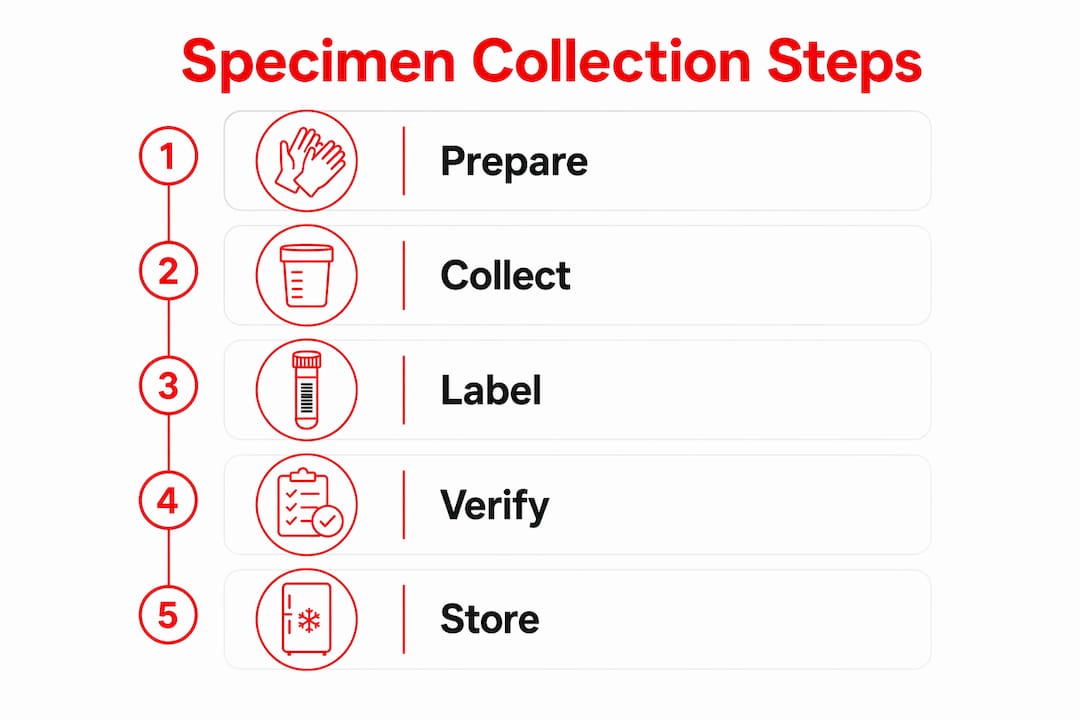
Urine remains the most utilized specimen for drug testing because it is noninvasive and produces higher metabolite concentrations than other specimen types. That concentration advantage makes urine the most sensitive matrix for detecting recent drug use. Detection windows for urine range from 2 hours up to several days, with chronic use detectable for weeks.
Blood collection provides the shortest detection window but offers quantification that urine cannot. Blood confirms active impairment rather than past exposure, which makes it the preferred matrix in post-accident investigations and forensic cases. The tradeoff is invasiveness and the need for trained phlebotomists.
Oral fluid collection is gaining ground in roadside law enforcement and workplace settings because it requires no restroom access and is harder to adulterate. Detection windows are shorter than urine, typically covering the past 24–48 hours, which aligns well with same-day impairment testing.
| Specimen type | Detection window | Key advantage | Primary limitation |
|---|---|---|---|
| Urine | 2 hours to several weeks | High metabolite concentration | Adulteration risk |
| Blood | Minutes to 12 hours | Quantifies active impairment | Invasive, short window |
| Oral fluid | Up to 24–48 hours | Observed collection, low tampering risk | Shorter detection window |
| Hair | Up to 90 days | Long history of use | Cannot detect recent use |
How to prepare for drug specimen collection to minimize errors
Preparation is where most collection failures begin. Laboratory rejections are often caused by pre-collection errors, not analytical failures in the lab. Clear donor instructions and a secured collection environment prevent the majority of these rejections before they happen.
Essential supplies checklist
Every collection site needs the following before a donor arrives:
- Specimen containers with temperature strips (90–100°F is the acceptable range for fresh urine)
- Tamper-evident seals and security tape
- Completed or pre-populated CCF forms
- Gloves and personal protective equipment for blood collection
- Bluing agent for toilet water to prevent specimen dilution
- Photo ID verification log
Environmental preparation
Effective collection site preparation requires securing the area and removing potential adulterants before the donor enters. This means turning off hot water access, adding bluing agent to toilet tanks, and removing any containers that could hold substitute specimens. A secured site preemptively eliminates the most common tampering methods.
Collector training and certification are non-negotiable. DOT-regulated programs require collectors to complete a qualification training program that includes mock collections and error correction exercises. Recertification is required when a collector makes a fatal flaw on a CCF or after a significant gap in collection activity.
Pro Tip: Brief every donor verbally before collection. Explain exactly what they should and should not do in the restroom. Donors who receive clear instructions produce fewer problematic specimens than those given only written handouts.
What are the step-by-step procedures for collecting urine, blood, and oral fluid?
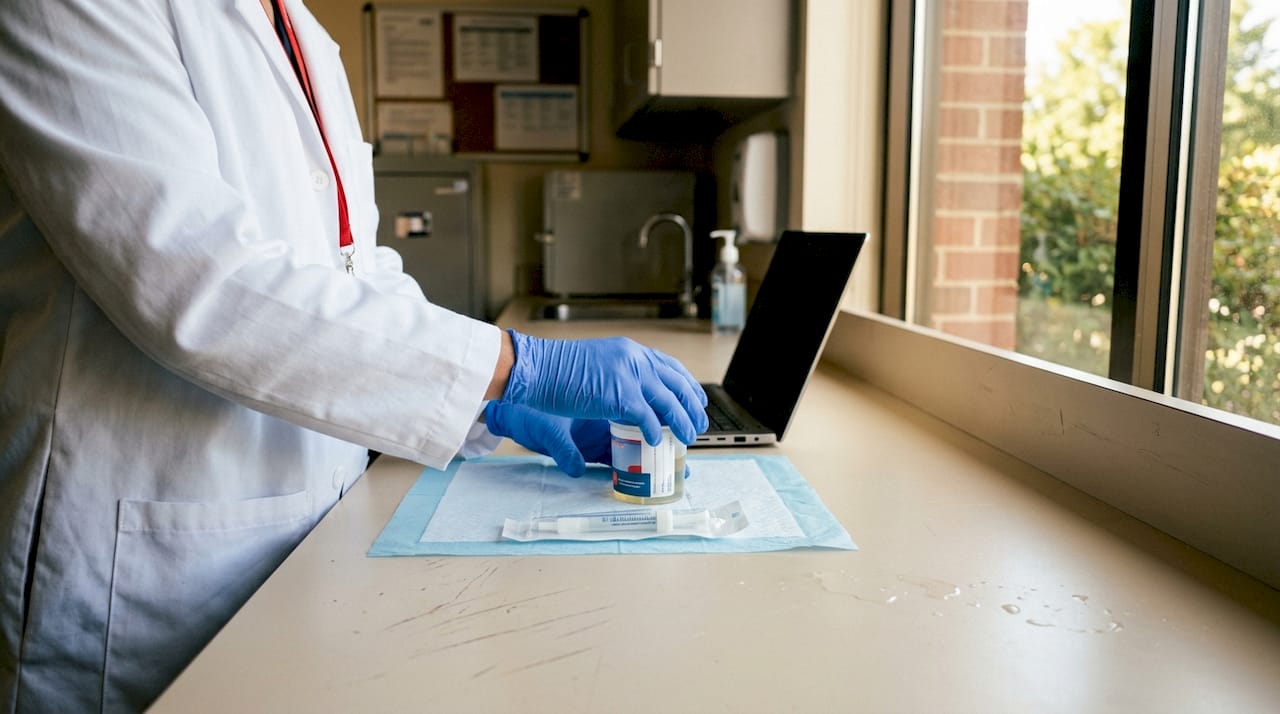
Urine collection procedure
Follow these steps for every urine collection:
- Verify donor identity with a current government-issued photo ID. Record the ID type and number on the CCF.
- Instruct the donor to remove outer garments and leave personal belongings outside the collection area.
- Provide a sealed specimen cup. For urine collection procedures, use containers with integrated temperature strips to confirm specimen validity immediately.
- Direct the donor to provide at least 30 mL of urine. Do not leave the collection area door unattended.
- Receive the specimen within 4 minutes of the donor exiting the restroom. Check temperature immediately. A reading outside 90–100°F requires a second collection under direct observation.
- In the donor’s presence, pour the specimen into the primary and split containers, apply tamper-evident seals, and have the donor initial the seals.
Blood collection procedure
Blood specimen handling requires a trained phlebotomist and strict venipuncture technique. Tourniquet time must stay under 1 minute to prevent hemolysis, which is one of the leading causes of specimen rejection. Collecting multiple sets totaling 40–60 mL optimizes specimen quality for forensic analysis.
Label each tube immediately after collection, before moving to the next draw. Mislabeled tubes are the most common identification error in blood collection. Place tubes in a biohazard bag with the completed requisition form before transport.
Oral fluid collection
Oral fluid collection uses a collection device placed under the tongue or along the cheek for a specified contact time, typically 2–5 minutes depending on the device manufacturer’s instructions. The collector must observe the entire collection to prevent substitution. Transfer the collected fluid to the transport vial immediately and seal it in the donor’s presence.
Common pitfalls to avoid across all specimen types:
- Leaving the donor unattended at any point during collection
- Accepting a specimen without checking temperature or seal integrity
- Failing to complete all CCF fields before the donor leaves the site
- Using expired or non-certified collection containers
How to maintain specimen integrity and complete the chain of custody
Specimen integrity verification begins the moment the donor hands over the container. Donors must not leave the site before the collector verifies temperature and seal integrity. If a problem is found after the donor has left, a legal re-collection cannot be ordered.
Proper labeling at every transfer point is the single most effective quality assurance measure. Identification errors from mislabeling cause specimen rejection and can delay or invalidate time-sensitive legal proceedings. Label every container with the donor’s full name, date and time of collection, and the collector’s credentials before the donor leaves the room.
Chain of custody documentation requirements:
- Record every individual who handles the specimen, with signature and timestamp
- Use tamper-evident packaging for all transfers between collection site and laboratory
- Retain a copy of the completed CCF at the collection site
- For split specimens, keep the secondary container sealed and stored under proper conditions until the laboratory requests it or the retention period expires
Storage conditions matter. Urine specimens held for more than 8 hours before transport must be refrigerated at 2–8°C. Blood specimens for forensic toxicology require refrigeration within 2 hours of collection. Oral fluid specimens follow the device manufacturer’s storage guidelines, which vary by collection system.
The chain of custody reporting workflow connects every handoff from collection to laboratory result. Any gap in that chain creates a legal vulnerability that opposing counsel will exploit. Treat every signature and timestamp as evidence, because in a legal proceeding, it is.
Key Takeaways
Proper drug specimen collection requires regulatory compliance, trained collectors, and unbroken chain of custody documentation from collection through laboratory submission.
| Point | Details |
|---|---|
| Regulatory compliance is mandatory | DOT 49 CFR Part 40 and SAMHSA guidelines set legally binding standards for every collection step. |
| Urine is the standard matrix | Urine offers the widest detection window and highest metabolite concentration for most drug classes. |
| Preanalytical errors drive rejections | Up to 70% of lab errors originate before analysis; checklists and training reduce these significantly. |
| Chain of custody is non-negotiable | Every specimen transfer must be documented with signatures and timestamps to maintain legal defensibility. |
| Temperature verification is immediate | Check specimen temperature within 4 minutes of collection; readings outside 90–100°F require re-collection. |
Why collectors are the last line of defense in drug testing
The part of drug testing that gets the least attention is the part that matters most. Analysts in a certified laboratory work with instruments that cost hundreds of thousands of dollars and follow validated methods. But none of that precision matters if the specimen arriving at the lab was collected incorrectly.
I have seen programs with excellent laboratory contracts and sophisticated reporting systems produce results that were thrown out because a collector skipped a step on the CCF or failed to check specimen temperature. The collector’s role as gatekeeper is not a metaphor. A collector who cuts corners hands every future legal challenge a ready-made argument.
The fix is not complicated. Standardized checklists, regular mock collections, and a culture where collectors feel comfortable flagging problems rather than hiding them produce far better outcomes than any technology upgrade. Preanalytical errors are the most common source of laboratory failures, and they are almost entirely preventable with training and discipline.
The collectors I have seen perform consistently well share one habit: they treat every collection as if it will be reviewed in court. That mindset changes how carefully they complete paperwork, how thoroughly they secure the collection site, and how precisely they communicate with donors. Build that standard into your program and your rejection rate will drop.
— Justin
Professional drug testing supplies for compliant collection
Reliable collection starts with the right equipment. Professionals who follow strict drug testing guidelines need supplies that match those standards.
Rapidtestcup carries a full range of certified collection supplies, including specimen cups with temperature strips that confirm specimen validity at the point of collection. For multi-panel screening, the 12 Panel ADLTX Cup delivers CLIA waived, FDA-cleared results in workplace and clinical settings. Rapidtestcup also stocks forensic-grade test cups with adulteration panels for programs that require tamper detection built into the collection device. Browse the full catalog of drug testing products for labs to find the right supplies for your collection program.
FAQ
What is chain of custody in drug testing?
Chain of custody is the documented record of every person who handles a specimen from collection through laboratory analysis. It uses signed CCF forms and tamper-evident seals to maintain legal defensibility.
What temperature should a urine specimen read at collection?
A freshly collected urine specimen must read between 90–100°F within 4 minutes of collection. A reading outside that range requires a second collection under direct observation.
How do urine and oral fluid detection windows compare?
Urine detects most drugs for 2 days to several weeks depending on frequency of use. Oral fluid typically covers the past 24–48 hours, making it better suited for same-day impairment testing.
What causes most drug test specimen rejections?
Laboratory rejections are most often caused by pre-collection errors such as incomplete CCF documentation, mislabeling, or improper temperature verification, not by analytical failures in the lab.
Who is required to complete collector training for DOT drug testing?
Any individual who collects specimens under DOT 49 CFR Part 40 must complete a formal qualification training program that includes mock collections and demonstrated proficiency before conducting regulated collections.