Blog
Read Fentanyl Test Cutoffs Correctly for Clinicians, Harm Reduction


Yes, fentanyl shows up on a urine drug test, but only when the right test is used at the right time. Immunoassay screens flag it within roughly 1 to 3 days of exposure, using a cutoff typically near 1.0 ng/mL. Any presumptive positive needs confirmatory testing by LC-MS/MS before anyone treats it as certain.
TL;DR:
- Immunoassay screens can detect fentanyl within one to three days of exposure but may yield false positives due to cross-reactivity with medications like labetalol, trazodone, or haloperidol.
- Confirmatory testing with LC-MS/MS is essential for verifying positive results, as it physically separates molecules and reduces false positives from antibody-based screens.
- Detection windows vary based on dose, administration route, metabolism, and urine concentration, especially in heavy or chronic use, which can extend detectability beyond three days.
- Test cutoff levels differ by type: around 1.0 ng/mL for screening and as low as 0.2 ng/mL for confirmatory LC-MS/MS, affecting the interpretation of borderline results.
- Proper specimen handling, including checks for dilution and adulteration, is critical to avoid misleading results that could impact medical or legal decisions.
Table of Contents
- Which Tests Actually Detect Fentanyl?
- How Long Does Fentanyl Stay Detectable in Urine?
- What Do Cutoff Levels Actually Mean?
- Why Do False Positives Happen?
- What Should Happen After a Positive Screen?
- How Do You Use Fentanyl Test Strips Safely?
- What Do Real Results Actually Look Like?
- Why Certified Testing and Documented Cutoffs Matter
- What I’d Prioritize Before Trusting a Result
- Getting the Right Fentanyl Test for Your Situation
- Sources
Which Tests Actually Detect Fentanyl?
Three distinct technologies handle fentanyl detection, and they are not interchangeable. Confusing them is where most misunderstandings about “the test was wrong” actually start.
Immunoassay screening is the workhorse of clinics, treatment programs, and point-of-care settings. It works by using antibodies that bind to fentanyl molecules in urine, triggering a color change or signal when concentration crosses a set threshold. It’s fast, cheap, and CLIA waived in many formats, which is why it’s the front line for employers and clinicians. But antibodies aren’t perfect matchmakers. They sometimes bind to molecules that resemble fentanyl closely enough to trigger a false signal, which is the tradeoff for speed.
Lateral-flow test strips and cassettes use the same antibody principle in a simpler, single-use format. Harm-reduction programs favor these because they require no lab equipment. A person dips the strip into a diluted drug residue sample or a urine sample, waits a set number of minutes, and reads the result lines the way you’d read an at-home pregnancy test.
LC-MS/MS confirmatory testing is the gold standard, and for good reason. Liquid chromatography-tandem mass spectrometry doesn’t guess based on antibody shape. It physically separates and identifies molecules by mass, distinguishing fentanyl and its metabolite norfentanyl from every look-alike compound. This is the method labs use when a screening result needs to hold up in a clinical or legal setting.
Where each one fits:
- Immunoassay screens: fast, inexpensive, used for initial triage in clinics and workplace programs.
- Test strips/cassettes: portable, no equipment needed, common in harm-reduction and personal-use settings.
- LC-MS/MS: definitive identification and quantification, used to confirm any presumptive positive.
How Long Does Fentanyl Stay Detectable in Urine?
Most people testing for fentanyl want one number, and the honest answer is a range: roughly 1 to 3 days after the last exposure, per drug reference data from Mayo Clinic Laboratories. Fentanyl itself clears the bloodstream fast, but its metabolite, norfentanyl, lingers longer in urine and is often what confirmatory testing is actually measuring.
Several variables stretch or shrink that window, and they interact with each other more than most people expect:
- Dose and potency: a larger or more potent exposure produces more metabolite to clear, extending detectability.
- Route of administration: injected or transdermal fentanyl behaves differently in the body than smoked or snorted fentanyl.
- Frequency of use: someone using daily builds up norfentanyl faster than they eliminate it, which can push detection well past the single-use window.
- Individual metabolism: liver function, body composition, and hydration all change how quickly fentanyl and norfentanyl clear.
- Urine concentration: a dilute sample, whether from high fluid intake or deliberate tampering, can push a borderline result below the cutoff.
Chronic, heavy use is the scenario where the “1 to 3 days” rule breaks down. Fentanyl accumulates differently in someone using multiple times a day for weeks than in someone with a single incidental exposure, and lab reference ranges assume the latter, not the former.
What Do Cutoff Levels Actually Mean?
A drug test doesn’t report “fentanyl: yes” or “fentanyl: no.” It reports whether the measured concentration crossed a specific line, and that line varies by test.
By the numbers: FDA-cleared immunoassay screens commonly use a cutoff near 1.0 ng/mL, while confirmatory LC-MS/MS testing can detect fentanyl at concentrations as low as 0.2 ng/mL, with norfentanyl confirmed above 1.0 ng/mL.
That gap between screening and confirmatory sensitivity matters more than it seems. A urine sample sitting right at the immunoassay cutoff, say 0.9 to 1.1 ng/mL, is exactly the zone where a screen can flip between positive and negative on a rerun. LC-MS/MS resolves that ambiguity because it measures the actual concentration rather than a threshold crossing.
Labs also adjust cutoffs deliberately, not arbitrarily. A clinical evaluation of a fentanyl immunoassay found that raising the screening cutoff at the local level meaningfully cut false-positive rates in specific patient populations, particularly where certain medications were common. A hospital treating a lot of patients on labetalol, for instance, might set a higher cutoff than a standalone workplace testing program would use. Neither cutoff is “wrong.” They’re calibrated for different populations and different tolerances for false positives versus missed detections.
Why Do False Positives Happen?
A presumptive positive is not proof of fentanyl use, and treating it that way is the single most common mistake in interpreting these results. Immunoassays work by molecular shape recognition, and several legitimate medications happen to share enough structural similarity with fentanyl to trigger a false signal.
Medications reported as interferents in some immunoassay formats include:
- Labetalol, a common blood pressure medication.
- Trazodone, widely prescribed for sleep and depression.
- Haloperidol, an antipsychotic used in psychiatric and emergency settings.
Beyond medication cross-reactivity, specimen issues cause their own share of misleading results. Diluted urine, whether from excessive water intake or intentional tampering, can suppress a true positive below the cutoff. Adulterants introduced into the sample can do the same, or trigger unrelated flags on an adulteration panel. This is why specimen integrity checks, things like creatinine levels and pH, matter as much as the drug screen itself. A urine sample that fails integrity checks should trigger re-collection or lab confirmation before anyone acts on the result.
Pro Tip: If you or a patient is taking labetalol, trazodone, or haloperidol, flag that medication list before the test, not after a positive result comes back. It saves a confirmatory testing cycle and a lot of unnecessary stress.
What Should Happen After a Positive Screen?
A positive immunoassay screen is a starting point for an investigation, not an endpoint. Here’s the sequence that should follow:
- Request LC-MS/MS confirmation with norfentanyl quantification. This distinguishes true fentanyl exposure from cross-reactivity and gives an actual concentration rather than a threshold flag.
- Review chain-of-custody documentation if the result carries employment or legal weight. Any sample used for disciplinary action, legal proceedings, or forensic purposes needs a documented, unbroken custody trail from collection to lab report, processed through a certified laboratory.
- Cross-reference medication history and testing timing with a clinician. A patient legitimately prescribed fentanyl for pain management will test positive, and the relevant clinical question is whether the level and timing match the prescribed regimen, not whether fentanyl is present at all.
Clinicians interpreting these results in an addiction treatment or pain management context read the number in light of the patient’s actual prescription, dose, and last-dose timing, not in isolation. A quant result that lines up with the last prescribed dose tells a very different story than one that doesn’t.
How Do You Use Fentanyl Test Strips Safely?
Fentanyl test strips serve a different purpose than clinical urinalysis. Harm-reduction programs use them to check drug supply before use, not to screen a person’s body. The mechanics are simple, but the details matter.
A typical process, drawn from harm-reduction program guidance, looks like this:
- Dissolve a small amount of the substance in water, following the specific dilution ratio recommended for that substance (pills, powder, and residue each need different prep).
- Dip the strip in the diluted solution for the specified number of seconds, no longer.
- Lay the strip flat and wait the full read time, typically a couple of minutes, before interpreting results.
- Read the lines exactly as instructed: one line means positive for fentanyl, two lines mean negative.
Strips are generally reliable for fentanyl itself but have known blind spots with certain novel analogs, and a negative reading is never a guarantee of safety. The CDC and harm-reduction organizations are consistent on this point: carry naloxone, never use alone, and treat a negative strip result as one data point, not a clearance.
Pro Tip: Strips validated for urine screening and strips meant for drug-sample checking are built for different jobs. Don’t assume one product does both reliably; check the labeling for its intended sample type.
What Do Real Results Actually Look Like?
Numbers on a lab report only mean something in context. Three scenarios cover most of what people actually run into.
- A urine screen comes back at 1.1 ng/mL, just above the immunoassay cutoff. This sits close enough to the threshold that it warrants LC-MS/MS confirmation and a medication review before any conclusion gets drawn. A borderline screen is exactly the case labs built confirmatory testing for.
- LC-MS/MS reports fentanyl at 4.5 ng/mL with norfentanyl well above 1.0 ng/mL. A quantified result that far above both cutoffs is a strong indicator of recent, actual use, not cross-reactivity or dilution artifact.
- A point-of-care strip flags positive, but LC-MS/MS comes back negative. This is the classic false-positive pattern, usually traced to a cross-reactive medication or a specimen handling issue rather than an error in the confirmatory method itself.
The pattern across all three: the further a result sits from the cutoff in either direction, the more confidently you can interpret it. The closer it sits to that line, the more the confirmatory step matters.
Why Certified Testing and Documented Cutoffs Matter
Not every fentanyl test is built for the same job, and picking the wrong one for your setting is where accuracy problems start. CLIA-waived point-of-care tests are designed for on-site screening in clinics, treatment programs, and workplace settings, where speed and simplicity matter and a presumptive result gets confirmed later if needed. Lab-only testing, run through certified toxicology labs, is what you reach for when a legal, employment, or clinical decision depends on an exact concentration.
Rapidtestcup’s catalog reflects that split deliberately. A 1 ng/mL CLIA-waived fentanyl strip matches the sensitivity of most FDA-cleared clinical screens, while a 20 ng/mL strip offers a more economical option where extreme sensitivity isn’t the priority. Analyzer-based readers add a layer of objectivity beyond visual line interpretation, reducing the subjective judgment calls that come with reading a strip by eye.
Documentation matters as much as the device itself. A cutoff concentration printed on the package insert, not just a marketing claim, is what lets a clinician or employer defend a result if it’s ever questioned.
What I’d Prioritize Before Trusting a Result
Choose a test with its cutoff printed on the box, not buried in a spec sheet you have to hunt for. If a product doesn’t disclose whether it’s FDA cleared or CLIA waived, that’s a signal to look elsewhere, not a detail to overlook.
Order confirmatory LC-MS/MS the moment a result matters for employment, legal, or treatment decisions, and insist on documented chain of custody the second a sample leaves your hands for one of those purposes. Skipping that step to save a few days is how disputed results turn into drawn-out disputes.
Specimen integrity gets ignored more than any other variable in this process. A dilute or adulterated sample can quietly undermine an otherwise accurate test, and checking creatinine and pH takes minutes. Treat that check as mandatory, not optional, on anything that carries real consequences.
— Justin
Getting the Right Fentanyl Test for Your Situation
Rapidtestcup exists so you don’t have to guess between a strip that’s too insensitive and a lab process that takes days you don’t have. If you need sensitive point-of-care screening that matches clinical-grade cutoffs, the 1 ng/mL CLIA-waived fentanyl strip is built for exactly that job.
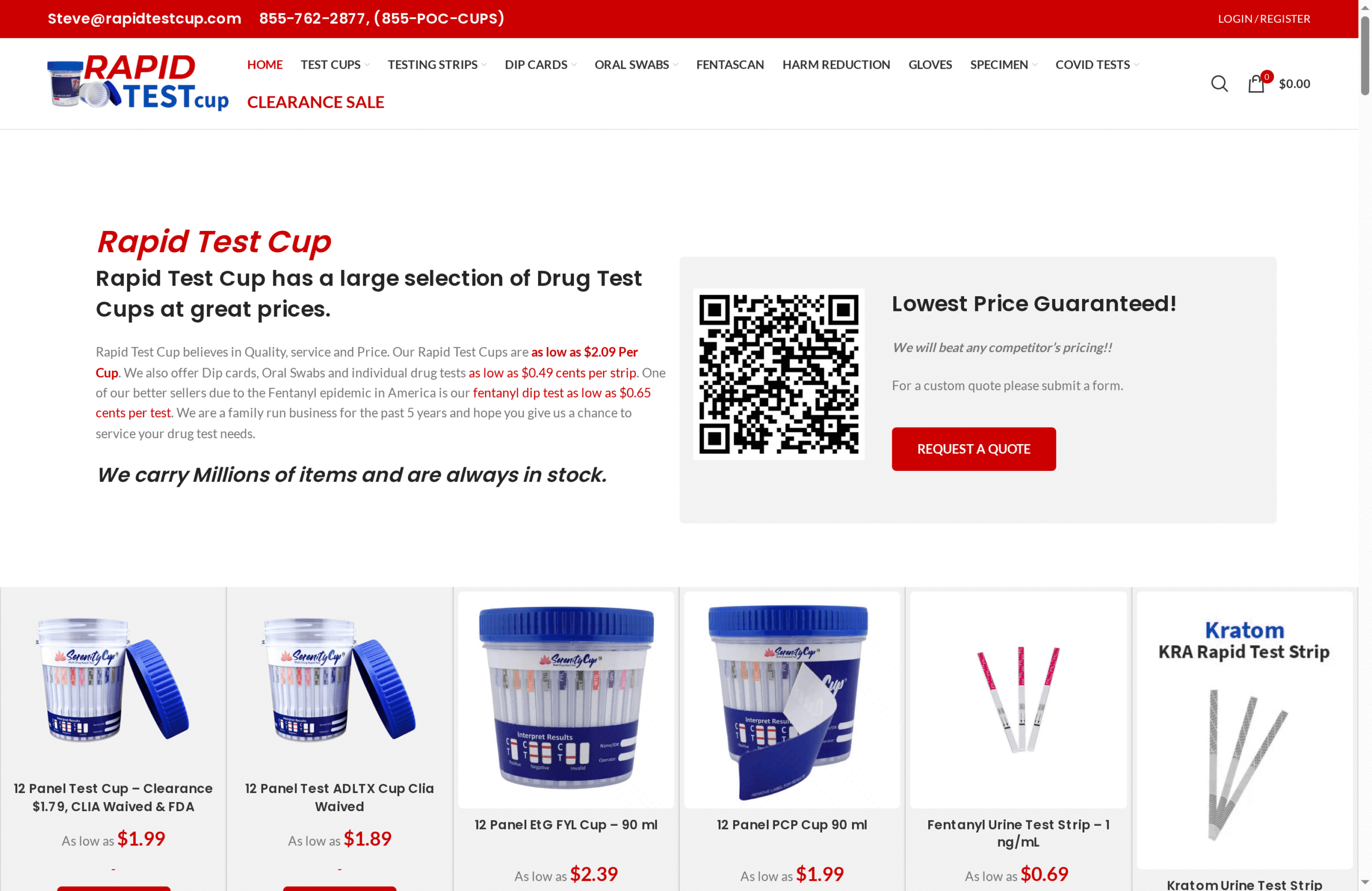
For organizations running broader panels, the 12 Panel Drug Test Cup bundles fentanyl detection with a full screening panel in a single collection step, cutting down on both cost and handling time versus running separate tests. Programs that also need to catch tampered samples should look at adulteration testing options alongside their panel choice. Bulk pricing and custom quotes are available for labs, clinics, and treatment programs ordering at volume. Browse the fentanyl and multi-panel product lines and place an order today to get testing supplies matched to your actual screening needs.
Sources
For deeper technical detail, consult the Mayo Clinic Laboratories fentanyl test catalog, CDC overdose prevention guidance, UT Dallas sensor research, and the clinical immunoassay evaluation on ScienceDirect.
This article is general information, not a substitute for advice from a qualified doctor. Consult a qualified healthcare professional about your own circumstances before acting on anything here.
- FENTU – Overview: Fentanyl with Metabolite Confirmation, Random, Urine (Mayo Clinic Laboratories)
- Fentanyl (Mayo Clinic Laboratories drug book)
- Clinical evaluation of SEFRIA fentanyl immunoassay (ScienceDirect)