

Blog
Biohazard Bag Requirements: Color, Labels, Fill and Disposal


A biohazard bag used for solid, non-sharp waste in the United States should be red, carry the universal biohazard symbol and the word “BIOHAZARD,” and meet the two ASTM strength tests. It must not be overfilled, it has to be closed so nothing can leak or protrude, and it goes into a labeled rigid container before it leaves the room. No single federal rule spells out all of this, so your state’s medical waste program sets the details. This guide walks through each requirement in the order you meet it on the job.
TL;DR
- Red bag, biohazard symbol, the word “BIOHAZARD,” and both ASTM tests passed: that is the standard for solid non-sharps waste. Clear, orange or pink bags are common inspection findings.
- Sharps never go in a bag. Hazardous chemicals, radioactive waste and ordinary trash stay out too, because once mixed they cannot be separated.
- Do not overfill. Close the bag at the point of generation, and put a damaged or punctured bag inside a second one.
- Filled bags go into closed, rigid, leak-resistant, labeled containers. Storage time limits are set by the state (one university in California ships within 7 days).
- Federal agencies point you to state and local rules, so check your state agency before you buy bags in bulk.
Table of Contents
- Who sets the rules: federal baseline, state detail
- What the bag itself must be
- What goes in the bag, and what never does
- Fill level, closing and handling
- Storage, containers and pickup
- Does this apply to personal testing and clinical waste alike?
- Our perspective
- Stock the testing side with one supplier
- A short setup checklist
- FAQ
- Sources
Who sets the rules: federal baseline, state detail
The first surprise for most buyers is that there is no single national biohazard bag code. The CDC notes that OSHA dictates the initial measures for discarding regulated medical waste, and that federal and state regulations address safe transport and storage (CDC regulated medical waste guidance). NIOSH goes a step further: it states that no federal regulations cover medical waste disposal as such, that some states such as New Jersey have adopted their own, and that you should consult the agency or agencies in your state to learn what is enforced (NIOSH safety checklist).
In practice that means three layers:
- OSHA governs how employees handle and label regulated waste at work.
- DOT governs how packaged waste travels. Bulk packaging that contains regulated medical waste must be marked “BIOHAZARD,” as set out in 49 CFR § 172.323.
- Your state and sometimes your county set the bag specification, fill limits, storage time and who may haul the waste.
The CDC also advises that any facility generating regulated medical waste should have a written management plan that covers federal, state and local regulations. If you run a clinic, lab or collection site, that plan is where your bag choices belong. Our laboratory compliance guide shows how that plan fits into the rest of a lab’s paperwork.
What the bag itself must be
Color and marking
For solid, non-sharps waste, university environmental health programs describe the same standard: the bag is red, it bears the universal biohazard symbol and the word “BIOHAZARD,” and it meets both ASTM tests (Stanford lab medical waste guidance). That guidance is written for California, but the color and marking convention is widely followed elsewhere.
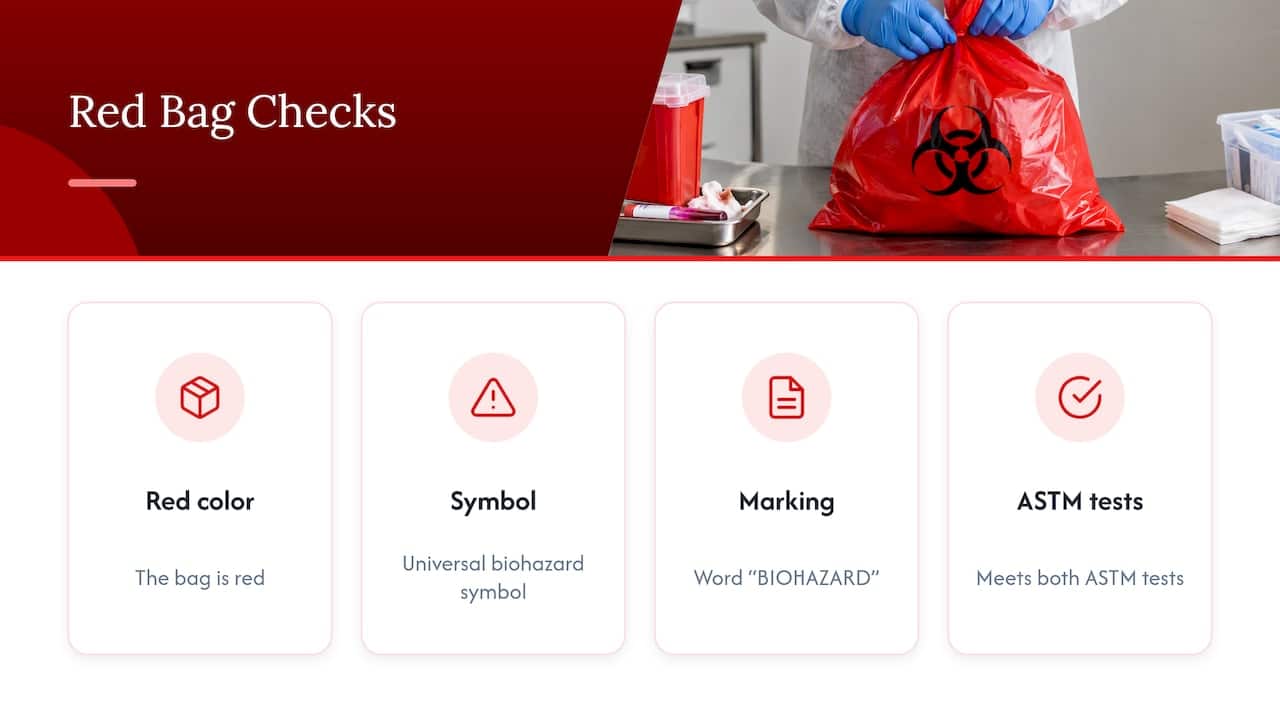
The color matters because inspectors look for it first. Stanford’s list of common inspection findings includes the wrong bag color, such as orange, pink or clear bags, which do not meet the red-bag standard (common inspection findings). A clear autoclave bag is fine for its own purpose, but it is not a substitute for a red biohazard bag in a state that requires red.
Strength and thickness
The “both ASTM tests” language refers to tear and impact resistance testing of the plastic film. A bag that passes carries a printed certification statement on the bag or on the box. When you compare bags, look for that statement rather than relying on a thickness number alone. Thickness in mils is a useful hint, but the test result is what an inspector or hauler will ask about. Match the bag size to the container it will sit in, and choose a size you can fill to the line instead of stuffing.
Labels on containers
The bag is one piece. The container it sits in carries the label too. Stanford requires biohazardous waste bags to go into closed, rigid, puncture-resistant, leak-resistant containers labeled with the biohazard symbol and “BIOHAZARD.” Some institutions add their own identification. UC San Diego, for example, requires labeling with the building name and room number where the waste was generated (UCSD biohazardous containers and bags). That is an institutional rule, not a national one, but it shows the kind of traceability waste haulers and auditors increasingly expect.
What goes in the bag, and what never does
Dartmouth’s environmental health office lists the typical contents: cultures, anatomical or pathological waste, human clinical specimens and contaminated personal protective equipment (Dartmouth biohazardous waste guide). For a drug testing site, that translates to items such as gloves, wipes and packaging that touched a specimen, depending on how your state defines regulated waste.
Three categories stay out of the bag:
- Non-hazardous trash. Paper towels, food wrappers and clean packaging go in regular waste. Putting them in a red bag does not make anything safer. It just raises your cost, because the whole bag is treated as regulated waste.
- Radioactive waste and hazardous chemicals. The same Dartmouth guide says these must never be placed in biohazard bags, since once combined they cannot be separated.
- Sharps. Needles, lancets and broken glass belong in a puncture-resistant sharps container, not in a bag. One industry guide that ranks for this topic says the same thing in plain terms: only non-sharp biohazard waste goes in red bags.
Dartmouth’s point about mixed waste is worth repeating to staff. A single clean item dropped in a red bag turns into regulated waste, and that is the most common reason a small site’s disposal bill creeps up.
What the CDC says about the term itself
You will see “infectious waste,” “biohazardous waste,” “biomedical waste” and “regulated medical waste” used loosely. The CDC prefers “regulated medical waste,” because the term stresses that regulation defines the material, and because evidence of this waste’s infectivity is limited. State agencies use different terms, so check the exact wording your state uses when you look up its definition.
Fill level, closing and handling
Do not overfill
Virginia’s regulation is a clear example. Waste packages must not be overfilled, and as a bag or container becomes full at the point of generation, and before it is moved, it must be closed, capped or sealed so the contents cannot leak, spill or protrude during handling, storage or transport (9VAC20-121-110). Other states set their own wording, and many guides suggest stopping at about three quarters full so the bag can be closed properly. Treat that as good practice unless your state gives a number.
Closing the bag
The CDC says all bags should be securely closed for disposal. Tie the neck in a gooseneck knot or use a closure approved by your hauler. Stapling is a common mistake, because staples puncture the bag and can injure the next person who handles it. One disposal primer that ranks for this keyword recommends sealing tightly and not stapling, which agrees with the standard practice.
When a bag is damaged
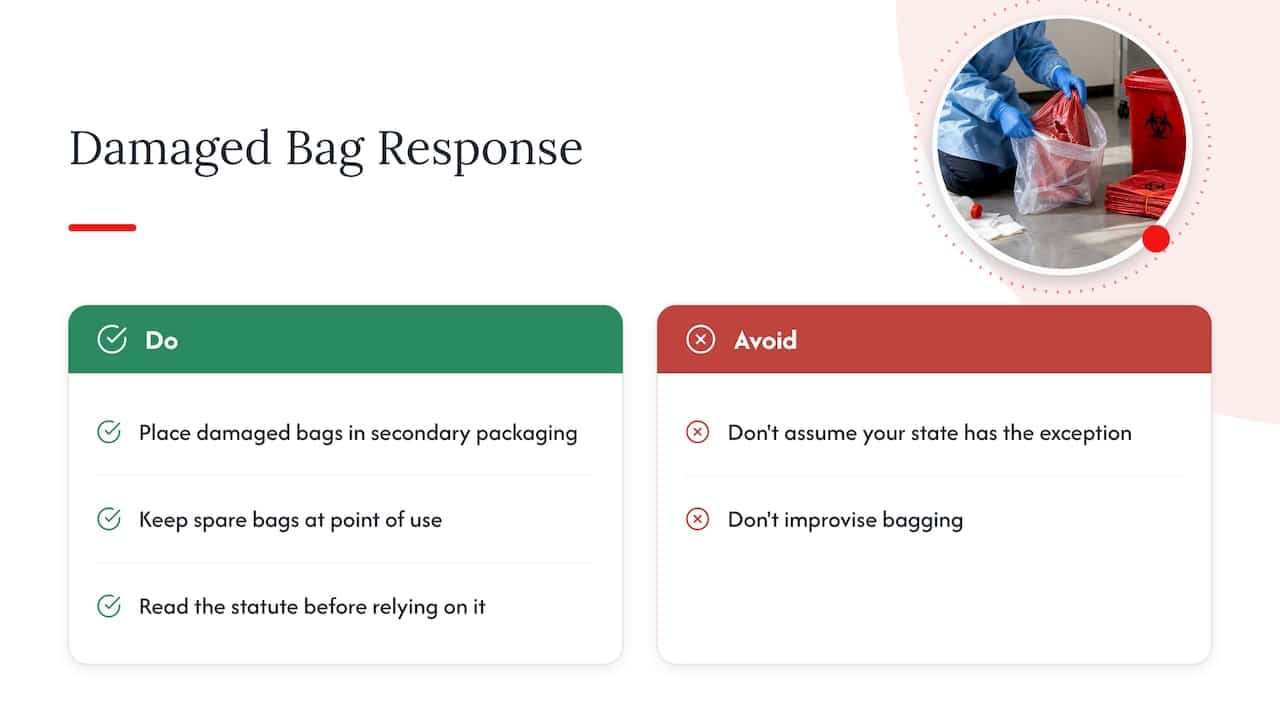
If a bag is contaminated on the outside or punctured, the CDC says to place it in a second biohazard bag. Virginia’s rule says the same for damaged, spilled or externally contaminated packaging: it goes into secondary packaging. Keep spare bags at the point of use so staff never have to improvise.
California has a narrow exception. Under Health and Safety Code section 118280, bags may travel from the point of generation to a storage area without an immediate secondary container, but only under limited, controlled procedures (California HSC 118280). Read the statute before you rely on it, and do not assume your state has a similar exception.
Storage, containers and pickup
A full, closed bag is not the end of the process. Stanford’s guidance describes the next steps, and the general pattern is common:
- Place the bag in a closed, rigid, puncture-resistant, leak-resistant container labeled with the biohazard symbol and “BIOHAZARD.”
- Keep the container in the room where the waste was generated, or move it straight to a secure, designated accumulation area.
- Ship red-bag medical waste off site within 7 days, or within 30 days if it is stored below 32°F.
Those time limits come from Stanford’s California-based guidance. Other states set different limits, so do not copy the numbers without checking your state agency. Reusable rigid containers have their own rule in California: they must be decontaminated by methods the local enforcement agency approves each time they are emptied, unless a disposable liner protects them (same California statute above).
A practical setup for a small collection site looks like this:
| Item | What to look for |
|---|---|
| Bag | Red, biohazard symbol, “BIOHAZARD,” printed ASTM certification |
| Container | Rigid, lidded, leak-resistant, labeled |
| Placement | At the point of use, away from the clean specimen area |
| Spare bags | Within reach, for double-bagging a damaged bag |
| Pickup | Licensed hauler arranged ahead of your state’s storage limit |
| Records | Written plan and pickup paperwork, kept where you can find them |
For the full disposal workflow after a screening, see our guide to disposing of used drug tests, and for how the specimen is handled before it reaches the bin, our collection site procedures and sample handling guide.
Does this apply to personal testing and clinical waste alike?
Not identically. The requirements above come from rules aimed at facilities that generate regulated medical waste: labs, clinics, research buildings and employers with collection sites. A person who runs a single home test is not running a waste program, and we have not found a federal biohazard bag requirement written for that situation. What counts as regulated waste for a household varies by state and by local waste authority, so ask your county or city waste office how to dispose of a used test. Businesses, treatment programs and clinics should assume the facility rules apply and build them into their written plan.
One point holds for everyone: a used drug test cup or dip card is not sharps, and it should never be mixed with sharps or chemicals.
Our perspective
We sell drug testing supplies to labs, clinics, treatment programs, employers and individuals, so we hear the same disposal question after almost every first order: what do I do with the cups afterward?
Our view is simple. Compliance should be planned before the first test is run, not after the first inspection. A site that buys test cups, dip cards and specimen cups from one supplier, with a bag, a lidded container and a pickup arrangement already in place, rarely has trouble. The mistakes we see are small ones: a clear bag where the state wants red, a stapled neck, a bag stuffed past its limit, regular trash mixed in.
We keep a large inventory in stock and ship same day because a collection site that runs out of supplies tends to improvise, and improvising is where waste rules get broken. Our guidance is to match your supplies to your written plan, and match the plan to your state’s rules.
Justin
Stock the testing side with one supplier
If you run a clinic, treatment program, workplace collection site or lab, you can order the testing supplies that generate this waste in one place. Our shop carries multi-panel test cups, dip cards, urine test strips, oral swabs and urine specimen cups, with bulk pricing and custom quotes for larger orders.
Buying in volume helps you plan the disposal side as well. Know how many specimens you expect in a month, and you can size your bags, containers and pickup schedule to match. For a broader checklist, see our laboratory drug testing checklist and the evidence handling workflow.
A short setup checklist
Before your first test day, confirm each of these:
- You have read your state’s medical waste rule, or called the agency that enforces it, and noted its definition of regulated waste.
- Your bags are red, marked, and certified to the ASTM tests, and you have extras for double-bagging.
- Your containers are rigid, closed, leak-resistant and labeled, and your staff know what stays out of them.
- A written management plan names who closes bags, who moves them, where they are stored and who collects them.
- Your pickup schedule stays inside your state’s storage limit.
- Staff know that sharps go in sharps containers and that clean trash goes in the regular bin.
Walk new staff through the checklist once, then post it by the bin. Most disposal problems come from a missing habit, not a missing rule.
FAQ
Do biohazard bags have to be red?
For solid, non-sharps waste, red is the standard described by university environmental health programs, and inspectors flag orange, pink or clear bags as findings. Some states and facilities allow other arrangements, so confirm with your state agency. When in doubt, buy red.
Can I put sharps in a biohazard bag?
No. Sharps go in a puncture-resistant sharps container. Red bags are for non-sharp regulated waste, and a sharp can tear the bag and injure whoever handles it next.
How full can I fill a biohazard bag?
Do not overfill it. Virginia’s rule requires closing a bag before it is moved and before the contents can leak, spill or protrude, and many guides suggest about 75 percent full. Your state may set its own limit, so check it.
How long can I store filled biohazard bags?
It depends on your state. Stanford’s California guidance calls for off-site shipment within 7 days, or 30 days if stored below 32°F. Ask your state agency or licensed hauler for the limit that applies to you.
Sources
- CDC: Regulated Medical Waste
- NIOSH: Regulated Medical Waste Safety Checklist
- 49 CFR § 172.323
- Stanford: Lab Medical Waste Guidance
- Stanford: Common Medical Waste Inspection Findings
- UC San Diego: Biohazardous Containers and Bags
- Dartmouth: Biohazardous Waste Disposal Guide
- Virginia 9VAC20-121-110
- California Health and Safety Code, Medical Waste Management Act