Blog
Are Fentanyl Test Strips Legal? A State-by-State Guide


Yes, in almost all of the country. Fentanyl test strips are not illegal under federal law, and as of August 2025 at least one type of drug-checking equipment was outside criminal paraphernalia penalties in 47 states, the District of Columbia and four U.S. territories. The gaps are a few states whose paraphernalia laws still reach testing equipment, and some states that protect only certain people or certain kinds of strips. Below: what the law says, where the risk remains, and how to check your own state.
TL;DR
- No federal law makes fentanyl test strips illegal. Legality is decided mostly by state drug paraphernalia statutes.
- Twenty-eight states have rewritten their paraphernalia definitions since 2018 to exclude some or all drug-checking equipment.
- A few states, Texas among them as of August 2025, still treat test strips as potentially punishable paraphernalia unless a new law has taken effect.
- Some states protect everyone, while others protect only syringe-service or harm-reduction program staff, or only fentanyl and xylazine strips.
- Laws change every legislative session, so confirm your state’s current text before you buy, carry or distribute strips.
Table of Contents
- What federal law says
- Why state law is what counts
- The four kinds of state rules
- Where strips are still a legal risk
- What the risk looks like in a restricted state
- Personal use versus programs and clinics
- How to check your own state
- Perspective: what we see at Rapidtestcup
- Where to buy strips and screening products
- Common mistakes people make
- FAQ
- Sources
What federal law says
Federal law does not prohibit possessing or using fentanyl test strips. A 2023 statement from Senator Coons’s office, introducing a bill to expand access, put it plainly: fentanyl and xylazine testing strips are not currently considered illegal under federal law, though several states have banned them as paraphernalia.
The FDA’s position helps explain why. NIH and FDA leaders noted in 2023 that the FDA generally does not regulate test products intended solely to detect substances or adulterants in illicit drugs. The same release said legal prohibitions can limit access to drug-checking tools and called for lowering barriers where use is not prohibited by law.
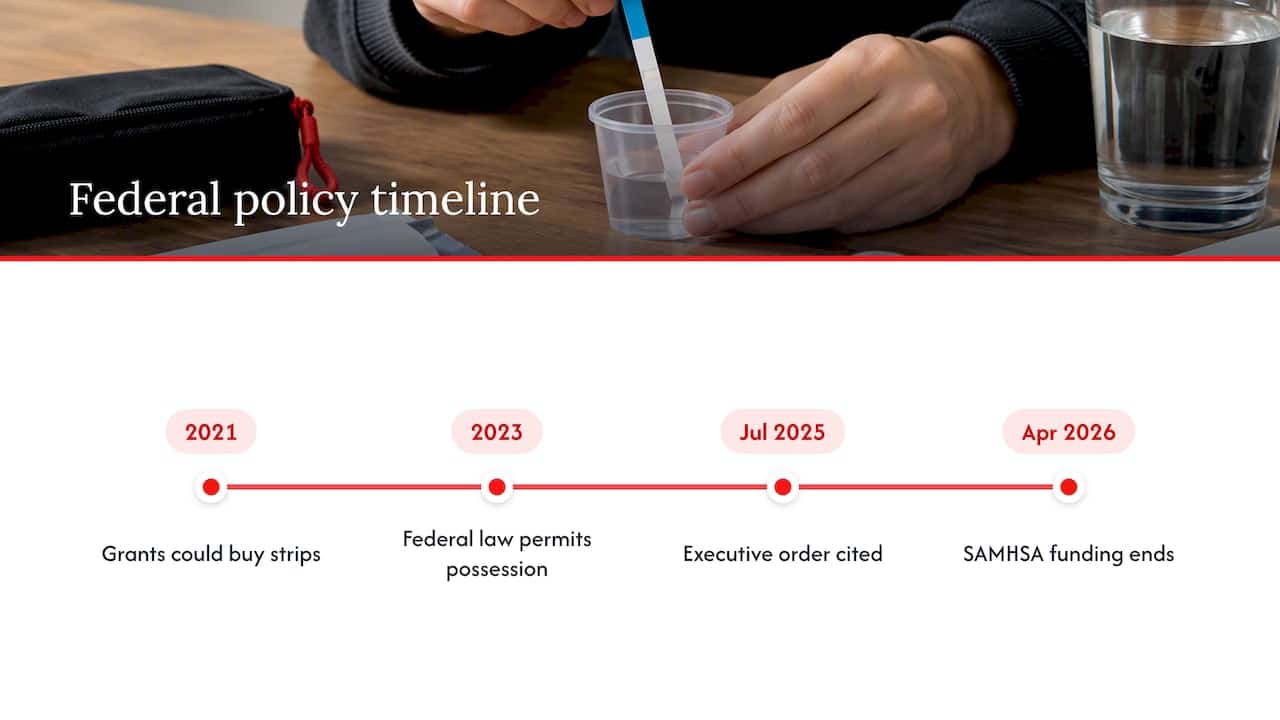
That is different from the question of who pays for them. In April 2021, CDC and SAMHSA announced that federal grant money could be used to buy fentanyl test strips when the purchase fits a program’s purpose. That changed in 2026. Reporting from April 30, 2026 says the federal government will no longer cover test strips with SAMHSA funding, citing a July 2025 executive order on programs that facilitate illegal drug use. The same report notes that strips are not considered paraphernalia in 45 states and Washington, D.C.
The distinction matters. Federal funding policy decides who can use grant dollars. It does not make a strip illegal to own, and it does not override a state’s decision to legalize them.
Why state law is what counts
Most drug paraphernalia offenses are written into state statutes. Many states adopted a model definition decades ago that covers objects used to test, analyze or identify a controlled substance. A fentanyl test strip fits that wording literally, which is how a $1 piece of paper ended up in the same legal category as pipes and scales.
The Legislative Analysis and Public Policy Association (LAPPA) tracks this. Its summary found that twenty-eight states have revised their paraphernalia definitions since 2018 to expressly exclude some or all types of drug-checking equipment. The trend is toward legalization, and it has moved quickly.
The result is a patchwork. Temple University’s public health law researchers describe a fragmented environment in which harm reduction groups must work through very different legal requirements in each jurisdiction. A strip that is fine to hand out in one state can be a misdemeanor risk across the border.
The four kinds of state rules
States do not simply sort into “legal” and “illegal.” When you read a statute, look for which of these patterns it follows.
| Pattern | What it means in practice |
|---|---|
| Broad exclusion | All drug-checking equipment is removed from the paraphernalia definition. Anyone may possess and use it. |
| Narrow exclusion | Only certain equipment is excluded, often fentanyl strips alone, or fentanyl and xylazine strips. Other test kits may still count as paraphernalia. |
| Program-based exemption | Possession or distribution is protected for people working with syringe-service or harm-reduction programs, but not necessarily for individuals. |
| No exemption | Testing equipment is still inside the paraphernalia definition, so possession or use may carry penalties. |
LAPPA notes that some jurisdictions exempt broader groups of people than others, while some limit exemptions to people working for syringe-service or harm-reduction programs. Rules can differ for organizations and for individuals, and separate laws may authorize users or program staff to possess drug samples for testing.
A useful rule of thumb: read two things. First, does the paraphernalia definition exclude test strips, and for whom? Second, is there a separate provision covering possession of the residue you test? A strip law that ignores the second question can still leave a gap.
Where strips are still a legal risk
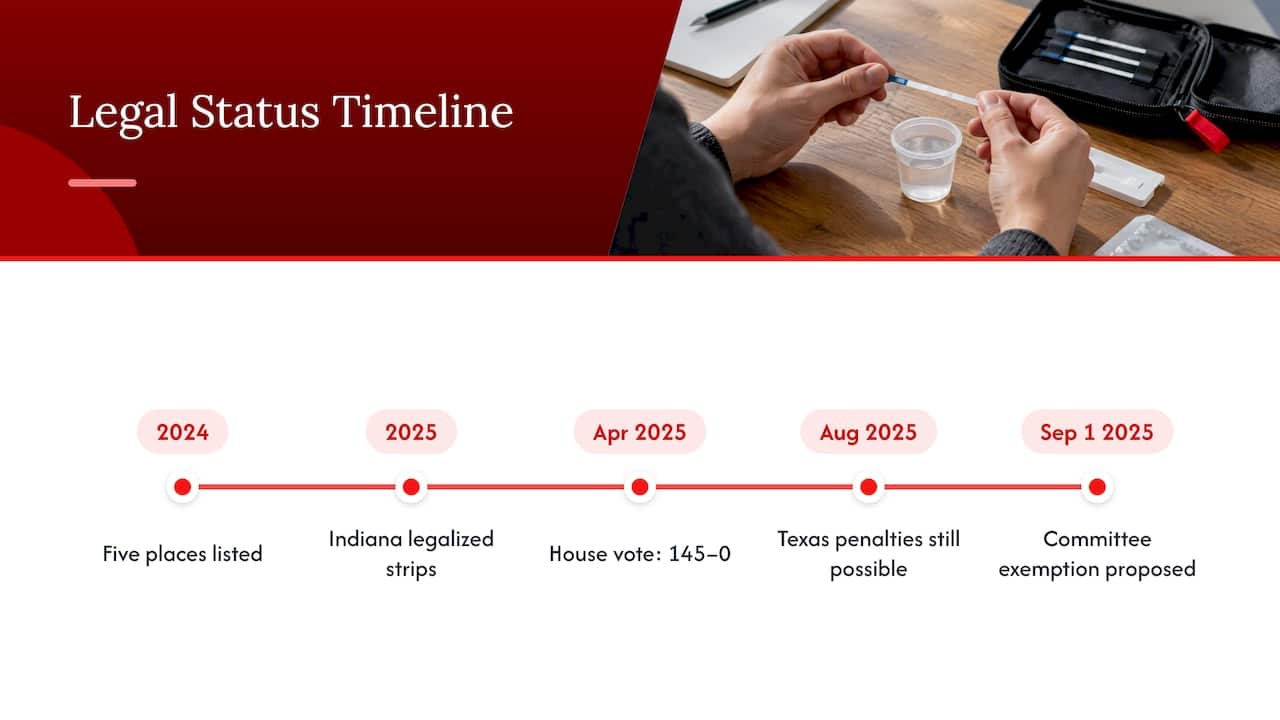
As of August 2025, only a handful of jurisdictions had not carved out any drug-checking equipment. A 2024 fact sheet from the Network for Public Health Law listed Indiana, Iowa, North Dakota, Puerto Rico and Texas as places where possession of all drug-checking equipment remained arguably a crime. That list is already out of date for Indiana, which has since moved to legalize strips.
Texas is the question many readers ask. LAPPA’s August 2025 summary lists it among the states where strips remain potentially subject to criminal penalties as paraphernalia because the state had not enacted broad exemptions. Before that, Texas law treated strips as paraphernalia, and possession was a Class C misdemeanor punishable by a fine of up to $500.
Texas lawmakers did act in 2025. House Bill 1644 passed the House 145 to 0 in April 2025, and the committee version would exempt equipment that identifies Penalty Group 1-B substances or xylazine from specified paraphernalia offenses, effective September 1, 2025. That is the committee text, not proof of the final law. If you live in Texas, read the current statute or ask a Texas attorney before relying on any summary, including this one.
Individual states change their statutes often, so a state listed as restricted may have fixed the issue since this was written, and a state listed as open could narrow its rules.
What the risk looks like in a restricted state
Where equipment is still potentially covered, LAPPA’s summary says possession or use may incur drug-paraphernalia penalties. In practice that has usually meant a low-level misdemeanor, often a fine. It is rarely the most serious charge a person faces, but a paraphernalia count can still come with a record, and it can complicate probation, housing or employment.
A second, separate risk is the drug you test. A strip needs a small sample dissolved in water. Residue is still a controlled substance, and possession laws apply to it whatever the strip’s status. This is why some states pass companion laws authorizing people to hold samples specifically for testing.
None of this is legal advice. If you are in a state with unclear rules and you work with people who use drugs, a local public defender’s office, a health department or a harm reduction coalition can tell you how your state’s law is enforced in practice.
Personal use versus programs and clinics
Legality can differ depending on who holds the strips and why.
- Individuals. Broad-exclusion states let anyone buy and carry strips. In program-based states, an individual’s protection may be weaker than a program employee’s.
- Harm reduction and syringe-service programs. These organizations often have the strongest protection, including authority to distribute strips free. Some states mail them, and New Jersey, for instance, offers free mailed strips to anyone in the state through its harm reduction program.
- Clinics, treatment centers and employers. These buyers are usually using urine-based fentanyl tests as clinical or workplace screens, not testing street drugs. That is a different product category with a different legal frame, covered by workplace testing rules rather than paraphernalia law.
- Campuses and venues. Colleges, bars and event organizers are usually bound by state paraphernalia law plus their own policies. Check both.
The type of strip matters too. A strip meant to test a powder or pill is a drug-checking device. A strip meant to test a person’s urine is a clinical screen. The first is the one affected by paraphernalia law. For how urine cutoffs differ, see our guide to reading fentanyl test cutoffs correctly.
How to check your own state
Follow this order to get a current answer.
- Find the latest summary. LAPPA’s September 2025 document gives jurisdiction-by-jurisdiction tables of laws in effect as of August 2025 and recently proposed legislation. It is the most thorough state-by-state overview available.
- Read the statute. Search your state code for “drug paraphernalia” and look for a sentence excluding fentanyl test strips, drug-checking equipment or testing equipment. Note who is covered.
- Look for pending bills. Your legislature’s website lists bills by topic. A new bill may take effect on a fixed date each year.
- Ask a local expert. A state health department’s overdose prevention office or a harm reduction coalition tracks what prosecutors actually do.
- Recheck after every session. What was true last year may not be true now.
Perspective: what we see at Rapidtestcup
We sell drug testing products to laboratories, clinics, treatment centers, law enforcement agencies, employers and individuals, so legal questions land on our desk constantly. Here is how we think about this one.
First, the buyer’s purpose should drive the product. Most of our customers are screening people, not checking street drugs, and they need a CLIA-waived, FDA-cleared test with a defined cutoff. Fentanyl test strips for drug checking are a different tool for a different job. We carry both, and we would rather you buy the right one than the cheapest one.
Second, accuracy limits are part of the safety story. A negative strip is not a guarantee. Strips have known blind spots with some analogs, which we cover in our analysis of analogs that strips miss and in what U.S. labs should know about strip accuracy. Legal access matters because it puts a useful, imperfect tool in more hands, and it should come with that honest caveat.
Third, we are a family business, and we would rather you ask than guess. If you are an organization unsure whether a purchase is covered by your state’s rules, check with counsel first, then contact us about quantities.
— Justin
Where to buy strips and screening products
If your state permits it, drug-checking strips and clinical fentanyl screens are available from us in several formats. For testing a powder or pill, our 10 ng/ml fentanyl test strips for harm reduction and fentanyl powder 10ng kit are built for that use. For screening urine in a clinic or workplace program, look at the fentanyl urine test strip, 20 ng/ml, the 1 ng/ml CLIA-waived option, or a multi-panel cup such as the 13 panel cup with FYL.
We offer bulk discounts and custom quotes for organizations. Browse the full range in our shop.
Common mistakes people make
Assuming a neighboring state matches yours. Neighboring states often take opposite approaches. Test the law where you live, and where you travel with strips.
Treating program protection as personal protection. A state may protect an outreach worker’s possession but not a private citizen’s. Read who is named in the exemption.
Confusing legality with endorsement. A strip being legal does not mean it is approved for every use. The FDA generally does not regulate products meant solely to test illicit drugs, so no regulator vouches for a particular strip’s performance. Pay attention to the manufacturer’s stated cutoff and instructions.
Reading a negative as safe. Strips detect fentanyl and many analogs, but not every analog, and a dose can be unevenly mixed. Test several parts of a sample and keep naloxone nearby.
Using old news. Funding rules, pending bills and statutes have all shifted in the last few years. Check the date on anything you read, including this page.
FAQ
Are fentanyl test strips illegal in Texas?
As of August 2025, Texas was listed among states where strips could still be treated as paraphernalia, with a Class C misdemeanor and a fine of up to $500 as the usual penalty. A 2025 bill, HB 1644, would exempt this equipment, and it passed the House 145 to 0. Confirm the current statute or ask a Texas attorney before relying on it.
Is it legal to buy fentanyl test strips online?
Federal law does not bar it. Whether you may possess them depends on your state’s paraphernalia statute. If your state excludes test strips from that definition, ordering them is generally fine. If it does not, check before you buy.
Can the federal government stop states from legalizing strips?
No. Paraphernalia offenses are mostly set by state law, which is why states have moved at different speeds. The 2026 federal decision ended SAMHSA grant funding for strips, but it did not criminalize them.
Do clinics and employers need to worry about this law?
Usually not for urine screening. Paraphernalia laws target tools for checking street drugs. Clinical and workplace tests fall under different rules, and CLIA waiver and FDA clearance apply to those products. If you also hand out drug-checking strips to clients, review your state’s program-based exemptions.
How often do these laws change?
Often. Twenty-eight states changed their paraphernalia definitions between 2018 and 2025. Recheck each year after your legislature adjourns.
Sources
- Senator Coons and colleagues introduce legislation to increase access to testing strips
- CDC: What You Can Do to Test for Fentanyl
- LAPPA: Drug Checking Equipment 50-State Summary (September 2025)
- Temple Public Health Law Research: Varying State Drug Laws Create Patchwork Landscape
- NIH: NIH and FDA leaders call for more research and lower barriers to drug-checking tools
- Texas Legislature: HB 1644 committee report
- CBS News: Trump administration ends funding for fentanyl test strips
- Network for Public Health Law: 2024 50-State Drug Checking Equipment Fact Sheet
- KXAN: Bill to legalize fentanyl test strips passes Texas House
- New Jersey Department of Health