Blog
Naloxone Drug Test: Does Narcan Show Up on a Screen?


No, naloxone (Narcan) does not show up on a standard urine opiate or opioid drug test, and it is not an opioid. It can be measured, but only when a laboratory orders a specific test for it, usually to monitor someone taking buprenorphine/naloxone (Suboxone-type) medication. Below we explain what routine screens look for, the rare exceptions, how long naloxone can be found, and how to read an unexpected result.
TL;DR
- Standard opiate panels target morphine and codeine. Naloxone is not part of routine workplace or point-of-care panels.
- In a small 1994 study, no urine samples tested positive on an opiate screen up to 48 hours after naloxone was given.
- Naloxone can be detected in urine for roughly 1 to 3 days, but only by specialized lab methods such as LC-MS/MS.
- Naloxone inside buprenorphine/naloxone medication is the main reason anyone tests for it. Naltrexone is a different drug and can cause its own confusing results.
- Any unexpected screen result should be confirmed by chromatography before anyone acts on it.
Table of Contents
- What a standard opiate screen actually looks for
- Can naloxone cause a false positive?
- Why naloxone is not a narcotic
- When naloxone can be detected, and for how long
- Buprenorphine/naloxone: the one case where naloxone matters
- Naltrexone is a different drug, with its own quirks
- How to read an unexpected result
- If someone received naloxone and is tested later
- Choosing the right test for your setting
- Our perspective
- Stock the screens your program needs
- FAQ
- Sources
What a standard opiate screen actually looks for
Most urine drug tests you can buy or run on site are immunoassays. They use antibodies that bind a target drug or its metabolites and produce a visible line (or its absence) at a set cutoff concentration. Clinical opioid immunoassays are built around morphine and, indirectly, codeine and heroin, according to the American College of Medical Toxicology position statement on urine opiate interpretation.
Federal workplace programs follow a similar logic. The SAMHSA model plan for a federal drug-free workplace program lists morphine, codeine, 6-acetylmorphine, hydrocodone, hydromorphone, oxycodone and oxymorphone among the opioids that may be tested for. Naloxone is not on that list.
Two practical points follow from this:
- A standard “OPI” or “MOP” cup or dip card is not designed to find naloxone, so it will not report it.
- The same panel may also miss opioids you do care about. Standard opiate immunoassays can fail to reliably detect semisynthetic or synthetic opioids such as buprenorphine, fentanyl or methadone, which need their own tests, per the same ACMT statement. Our guide on why a 300 ng/mL opiate screen can miss oxycodone walks through that gap.
Can naloxone cause a false positive?
Very rarely, in theory. Naloxone is structurally similar to morphine, and the ACMT statement notes it may rarely cause a false-positive immunoassay result. In practice, the evidence that exists points the other way.
The best-known study gave 2 or 4 mg of intravenous naloxone to 14 healthy adults. None of the urine samples tested positive on an EMIT opiate screen up to 48 hours later, as reported in Storrow’s 1994 study in the Annals of Emergency Medicine. It is a small sample and an older assay, so it is reassuring rather than final.
There is a useful lesson in the ACMT’s wording. Cross-reactivity is assay-specific: a compound can trigger a positive on one manufacturer’s immunoassay and not another’s. That is why a single study, or a single product’s behavior, never settles the question for every cup, card or strip on the market.
Why naloxone is not a narcotic
People often assume anything that interacts with opioid receptors is a narcotic. Naloxone blocks those receptors; it does not activate them. The FDA’s naloxone information page states that naloxone has no abuse potential and is not a controlled substance in the United States.
That is also why you can get it without a prescription. The FDA approved the first over-the-counter naloxone nasal spray in March 2023, and Drugs.com gives the date of OTC approval as March 29, 2023. The CDC explains that people without medical training can give naloxone, and that it can reverse overdoses from heroin, fentanyl and prescription opioids when given in time.
For employers and clinics, this matters in a simple way: keeping naloxone on site, or a person receiving it after an overdose, is not something a routine panel will flag.
When naloxone can be detected, and for how long
Naloxone is not invisible. It is simply not tested for unless someone asks. Drugs.com notes that naloxone is not part of routine testing for drugs that may be abused.
When a lab does look for it, the method is different from a rapid screen. A hospital laboratory interpretive guide, Opioid Interpretation Aids (August 2025), says naloxone can be detected in urine for approximately 1 to 3 days after administration using highly sensitive methods such as liquid chromatography-tandem mass spectrometry (LC-MS/MS). It adds that windows vary by person and dose.
| Question | Short answer |
|---|---|
| Does a rapid opiate cup or dip card detect it? | No, not by design |
| Can a lab test measure it? | Yes, with a targeted LC-MS/MS order |
| Typical urine window | About 1 to 3 days, varying by dose and person |
| Does it appear on a hair test? | Generally not part of standard offerings |
LC-MS/MS is a confirmatory technology. According to the ADLM clinical laboratory news article on confirmation testing, chromatographic confirmation identifies the specific drug in a specimen and its concentration, which an immunoassay cannot do.
Buprenorphine/naloxone: the one case where naloxone matters
Many people searching this topic are not asking about an emergency spray at all. They take, or monitor patients who take, a combination medication such as Suboxone, which contains buprenorphine plus naloxone.
In the U.S., naloxone testing is used to monitor adherence to those combination medications for opioid use disorder, according to Drugs.com. Seeing both buprenorphine and naloxone (and their metabolites) in a confirmatory result helps a clinician judge whether the patient is taking the prescribed product.
Two details are worth knowing:
- A standard opiate screen will usually be negative. Buprenorphine does not reliably register on a morphine-targeted test. A clinic that wants to confirm buprenorphine treatment needs a buprenorphine-specific assay. We stock buprenorphine test strips for that purpose.
- Unusual patterns happen. A 2019 literature review of unusual results in patients on buprenorphine discusses cases where immunoassay results did not match expectations. When the picture does not fit the prescription, confirmation, not guesswork, is the answer.
Naltrexone is a different drug, with its own quirks
Naloxone and naltrexone sound alike and both block opioid receptors, but they are not interchangeable on a drug screen. A 2024 peer-reviewed case report, Opioid-positive urine drug screen during treatment with naltrexone, found that oral naltrexone treatment produced a false-positive oxycodone screen, likely because its metabolite noroxymorphone was detected. The authors stress that immunoassays can be nonspecific and that unexpected results should be confirmed with definitive laboratory testing.
So if a patient on naltrexone shows a surprising oxycodone positive, the first step is to check the medication list, then confirm, rather than assume relapse.
How to read an unexpected result
A rapid test is a screen. It tells you a drug class may be present above a cutoff. It does not tell you which compound, how much, when, or whether the person was impaired. A workplace drug testing program guide from a Texas primary care clinic covers how employers handle screens and confirmations, and our own articles on interpreting urine drug test results go deeper on cutoffs.
When a result does not match the story, work through this order:
- Check the medication list. Ask about prescribed buprenorphine/naloxone, naltrexone, and recent emergency care, including naloxone given by a bystander or EMS.
- Check specimen validity. A diluted or adulterated sample can distort a reading. See our overview of urine specimen validity.
- Know your assay. Cross-reactivity differs between manufacturers, so read the package insert for the exact test in use.
- Consult an expert. The ACMT recommends consulting the laboratory, a medical toxicologist, a medical review officer, or the assay manual for unexpected immunoassay results.
- Confirm if you need a definitive answer. Chromatographic confirmation (GC-MS or LC-MS/MS) can tell similar drugs apart. LC-MS/MS can distinguish drugs within the same class and measure very low concentrations, as one laboratory services article describes.
If you manage a workplace or clinic, build that sequence into your written policy so staff do not improvise when a result surprises them.
If someone received naloxone and is tested later
For a person who was revived with Narcan, the later test will reflect what they used, not the rescue. If they had taken heroin, a morphine-targeted screen may show opiates; if the overdose involved fentanyl, a standard opiate panel will likely miss it, because fentanyl needs its own assay. Our piece on reading fentanyl test cutoffs explains the cutoffs, and fentanyl-specific strips such as our 20 ng/mL fentanyl urine strip are made for that job.
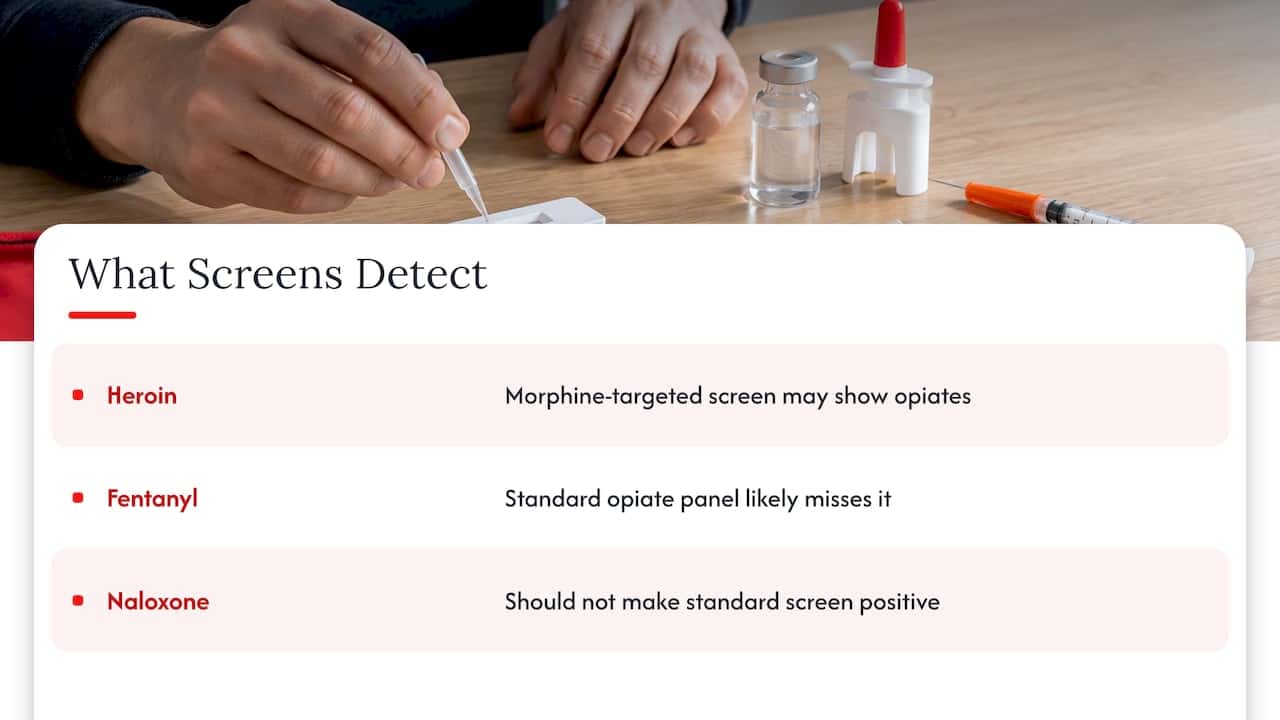
Naloxone itself, as covered above, should not make a standard screen positive.
Choosing the right test for your setting
The right test depends on what you actually need to learn, not on naloxone.
| Your situation | What to look for |
|---|---|
| Pre-employment or random workplace screening | A multi-panel cup or dip card matching your policy’s drug list |
| Clinic monitoring buprenorphine treatment | A buprenorphine-specific test, with lab confirmation when results are unexpected |
| Concern about fentanyl exposure | A dedicated fentanyl strip or a cup with a fentanyl panel |
| Suspected tampering | A cup with built-in adulterant checks |
| Need to know if naloxone specifically is present | A targeted LC-MS/MS order from a reference laboratory |
If you are deciding between formats, our comparison of cups versus dip cards lays out speed, handling and cost trade-offs.
Our perspective
Most of the naloxone questions we hear come from two groups: employers worried that a rescue medication will cause a false positive, and clinics trying to confirm that patients are taking their buprenorphine/naloxone as prescribed. The reassuring answer for the first group is that a well-chosen screening panel is built around the drugs you actually care about, and naloxone is not one of them.
For the second group, the lesson is about matching the tool to the question. A rapid screen is the fast, affordable first step. A confirmed result is what you use when a decision depends on it. We built our catalog of test cups, dip cards, strips and oral swabs, many of them CLIA waived, so a lab, clinic or employer can screen at the point of care and escalate to confirmation only when needed.
Our advice is simple: choose the panel that fits your written policy, read the package insert for cutoffs, and never treat a single screen as the final word. We are a family business, we keep a large inventory in stock, and we are happy to quote bulk orders so your team never runs short.
Justin
Stock the screens your program needs
If you run a clinic, treatment program, workplace or lab, we carry the formats described above, from multi-panel cups to single-drug strips, with bulk pricing and custom quotes available. Browse the full range in our drug test shop.
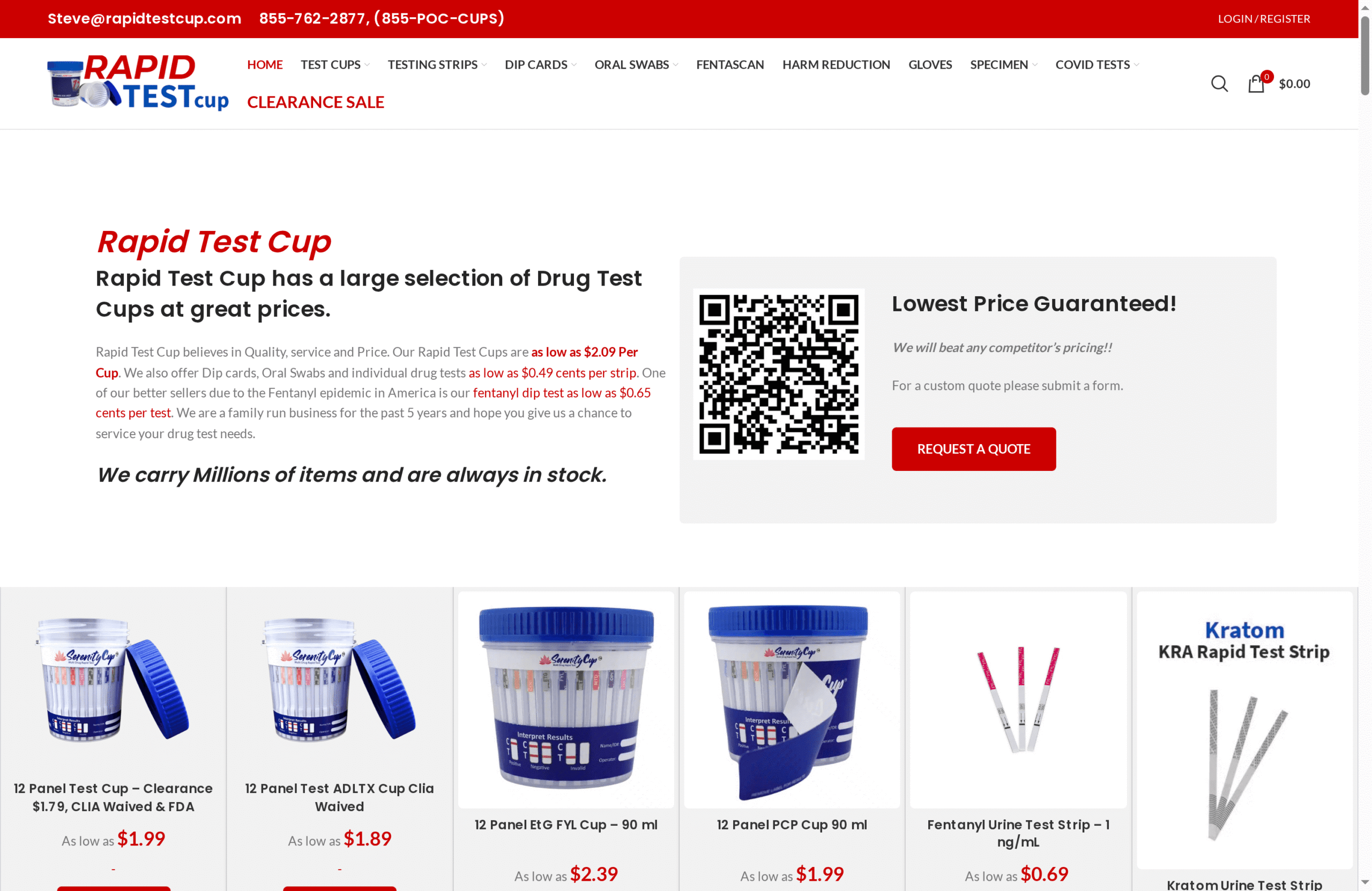
For a broad everyday screen, our 10 panel dip card is a common starting point, and our 15 panel cup with adulterant checks adds fentanyl and validity testing in a single device. Check each product page for the panel and cutoffs before ordering.
FAQ
Can naloxone cause a positive drug test?
It is very unlikely. Naloxone resembles morphine structurally, so a rare false positive on an immunoassay is theoretically possible, but a small study found no positive opiate screens up to 48 hours after dosing. If a result is unexpected, confirm it with a laboratory method.
How long is naloxone detected in urine?
Only specialized lab tests such as LC-MS/MS can find it, typically for about 1 to 3 days after administration. The exact window depends on dose and the individual. Rapid cups and dip cards do not look for it.
Is naloxone considered a narcotic drug?
No. The FDA states that naloxone has no abuse potential and is not a controlled substance in the United States. It blocks opioid receptors rather than activating them, and it has been available over the counter since 2023.
Does naltrexone show up on a urine drug screen?
Naltrexone is not a standard panel target, but it can cause confusing results. A 2024 case report described a false-positive oxycodone screen in a patient taking oral naltrexone, likely from a metabolite. Confirm unexpected results with definitive testing.
Does Suboxone contain naloxone, and will it show on a standard test?
Yes, Suboxone-type products combine buprenorphine and naloxone. A standard opiate panel usually will not flag them. Clinics monitoring treatment use buprenorphine-specific tests and, when needed, lab testing that can include naloxone.
Sources
- ACMT Position Statement: Interpretation of Urine Opiate and Opioid Immunoassays
- Does naloxone cause a positive urine opiate screen? (Storrow, 1994)
- SAMHSA Model Plan for a Comprehensive Federal Drug-Free Workplace Program
- FDA: Information about Naloxone and Nalmefene
- Drugs.com: Will naloxone show up on a drug test?
- CDC: Naloxone Frequently Asked Questions
- Opioid Interpretation Aids, August 2025
- ADLM: confirmation testing in clinical laboratory news
- Opioid-positive urine drug screen during treatment with naltrexone
- Preventing Substance Dependency Through Enhanced Screening
- Workplace Drug Testing Program: A Complete Guide for Employers
Recommended
- 300 ng/mL Opiate Screens Miss Oxycodone: A Clinician’s Two Tier Plan
- Clinicians: Order the Right Hydrocodone Test, 300 ng/mL or 25 ng/mL
- Read Fentanyl Test Cutoffs Correctly for Clinicians, Harm Reduction
- Cup 22 Nitrazine, XYL/1000, ZAZA/500, K2/50, FEN/20, ETG/300, KRAT/500, Delta 8/25, TRA/100, KET/1000 & 3 ADLTX (Specific Gravity, pH, and Creatinine) 22 Panel Drug Test Cup – Click Top- XYL(Xylazine)/1000,ZAZA/500, Delta 8/25, TRA/100, KET/1000, K2/50,FEN/10, ETG/300, KRAT/500 & 3 Adulterations ADLTX (Specific Gravity, pH, and Creatinine), AMP/1000, BAR/300, BUP/10, BZO/300, COC/300, MDMA/500, MET/1000, MTD/300, OPI/300, OXY/100, PCP/25, THC/50, Nitrazine – RapidTestCup