Blog
Drug Court Testing Requirements: What Programs Must Do


There is no single national rulebook for drug court testing. Each state, and often each county, writes its own policy. Those policies lean heavily on the same source, the Adult Treatment Court Best Practice Standards from All Rise (formerly NADCP). The pattern is consistent across states: at least twice-weekly testing, random and unpredictable scheduling, directly observed collection, checks for dilution and tampering, lab confirmation of disputed positives, and results back to the team within days. If you run a program, work in a clinic or probation office, or are preparing for a court-ordered schedule, build your testing routine around those points. We sell screening cups, dip cards, oral swabs and collection supplies for this work, so the sections below also show where each piece fits.
TL;DR
- Most state standards call for drug and alcohol testing at least twice per week in the intensive phases, scheduled randomly, including weekends and holidays.
- Collection is witnessed by a trained, same-gender staff member, with chain of custody and routine checks for dilution and adulteration.
- Urine is typically due within 8 hours of notification and oral fluid within 4 hours; results should reach the team within 48 hours in several states.
- A positive that the participant denies is confirmed by GC/MS or LC/MS on a portion of the same specimen.
- A missed, diluted or tampered test is generally treated as a positive and answered with graduated sanctions.
Table of Contents
- Who sets drug court testing rules
- How often participants are tested
- Random, unpredictable scheduling
- Observed collection and chain of custody
- Checking for dilution, substitution and adulteration
- Which substances and sample types
- Results, confirmation and participant rights
- What happens after a positive, missed or tampered test
- Perspective: building a testing routine that holds up
- Stocking your program
- FAQ
- Sources
Who sets drug court testing rules
Drug courts are county and state programs, so the binding rules are the state’s court standards, the local policy manual, and the participant contract each person signs. The national benchmark behind them is the Adult Treatment Court Best Practice Standards. The Texas standards note that All Rise published its most recent iteration in 2025 and that it applies broadly to drug, mental health, veterans, DWI, reentry, co-occurring and family treatment courts.
In practice, that means the details below differ in numbers (hours, days, panels) but not in logic. When you need the exact rule for a given court, read that court’s handbook. This article walks through the common requirements, with state examples so you can see the range.
How often participants are tested
Frequency is the headline requirement, and the states agree closely.
| State | Minimum frequency | Other notes |
|---|---|---|
| Florida | Drug and alcohol testing at least twice per week through intensive phases | Ankle monitor for at least 90 consecutive days, then urine or other intermittent testing |
| Idaho | Urine at least twice per week until the last phase | Short-window tests when recent use is suspected |
| Texas | At least twice weekly, seven days a week coverage | May decrease after early remission and engagement in recovery management |
| Virginia | Minimum twice-weekly urine until the last phase | Weekly EtG or EtS alcohol testing in the first two phases |
| Colorado (CS-062) | Risk-based, maximum of 8 tests per month | At least one full polysubstance test per month; recommends not exceeding twice per week |
Two details matter for planning. First, frequency is not cut on a calendar. Florida’s earlier standards state that testing frequency is not reduced until clinically appropriate. Second, Colorado’s interim standard shows that some states cap testing by risk level, so a program should confirm its own state’s ceiling as well as its floor.
For a program, twice weekly across a caseload adds up quickly. A court with 40 participants in the intensive phase is running roughly 80 collections a week before any extra for-cause tests. That is where supply planning starts to matter.
Random, unpredictable scheduling
Predictable testing defeats the point. A 2024 Georgia handout on drug court testing warns that fixed patterns such as Monday and Wednesday testing give participants a window to avoid detection, and recommends random testing that includes weekends and holidays.
The mechanics you will see in policies:
- A daily call-in or app. Lincoln County, Oregon uses a daily 8 a.m. hotline color call, with random samples Monday through Saturday including holidays. Virginia calls for a computerized random system. Kentucky requires participants to access the notification system daily.
- Equal odds every day. Florida’s standards require the schedule to be random with equal probability on weekends and holidays.
- A short window to report. Florida and Idaho set delivery at 8 hours from notification for urine and 4 hours for short-window tests such as oral fluid. Georgia’s handout recommends limiting the delay to 2 hours where possible.
The practical consequence: your site must be able to collect on a Saturday or a holiday morning, not only on weekdays. Supplies need to be on the shelf, not on order.
Observed collection and chain of custody
A result is only as good as the specimen. The Florida standards require witnessed collection by a gender-appropriate person trained to prevent tampering and substitution, with chain of custody for each specimen. Kentucky’s participant handbook adds specifics: at least 30 ml of urine, same-gender observation, and set clothing and hand-washing procedures. Lincoln County uses a mouth swab when same-gender staff are not available.
A workable collection routine looks like this:
- Verify identity and log the time of notification and arrival.
- Prepare the room: remove coats and bags, and keep water sources controlled.
- Observe the collection with a trained same-gender staff member.
- Check the specimen immediately: volume, temperature, color, and the adulterant strips on the device.
- Seal, label and sign each specimen, and record every handoff.
Our drug specimen collection guide covers these steps for professional settings, and how collection methods shape test validity explains why the way a sample is taken affects the result as much as the device. For sealed, individually wrapped collection, we stock sterile urine vacuum cups and urine specimen cups.
Checking for dilution, substitution and adulteration
Every standard we reviewed expects specimens to be routinely examined for tampering. Florida requires routine examination for dilution and adulteration. Virginia requires the same, and also expects dockets to have breathalyzer capability.
Courts define the categories in writing. Hall County, Georgia’s handbook defines invalid screens as creatinine below 20 or above 400 mg/dl, and substituted screens as creatinine at or below 5 mg/dl without normal urine characteristics. Suspected adulterated or substituted screens go to an outside lab for confirmation.
This is where the device choice matters. A cup with built-in adulterant strips lets staff check validity at the moment of collection, while the participant is still in the room. Our 18-panel cups are available with adulterants, and the 15-panel version includes adulterants and ETG/300. Two reference pages help staff train: what adulterants are in drug testing, and a checklist for preventing sample adulteration.
Which substances and sample types
Standards generally require testing for the participant’s primary drug of choice plus other drugs of abuse, including alcohol. Virginia states this directly. Georgia’s handout describes the NIDA-5 and eight-panel tests as capturing most, but not all, drugs, and warns about novel psychoactive substances. Idaho adds that randomly selected specimens are periodically tested for a broader range than the routine panel.
Different sample types answer different questions. The Georgia handout lists approximate detection windows: urine 2 to 4 days, oral fluid about 24 hours, sweat several days, blood and breath 12 to 24 hours. It recommends combining matrices: sweat and urine for longer-term coverage, oral fluid and breath for recent use. Alcohol is tracked through the metabolites EtG and EtS, or through remote monitors like SCRAM.
A simple way to match the device to the question:
- Routine scheduled check: a multi-panel urine cup. Modern panels can include fentanyl, tramadol, synthetic cannabinoids and EtG. See the 16-panel cup or the 13-panel cup with fentanyl.
- Weekend or for-cause check on recent use: an oral swab such as the 8-panel or the 12-panel with alcohol, which fits the short delivery window.
- Fast field screening: a 10-panel dip card or 12-panel dip card. Our cup versus dip card comparison explains the trade-offs.
Results, confirmation and participant rights
A screen is a first look, not a final finding. The Florida standards say that when a participant denies a positive screen, it is confirmed by GC/MS, LC/MS or a similarly calibrated test on a portion of the same specimen, with results available to the team within 48 hours. Texas and Idaho use the same 48-hour benchmark. Colorado allows up to 3 business days for urinalysis results. Lincoln County enters positive results into its case system within 24 hours.
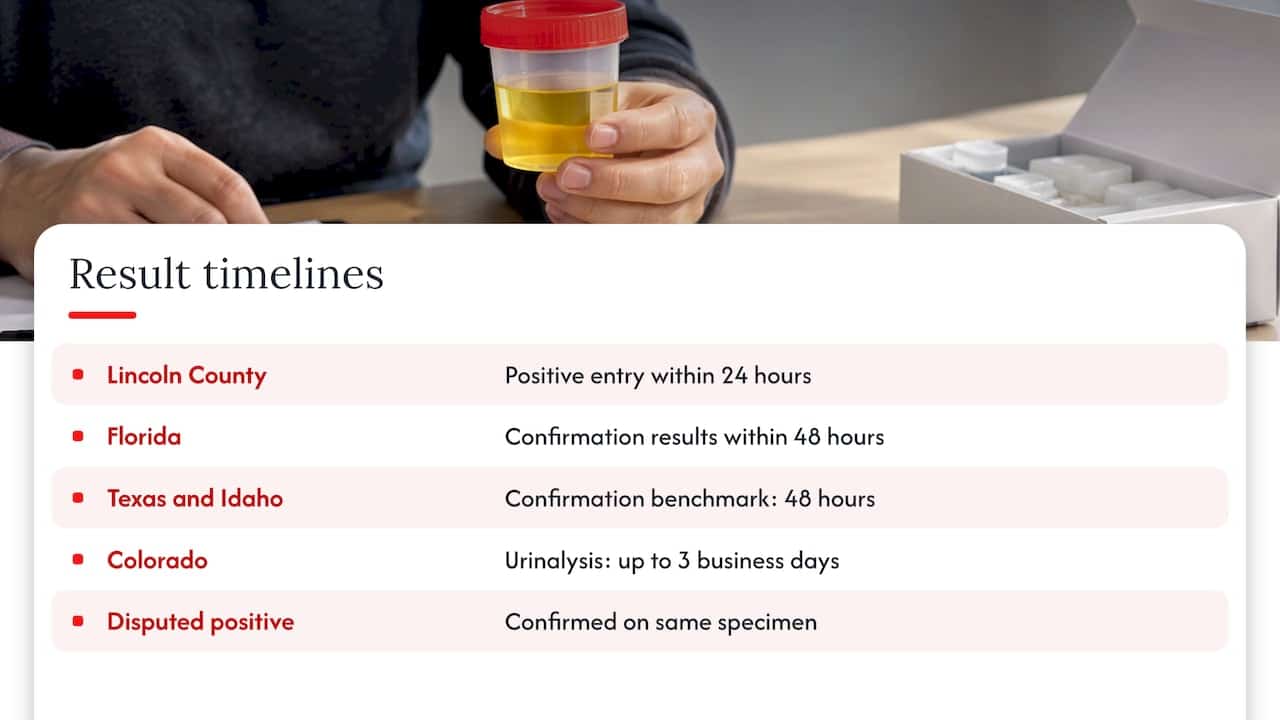
The All Rise commentary explains why the same specimen is used: a later-collected sample may differ because of detection windows or the participant’s metabolism. It also notes that confirmation on a properly collected and stored portion of the original specimen virtually eliminates false positives, and that courts commonly have participants pay confirmation costs when the screen is confirmed. Our GC-MS confirmation explainer walks through why labs rely on it for final results.
Participants also have documented rights. Idaho’s standards call for a clear explanation of testing rights and responsibilities in a contract or handbook, reviewed periodically, and say that concentrations below cutoffs should not be read as new use without toxicology expertise. Hall County gives clients the right to request third-party confirmation of a positive screen. Lincoln County requires a signed Substance Testing and Abstinence Contract before entry.
For an individual under a court order, the useful step is simple: read your contract and handbook now, and know your reporting hours before the first call-in.
What happens after a positive, missed or tampered test
The standards expect a written, graduated response, not improvisation. Virginia requires a coordinated strategy with prompt responses to positive, missed and fraudulent tests. Local policies are blunt about what counts:
- Buncombe County, NC: failure to screen counts as a positive, and a diluted screen is considered positive. Sanctions range from community service and increased treatment to curfew, phase demotion, jail or an activated prison sentence.
- Williamson County, TX: a positive, diluted or missed test results in sanctions, and any issue with a test is treated as a positive that may lead to termination.
- Hall County, GA: an admission before providing a sample may reduce the sanction by 50%, while a denial followed by a confirmed test may double the matrix sanction and add a $35 fee.
Florida’s full standards add guardrails. Sanctions should escalate with successive infractions, be finite, keep incarceration as a last option, keep jail to no more than three to five days, and give participants access to counsel and a fair hearing. For participants, the lesson is that a missed call-in costs as much as a positive. For staff, it is that the sanction matrix must be written down before the first positive.
Texas also asks teams to be mindful of participants’ trauma history during testing, and to set and clearly communicate any required abstinence period before graduation.
Perspective: building a testing routine that holds up
Most testing problems we hear about are not about the device. They come from gaps in routine: a Saturday with no supplies, a collection nobody observed, a cup nobody checked for validity until the next day. The standards describe the fix in plain terms, and each requirement maps to something you can stock and schedule.
We built our catalog around that. Multi-panel cups with adulterant strips for the validity check at collection. Oral swabs for the short window. Dip cards for quick screening. Sealed specimen cups for lab confirmation. Fentanyl-capable panels because that is what programs are being asked to cover now. Bulk pricing and a large in-stock inventory mean a twice-weekly schedule across a full caseload does not turn into a purchasing problem, and we ship the same day.
If you are setting up or revising a protocol, write the sequence first: notify, collect, observe, check validity, screen, seal, confirm if disputed. Then match one product to each step. That is the approach we would take in your seat.
Justin
Stocking your program
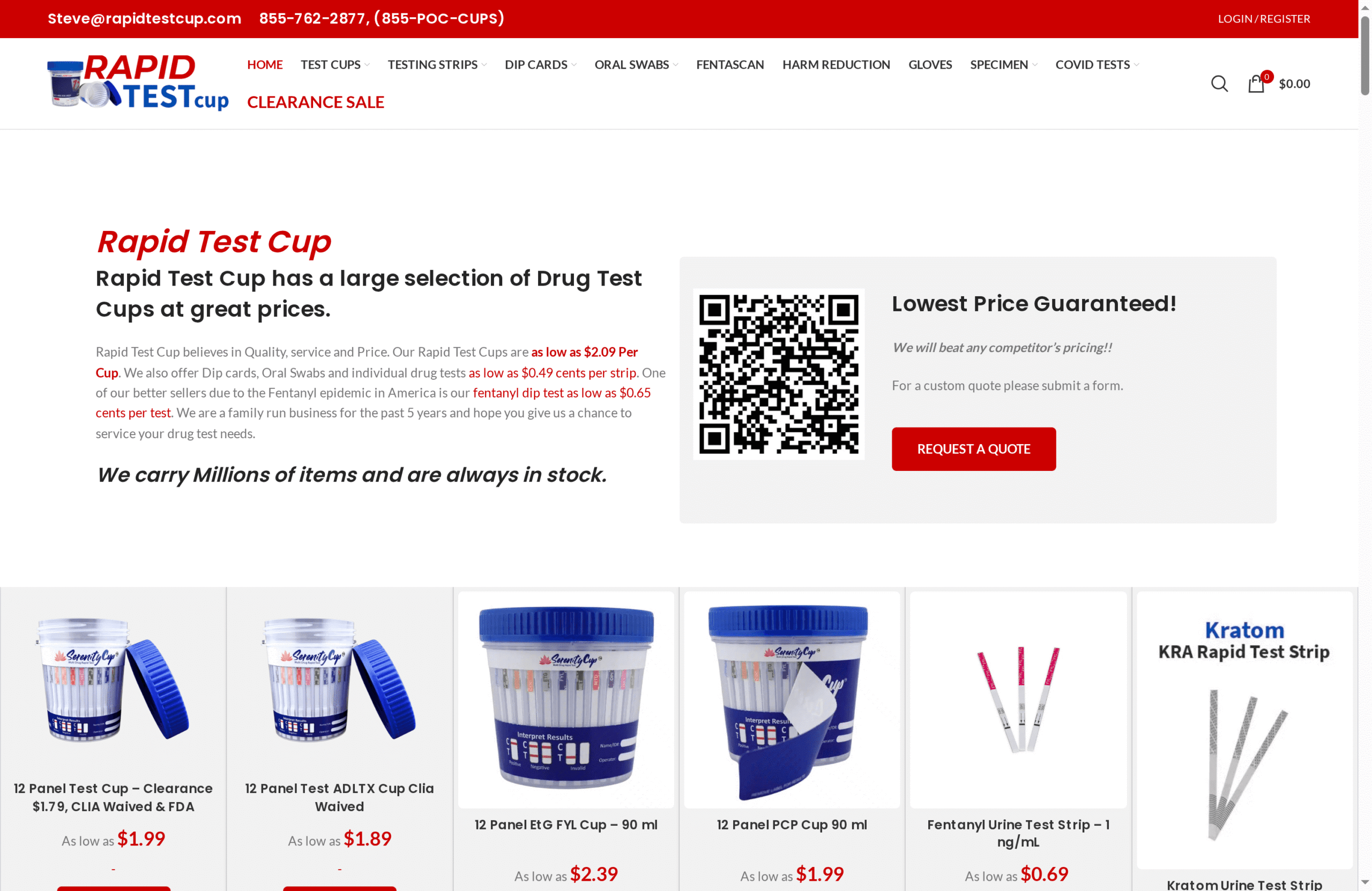
If you are supplying a drug court, probation office, treatment center or clinic, start with a multi-panel cup for scheduled tests, add oral swabs for weekends and for-cause checks, and keep sealed specimen cups on hand for anything sent for confirmation. Our guide to drug testing in probation and forensic testing tips for law enforcement cover the same workflow from the officer’s side.
Our CLIA-waived and FDA-approved options, bulk discounts and custom quotes are all on the shop page. Programs that need volume can request a quote, and we stand behind our commitment to beat any competitor’s price.
FAQ
How often are drug court participants tested?
Most state standards set a floor of two tests per week during the intensive phases, with random scheduling that includes weekends and holidays. Frequency usually drops only when the participant reaches clinical benchmarks, not just because time has passed. Some states, such as Colorado, also cap monthly tests by risk level.
How fast do you have to report for a test?
Florida and Idaho standards set 8 hours from notification for urine and 4 hours for short-window tests such as oral fluid. Georgia’s handout recommends 2 hours where possible. Your own court’s handbook sets the binding deadline, so check it and your call-in method.
Is a missed or diluted test the same as a positive?
In many programs, yes. Buncombe County counts a failure to screen and a diluted screen as positives, and Williamson County treats any issue with a test as a positive. Responses are meant to be graduated sanctions, and participants are entitled to written rules and a fair hearing.
Can a positive result be confirmed?
Yes. Standards call for GC/MS or LC/MS confirmation on a portion of the same specimen when a participant denies a positive screen. Results are generally due to the team within 48 hours. Some programs, such as Hall County’s, let participants ask for third-party confirmation.
What substances do drug courts test for?
The participant’s primary drug of choice, other drugs of abuse and alcohol, usually through a multi-panel urine test with periodic broader panels. Courts add oral fluid, breath, sweat or ankle monitors depending on the detection window they need.
Sources
- Florida Adult Drug Court Best Practice Standards (Nov 2023)
- State of Florida Adult Drug Court Best Practice Standards (June 2017)
- Idaho Treatment Court Best Practice Standards Volume II (2025)
- Texas Specialty Courts Standards (2025)
- Virginia specialty docket drug testing standard
- Colorado DCJ CS-062 Interim Drug Testing Processes Standard
- Georgia CACJ: Drug Courts and Drug Testing Best Practices (2024)
- Lincoln County (OR) Drug Court policy
- Kentucky Specialty Courts participant handbook
- Hall County H.E.L.P. Program handbook
- Buncombe County Adult Drug Treatment Court handbook
- Williamson County DWI/Drug Court policies
- All Rise Adult Drug Court Best Practice Standards Vol. 2, Standard VII