Blog
Benzodiazepine False Negatives: Why Screens Miss Them


A negative benzodiazepine screen does not always mean no benzodiazepine is present. Most rapid and lab immunoassays (tests that use antibodies to flag a drug class) are built to react to a few common metabolites, so some drugs, especially lorazepam, clonazepam and alprazolam, can pass through at low or undetectable signal. Treat a negative screen as a presumptive result. If use is suspected, the next step is confirmatory testing. Choosing the right panel and cutoff for the people you test makes that screen as useful as it can be.
This guide is for labs, clinics, treatment programs, employers, law enforcement and individuals who run or read urine screens. It explains in plain terms why misses happen, which drugs are involved and what to do about a negative that does not fit the picture.
TL;DR
- A false negative means the drug or its metabolite is in the sample but below what the screen can detect, or in a form the antibody does not recognize.
- Many immunoassays reliably pick up nordiazepam, oxazepam and temazepam, but not alprazolam, lorazepam or clonazepam.
- Two main causes: conjugated (glucuronide) metabolites and high cutoffs set for older, higher-dose drugs.
- Newer designer benzodiazepines such as bromazolam are not well covered by standard screens.
- If benzodiazepine use is suspected despite a negative screen, send the sample for confirmatory testing.
Table of Contents
- What a benzodiazepine screen actually detects
- Why benzodiazepine screens return false negatives
- Which benzodiazepines are most often missed
- What to do after a negative result
- Choosing a screen that fits your setting
- Where Rapidtestcup fits
- Our perspective
- FAQ
- Sources
What a benzodiazepine screen actually detects
Benzodiazepines are a class of sedative medicines prescribed for anxiety, panic, insomnia, seizures and alcohol withdrawal. Diazepam, alprazolam, lorazepam, clonazepam, temazepam and oxazepam are common examples. They are also misused, and illicit supplies increasingly include non-prescription “designer” versions.
A urine screen does not look for the drug the way a chemist would. An immunoassay uses antibodies that bind to a target molecule, usually a metabolite (the substance the body turns a drug into). If the antibody binds enough of it to cross a set cutoff concentration, the result reads positive. If not, it reads negative.
That design is fast and inexpensive, which is why screens are the standard first step in workplaces, clinics and treatment programs. It also explains the limit. The antibody is tuned to certain molecules. If a drug leaves the body as something else, or at low concentration, the screen may not react.
The American Academy of Family Physicians explains that all screening results are presumptive until confirmed. A negative can be a true negative, meaning no drug was present or the metabolites were eliminated before testing. It can also be a false negative, where the drug or metabolite is present below the detection level.
Why benzodiazepine screens return false negatives
Glucuronide metabolites go unseen
Many benzodiazepines are cleared by the body as glucuronide conjugates, which are inactive compounds the body attaches to a drug so it can be excreted in urine. Standard immunoassay antibodies often do not recognize these conjugates well. Moeller and colleagues, in a clinical interpretation guide for urine drug tests, name this as one of two significant limitations. They note that most laboratories do not perform beta-glucuronidase hydrolysis, the enzyme step that cuts the conjugate off so the antibody can see it.
Lorazepam is the clearest case. Only about 0.5% of a lorazepam dose is excreted as free drug, so what matters is whether the assay reacts to lorazepam glucuronide. A 2023 study in the Journal of Applied Laboratory Medicine spiked urine with both forms. One commercial assay was positive for every lorazepam-spiked specimen but negative for every lorazepam glucuronide-spiked specimen at 650, 5,000 and 10,000 ng/mL. A second assay detected both.
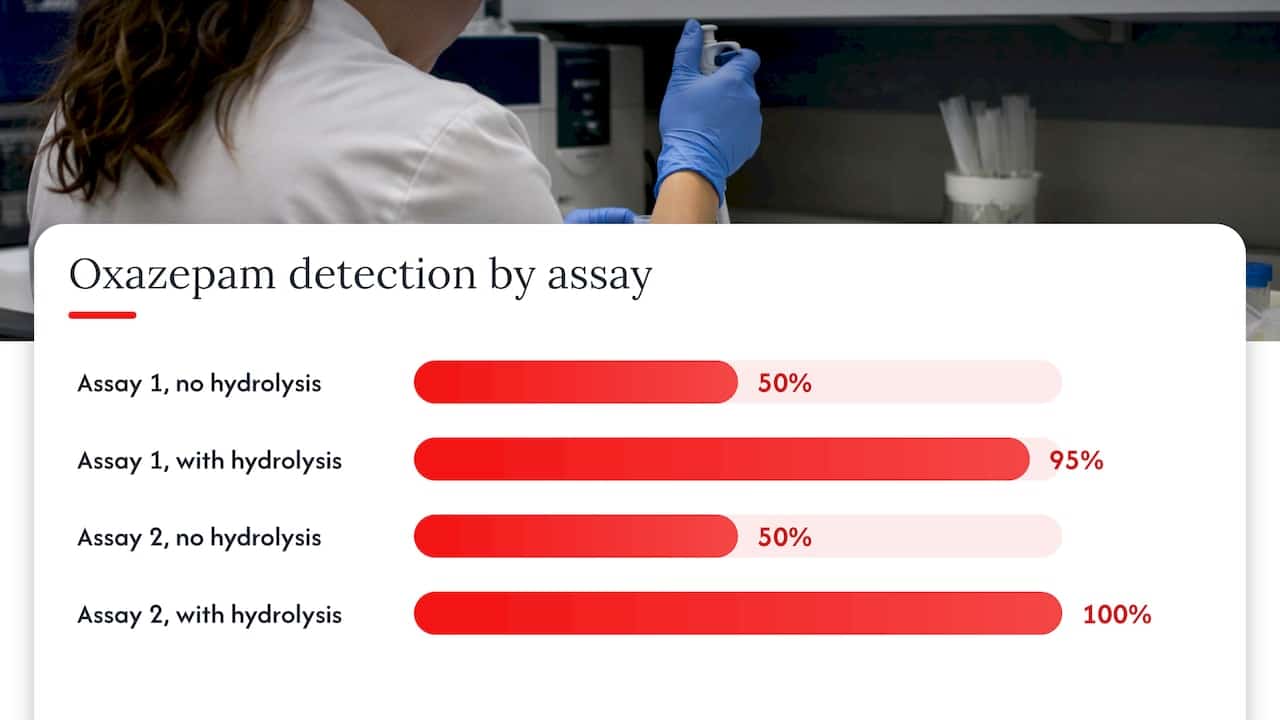
Hydrolysis can change the picture. In a study summarized in the same journal, adding the enzyme step raised oxazepam detection from 50% to 95% on one immunoassay and from 50% to 100% on another.
Cutoffs were set for older drugs
The second limitation is the cutoff, the concentration a sample must reach to read positive. Common cutoffs of 200 or 300 ng/mL were set around older benzodiazepines dosed at 5 to 20 mg a day. Moeller’s guide notes they are often too high for potent drugs such as lorazepam, alprazolam and triazolam, which are prescribed at much lower doses. A person taking a low therapeutic dose may simply not reach the line.
Clonazepam shows the same pattern. Per the package insert of one widely used assay, discussed in the 2023 study, a positive needs 150 ng/mL of clonazepam or 2,750 ng/mL of its main urinary metabolite, 7-aminoclonazepam. The highest expected 7-aminoclonazepam concentration after a single 3 mg dose is about 183 ng/mL, so a miss is likely on that assay.
The University of Washington’s laboratory guide makes a related point about broad comprehensive screens. They are designed to catch overdose-level concentrations, so drugs at therapeutic levels may go undetected, and a negative does not necessarily mean the drug is absent.
Timing, hydration and the sample itself
Urine concentration is not constant. Mayo Clinic Laboratories lists several reasons expected drugs may be absent: timing of the specimen, poor absorption, diluted or adulterated urine, or testing limitations. The AAFP adds that urine drug concentrations depend on how quickly a person metabolizes and eliminates the drug, and on hydration.
For detection windows by drug, see our guide to benzo detection time for labs and our overview of drug detection windows.
Which benzodiazepines are most often missed
The pattern is consistent across sources. The Journal of Applied Laboratory Medicine reports false-negative immunoassay results with parent drugs and glucuronide metabolites of clonazepam, 7-aminoclonazepam, chlordiazepoxide, flunitrazepam, lorazepam, oxazepam glucuronide and temazepam glucuronide, among others.
| Drug | Why a screen may miss it | Practical note |
|---|---|---|
| Lorazepam | Excreted mostly as glucuronide, with very little free drug | Not detected in one major lab’s routine screen; the lab’s confirmation assay includes related drugs |
| Clonazepam | Main urinary metabolite is present at low concentration | Limited detection on routine screens |
| Alprazolam | Low-dose drug; often conjugated | Cutoff may be too high for therapeutic doses |
| Oxazepam, temazepam | Detected well as free forms, less so as glucuronides | Hydrolysis improves detection |
| Designer benzodiazepines (etizolam, flualprazolam, bromazolam) | Cross-reactivity poorly studied | Not reliably covered by standard screens |
Labcorp’s 2025 testing resource guide states that lorazepam is non-detectable in its routine benzodiazepine screen and clonazepam is only limitedly detected, while its confirmation assay covers alprazolam, clonazepam, diazepam, midazolam, oxazepam, temazepam, triazolam and others.
How often does this happen in practice? The 2023 study cites a recent report of a 47% false-negative rate for benzodiazepine immunoassay screening in patients being monitored. That figure comes from clinical monitoring populations, so it does not describe every setting. It shows why the choice of assay and the follow-up plan matter.
Newer assays and designer benzodiazepines
Assay makers have improved. A 2024 study of the Roche benzodiazepines II assay found better sensitivity thanks to improved cross-reactivity with lorazepam and clonazepam metabolites. The authors still conclude it should not replace mass spectrometry for compliance monitoring. Designer compounds are a bigger gap: in that study, 55% of bromazolam specimens at 41 to 88 ng/mL were negative on the newer assay.
The practical lesson for anyone testing in a setting where non-prescribed pills circulate: a standard benzodiazepine line may not reflect what a person took.
What to do after a negative result
The answer depends on why you tested.
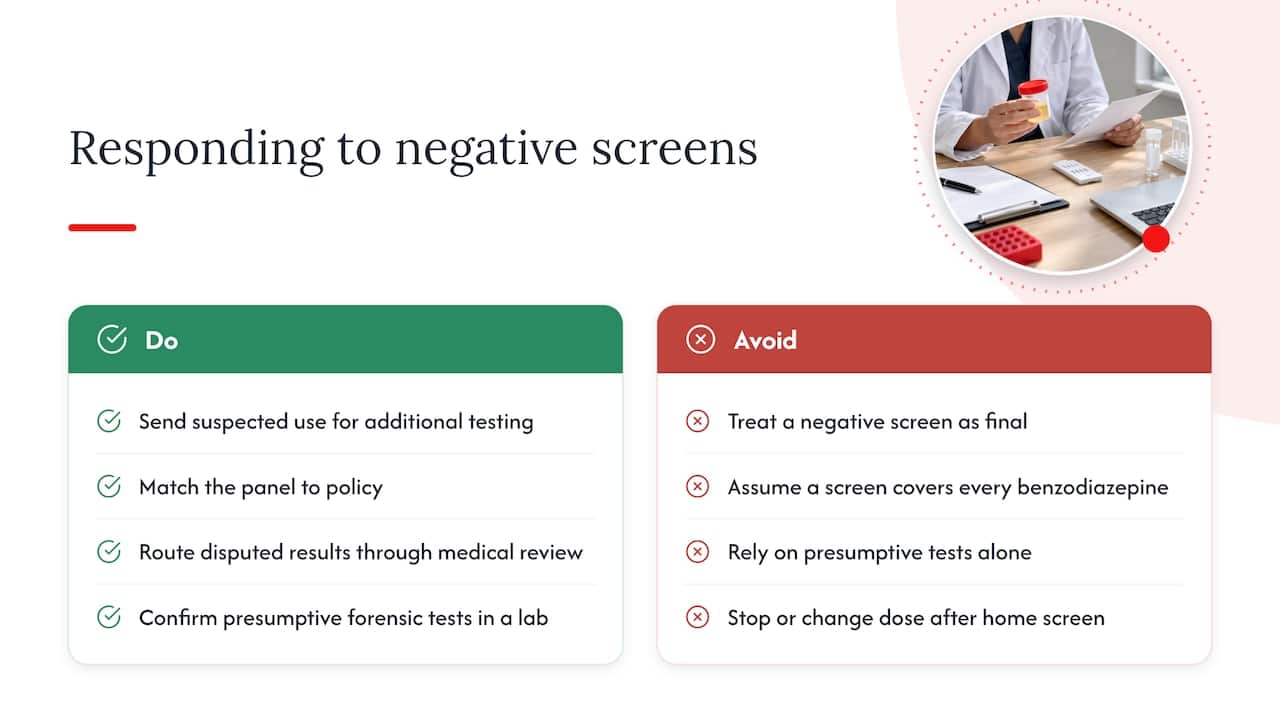
Clinics and treatment programs. If the history, prescription record or clinical picture says the patient should be taking a benzodiazepine, or if misuse is suspected, a negative screen is not the end of the workup. The AAFP states that when use is suspected, the sample must be sent for additional testing despite a negative initial screen. False negatives can mean a missed chance to detect misuse in patients on long-term therapy.
Employers and occupational health. Match the panel to the policy. If your policy covers benzodiazepines, confirm which compounds the screen is designed to detect, and route any non-negative or disputed result through your medical review process. A negative on a screen is a statement about that screen, not about every benzodiazepine.
Law enforcement and forensic users. Presumptive tests support a decision to collect and send evidence. They do not stand alone. Confirmation by a laboratory method is what carries weight.
Individuals. If you took a prescribed benzodiazepine and your at-home result is negative, that can happen for the reasons above, and it does not mean the medicine was not taken or not working. Talk to your prescriber about any test that matters for your care, and do not stop or change a dose based on a home screen.
What confirmatory testing adds
Definitive testing uses mass spectrometry, which identifies molecules by their mass and structure rather than by antibody reaction. Mayo Clinic Laboratories describes a targeted benzodiazepine screen using high-resolution accurate mass spectrometry that identifies 27 benzodiazepines and metabolites, with lower detection limits than its earlier screens. It also notes that compliant patients taking clonazepam or lorazepam may screen negative by immunoassay but positive on confirmation.
The University of Washington guide gives a rule of thumb: when detecting any amount of a drug matters, choose an assay designed to measure that specific drug rather than a general screen. For a plain-language look at how LC-MS/MS accuracy compares with other methods, that page walks through the principle in another testing context.
Two practical points for the sample:
- Keep the original specimen sealed and labeled so it can be forwarded without a recollection. Collection quality matters: our urine specimen cups are made for this step.
- Record the collection time, the last reported dose and any validity concerns such as very dilute urine. Those details help the lab interpret the result.
Choosing a screen that fits your setting
False negatives are a reason to choose the screen deliberately. Ask four questions before you buy.
- Which benzodiazepines matter to you? Prescribed lorazepam and clonazepam monitoring is a different task from checking for diazepam or oxazepam use.
- What cutoff does the test use? A higher cutoff favors fewer positives from incidental exposure. A lower one catches more low-dose use. Match it to your policy or clinical purpose.
- Is a confirmation path in place? Know in advance which lab you will send a sample to and how quickly.
- Do you need adulteration and validity checks? Dilute urine lowers every drug concentration, so panels with specimen validity checks help you read a negative correctly. For the opposite problem, see how to identify false positives on a drug test.
Because metabolites drive what any immunoassay sees, our explainer on drug metabolites and accurate drug testing is a useful companion to this section.
Where Rapidtestcup fits
We sell drug testing products for laboratories, clinics, treatment centers, employers, law enforcement and individuals, including BZO benzodiazepine test strips, multi-panel test cups and dip cards, and specimen collection supplies. Our selection includes CLIA waived and FDA-approved options, bulk pricing and custom quotes. You can browse every category in our shop, or look at a multi-panel option such as the 12 panel urine test cup if you want benzodiazepines screened alongside other drugs in a single collection.
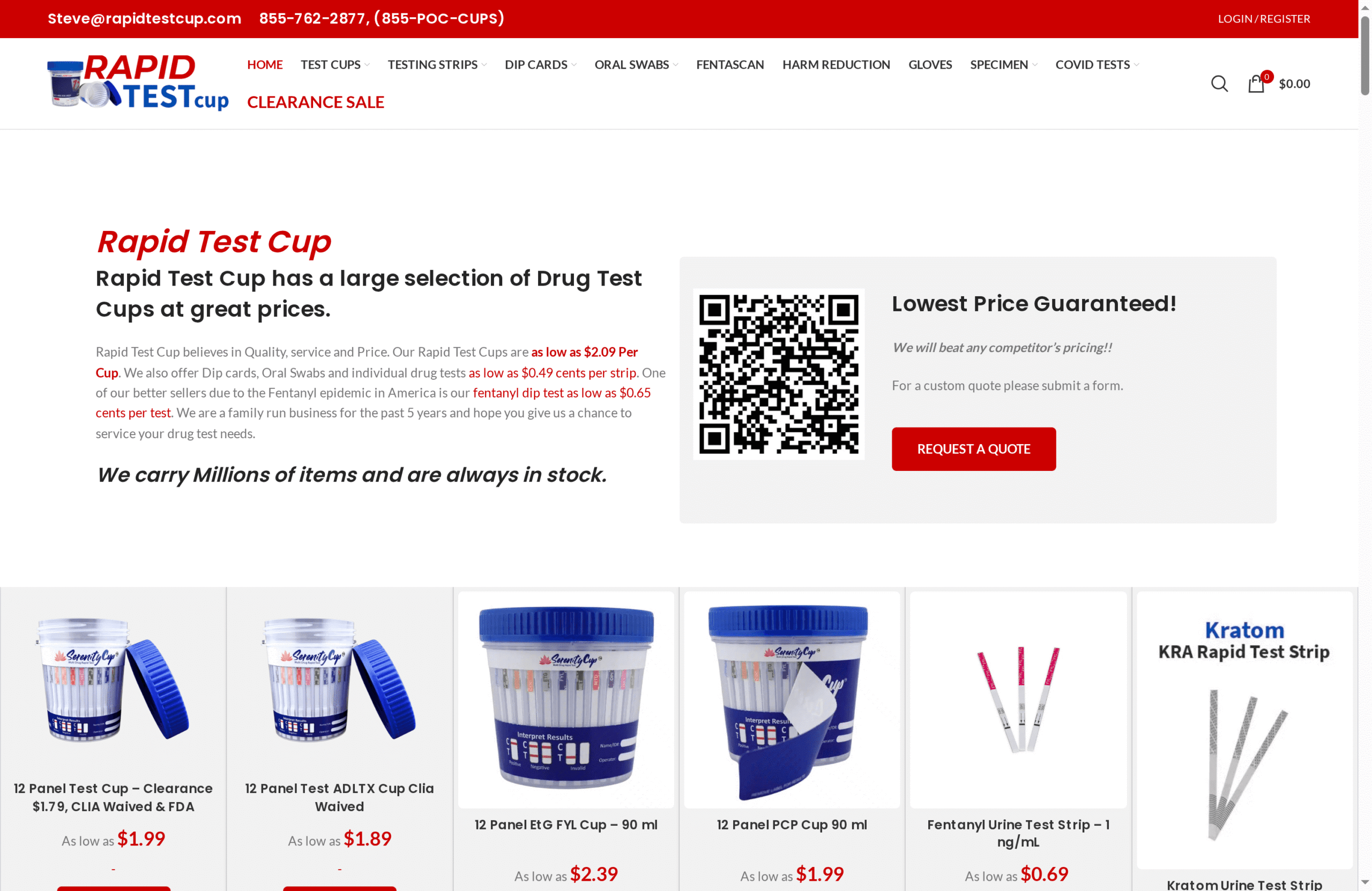
Buying the screen and the collection supplies in one place, and planning the confirmation step before you test, keeps your program consistent from the first cup to the final report.
Our perspective
A screening test is a question you ask a sample, and every question has a scope. The best programs we see in the market we serve are the ones that decide that scope on purpose: which drugs, which cutoff, which follow-up.
We built our catalog around that idea. Benzodiazepine strips, multi-panel cups, dip cards and collection supplies give a lab, clinic or employer a fast first answer at a price that lets you test as often as your policy requires. Fast screening is what makes it practical to test every person who needs testing, and it is what tells you which samples deserve a deeper look.
When you pair a well-chosen screen with a clear confirmation plan, a negative result becomes something you can act on with confidence. That is the standard we want every customer to reach, whether they order one cup or a case.
Justin
FAQ
Can a benzodiazepine test be negative if the person took a benzodiazepine?
Yes. Screens react to particular metabolites at or above a cutoff, so low doses, glucuronide-heavy drugs such as lorazepam, or dilute urine can produce a negative. A negative screen is presumptive, and confirmatory testing is the way to tell a true negative from a false negative.
Which benzodiazepines are most likely to be missed?
Lorazepam, clonazepam and alprazolam are the usual examples, along with designer benzodiazepines such as bromazolam. Many immunoassays detect nordiazepam, oxazepam and temazepam more reliably. Check the assay’s stated cross-reactivity for the drug you care about.
What should I do if a negative result does not match the history?
Send the specimen for confirmatory testing by a laboratory method such as LC-MS/MS, and record the collection time, last dose and any validity concerns. In a clinical setting, review the result with the prescribing clinician.
Does a negative result mean the medication is not working or was not taken?
Not necessarily. A negative can reflect the screen’s design, the dose, timing or hydration. Do not change or stop a prescribed medicine because of a screening result. Speak with your prescriber.
Sources
- Urine Drug Tests: Ordering and Interpretation, American Family Physician (2019)
- Clinical Interpretation of Urine Drug Tests (Moeller et al., 2017)
- Opiate and Benzodiazepine Confirmations: To Hydrolyze or Not, Journal of Applied Laboratory Medicine (2018)
- Urine Benzodiazepine Screening in Lorazepam-Treated Patients, Journal of Applied Laboratory Medicine (2023)
- Roche benzodiazepines II assay evaluation (2024)
- Comprehensive Drug Screen Limits of Detection, University of Washington Laboratory Medicine
- Targeted Benzodiazepine Screen, Mayo Clinic Laboratories
- Definitive Testing Resource Guide, Labcorp (December 2025)
- LC-MS/MS accuracy explained