

Blog
Amphetamine vs. Methamphetamine Test: How Results Differ


An amphetamine (AMP) test and a methamphetamine (MET) test look for related drugs, but they are not interchangeable. Methamphetamine breaks down in the body into amphetamine, while amphetamine never turns into methamphetamine, so the pattern of the two on a lab report tells you which one was taken. A rapid screen can flag either one. Only a laboratory confirmation can tell them apart with certainty. If you need to screen for both, use a panel cup or dip card that carries separate AMP and MET lines, or a single-drug strip for each, and send every presumptive positive for confirmation.
This guide is for labs, clinics, treatment programs, employers and individuals who need to choose a test and read the result correctly.
TL;DR
- Methamphetamine is metabolized into amphetamine, but amphetamine is not metabolized into methamphetamine. Amphetamine alone points to amphetamine as the drug taken.
- Rapid screens are presumptive. Cross-reacting medicines can trigger them, and confirmation by GC-MS or LC-MS/MS settles which substance is present.
- Typical urine detection is about 1 to 5 days for both drugs, depending on dose, frequency and individual metabolism.
- Federal workplace testing under DOT rules uses a 500 ng/mL screen and a 250 ng/mL confirmation cutoff for both drugs.
- Choose the test by purpose: a screen for fast decisions, a lab confirmation for anything that carries consequences.
Table of Contents
- What the two drugs are and why they get confused
- Why a positive for one can show up with the other
- What each kind of test actually detects
- Side-by-side comparison
- Cutoffs: why the number on the device matters
- What else can cause a positive result
- Choosing the right test for your setting
- How to collect and read a test properly
- Our perspective
- Get the right screen in your hands
- FAQ
- Sources
What the two drugs are and why they get confused
Amphetamine and methamphetamine are central nervous system stimulants. Both are Schedule II controlled substances in the United States, which means they have accepted medical uses and a high potential for misuse. Amphetamine is the active ingredient in prescription ADHD and narcolepsy medicines such as Adderall. Methamphetamine is available by prescription as Desoxyn, but most people who test positive for it have used illicit methamphetamine.
The molecules differ by one small chemical group, which is why the tests overlap. Each drug also exists in two mirror-image forms, called d- and l-isomers. The d-form carries considerably more stimulant activity, while the l-form has decongestant properties and is the active ingredient in some nasal inhalers. That detail matters later when a positive methamphetamine result needs an explanation.
Why a positive for one can show up with the other
The body handles the two drugs differently:
- Methamphetamine is metabolized in the liver to amphetamine. A person who used methamphetamine will usually show both methamphetamine and amphetamine in urine.
- Amphetamine is not converted back. Mayo Clinic Laboratories states that absence of methamphetamine in the presence of amphetamine indicates amphetamine was the primary drug taken.
This one-way relationship is the key to interpretation. Amphetamine only: think amphetamine, including prescribed amphetamine products. Methamphetamine with amphetamine: think methamphetamine. Methamphetamine at a much higher level than amphetamine: the dose was likely recent, since the metabolite has not yet built up.
Half-lives differ, too. Mayo Clinic Laboratories lists 9 to 24 hours for methamphetamine and 4 to 24 hours for amphetamine.
What each kind of test actually detects
Rapid screens (cups, dip cards and strips)
A rapid test is an immunoassay: antibodies react to a drug family and show a line or no line against a set cutoff. An AMP line responds mainly to amphetamine, and a MET line responds mainly to methamphetamine. Because the antibodies recognize chemical shapes rather than exact molecules, similar compounds can set them off. Research on amphetamine immunoassays notes that cross-reactivity limits specificity, and that is the reason the next step exists.
A screen tells you quickly whether a specimen is below or above the cutoff. It does not tell you the exact drug, the exact amount or the exact source.
Laboratory confirmation
Confirmation uses mass spectrometry (GC-MS or LC-MS/MS), which identifies each molecule by its mass. A clinician guide describes GC-MS as the criterion standard for confirmation, accurate and reliable though slower and costlier than a screen. Mayo Clinic Laboratories’ LC-MS/MS method reports amphetamine and methamphetamine as separate quantitative results, which is exactly the separation a rapid test cannot give.
Isomer testing
When a methamphetamine result needs a source, laboratories can run a d/l isomer test. LabCorp explains that both forms test positive by immunoassay and most confirmation assays, so a special isomer test measures how much of each form is present. In its FAQ, a report showing more than 80% l-methamphetamine is consistent with an inhaler or a prescription medicine metabolized to l-methamphetamine, while more than 20% d-methamphetamine points to a prescription or illicit d-methamphetamine preparation.
There are limits. Aegis Laboratories reviewed over 2,300 positive methamphetamine urine specimens and found that 92% were entirely d-methamphetamine. A mostly l-isomer result does not guarantee that no illicit methamphetamine was used, because seized illicit samples have contained high proportions of l-methamphetamine.
Side-by-side comparison
| Question | Amphetamine (AMP) test | Methamphetamine (MET) test |
|---|---|---|
| What it targets | Amphetamine | Methamphetamine |
| Will it flag the other drug? | Can, if methamphetamine metabolizes to amphetamine | Can, with related compounds, at high levels |
| Common non-illicit sources | Prescription ADHD medicines, some OTC and prescription cross-reactants | Desoxyn, certain inhalers, selegiline |
| Typical urine window | About 1 to 3 days, up to 5 | About 1 to 5 days |
| Rapid screen result | Presumptive | Presumptive |
| How to settle it | LC-MS/MS or GC-MS | LC-MS/MS or GC-MS, plus d/l isomers if needed |
Urine detection times come from lab sources: Mayo Clinic Laboratories lists up to 3 days for both drugs at a 25 ng/mL limit, and Navis Clinical Laboratories gives 1 to 5 days for methamphetamine in urine. Dose, frequency of use and individual metabolism move the window in either direction. For a deeper look at timing by test type, see our guide to methamphetamine detection time and the broader detection windows overview.
Cutoffs: why the number on the device matters
A cutoff is the concentration at or above which a specimen is called positive. Two cutoff layers exist: one for the screen and a lower one for confirmation.
For federally regulated DOT testing, 49 CFR 40.87 sets a 500 ng/mL initial screen and 250 ng/mL confirmatory cutoffs for both amphetamine and methamphetamine. A result below the cutoff is reported negative. A screen at or above 500 ng/mL goes to confirmation, and a confirmed result at or above 250 ng/mL is reported positive.
Non-regulated settings can use different numbers. Some laboratory confirmation methods run much lower, such as a 25 ng/mL cutoff at Mayo Clinic Laboratories or 200 ng/mL at OHSU’s confirmatory test. Lower cutoffs find lower concentrations and extend the apparent window, so a quoted “detection time” is only meaningful next to its cutoff. Our cutoff levels guide for professionals walks through how to match a device to a program’s policy.

What else can cause a positive result
Because the answer is rarely just “drug or no drug,” a good reader of results asks about medicines.
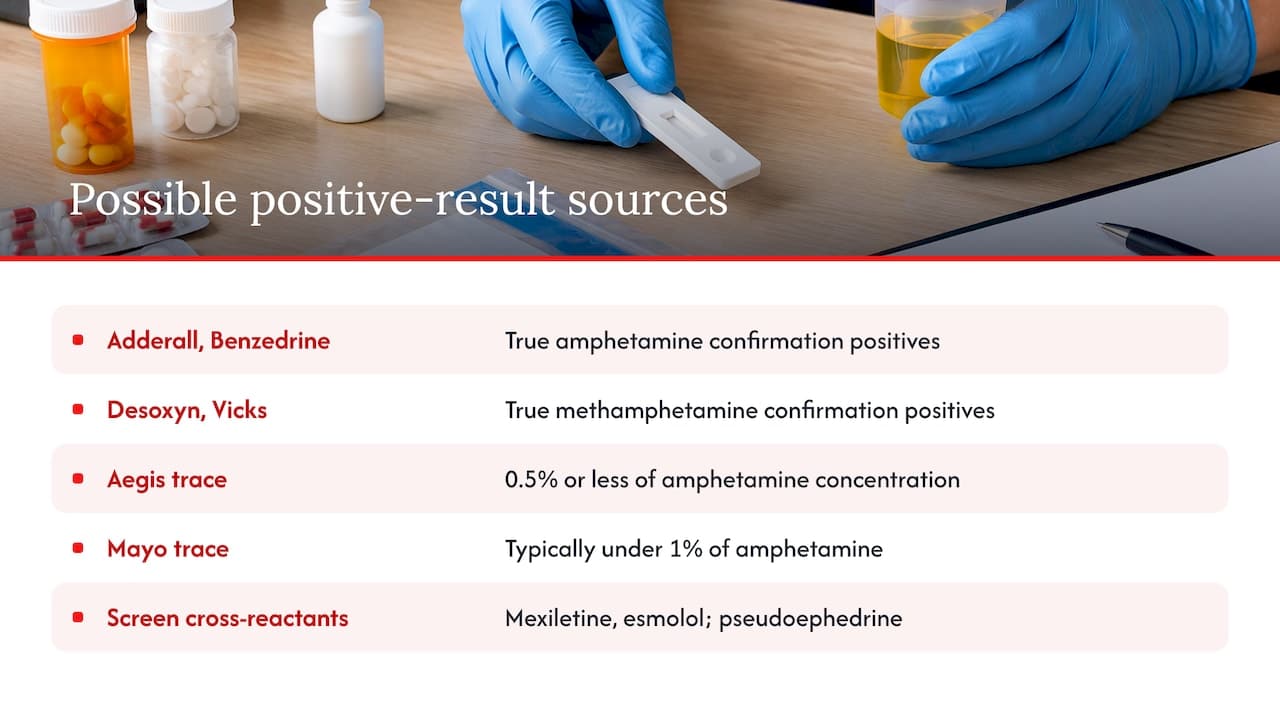
Prescription amphetamine products. Mayo Clinic Laboratories notes that its confirmation test returns true positives for patients taking Adderall and Benzedrine (amphetamine), and Desoxyn and Vicks Inhaler (methamphetamine). Selegiline and famprofazone are metabolized to methamphetamine and amphetamine, and some pro-drugs such as clobenzorex and fenproporex are metabolized to amphetamine.
Adderall and methamphetamine. This is the most common question. Aegis states that amphetamine products do not typically cause a positive methamphetamine result on definitive testing, except where a trace of methamphetamine, 0.5% or less of the amphetamine concentration, appears as a possible impurity. Mayo Clinic Laboratories puts trace methamphetamine in amphetamine products at typically under 1% of the amphetamine concentration. A large methamphetamine value is therefore a different picture from a trace. Our page on Adderall urine detection covers the timelines in more detail.
Cross-reacting substances on screens. Point-of-care devices can give a false-positive amphetamine result from structurally similar prescription, over-the-counter or illicit drugs, which definitive testing does not reproduce. Published case reports describe examples such as mexiletine and esmolol triggering amphetamine screens. Pseudoephedrine can cross-react on immunoassays, while Mayo Clinic Laboratories reports it as negative in its confirmation at 25 ng/mL.
For anyone taking prescribed amphetamine, the useful step is to record the medicine and dose before collection and take the question to the prescriber. Patients who manage ADHD treatment can find a step-by-step overview of ADHD medication management helpful when preparing for a screening conversation.
Choosing the right test for your setting
Employers and occupational health
For regulated work, follow the federal rule and send non-negative screens to a certified laboratory. If an employee says a prescription explains the positive, 49 CFR 40.141 requires the medical review officer to conduct a medical interview and verify the medical records, and it allows the MRO to request d,l-stereoisomer testing for amphetamine and methamphetamine. For non-regulated programs, a multi-panel cup that includes both AMP and MET lines gives a fast, documented first pass. Our comparison of cup and dip card formats helps with the choice.
Clinics and treatment centers
Treatment programs often want to know whether a patient is taking a prescribed stimulant, an illicit one, or both. ARUP Laboratories describes a screen with reflex to quantitation as the preferred method for ruling out amphetamine exposure in compliance or abuse settings: a positive screen is confirmed by LC-MS/MS. In practice that means rapid screening at the point of care, with confirmation for any result that will change care or standing in the program. Laboratories such as OHSU also note that identifying the specific drug can be hard when metabolites are themselves prescription drugs, and that a missing expected drug can reflect timing, dilution or adulteration as well as non-adherence. That is why adulterant checks on the cup are worth having.
Law enforcement and forensic users
A field or intake screen is an investigative lead. Evidentiary conclusions rest on laboratory confirmation, with the d/l isomer ratio available where the source of methamphetamine is disputed.
Individuals
At home, a single-drug strip answers one question well, while a panel answers several. If you are checking for methamphetamine only, a MET drug test strip is the direct route, and an AMP drug test strip covers amphetamine. If you take a prescribed amphetamine, expect your AMP line to react. A positive for either drug on a home test is a presumptive result, and a doctor or laboratory can give you a definitive answer.
How to collect and read a test properly
- Pick the cutoff first. Match the device to the cutoff your policy or physician specifies, not the other way round.
- Record medicines. Note prescription and over-the-counter products taken in the past several days, including inhalers and cold remedies.
- Collect a fresh specimen. Use a sterile urine collection cup, and keep the chain of custody if results may be disputed. Dilute or adulterated urine can hide a drug, which is the reason adulterant checks matter.
- Read within the stated time. Follow the device instructions exactly. A line that appears after the window is not a result.
- Treat any positive as presumptive. Send the same specimen, or a split specimen, to a laboratory for GC-MS or LC-MS/MS. OHSU states that urine specimens stay stable for 7 days at ambient temperature, 14 refrigerated and 30 frozen, so there is time to arrange confirmation.
- Interpret in context. Amphetamine alone, methamphetamine with amphetamine, and methamphetamine with a high l-isomer share each tell a different story.
Unexpected results from point-of-care devices should go to a reference laboratory for follow-up, as family physicians’ guidance on point-of-care screening also notes.
Our perspective
We sell drug tests every day, and the question we hear most is whether one test can tell amphetamine from methamphetamine. The honest, useful answer is that a screen is the fast first step and the lab report is the final word, and the two work best together.
That is how we stock the catalog. For labs, clinics and employers who need speed, we carry multi-panel cups and dip cards with separate AMP and MET lines, single-drug AMP and MET strips for targeted checks, and urine specimen collection supplies. Our selection includes CLIA-waived and FDA-approved options, and bulk pricing is available for programs that test often.
We are a family business, and we ship the same day. Our aim is to make accurate screening affordable enough that programs test when they should, then confirm what matters.
Justin
Get the right screen in your hands
If you test for both drugs regularly, start with a multi-panel format that matches your cutoff policy. Browse test cups, dip cards, strips and collection supplies in one place, or look at the 10 panel dip card if you want a card format. We offer bulk discounts and custom quotes for larger orders.
FAQ
Can a drug test tell amphetamine from methamphetamine?
A rapid screen cannot reliably separate them, because each antibody line can react to related compounds. A laboratory test using GC-MS or LC-MS/MS reports each drug separately. If methamphetamine is present, amphetamine usually appears too, while amphetamine alone points to amphetamine.
Can Adderall cause a positive methamphetamine test?
On definitive laboratory testing, it typically does not. A trace of methamphetamine, around 1% or less of the amphetamine concentration, can be detected in some amphetamine products. A rapid screen may cross-react, so confirmation is the way to resolve it.
How long do amphetamine and methamphetamine stay in urine?
Laboratory sources give roughly 1 to 5 days, with up to 3 days common at low cutoffs. Dose, frequency of use and individual metabolism change this, and heavier or chronic use can extend it.
Which is the best methamphetamine test?
The best one depends on the job. For quick on-site checks, a MET strip or a multi-panel cup or card with a MET line matches the cutoff you need. For results that carry consequences, a laboratory LC-MS/MS confirmation is the standard.
Why did I test positive for amphetamine?
Common reasons are a prescribed amphetamine medicine, methamphetamine use that metabolized to amphetamine, or a cross-reacting drug on a screen. Share your medication list with the testing provider or medical review officer so the result can be interpreted correctly.
Sources
- Mayo Clinic Laboratories: Amphetamines Confirmation, Random, Urine
- Mayo Clinic Laboratories: Amphetamine-Type Stimulants
- Navis Clinical Laboratories: Methamphetamine & Amphetamine
- Aegis: Methamphetamine Interpretation and D/L Isomer Testing
- Aegis: What Did My Patient Actually Take?
- LabCorp: Amphetamine testing FAQ
- OHSU: Amphetamine/Methamphetamine Confirm, Urine
- ARUP Laboratories: Amphetamines Urine Screen with Reflex to Quantitation
- Urine Drug Screening: Practical Guide for Clinicians
- 49 CFR 40.87
- 49 CFR 40.141
- Qualitative GC-MS method for methamphetamine and amphetamine in urine
- Mexiletine and False Positive Urine Drug Screen for Amphetamine
- Esmolol-Induced False-Positive Amphetamine Urine Drug Test
- ACOFP: Urine Drug Screening, Point of Care Testing