Blog
How Accurate Are Adulteration Strips? What Each Pad Tells You


Adulteration strips are accurate at the job they are built for: flagging urine whose pH, creatinine, specific gravity or oxidant content falls outside the range of normal human urine. They do not identify drugs, and no strip is a lab test. Used inside a drug test cup, read within the insert’s time window and backed by supervised collection and a confirmation path, they give a clinic, employer or treatment program a fast, defensible first check on whether a specimen is genuine.
This guide explains what each pad measures, the numeric cutoffs that regulators use, what drives agreement between strips and instruments, and how to act on a result.
TL;DR
- Adulteration pads screen specimen validity (pH, creatinine, specific gravity, oxidants such as nitrite, bleach and chromium). They do not detect drugs.
- Accuracy depends on the cutoff each pad is built around and on reading the color blocks inside the time window in the insert.
- Strips and laboratory instruments can disagree near the edges of a range, so treat a borderline pad as a reason to look closer, not as a verdict.
- Every strip or immunoassay result is presumptive. Send questionable or consequential specimens to a reference laboratory.
- A cup with built-in adulteration pads, a supervised collection and a documented next step is the most reliable setup for daily screening.
Table of Contents
- What adulteration strips actually check
- The numbers that define “adulterated,” “substituted” and “dilute”
- What drives strip accuracy
- What the research says about commercial adulterants
- Synthetic urine: add controls around the strip
- How to read an adulteration result
- Which setup fits which reader
- Promo: cups with adulteration pads built in
- Our perspective on strip accuracy
- Choosing a cup for validity checking
- FAQ
- Sources
What adulteration strips actually check
A drug test cup has two jobs. The drug panel tells you whether certain drugs or metabolites are above a cutoff. The adulteration strip tells you whether the liquid in the cup behaves like urine. Both are screens, and both are read visually against a printed color chart.
People tamper with a specimen in three ways: they dilute it, they substitute something else, or they add a chemical. Each leaves a different footprint, and each pad targets one:
| Pad | What it looks for | Why it matters |
|---|---|---|
| Creatinine | Concentration of a normal urine waste product | Very low values suggest dilution or substitution |
| Specific gravity | Density of the liquid | Out-of-range density points to dilution or a non-urine liquid |
| pH | Acidity or alkalinity | Extreme values suggest an added acid or base |
| Oxidants (nitrite, bleach, chromium, other) | Oxidizing chemicals that can destroy drug metabolites | Their presence means something was added |
The American College of Osteopathic Family Physicians advises suspecting adulteration or dilution when pH is below 3 or above 11, or when specific gravity is below 1.002 or above 1.030. It also lists the usual additives and what each one targets, including bleach, potassium nitrate, peroxidase, glutaraldehyde and pyridium.
If you want a plain-language walkthrough of the individual pads, our guide to adulteration test strips covers them one by one.
The numbers that define “adulterated,” “substituted” and “dilute”
The clearest cutoffs come from federal rules. They were written for regulated programs, but they are a useful benchmark for any strip user, because they show where the field draws its lines.
Under 10 CFR 26.161, the cutoffs used for validity testing in programs covered by that regulation are:
- Adulterated: pH below 3 or at or above 11, nitrite at or above 500 mcg/mL, chromium (VI) verified at or above 50 mcg/mL, or a halogen verified. Nitrite, chromium (VI) and halogen require a different confirmatory test on a second aliquot (a second portion of the same specimen).
- Substituted: creatinine below 2 mg/dL and specific gravity at or below 1.0010 or at or above 1.0200, on both the initial and the confirmatory test.
- Dilute: creatinine from 2 mg/dL up to but not including 20 mg/dL, with specific gravity above 1.0010 but below 1.0030.
The same rule family sets a lower bar for screening at the point of collection. 10 CFR 26.137 requires on-site validity screening tests to use a 20 mg/dL creatinine cutoff, to detect pH below 4.5 or at or above 9, and to detect oxidants at 200 mcg/mL nitrite-equivalent or more, or chromium at 50 mcg/mL chromium (VI)-equivalent, or a halogen at the limit of detection. That is deliberate. A screen is set to be sensitive, so that anything suspicious goes on for confirmation.
For DOT-regulated testing, 49 CFR Part 40 requires HHS-certified laboratories to measure creatinine on every primary specimen, specific gravity when creatinine is below 20 mg/dL, pH on every specimen, and at least one oxidizing-adulterant test. Federal workplace programs run those checks in a certified lab, which is where a strip result gets confirmed.
What drives strip accuracy
When readers ask how accurate a strip is, they usually want one percentage. No single figure applies to every strip, because accuracy depends on four things.
1. The pad’s cutoff and its color chart
Each pad is built to change color at a stated threshold. Reading is semi-quantitative: you match the reacted block to the printed color blocks. A result that sits squarely in the normal block is reliable. One that sits between two blocks is a signal to look again under good light, then follow your protocol.
2. Timing
Reagent pads keep reacting after the window in the insert closes. Read at the time the instructions give and ignore later color shifts. Set a timer rather than judging by feel.
3. The method you compare against
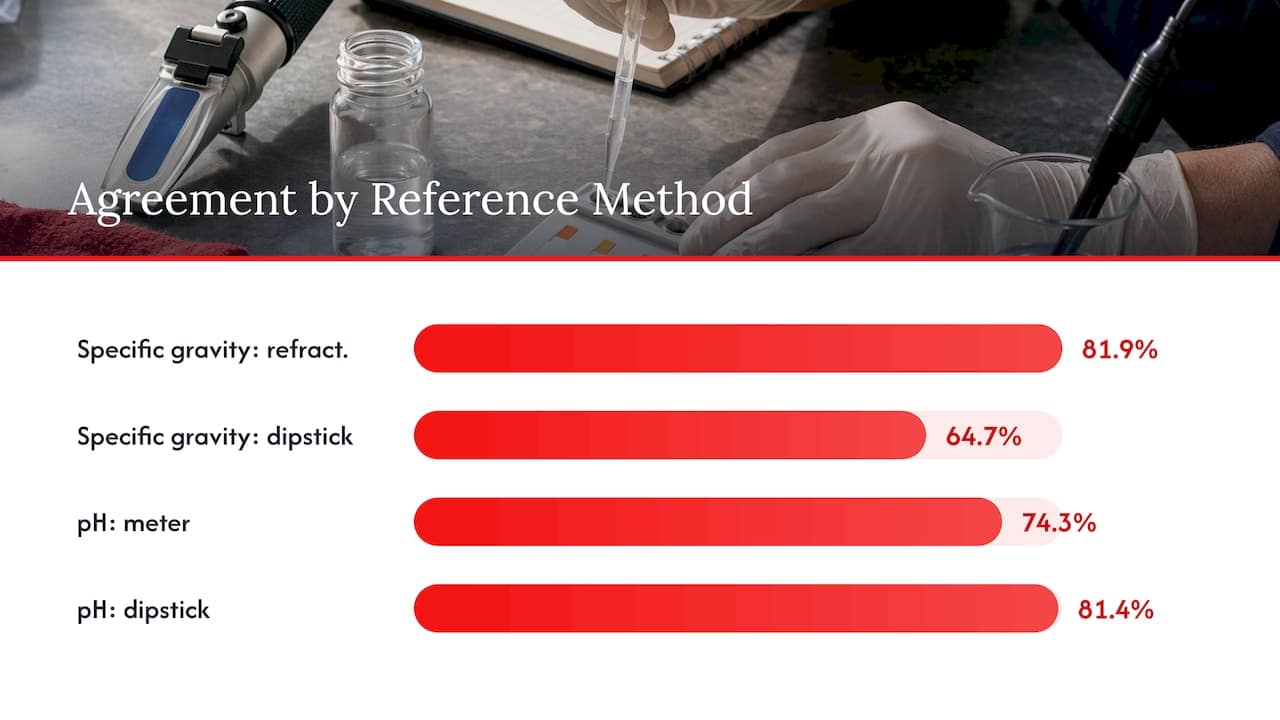
A 2021 peer-reviewed comparison of validity-testing methods in PubMed Central shows how much the reference method matters. Automated chemical specific-gravity methods agreed with a refractometer 81.9% of the time and with a dipstick 64.7% of the time. For pH, chemical methods agreed with a pH meter 74.3% of the time and with a dipstick 81.4% of the time. In other words, strips and instruments are measuring the same thing in different ways, and agreement is strongest away from the cutoff edges.
The same study found the oxidant assay correlated well with the dipstick method for pyridinium chlorochromate, nitrite and bleach. That is good news for the pad most people care about, the oxidant check, because oxidants are what the most common commercial adulterants rely on.
4. What was added, and how much
Strips respond to concentration. A 2023 review summarized one study in which lower concentrations of bleach were missed by the bleach pad, while acetic acid showed up mainly through abnormal pH. A 2020 study found that vinegar barely shifts urine’s physiological properties, which is why small household additions can pass a validity check. The practical lesson is that the strip is one layer. Controls at collection fill in the rest.
What the research says about commercial adulterants
The products people actually buy are more chemically active than kitchen additives. A 2022 study in the Journal of Analytical Toxicology searched the U.S. market in December 2020 and found three commercial adulterants and 32 synthetic urines. An iodate-containing adulterant reduced THC-COOH (the main cannabis metabolite) by 65%, and a nitrite adulterant reduced it by 22%. Both active adulterants in that study were caught by positive oxidant screens, which is exactly the kind of product the oxidant pad is there to flag.
That is the strongest argument for a cup with adulteration pads built in: the products that do the most damage to a drug result are the ones with an oxidant signature.
Synthetic urine: add controls around the strip
Synthetic urine is designed to look like real urine, with normal creatinine, pH and specific gravity. In the 2022 study above, 8 of 10 synthetic urines gave validity results consistent with authentic urine. A 2018 U.S. Army study of eight commercial synthetic products found that five were identified by physical observation, and that a dedicated on-site synthetic-urine strip detected them.
Two points follow for anyone running collections:
- Physical observation matters. Temperature, color, foaming and how the specimen was produced catch things no pad can.
- A 2023 review concluded that supervised collection with temperature control and visual inspection, plus creatinine and oxidant validity testing, together minimize manipulation risk. It also noted that laboratories are moving toward screening for the absence of endogenous biomolecules as a more robust synthetic-urine check.
Our checklist for test administrators turns this into steps you can post at the collection site.
How to read an adulteration result
Follow the same sequence every time. It keeps results consistent between staff and defensible if questioned.
- Check the cup temperature strip first. Do this within the window stated in the insert.
- Start the timer when you read the pads. Use the reading window in the instructions and ignore changes afterward.
- Read each pad against the printed color chart, in good, neutral light, with the cup held next to the chart.
- Record every pad result, including normal ones, with the lot number and time.
- Interpret the drug panel only after the validity pads are normal. A negative drug result on a specimen with an abnormal pad is not a clean negative.
- Decide the next step in advance: recollect under direct observation, or send the specimen to a reference laboratory.
The ACOFP guidance is clear that immunoassay results are presumptive and that neither a positive nor a negative result alone includes or excludes drug use. For legal, forensic, medical or pre-employment settings, it advises considering screening and confirmation through a reference laboratory when needed.
When a pad is abnormal
A 2021 recommendation in the PubMed Central comparison is useful here. When the oxidant assay is negative but pH or specific gravity falls outside the reference interval, test the suspected specimen further for synthetic urine. Dilute urine, cleansing products, additives and substituted samples can all mask drug use.
If your program is federally regulated, the confirmation stage is formal. The 2024 SAMHSA Medical Review Officer Guidance Manual, effective February 1, 2024, states that HHS requires certified laboratories to run a pH test and a test for one or more oxidizing compounds on all regulated urine specimens. It also says the laboratory must contact the Medical Review Officer (the physician who reviews results) before reporting a specimen invalid when tests suggest a possible unidentified adulterant. For adulterants without a set cutoff, such as glutaraldehyde or peroxide, split-specimen reconfirmation is reported only as “reconfirmed” or “failed to reconfirm.” Those steps belong to the laboratory and the MRO, which is why a strip result in a regulated program is a trigger, not a final finding.

A January 2025 Federal Register rule, effective July 7, 2025, also revised the authorized testing panels and required report nomenclature for federal workplace programs. If you test under those rules, check your panel and report wording against it.
Which setup fits which reader
- Employers and occupational health providers: a multi-panel cup with adulterant pads covers drug screening and validity in one device. Keep a written recollection and referral policy. For DOT-regulated testing, the regulated process runs through certified labs and an MRO, so use the cup for non-regulated screening.
- Treatment centers and clinics: frequent testing makes consistent reading and record-keeping matter more than any single device feature. A cup with a validity strip row gives staff the same check at every visit.
- Law enforcement and forensic users: treat the strip as the on-site screen and send anything that will be relied on to a laboratory.
- Individual consumers: adulteration pads help you confirm that a home specimen was handled correctly, and they make a result easier to interpret.
Promo: cups with adulteration pads built in
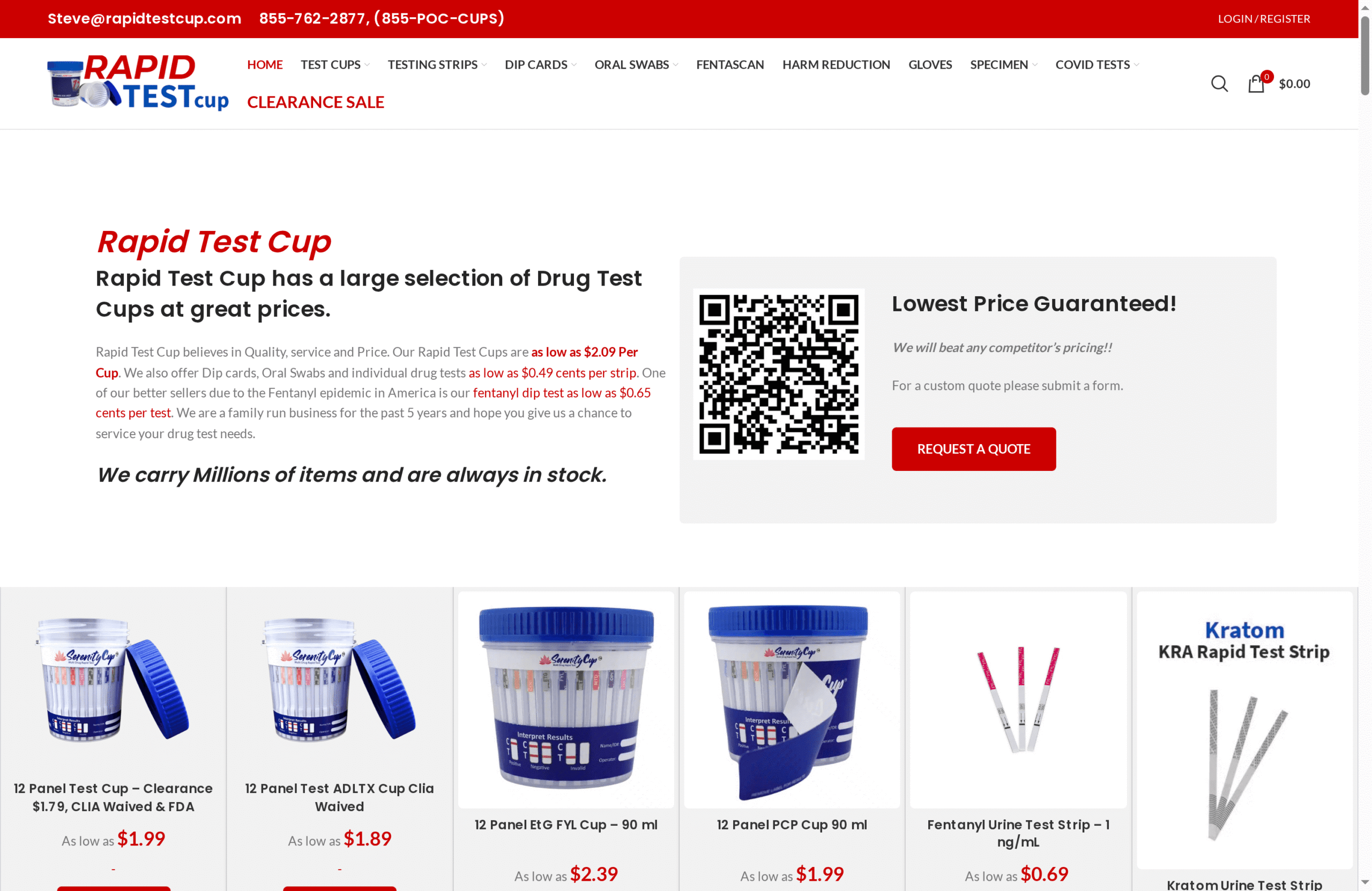
Our catalog includes drug test cups where the adulterant pads sit in the same device as the drug panel, so one collection gives you both answers. Options include the 15 panel cup with adulterants, the 16 panel cup with ADLTX and the 18 panel cup with adulterants. Our selection includes CLIA waived and FDA-approved options, bulk pricing and custom quotes for larger programs. You can browse everything in our shop.
If you want to compare formats first, see cup vs dip card drug tests.
Our perspective on strip accuracy
Most questions we get about adulteration strips are really questions about trust: can I rely on what I am seeing in the cup? Our answer is that you can rely on a strip when you use it for what it was designed to do.
A validity pad is a fast, low-cost way to find out whether a specimen behaves like urine. The cutoffs it is built around are the same ones the field uses: pH, creatinine, specific gravity and oxidants. That is why we sell cups with adulterant pads built in. One collection, one device, both the drug result and the validity result.
The best programs we can describe treat the pad as the first layer of three: supervised collection, the on-site strip, and a laboratory for anything that matters. That is also why we offer bulk pricing and custom quotes, so a clinic or employer can standardize on one device and one reading routine across every site and every staff member. Consistency does more for accuracy than any single feature.
Our guides on urine specimen validity and adulterant detection methods go deeper on each pad.
Justin
Choosing a cup for validity checking
When you compare cups, look at four things:
- Which adulterants the cup checks. Confirm that it includes oxidants, pH and creatinine or specific gravity, and match it to your policy.
- Panel and cutoffs in ng/mL. Make sure the drug panel matches what you need to detect, including fentanyl, synthetic cannabinoids or alcohol metabolite where relevant.
- Regulatory status. Check whether the model is CLIA waived and FDA-cleared for your use.
- Volume and reordering. If you test regularly, bulk pricing and consistent stock mean the same lot and the same color chart for everyone.
Our comparison of top urine drug test cups lays these side by side, and our guide to urine test strip types helps if you are also using separate strips.
FAQ
Do adulteration strips detect drugs?
No. They check whether the specimen looks like genuine, undiluted urine by measuring pH, creatinine, specific gravity and oxidants. The drug panel on the cup or dip card does the drug screening, and both results should be read together.
What pH and specific gravity values suggest a tampered sample?
Guidance from the American College of Osteopathic Family Physicians says to suspect adulteration or dilution when pH is below 3 or above 11, or when specific gravity is below 1.002 or above 1.030. Federal rules use their own formal cutoffs for reporting a specimen as adulterated, substituted or dilute.
Can a strip result be used as final proof of tampering?
No. Strip and immunoassay results are presumptive. For employment, legal, forensic or medical decisions, send the specimen to a reference laboratory, and in a federally regulated program let the laboratory and the Medical Review Officer handle it.
How can I reduce false readings?
Read the pads within the time window in the insert, use good light, compare against the printed chart, and record every result. Combine the strip with supervised collection and a temperature check.
Sources
- Urine Drug Screening: Point of Care Testing (ACOFP)
- 10 CFR 26.161, Cutoff levels for validity testing
- 10 CFR 26.137, Quality assurance and quality control
- 49 CFR Part 40, DOT drug testing procedures
- Comparison of different methods used in drugs of abuse for sample validity testing (PMC, 2021)
- Advances in testing for sample manipulation in clinical and forensic toxicology (PMC, 2023)
- Effect of Urine Adulterants on Commercial Drug Abuse Screening Tests (PMC, 2020)
- Update on Urine Adulterants and Synthetic Urine Samples (Journal of Analytical Toxicology, 2022)
- Can synthetic urine replace authentic urine to beat drug tests? (PubMed, 2018)
- SAMHSA Medical Review Officer Guidance Manual, 2024
- Federal Register, Mandatory Guidelines for Federal Workplace Drug Testing Programs: Authorized Testing Panels (January 16, 2025)