Blog
Compliance in Drug Testing: Risks and Best Practices


Protecting your laboratory from regulatory pitfalls and ensuring reliable drug test results demands more than procedural checklists. Compliance officers face the daily challenge of translating complex regulations into practical workflows that safeguard both data integrity and legal standing. By mastering the principles of Good Laboratory Practice, regulatory frameworks, and industry-specific solutions, you position your facility to deliver trustworthy outcomes—while minimizing risks of failed audits or reputational damage.
Table of Contents
- Drug Testing Compliance Fundamentals
- Legal Framework And Global Standards
- Industry-Specific Regulations And Practices
- Testing Methods And Quality Assurance
- Privacy, Consent, And Data Protection
- Common Compliance Risks And Mistakes
Key Takeaways
| Point | Details |
|---|---|
| Importance of Compliance | Drug testing compliance ensures legal protection, accuracy of results, and integrity of the testing program. Implementing robust compliance systems is essential for meeting regulatory requirements. |
| Legal Framework Awareness | Understanding federal, state, and international regulations is crucial for maintaining compliance. Organizations must adhere to the most stringent standards applicable to their operations. |
| Industry-Specific Needs | Compliance strategies should be tailored to specific industries to address their unique regulatory demands and operational risks. Regular assessments of testing protocols are necessary to ensure adequacy. |
| Data Protection and Privacy | Protecting the sensitive health information obtained through drug testing is vital. Organizations must obtain explicit consent and adhere to data protection regulations to maintain compliance and trust. |
Drug Testing Compliance Fundamentals
Drug testing compliance isn’t just about following rules. It’s about protecting your organization from legal liability, ensuring accurate results, and maintaining the integrity of your testing program. As a compliance officer overseeing laboratory or healthcare facility operations, you’re responsible for implementing systems that meet regulatory standards while delivering reliable outcomes. The foundation of this responsibility rests on understanding what compliance actually means in the context of drug testing and why it matters at every level of your operation.
Compliance in drug testing requires adherence to established regulatory frameworks and quality standards that govern how tests are conducted, documented, and reported. Organizations implementing good laboratory practices establish standardized procedures that ensure consistent quality across all testing activities. These practices cover several critical areas:
- Test facility management and personnel qualifications
- Standard operating procedures that staff must follow without exception
- Equipment maintenance and calibration schedules
- Data recording systems that create an auditable trail
- Quality assurance protocols that verify results before reporting
- Proper archiving and retention of all testing records
Your facility must also address quality attributes and release testing procedures to ensure every test meets established specifications. This means validating your testing methodologies, maintaining detailed certificates of analysis, and ensuring your analytical processes can withstand regulatory scrutiny. When results are questioned or challenged in legal proceedings, your documentation becomes the evidence that proves your testing was conducted correctly.
The practical reality of compliance involves more than understanding regulations. You need systems that translate regulatory requirements into daily operational tasks. This includes training staff members consistently, implementing verification checkpoints throughout the testing workflow, and maintaining communication between departments about procedural changes. Non-compliance creates exposure: failed audits, invalidated results, potential legal liability, and damage to your facility’s reputation. Compliance isn’t a destination you reach once and forget about. It’s a continuous process that requires regular review, staff training, and refinement as regulations evolve and your facility’s capacity changes.
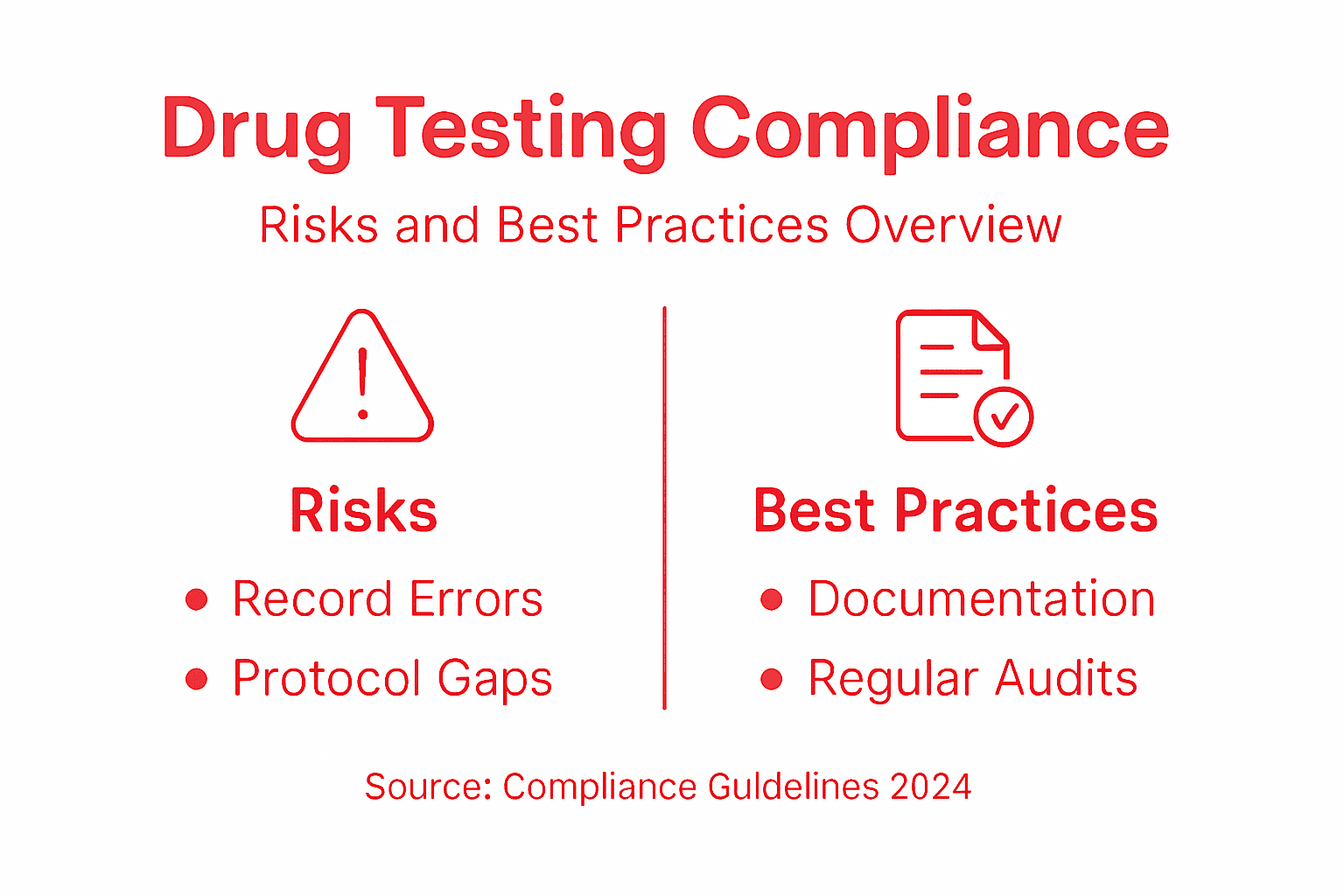
Pro tip: Create a quarterly compliance review schedule where you audit 10-15 percent of your completed test files, checking that all required documentation is present, procedures were followed, and results were properly verified before reporting.
Legal Framework and Global Standards
Your drug testing program doesn’t operate in isolation. It exists within a complex web of federal regulations, state laws, and international agreements that define what you can test for, how you must conduct tests, and what happens with the results. Understanding this legal landscape is critical because a single compliance misstep can invalidate your entire testing program, expose your organization to litigation, and undermine the credibility of results you’ve documented meticulously. For compliance officers, mastering these frameworks transforms you from someone checking boxes into someone protecting your organization strategically.
At the federal level, updated mandatory guidelines for federal workplace drug testing establish precise standards that many organizations adopt even when not federally mandated. These guidelines specify:
- Authorized drug panels and testing methodologies
- Specimen collection procedures that prevent tampering or contamination
- Chain of custody requirements that document every person handling the sample
- Medical review officer verification processes before results are reported
- Cutoff levels that determine whether a test registers positive or negative
These aren’t suggestions. They represent science-based practices designed to produce results that withstand legal challenge. If your facility tests for federal contractors, transportation workers, or safety-sensitive positions, compliance with these guidelines is mandatory. Even if you’re not federally regulated, following these standards provides a defensible baseline that protects you legally.
Beyond American borders, international drug standards through United Nations treaties create a framework that influences how countries regulate drug testing, manufacturing, and distribution. The Single Convention on Narcotic Drugs and the Convention on Psychotropic Substances establish protocols that promote harmonization across nations. If your facility operates internationally or works with international clients, understanding these treaties prevents you from conducting testing that violates another jurisdiction’s laws. What’s legal in one country may be prohibited in another, particularly regarding which substances you can test for and how you handle positive results.
State and local regulations add another layer. Many states impose stricter requirements than federal law, particularly regarding privacy, notice to employees, and how results can be used. Your facility must comply with the most restrictive standard that applies to your operations, not the most lenient one. This is where many compliance failures occur: officers assume federal guidelines are sufficient without researching state requirements specific to where they operate.
Pro tip: Maintain a master compliance matrix documenting which regulations apply to each of your testing programs, including federal guidelines, relevant state laws, and any industry-specific requirements, then update it quarterly as regulations change.
This reference table shows how major regulations impact drug testing compliance:
| Regulation Level | Scope of Requirements | Example Impact |
|---|---|---|
| Federal Guidelines | Testing procedures, cutoff | Standardizes key workflows |
| State/Local Laws | Privacy, use of results | May increase employee protections |
| International Treaties | Substance definitions | Aligns cross-border testing policies |
| Industry Standards | Sector-specific protocols | Adds safety requirements for risks |
Industry-Specific Regulations and Practices
One size doesn’t fit all when it comes to drug testing compliance. A healthcare facility operates under completely different requirements than a manufacturing plant or a transportation company. Your compliance strategy must account for the specific regulatory demands of your industry because failing to do so creates gaps that regulators will find. Understanding where your industry sits on the compliance spectrum determines how aggressive your testing protocols need to be and where you should focus your resources.
Certain industries face heightened scrutiny because safety directly impacts public welfare. Healthcare organizations must verify that employees aren’t impaired while caring for patients. Transportation companies operate under federal mandates because a drowsy or impaired driver endangers lives. Safety-sensitive industries like construction and energy production conduct drug testing across pre-employment, random, and post-incident scenarios because the consequences of substance use are severe and potentially catastrophic. These sectors typically require:
- Mandatory pre-employment screening before anyone starts work
- Random testing throughout employment with no advance notice
- Post-incident testing after accidents or near-misses
- Return-to-duty testing after positive results or treatment completion
- Reasonable suspicion testing when supervisors observe impairment indicators
Manufacturing and pharmaceutical industries add another layer of complexity. Pharmaceutical regulatory compliance spans production stages from raw materials through final packaging, with agencies like the Food and Drug Administration overseeing adherence to Good Manufacturing Practices. If your facility manufactures products that enter the pharmaceutical supply chain, your drug testing program must align with GMP standards and quality assurance protocols that verify the integrity of your entire operation. This isn’t just about testing employees. It’s about demonstrating that your facility maintains the controls necessary to ensure product safety.
Other industries may implement testing more selectively based on operational risk. Office environments with minimal safety risks might conduct pre-employment screening only, while financial services firms might focus on compliance testing to meet industry standards without conducting random testing. The key is matching your testing intensity to regulatory requirements and legitimate business risks. Document your rationale for your testing approach. When audited, you need to explain why you test the way you do based on industry standards, regulatory mandates, and operational necessity. This documentation protects you if your testing practices are ever challenged.
Pro tip: Create an industry-specific compliance checklist for your sector that maps regulatory agencies, required testing types, cutoff levels, and frequency requirements, then distribute it to all supervisory staff so they understand why your facility conducts testing the way it does.
Testing Methods and Quality Assurance
Your choice of testing method determines accuracy, cost, and how quickly you can deliver results. But selecting a method isn’t just about picking what works. It’s about selecting what works reliably, consistently, and in a way that produces defensible results. As a compliance officer, you need to understand the strengths and limitations of different methodologies because regulators will ask why you chose one approach over another. A poorly selected method creates liability that no amount of documentation can fix.

Most drug testing programs use a tiered approach that balances speed with accuracy. Initial screening typically relies on immunoassay testing, which is fast and cost-effective, using antibodies to detect drug metabolites in urine. When screening tests return positive, confirmatory testing using chromatography or mass spectrometry techniques provides definitive results. This two-step process catches the vast majority of positive cases quickly while ensuring that any positive result reported to employees or agencies can withstand legal challenge. The key is that your initial screening method must meet regulatory cutoff levels and be validated for your specific population.
Here is a summary comparing major drug testing methods and their typical use cases:
| Method | Typical Use Case | Key Advantage | Main Limitation |
|---|---|---|---|
| Immunoassay | Initial rapid screening | Fast and low cost | False positives possible |
| Chromatography | Confirming positive tests | High specificity and detail | Slower, requires experts |
| Mass Spectrometry | Legal defensibility | Highest accuracy for results | Expensive and complex |
| Point-of-Care Kits | Field or quick scenarios | Immediate feedback | Limited panel coverage |
Implementing quality management systems in drug testing laboratories requires adherence to international standards like ISO 17025, which establishes requirements for laboratory competence and reliability. Your quality management system must address:
- Standard operating procedures that every technician follows consistently
- Equipment calibration and maintenance documentation
- Control materials and proficiency testing to verify accuracy
- Personnel training and competency verification
- Chain of custody protocols that track every specimen
- Result review procedures before reporting
Method validation is non-negotiable. You can’t simply adopt a new test because it’s faster or cheaper. You must validate that it performs accurately within your laboratory setting, using your equipment, with your staff. Proper analytical methodology selection balances cost, performance, and clinical utility by comparing immunoassays, chromatography, and mass spectrometry across your specific testing needs. This validation creates documented evidence that your chosen method produces reliable results, which becomes essential when results are challenged in legal proceedings or regulatory audits.
Quality control doesn’t end after validation. You run control materials alongside every batch of tests, maintain proficiency testing records quarterly, and conduct internal audits regularly. When an external regulator asks whether your laboratory is producing accurate results, these records prove you’ve been systematically verifying accuracy. Without this documentation, you’re asking regulators to trust your results based on your word alone. That’s not compliance. That’s hope.
Pro tip: Establish a quarterly method performance review where you compare your positive detection rates across testing panels to historical benchmarks and identify any drift that might indicate equipment or procedural problems before they produce inaccurate results.
Privacy, Consent, and Data Protection
Drug testing generates sensitive health information about employees and test subjects. The moment you collect a specimen, you’re collecting personal health data that deserves protection under data protection laws. Your facility doesn’t just need to conduct accurate tests. You need to protect the information you gather in ways that respect individual privacy rights while meeting regulatory obligations. This creates tension that compliance officers must navigate carefully because protecting privacy and maintaining compliance aren’t competing goals. They’re interconnected requirements that reinforce each other.
Employee consent forms the legal foundation for drug testing. Before you test anyone, you must inform them that testing will occur and obtain their explicit agreement. This isn’t a casual checkbox on an employment application. It’s documented proof that you explained what testing involves, what happens with results, and how their health information will be handled. Legal frameworks governing data processing in employment settings require that testing be justified, proportional, and authorized by law. You can’t test simply because you want to. You must have legitimate business reasons based on safety, regulatory mandate, or operational necessity. Your consent documentation must explain these reasons clearly so individuals understand why their privacy is being accessed.
Data protection regulations like GDPR establish strict requirements for handling sensitive health information. If you operate in Europe or test European residents, GDPR applies to your drug testing data. The regulation requires:
- Explicit, informed consent before processing health data
- Data minimization (collecting only what you actually need)
- Secure storage preventing unauthorized access
- Retention limits (destroying data after it’s no longer necessary)
- Rights for individuals to access, correct, or withdraw consent
- Breach notification procedures if data is compromised
Even if GDPR doesn’t directly apply to your facility, the principles represent best practices that protect you legally. When individuals know their data is secure and they understand how it’s used, they’re less likely to challenge your testing program or file privacy complaints. Your data protection practices demonstrate that you respect individuals while conducting necessary testing.
Confidentiality extends beyond legal compliance. Results must be accessible only to individuals with legitimate business need. A positive result shouldn’t be posted on a bulletin board or discussed in the break room. Medical review officers review results before reporting. Supervisors receive only confirmation that an employee is cleared to work or information about required follow-up. This compartmentalization protects privacy while allowing your facility to act on test results appropriately. Document who has access to what information and why. When audited, you need to show that your information systems are designed to protect sensitive health data rather than expose it unnecessarily.
Pro tip: Develop a data retention schedule specifying how long you keep test results, supporting documentation, and consent forms, then implement automated deletion procedures so outdated records don’t accumulate and create unnecessary security risks.
Common Compliance Risks and Mistakes
Compliance failures don’t happen because officers intentionally violate regulations. They happen because organizations underestimate the details that matter and fail to maintain consistent practices over time. You might conduct perfect testing one month and cut corners the next because of budget pressure or staff shortages. That inconsistency creates the gaps that regulators find. Understanding where most organizations stumble gives you a roadmap for where to focus your compliance efforts and what safeguards actually prevent problems.
Documentation failures top the list of compliance mistakes. You can conduct perfectly accurate tests, but if you haven’t documented that you followed proper procedures, regulators cannot verify your compliance. Common regulatory mistakes in pharmaceutical and clinical settings include incomplete records, inadequate supervision documentation, and failure to maintain chain of custody logs. Your drug testing program requires:
- Written standard operating procedures that staff must follow
- Training records proving employees understand those procedures
- Maintenance logs documenting equipment calibration and repairs
- Quality control records showing tests are verified before reporting
- Adverse event documentation if testing equipment malfunctions
- Audit trails showing who accessed sensitive test results and when
Protocol deviations represent another critical failure point. This is where your written procedures don’t match what actually happens in the laboratory. A technician takes a shortcut because they’re under time pressure. A supervisor approves a result without proper verification because the employee is trusted. Someone accesses test results without documented business need because they’re curious. Each deviation is a compliance violation. Poor supervision and protocol deviations create risks including data inaccuracies and regulatory sanctions, which can result in FDA warning letters and irreparable reputational damage. The solution isn’t to create perfect procedures that no one follows. It’s to establish realistic procedures and then enforce them consistently through regular audits and accountability.
Data integrity failures cut across all compliance issues. If your testing records are inaccurate, incomplete, or altered after initial entry, your entire program loses credibility. This includes transcription errors where positive results are accidentally recorded as negative, or intentional data manipulation where someone changes results under pressure. Implement controls that prevent data from being altered after it’s entered. Use electronic systems with audit trails. Require two people to verify positive results before reporting. Train staff that data integrity is non-negotiable. When regulators review your facility, they assume data integrity failures exist until you prove they don’t. This paranoid approach protects you because it creates the systems and documentation that actually prevent failures.
Pro tip: Conduct a mock regulatory inspection quarterly where you select 15 percent of your test files randomly and verify that all required documentation is present, procedures were followed correctly, and data entries are accurate and unaltered.
Ensure Compliance in Drug Testing with Reliable Supplies from RapidTestCup
Navigating the complex landscape of drug testing compliance requires more than knowledge—it demands accurate, high-quality testing tools that meet regulatory standards and support your quality assurance protocols. Whether you are managing chain of custody requirements, validating testing methods, or ensuring data integrity in your laboratory, every detail counts. RapidTestCup offers a comprehensive selection of FDA-approved, CLIA-waived drug test cups, urine test strips, and specimen collection supplies designed to help you maintain strict adherence to federal and state regulations.
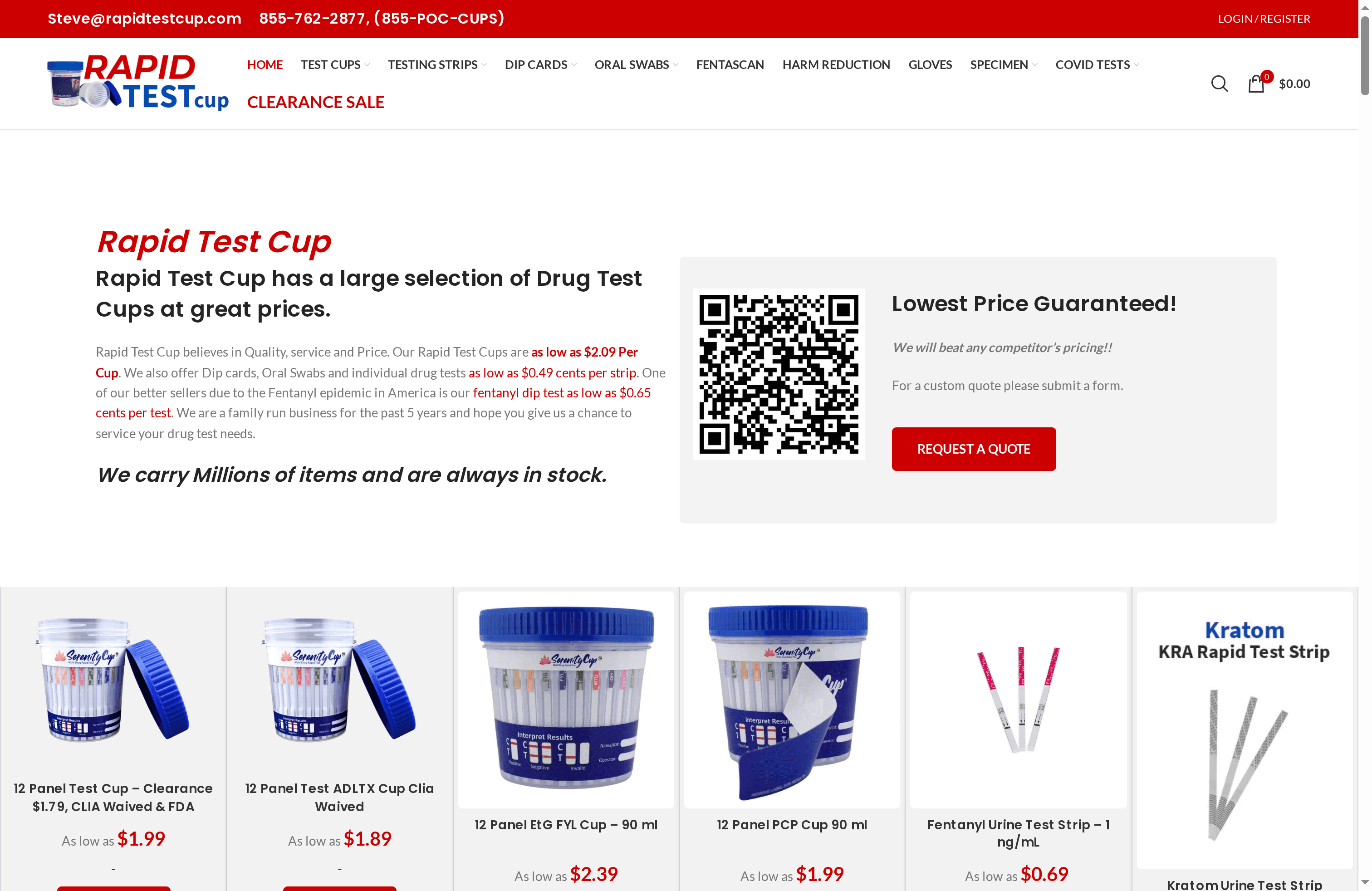
Take control of your compliance program today by choosing trusted products tailored to professional, forensic, and healthcare settings. Visit RapidTestCup for affordable bulk pricing and quick shipping that keep your operations running smoothly. Explore the full range of drug test cups and specimen collection supplies to strengthen your procedures and reduce audit risks. Don’t wait for compliance gaps to happen—equip your facility with the right tools now to uphold accuracy, privacy, and data integrity as outlined in your best practices.
Frequently Asked Questions
What is drug testing compliance?
Drug testing compliance refers to the adherence to established regulatory frameworks and quality standards that govern how drug tests are conducted, documented, and reported to ensure accuracy and legal protection.
Why is proper documentation important in drug testing?
Proper documentation is critical in drug testing because it validates that all procedures were followed correctly, creating an auditable trail that protects your organization from legal challenges and regulatory scrutiny.
What are common compliance risks in drug testing?
Common compliance risks in drug testing include documentation failures, protocol deviations, and data integrity issues, which can lead to inaccurate results and potential legal ramifications for the organization.
How can organizations improve their drug testing compliance processes?
Organizations can improve drug testing compliance by establishing written standard operating procedures, conducting regular staff training, implementing a systematic quality management system, and performing routine audits to ensure adherence to regulations.