Blog
How to document drug testing procedures for compliance


Drug testing programs fail when documentation falls short. Nearly 20% of drug test results get rejected due to improper documentation of the chain of custody, creating legal risks and compliance headaches for substance abuse programs. Accurate, standardized documentation protects your facility from litigation, ensures regulatory compliance, and maintains program credibility. This guide walks you through the essential procedures, error prevention strategies, and audit preparation methods you need to implement compliant drug testing documentation in 2026.
Table of Contents
- Introduction To Drug Testing Documentation
- Prerequisites And Requirements Before Starting Documentation
- Step-By-Step Drug Testing Documentation Procedures
- Common Documentation Errors And How To Avoid Them
- Using Technology To Improve Drug Testing Documentation
- Audit Preparation And Expected Outcomes From Proper Documentation
- Boost Your Drug Testing Compliance With Reliable Supplies
- How To Document Drug Testing Procedures Faq
Key takeaways
| Point | Details |
|---|---|
| Regulatory compliance | SAMHSA, CLIA, and FDA regulations mandate specific documentation standards for drug testing programs to maintain legal defensibility. |
| Chain of custody | Every specimen transfer requires documented signatures, timestamps, and tamper-evident seals to ensure traceability and prevent rejections. |
| Common errors | Incomplete forms, documentation delays, and non-approved test kits cause 15-20% of test rejections and create audit vulnerabilities. |
| Technology solutions | Electronic documentation systems reduce errors by 40% while improving security, efficiency, and regulatory compliance. |
| Audit readiness | Organized documentation with regular internal reviews minimizes litigation risk and demonstrates program integrity to regulators. |
Introduction to drug testing documentation
Documentation sits at the heart of defensible drug testing programs. Without proper records, even accurate test results become legally inadmissible. Understanding the regulatory framework helps you build documentation systems that withstand scrutiny.
Three primary agencies govern drug testing documentation. SAMHSA establishes federal workplace testing standards, CLIA regulates laboratory testing requirements, and the FDA approves testing devices. Failure to document specimen chain of custody correctly is a leading cause of rejected drug test results, accounting for 15-20% of all rejections. These rejections create immediate legal exposure and undermine program effectiveness.
Incomplete documentation opens your facility to multiple risks. Courts may exclude test results lacking proper chain of custody records. Regulators can impose fines or suspend testing privileges. Patients may challenge terminations or treatment decisions based on questionable documentation. These consequences extend beyond legal costs to damage your program’s reputation and operational continuity.
Standardized documentation protocols deliver measurable benefits:
- Legal defensibility when test results face challenges in administrative or court proceedings
- Regulatory compliance that satisfies SAMHSA, CLIA, and state licensing requirements
- Quality assurance through systematic tracking of specimens, equipment, and personnel
- Improved patient care by reducing errors that delay or invalidate critical test results
FDA-cleared drug test cups with tamper-evidence mechanisms are required for CLIA-waived testing environments, making equipment selection a documentation concern. Your forms must capture device information including FDA clearance numbers and lot codes. This integration between physical supplies and paperwork creates the complete record regulators expect during CLIA compliance audits.
Effective management of drug test results begins with proper documentation from collection through reporting. The documentation trail you establish today becomes the evidence you rely on during future audits or legal proceedings. Understanding drug test rejection causes helps you design systems that prevent common failures.
Prerequisites and requirements before starting documentation
Successful documentation requires preparation before the first specimen arrives. Staff competency, proper supplies, and standardized forms create the foundation for compliant record keeping.
Staff training forms your first line of defense against documentation errors. Every person who handles specimens or completes forms needs demonstrated competency in chain of custody procedures. Training should cover regulatory requirements, form completion, error recognition, and correction protocols. Document all training sessions with dates, topics, and attendee signatures. Competency assessments verify that staff can correctly execute procedures before working independently.

Using tamper-evident drug testing cups and documenting their use helps ensure specimen integrity and satisfies FDA and CLIA regulatory standards. Select collection supplies that meet three criteria. First, FDA clearance for your intended use. Second, tamper-evident seals that show any interference. Third, integrated labels or specimen IDs that prevent mix-ups. Budget-priced cups lacking these features create documentation gaps that auditors flag immediately.
Standardized forms eliminate the variation that causes documentation failures. Your chain of custody form must capture:
- Donor identification with photo ID verification
- Specimen collection date, time, and collector signature
- Transfer documentation for every person who handles the specimen
- Test device information including lot numbers and expiration dates
- Results with interpretation and reviewer signatures
Paper versus electronic documentation presents a strategic choice. Paper systems cost less upfront but require physical storage and manual searches. Electronic systems demand initial investment but deliver searchability, automated alerts, and integration with health records. Consider your program size, audit frequency, and IT infrastructure when choosing. Many facilities start with paper and migrate to electronic as volume grows.
Pro Tip: Create a documentation checklist that staff complete before each testing session. Include verification of form supplies, collection cups, lot number checks, and equipment calibration. This simple step catches missing prerequisites before they cause problems.
Invest in staff training for drug testing compliance that emphasizes documentation as much as technical procedures. Your documentation system only works when trained personnel execute it consistently. Review CLIA regulatory standards annually to ensure your prerequisites remain current with evolving requirements.
Step-by-step drug testing documentation procedures
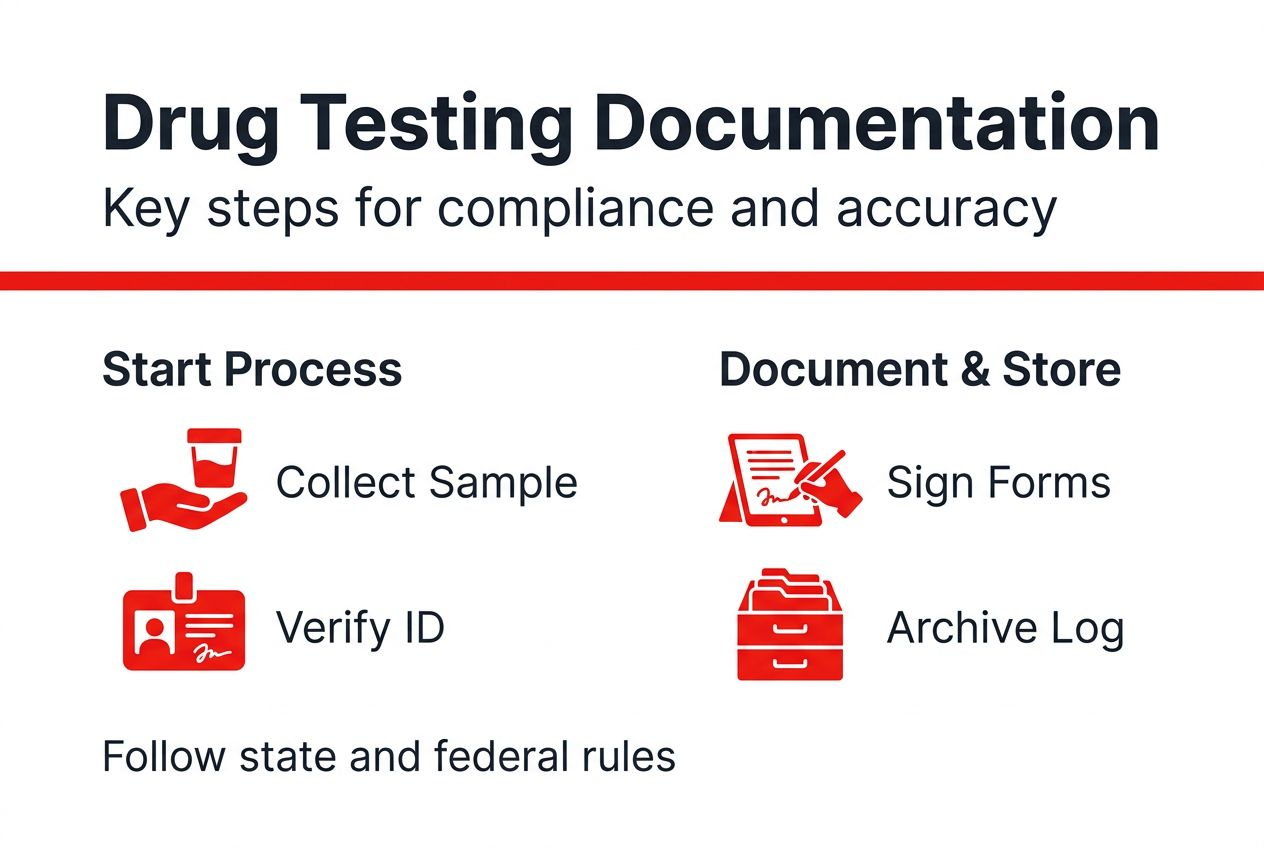
Systematic documentation procedures create the defensible records regulators demand. Follow these steps for every specimen from collection through result reporting.
-
Verify donor identity using government-issued photo identification. Record the ID type and number on the chain of custody form. Match the name exactly as it appears on the ID. Mismatched names invalidate results.
-
Document specimen collection using FDA-approved tamper-evident cups. Record the collection date and time immediately. Have the donor initial the tamper-evident seal after witnessing you apply it. This step proves the specimen came from the identified donor.
-
Complete the collector section of the chain of custody form. Sign, print your name, and date the form. Include any observed abnormalities like unusual specimen color or temperature readings outside normal range.
-
Transfer custody by having the next handler sign and timestamp the form. Standardized documentation including detailed specimen collection notes reduces drug testing procedural errors by up to 30%. Every custody change requires signatures from both the releasing and receiving parties.
-
Record test device information before running the analysis. Document the test cup or strip lot number and expiration date. Using tamper-evident drug testing cups and documenting their use is required to maintain compliance. Expired devices produce inadmissible results regardless of documentation quality.
-
Log quality control activities including equipment calibration checks and control sample results. Run controls according to manufacturer instructions and regulatory requirements. Document control results with pass/fail determinations before analyzing patient specimens.
-
Record test results exactly as they appear. Use positive, negative, or invalid designations. Photograph results for electronic records or attach photos to paper files. Include the interpretation time since some results change after extended periods.
-
Complete the reviewer section with signatures from the qualified person interpreting results. Medical review officers or licensed healthcare providers should sign off on positive or invalid results before reporting.
-
Double-check all entries for completeness and accuracy. Missing signatures, dates, or lot numbers create documentation failures. A second person review catches errors before forms enter permanent files.
| Documentation Element | Required Information | Common Errors |
|---|---|---|
| Donor ID | Name, ID number, signature | Misspelled names, missing signatures |
| Collection Data | Date, time, collector signature | Incomplete timestamps, unsigned forms |
| Chain of Custody | Signatures at each transfer | Skipped signatures, missing dates |
| Device Information | Lot number, expiration date | Using expired devices, undocumented lots |
| Results | Positive/negative/invalid interpretation | Delayed documentation, unsigned reviews |
Pro Tip: Keep a specimen log separate from individual chain of custody forms. This master list provides quick reference for auditors and helps track testing volume, positive rates, and documentation completion.
Implement a forensic-grade documentation checklist even for clinical programs. The systematic approach reduces errors and creates audit-ready records. Research shows that reducing errors with standardized documentation delivers measurable improvements in program quality and regulatory compliance.
Common documentation errors and how to avoid them
Even experienced programs make documentation mistakes. Recognizing these errors helps you implement prevention strategies.
Incomplete chain of custody forms top the list of documentation failures. Missing signatures at custody transfers, blank date fields, or omitted device lot numbers make results legally inadmissible. 15-20% of drug test rejections result from improper chain of custody documentation errors. Implement a completion checklist that staff verify before filing forms.
Documentation delays create serious problems. Recording information hours or days after collection introduces memory errors and timestamp discrepancies. Complete all documentation in real time as each step occurs. Delayed entries lose credibility during legal challenges.
Non-FDA approved test kits generate invalid documentation regardless of procedure quality. Verify FDA clearance before purchasing any testing supplies. Document clearance numbers on your master equipment list. Using unapproved devices wastes time and money while creating compliance violations.
Inconsistent record formatting hinders audits and internal reviews. Staff using different abbreviations, date formats, or result codes create confusion. Standardize all documentation elements through written policies and regular training. Provide examples of correctly completed forms.
Prevention strategies address root causes:
- Conduct quarterly competency assessments where staff complete sample documentation under observation
- Schedule regular audits of documentation completeness and accuracy with corrective action for deficiencies
- Use pre-printed forms with clear instructions and required field indicators
- Implement electronic systems with mandatory fields that prevent incomplete submissions
- Require supervisory review of all positive or invalid results before reporting
Double-check review processes can reduce documentation errors by 40%. Assign a second qualified person to review completed forms before filing. This catches errors while correction remains simple.
Address chain of custody errors that lead to test rejection through root cause analysis. When documentation fails, investigate why the error occurred and modify procedures to prevent recurrence. Track error types and frequencies to identify training needs.
Invest in ongoing staff training that emphasizes documentation as critical to program success. Staff who understand the legal and regulatory consequences of errors take documentation more seriously. Share real examples of how proper documentation protected programs during challenges or audits.
Systematic approaches to reducing documentation errors pay dividends through reduced rejections, better audit outcomes, and stronger legal defensibility.
Using technology to improve drug testing documentation
Electronic documentation systems transform compliance from a paper burden into a strategic advantage. Technology reduces errors, improves efficiency, and strengthens audit readiness.
Electronic drug testing management platforms eliminate common documentation failures. Mandatory field validation prevents incomplete forms. Automated timestamps remove recording errors. Digital signatures with authentication create stronger chain of custody records than handwritten signatures. Barcode scanning links specimens to donors without transcription mistakes.
Security features protect sensitive health information while ensuring compliance. Role-based access controls limit who views or modifies records. Audit trails track every user action with timestamps. Encrypted storage and transmission meet HIPAA requirements. Automated backups prevent data loss. These features exceed what paper systems can achieve.
Time savings compound across your program. Staff spend less time searching for records. Supervisors review documentation electronically without handling paper. Auditors access organized records instantly. Reporting becomes automated rather than manual. Programs typically recover implementation costs within 18 months through efficiency gains.
Integration with existing healthcare IT systems creates seamless workflows:
- Link to electronic health records for complete patient documentation
- Connect with laboratory information systems for confirmatory testing
- Interface with billing systems for automated charge capture
- Export to compliance tracking platforms for regulatory reporting
Implementation challenges require planning. Staff need training on new systems. IT infrastructure must support the software. Data migration from paper records takes time. Initial costs include software licenses, hardware, and training. Start with a pilot program in one area before facility-wide rollout.
Pro Tip: Choose electronic systems with mobile access. Collectors can document specimens at the collection site using tablets or phones, reducing delays and improving accuracy.
Best practices ensure successful technology adoption. Involve frontline staff in vendor selection so systems meet actual workflow needs. Maintain paper backup procedures during initial implementation. Schedule vendor support during go-live periods. Build in time for staff to achieve competency before going fully electronic.
Electronic solutions support better drug screening workflow compliance through systematic processes and automated quality checks. Technology does not replace trained staff but amplifies their effectiveness and reduces documentation burden.
Audit preparation and expected outcomes from proper documentation
Well-organized documentation transforms audits from stressful events into opportunities to demonstrate program quality. Prepare systematically to achieve positive outcomes.
Auditors expect immediate access to key documents. Organize your files to provide:
- Chain of custody forms for reviewed specimens sorted chronologically
- Equipment maintenance logs with calibration records and quality control results
- Staff training documentation including competency assessments and continuing education
- Standard operating procedures for all testing and documentation processes
- Corrective action records showing how you addressed identified problems
Success metrics demonstrate documentation effectiveness. Track your rejection rate and aim for under 2%. Monitor documentation completion time, targeting real-time entry. Measure training compliance with 100% of staff current on competency assessments. Calculate audit findings trends, working toward zero major deficiencies.
Proper documentation delivers measurable benefits. Legal challenges collapse when you produce complete chain of custody records. Regulatory audits conclude faster with fewer findings. Insurance claims related to testing face fewer disputes. Staff confidence increases knowing documentation withstands scrutiny. Program reputation strengthens among referring providers and oversight agencies.
Regular internal audits maintain readiness. Schedule quarterly reviews of random documentation samples. Use the same criteria external auditors apply. Document findings and corrective actions. Verify corrections during subsequent audits. This continuous improvement approach prevents surprise deficiencies.
Audit preparation extends beyond pulling files. Brief staff on their potential role as audit witnesses. Organize physical spaces where auditors will work. Ensure computer systems can generate required reports. Designate a point person to coordinate auditor requests. The investment in preparation pays off through smoother audits and better findings.
Combine thorough drug testing result reporting workflows with systematic audit preparation. Your documentation system should make compliance verification straightforward rather than challenging.
Boost your drug testing compliance with reliable supplies
Documentation quality starts with the testing supplies you choose. FDA-cleared, tamper-evident products create the specimen integrity your records must reflect.
RapidTestCup.com specializes in CLIA-waived, FDA-approved drug testing supplies designed for professional compliance needs. Our 12-panel test cups include integrated adulterant screening and tamper-evident seals that satisfy regulatory requirements. Each cup provides the device information your documentation protocols require, including lot numbers and expiration dates clearly printed on every unit.
Specialized testing needs demand reliable solutions. Our MET drug test strips offer targeted screening with the accuracy documentation demands. For comprehensive testing programs, 15-panel drug test kits with adulterants deliver extensive detection capabilities while maintaining the tamper-evidence and traceability compliance requires.
Using trusted, FDA-approved testing products strengthens your documentation’s legal defensibility. Courts and regulators scrutinize the devices behind test results. CLIA-waived status ensures your testing environment meets federal standards. Bulk pricing and quick shipping help programs maintain adequate supplies without budget strain. Explore our complete catalog to find testing solutions that support your compliance documentation needs.
How to document drug testing procedures faq
What are the most critical elements to document during drug testing?
You must document donor identification with photo ID verification, specimen collection date and time with collector signature, complete chain of custody with signatures at every transfer, and test device information including lot numbers and expiration dates. Missing any of these elements can invalidate results and create compliance violations.
How soon after specimen collection should documentation be completed?
Complete all documentation in real time as each step occurs. Delayed documentation introduces errors and loses credibility during audits or legal challenges. Record collection information immediately after obtaining the specimen, and document each subsequent step before moving to the next procedure.
Can electronic documentation systems replace paper records completely?
Electronic systems can fully replace paper documentation when they meet regulatory requirements including secure storage, audit trails, and electronic signatures. However, maintain paper backup procedures during system outages. Verify your electronic system complies with CLIA, HIPAA, and state regulations before eliminating paper records entirely.
What are best practices for chain of custody documentation?
Require signatures from both releasing and receiving parties at every custody transfer. Use tamper-evident seals that donors witness you apply. Include timestamps for each transfer. Never leave custody documentation blank or incomplete. Implement a second-person review of all chain of custody forms before filing to catch errors while correction remains simple.
How can administrators prepare for a drug testing compliance audit?
Organize all required documents including chain of custody forms, equipment logs, training records, and standard operating procedures. Conduct quarterly internal audits using external auditor criteria. Track rejection rates and documentation completion metrics. Brief staff on audit procedures and designate a coordinator to manage auditor requests. Preparation transforms audits from stressful events into opportunities to demonstrate program quality.