

Blog
The Importance of Test Validity in Assessments


TL;DR:
- Test validity ensures that a test accurately measures the concept it claims to assess, forming the foundation of trustworthy results. Validity evidence must be multi-faceted, including content, construct, criterion-related, and face validity, and should match the test’s purpose and population. Reliability alone does not guarantee validity, which is essential to avoid errors in medical diagnostics and educational assessments.
Test validity is defined as the degree to which a test accurately measures the specific concept it claims to measure, making it the foundation of trustworthy results in research, education, and healthcare. Without validity, test scores are meaningless at best and actively harmful at worst. The importance of test validity extends from classroom exams to clinical diagnostics, where a flawed measure can lead to misdiagnosis, wasted resources, or unjust decisions about students. Understanding validity is not optional for researchers, educators, or healthcare professionals. It is the standard that separates a useful test from a dangerous one.
What are the main types of test validity?
Validity governs the meaningfulness) of every conclusion drawn from a test score. Modern psychometrics treats validity as a single unified argument supported by multiple lines of evidence, rather than a checklist of separate categories. That said, researchers and practitioners commonly organize validity evidence into four main types, each addressing a different aspect of measurement quality.
Content validity asks whether the test covers the full range of the concept being measured. A drug knowledge exam that only tests opioid awareness but ignores stimulants has weak content validity. Construct validity is the broadest type. It asks whether the test actually measures the theoretical construct it targets, such as anxiety, reading comprehension, or substance use. Criterion-related validity compares test scores against an external standard. Predictive validity, a subtype, is especially critical in education and psychology because it forecasts future performance. Face validity is the weakest form. It simply reflects whether a test looks valid to the people taking it, which matters for compliance but proves nothing about accuracy.
| Validity type | What it asks | Typical use context |
|---|---|---|
| Content | Does the test cover the full construct? | Curriculum assessments, licensing exams |
| Construct | Does the test measure the right concept? | Psychological testing, research studies |
| Criterion-related | Does the test predict an external outcome? | Employment screening, clinical diagnostics |
| Face | Does the test appear credible to respondents? | Patient surveys, compliance-sensitive settings |
- Choose validity evidence that matches your test’s purpose, not just what is easiest to collect.
- Construct validity requires both convergent evidence (the test correlates with related measures) and discriminant evidence (it does not correlate with unrelated ones).
- Criterion-related validity needs a credible, well-defined external criterion, or the comparison is worthless.
Pro Tip: Never rely on a single type of validity evidence. A strong validity argument integrates content, construct, and criterion evidence together.
How does test validity differ from reliability, and why does it matter?
Reliability and validity are related but distinct properties. Reliability means a test produces consistent results across repeated administrations. Validity means those results accurately reflect the intended construct. The critical distinction is that reliability is necessary but insufficient for validity.
The classic example makes this concrete. A scale that consistently reads 5 pounds too heavy is perfectly reliable. Every measurement is consistent. But the scale is invalid because it does not accurately measure actual weight. The same logic applies to a drug screening test that consistently flags a legal medication as an illicit substance. Consistent results do not equal correct results.
Key contrasts between reliability and validity:
- Reliability reflects measurement consistency. A test can be reliable without being valid.
- Validity reflects measurement accuracy. A valid test is almost always reliable, because accuracy requires consistency.
- The direction matters. High reliability does not guarantee validity. High validity does imply reliability.
- Consequences differ. Low reliability introduces random error. Low validity introduces systematic error, which is far more dangerous because it is harder to detect.
Pro Tip: When evaluating any test, check reliability first. If reliability is low, validity is impossible. Then check validity evidence, because reliability alone tells you nothing about accuracy.
Why is test validity critical in medical diagnostics and educational assessments?
In high-stakes settings, invalid tests cause real harm. Diagnostic tests carry inherent risks including false positives and false negatives, and those risks multiply when the test is applied outside its validated context. A false positive in drug testing can cost someone their job. A false negative in clinical diagnostics can delay life-saving treatment.

Test accuracy metrics like sensitivity and specificity describe how well a test performs under ideal conditions. But clinical impact requires more than accuracy alone. A test must also be feasible, appropriate for the patient population, and interpreted within the right clinical context. Ignoring any of these factors turns a technically accurate test into a clinically misleading one.
Medical experts confirm that test interpretation requires clinical context to avoid diagnostic errors, regardless of a test’s intrinsic sensitivity or specificity. A urine drug screen validated for workplace use may perform very differently in a pain management clinic with a different patient population and different base rates of substance use. Applying it without adjustment is a validity failure.
Consequences of invalid or misapplied tests in clinical and educational settings:
- False positives trigger unnecessary interventions, patient anxiety, and wasted resources.
- False negatives allow real problems to go undetected, delaying treatment or support.
- Misclassification in education leads to students being placed in the wrong programs or denied appropriate accommodations.
- Legal and ethical exposure increases when professionals rely on tests that lack documented validity evidence for their specific use case.
- Erosion of trust occurs when patients or students experience outcomes that contradict their actual condition or ability.
Pro Tip: Always check whether a test’s validity evidence was established in a population similar to yours. A test validated on adults may not be valid for adolescents, and a test validated in one clinical setting may not transfer to another. For a deeper look at interpreting test results accurately, the clinical context always shapes what a result actually means.
What steps are required to establish and maintain test validity?
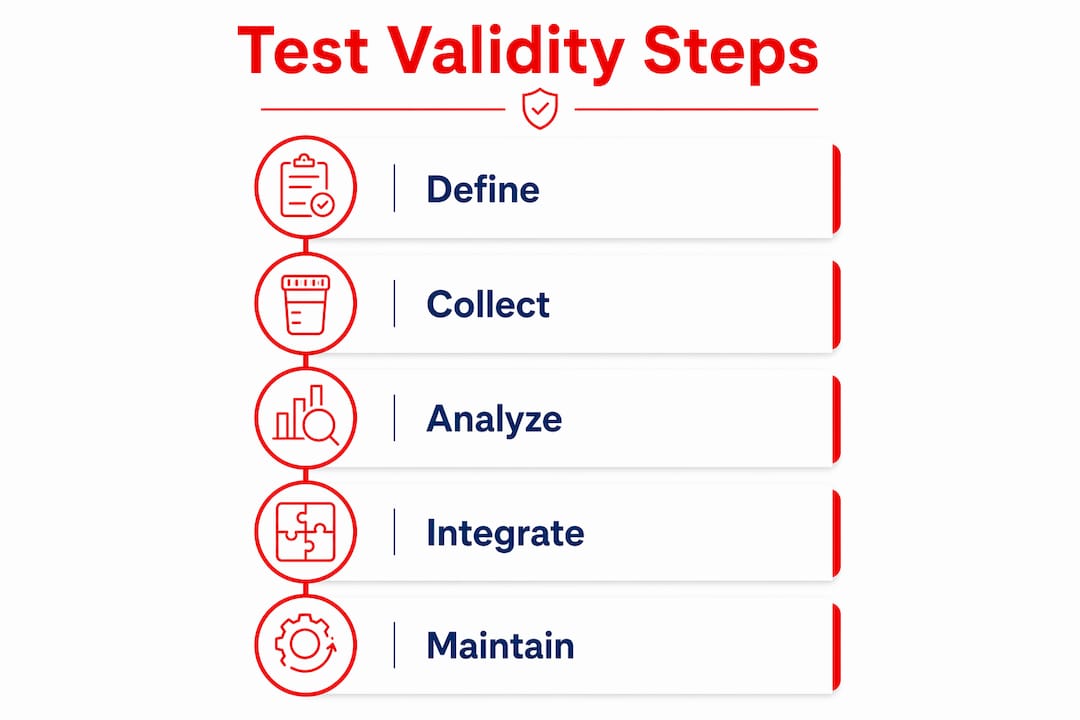
Validation is not a one-time event. Validity is an evolving argument that integrates theory and empirical evidence, and it must be revisited whenever the test protocol, population, or intended use changes. Treating validity as a fixed attribute is one of the most common mistakes in applied measurement.
The validation process starts with a clear theoretical framework. You must define what the test measures, who it is designed for, and what decisions it will support. Without that foundation, no amount of statistical analysis produces a valid instrument. From there, empirical evidence collection begins, drawing on multiple sources including expert review, pilot testing, and criterion comparisons.
Steps to build a defensible validity argument:
- Define the construct clearly. Ambiguous constructs produce ambiguous tests.
- Specify the intended population. Validity evidence from one group does not automatically transfer to another.
- Collect content validity evidence. Use subject matter experts to review item coverage and relevance.
- Gather construct validity evidence. Run factor analyses and examine convergent and discriminant correlations.
- Establish criterion validity. Compare test scores against a credible external outcome.
- Document threats to validity. Common threats include construct-irrelevant variance (the test measures something extra) and construct underrepresentation (the test misses part of the construct).
- Revalidate after changes. Any modification to test items, scoring, or administration procedures requires fresh evidence.
Pro Tip: Build your validity argument before you finalize the test, not after. Retrofitting validity evidence onto an already-deployed instrument is far harder and far less convincing.
How can researchers and practitioners apply test validity to improve assessments?
Applying validity principles in practice means making deliberate choices at every stage of the testing process. Focusing solely on technical accuracy while ignoring patient or educational outcomes is a recognized mistake in diagnostic medicine and educational measurement alike. The same principle applies to drug testing in clinical and forensic settings.
Practical recommendations for researchers, educators, and healthcare professionals:
- Select tests with published validity evidence that matches your specific purpose and population. Peer-reviewed validation studies are the gold standard.
- Review sensitivity and specificity data alongside clinical impact data. A test with 99% sensitivity is still a poor choice if its false positive rate causes systematic harm in your setting. Rapidtestcup provides clinical accuracy metrics to help professionals evaluate these trade-offs.
- Train staff on valid test administration. Deviations from standardized procedures introduce construct-irrelevant variance and undermine validity.
- Interpret results in context. Pre-test probability, patient history, and clinical presentation all affect what a result means. A positive drug test result means something different in a pain clinic than in a workplace screening program.
- Document your validity rationale. When challenged legally or professionally, documented validity evidence is your defense.
- Avoid over-relying on face validity. A test that looks right is not necessarily right. Demand empirical evidence.
Understanding false positive risks in drug tests is a direct application of validity thinking. When a test flags a substance it was not designed to detect, that is a validity failure with real consequences for the person being tested.
Key Takeaways
Test validity is the non-negotiable standard that determines whether a test result is meaningful, accurate, and safe to act on in research, education, and healthcare.
| Point | Details |
|---|---|
| Validity defines accuracy | A test is only useful if it measures what it claims to measure, not just what it consistently produces. |
| Reliability is not enough | A test can be perfectly consistent and still be wrong; validity requires accuracy, not just repeatability. |
| Context shapes validity | Validity evidence established in one population or setting does not automatically apply to another. |
| Validation is ongoing | Any change to test items, scoring, or population requires fresh validity evidence, not a one-time check. |
| High stakes demand high standards | In clinical diagnostics and educational decisions, invalid tests cause measurable harm to real people. |
Why validity deserves more attention than it gets
Most professionals understand reliability intuitively. Consistency is easy to grasp. Validity is harder because it requires asking a more uncomfortable question: are we actually measuring what we think we are measuring?
I have seen this gap play out in drug testing contexts repeatedly. A test gets deployed because it has strong sensitivity and specificity data from a manufacturer’s study. Nobody asks whether that study population matches the clinic’s patient mix. Nobody checks whether the cutoff concentrations are appropriate for the substances most prevalent in that community. The test is reliable. The results are consistent. And the clinical decisions built on those results are quietly wrong.
The rise of multi-panel testing and expanded drug screens has made this problem more acute, not less. More panels mean more opportunities for construct-irrelevant variance, more chances for a cross-reactive compound to trigger a false positive, and more complexity in interpreting what a result actually means. Technology does not solve validity problems. It amplifies them if validity thinking is not built into the selection and interpretation process from the start.
The professionals who get this right treat validity as a living question, not a box checked at purchase. They ask whether the test fits the population, whether the cutoffs are appropriate, and whether the clinical context changes what a result means. That discipline is what separates a trustworthy diagnostic program from one that produces confident-looking errors.
— Justin
Validated drug testing products for accurate results
Accuracy in drug testing starts with choosing products that have documented validity and reliability evidence for your specific use case. Rapidtestcup carries a full range of CLIA waived, FDA-approved drug testing products designed for laboratories, clinics, substance abuse programs, and law enforcement.
From multi-panel drug test cups to individual urine test strips, every product in the catalog is built to meet professional standards for sensitivity and specificity. Bulk pricing and fast shipping make it practical to maintain consistent testing protocols without cutting corners on quality. Browse the full catalog at Rapidtestcup to find the right product for your program’s validated testing needs.
FAQ
What is test validity in simple terms?
Test validity is the degree to which a test measures what it is designed to measure. A valid test produces results that accurately reflect the concept being assessed, whether that is a student’s reading level or a patient’s drug use.
Can a test be reliable but not valid?
Yes. A test can be reliable yet invalid if it consistently mismeasures the intended construct. A scale that always reads 5 pounds too heavy is reliable but not valid.
Why does validity matter more than accuracy alone?
Diagnostic accuracy is only one step in evaluating a test. Clinical impact, feasibility, and patient outcomes must also be considered. A test with high accuracy in a research setting can still produce misleading results when applied in a different clinical context.
What are the main threats to test validity?
The two primary threats are construct-irrelevant variance, where the test measures something beyond the intended construct, and construct underrepresentation, where the test fails to capture the full scope of what it claims to measure.
How often should a test be revalidated?
Revalidation is necessary whenever the test protocol, target population, or intended use changes. Validity is not a permanent property of a test. It is tied to a specific purpose, population, and context.