Blog
Drug Cutoff Levels in 2025: A Professional Guide


TL;DR:
- Drug cutoff levels define the minimum concentrations needed for positive drug test results. In 2025, fentanyl was added to federal testing panels at 1 nanogram per milliliter, a significant update. Proper understanding ensures compliance, legal safety, and accurate detection of recent drug use.
Drug cutoff levels are the minimum concentrations of a drug or its metabolites in a specimen that must be exceeded for a test to report a positive result. Understanding drug cutoff levels 2025 is non-negotiable for health professionals, law enforcement officers, and employers managing compliance programs, because the thresholds set by SAMHSA and the Department of Transportation (DOT) directly determine who tests positive and who does not. The DOT 5-panel urine test governs safety-sensitive industries from trucking to aviation, and mid-2025 brought a significant change: fentanyl was added as a required analyte. Getting these numbers wrong carries legal, clinical, and operational consequences.
What are the 2025 federal drug cutoff levels?
Federal drug testing cutoff thresholds are set by SAMHSA and enforced through DOT’s 49 CFR Part 40. These thresholds apply to all federally mandated urine drug testing programs and form the baseline that most private employers also follow.
The table below shows the current initial screening and confirmatory cutoff levels for the major drug classes tested under federal guidelines.
| Substance | Screening cutoff (ng/mL) | Confirmation cutoff (ng/mL) |
|---|---|---|
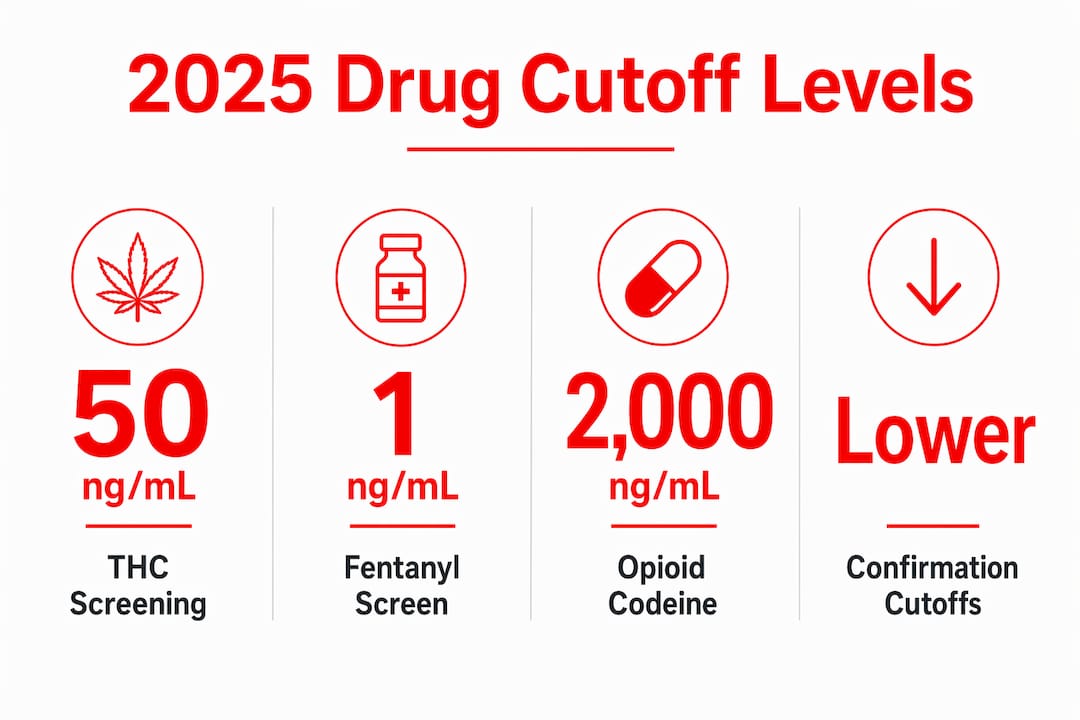
| Marijuana (THC-COOH) | 50 | 15 |
| Cocaine metabolite | 150 | 100 |
| Codeine / Morphine | 2,000 | 2,000 |
| Hydrocodone / Oxycodone | 300 | 100 |
| Amphetamines | 500 | 250 |
| Phencyclidine (PCP) | 25 | 25 |
| MDMA | 500 | 250 |
| Fentanyl | 1 | 1 |
The DOT fentanyl cutoff of 1 ng/mL reflects how potent the drug is at trace concentrations. Even at that threshold, the addition of fentanyl to the federal panel marks the most significant update to DOT testing requirements in years.
Opioid cutoffs vary widely by analyte. Codeine and morphine screen at 2,000 ng/mL, while hydrocodone and oxycodone screen at 300 ng/mL. That difference exists because the drugs metabolize differently and carry different abuse profiles.
Screening cutoffs are always equal to or higher than confirmation cutoffs. A specimen that screens positive at 50 ng/mL for marijuana must then confirm at 15 ng/mL or above to be reported as a confirmed positive. The lower confirmation threshold accounts for the greater molecular specificity of the confirmatory method.
Pro Tip: Always check whether your testing program references the initial screening cutoff or the confirmation cutoff when communicating results. Mixing the two is a common source of policy errors.
How do specimen types affect cutoff thresholds?
Cutoff levels are not universal across specimen types. Specimen type dramatically affects cutoff levels and detection windows, and applying urine cutoffs to hair or oral fluid results is a technical error with real consequences.
The three primary specimen types each use different units and different thresholds:
- Urine: Cutoffs expressed in nanograms per milliliter (ng/mL). The most widely used specimen for federal and workplace testing. Detection windows range from days to weeks depending on the drug and frequency of use.
- Oral fluid: Cutoffs also expressed in ng/mL but set much lower due to shorter detection windows. Marijuana oral fluid screening sits at 4 ng/mL, compared to 50 ng/mL in urine. Oral fluid testing is federally authorized but pending HHS laboratory certification, so it is not yet operational for DOT-regulated programs.
- Hair: Cutoffs expressed in picograms per milligram (pg/mg). Hair testing detects a longer history of drug use, typically up to 90 days, and uses entirely different reference ranges that cannot be compared to urine values.
The testing method also shapes how results are interpreted. Immunoassay screening provides rapid, broad detection but lacks molecular specificity. Immunoassay screens have limitations including cross-reactivity, meaning a substance structurally similar to the target drug can trigger a positive screen without the target drug actually being present. That is why a screen is never a final result.
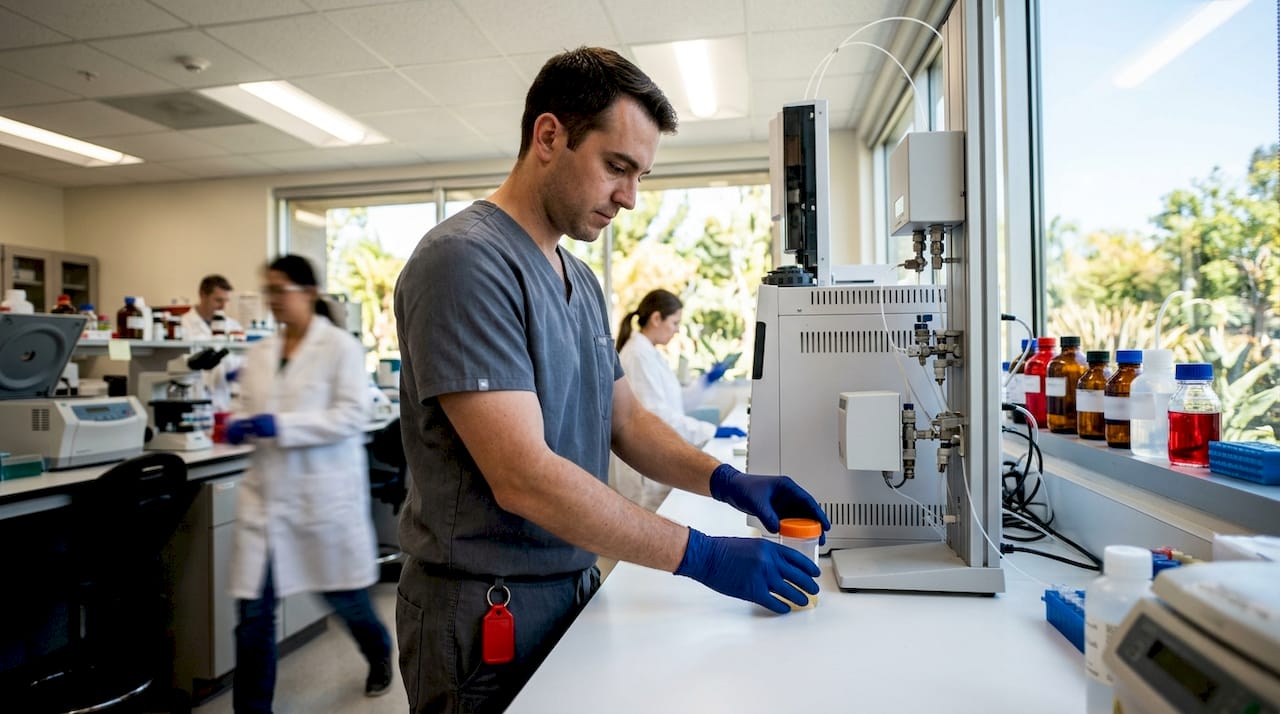
Confirmatory testing using GC-MS or LC-MS/MS is required to definitively identify substances above cutoff thresholds. These methods identify the exact molecular structure of a compound, eliminating cross-reactivity as a variable. A confirmed positive is the only result that carries legal and clinical weight.
Pro Tip: When reviewing a lab report, check whether the result comes from an immunoassay screen or a GC-MS/LC-MS confirmation. A screened positive without confirmation is not a positive result for any enforcement or clinical purpose.
For a deeper look at the screening vs. confirmation workflow, Rapidtestcup has a dedicated professional guide covering both methods in detail.
Why are cutoff levels set where they are?
Cutoff levels exist to balance detection sensitivity with fairness. Setting a threshold too low produces false positives from incidental exposures. Setting it too high misses genuine drug use. Federal regulators chose the current thresholds to withstand legal scrutiny while remaining clinically meaningful.
The poppy seed problem illustrates this well. Poppy seeds contain trace amounts of morphine and codeine. Poppy seeds rarely produce morphine above the 2,000 ng/mL cutoff, which is exactly why that threshold was chosen. A person who ate a poppy seed bagel will not test positive under federal guidelines. A person who used heroin will. The cutoff does the work of separating those two outcomes.
Drug cutoff thresholds are not designed to catch every instance of drug use. They are designed to identify recent, meaningful use while protecting people from positive results caused by diet, passive exposure, or cross-reactive substances. That distinction matters enormously when a positive result affects someone’s employment or freedom.
Detection windows add another layer of complexity. Marijuana is detectable for 3–4 days at the 50 ng/mL cutoff for infrequent users, but up to 30 days for chronic users. The cutoff does not change, but the detection window does. This means a positive marijuana result tells you the person used marijuana within a certain window. It does not tell you when they used it or whether they were impaired at the time of testing.
Federal programs mandate 49 CFR Part 40 compliance for safety-sensitive employees, and private employers can adopt these standards or customize them. Private employers who deviate from federal cutoffs face greater legal exposure. Standard federal cutoffs provide a legally defensible baseline, and any deviation requires legal review before implementation. For guidance on legal compliance in workplace testing, Rapidtestcup’s resource covers the key considerations for employers.
How to interpret and apply cutoff levels in practice
Interpreting drug test results correctly requires a clear process. A result above the cutoff is not automatically actionable. A result below the cutoff is reported as negative regardless of whether any drug is detected at a lower concentration. These are the rules, and they apply consistently.
Follow this sequence when managing results in a professional setting:
- Receive the screening result. A positive screen means the specimen exceeded the initial cutoff for that analyte. Do not take adverse action at this stage.
- Order confirmatory testing. Send the specimen or a split specimen to a certified laboratory for GC-MS or LC-MS/MS analysis. This step is required under federal guidelines and best practice for all programs.
- Review the confirmed result. A confirmed positive means the substance was identified above the confirmation cutoff. A confirmed negative means the screen was a false positive.
- Apply the Medical Review Officer (MRO) process. For DOT-regulated programs, a licensed MRO reviews all confirmed positives, contacts the donor for legitimate medical explanations, and issues the final result.
- Communicate the result under your policy. Inform the relevant parties according to your written drug testing policy. Document every step.
- Understand what the result does not say. Positive results above cutoff thresholds indicate the presence of metabolites but do not correlate with impairment or time of use. Never characterize a positive result as proof of impairment in documentation or communication.
The most common professional error is acting on a screening result before confirmation. The second most common error is applying urine cutoffs to oral fluid or hair results. Both errors create legal liability and undermine the integrity of the testing program.
For professionals who need a detailed reference on cutoff levels for drug screening, Rapidtestcup’s professional explainer covers clinical limitations and interpretation boundaries.
Key Takeaways
Drug cutoff thresholds are legally and scientifically calibrated benchmarks, and applying them correctly requires knowing the specimen type, the testing method, and the regulatory framework that governs your program.
| Point | Details |
|---|---|
| Fentanyl added in 2025 | The DOT 5-panel now includes fentanyl at a 1 ng/mL screening and confirmation cutoff. |
| Confirmation is required | A screened positive is never a final result; GC-MS or LC-MS/MS confirmation is mandatory. |
| Specimen type changes the cutoff | Urine, oral fluid, and hair use different units and thresholds that cannot be applied interchangeably. |
| Cutoffs do not measure impairment | A positive result confirms metabolite presence above a threshold, not impairment or timing of use. |
| Private employers need legal review | Deviating from SAMHSA or DOT federal cutoffs requires legal guidance to maintain defensibility. |
Why the 2025 updates deserve more attention than they are getting
The addition of fentanyl to the federal testing panel is the most consequential change to DOT drug testing in over a decade. I have watched safety-sensitive industries absorb regulatory updates before, and the pattern is consistent: the policy changes, the paperwork updates, and the actual testing practice lags by months. That lag is dangerous when the substance in question is fentanyl.
The 1 ng/mL cutoff for fentanyl is not a rounding error. It reflects how little of the drug is needed to cause harm. Employers and law enforcement agencies that have not yet updated their testing cups and panels to include fentanyl detection are running programs that are technically non-compliant and practically blind to one of the most prevalent substances in the current drug supply.
The oral fluid authorization is the other development worth watching. The regulatory framework is in place, but HHS-certified labs are not yet operational for federal programs. When they are, oral fluid testing will change how roadside law enforcement and post-incident workplace testing works. The shorter detection window is actually an advantage in those contexts, because it narrows results to more recent use.
My advice: review your current testing panels now, confirm fentanyl is included at the correct cutoff, and build oral fluid testing into your planning for the next 12–18 months. Waiting for a compliance audit to find the gap is the wrong way to learn about it.
— Justin
Rapidtestcup’s panels built for 2025 compliance
Health professionals, law enforcement officers, and employers need testing products that reflect current federal cutoff standards, including fentanyl detection.
Rapidtestcup carries a full range of multi-panel drug test cups designed for professional and forensic use. The 12-panel drug test cup covers the core substance classes required for most workplace programs, while the 18-panel cup with FEN/20 adds fentanyl, kratom, K2, and ETG detection in a single collection. All products are CLIA waived and FDA approved. Bulk pricing and custom quote options are available for programs with high testing volume.
FAQ
What is a drug test cutoff level?
A drug test cutoff level is the minimum concentration of a drug or metabolite in a specimen required for a test to report a positive result. Results below the cutoff are reported as negative, even if trace amounts are detected.
What changed in 2025 drug testing standards?
The DOT added fentanyl to its 5-panel urine test with a 1 ng/mL screening and confirmation cutoff. This is the most significant update to federal drug testing requirements in years and applies to all DOT-regulated safety-sensitive programs.
Does a positive drug test mean the person was impaired?
No. Positive results confirm metabolite presence above a cutoff threshold but do not indicate impairment or establish when the drug was used. Impairment is a separate clinical or behavioral determination.
Why are confirmation cutoffs lower than screening cutoffs?
Confirmation methods like GC-MS and LC-MS/MS are molecularly specific and more sensitive than immunoassay screens. The lower confirmation cutoff accounts for that precision and reduces the risk of a false negative at the confirmation stage.
Can private employers set their own cutoff levels?
Private employers can customize cutoff levels, but deviating from federal SAMHSA or DOT standards reduces legal defensibility. Legal review is required before any deviation from established federal thresholds.