
Blog
Clinics: Detect Methadone Up to 7 Days, EDDP, Tests, 4 Kit Checks


Methadone typically will not show up on a standard 5-panel or 7-panel drug test because those panels screen for older opiates like morphine and codeine, not synthetic opioids. It shows up reliably only on an extended panel that specifically includes methadone or a dedicated methadone assay, almost always run on a urine sample. Detection can stretch to roughly seven days after the last dose, though the real number depends on your metabolism, dose, and how long you’ve been taking it.
TL;DR:
- Standard drug tests like the 5-panel and 7-panel do not reliably detect methadone because they screen for older opiates rather than synthetic opioids.
- Extended panels, such as 10- or 12-panel tests, include specific antibodies for methadone and metabolites like EDDP, improving detection accuracy.
- Methadone can remain detectable in urine for up to seven days, with detection times in blood or saliva being much shorter, typically hours to two days.
- The EDDP metabolite provides a more stable indicator of methadone use than raw drug concentration, helping distinguish genuine intake from sample spiking.
- Validity checks like temperature, pH, creatinine, and specific gravity are essential to prevent tampering and ensure accurate results.
Table of Contents
- Which Drug Tests Actually Detect Methadone
- How Long Does Methadone Stay in Your System by Specimen Type
- What EDDP Tells You That Methadone Alone Doesn’t
- Specimen Integrity: How Labs Catch a Tampered Sample
- Why You Might Get a Surprising Result
- What To Do After a Positive Methadone Result
- The Gap Between a Cheap Test and a Trustworthy One
- Choosing a Test Kit That Actually Catches Methadone
- Sources
Which Drug Tests Actually Detect Methadone
The panel matters more than the specimen. Standard workplace and clinical screens, the 5-panel and 7-panel varieties, were built around the federal SAMHSA guidelines from decades ago, when heroin and prescription opiates like morphine and codeine were the primary concern. Methadone is a synthetic opioid with a different chemical structure, so the antibodies used in those basic immunoassays often walk right past it.
That’s why a person maintained on methadone at a clinic can fail a workplace screen for opiates and still pass a basic 5-panel cup test showing no trace of the drug they’re actually taking daily.
Extended panels, the 10, 12, and sometimes 22-panel versions, close that gap by adding a methadone-specific antibody strip. Rapidtestcup’s 12-panel ADLTX cup is one example built to catch a broader analyte list, including methadone, in a single collection.
Screening and confirmation work as two distinct steps:
- Point-of-care immunoassays (test cups, dip cards, strips) give a fast preliminary result, positive or negative, based on antibody binding.
- Confirmatory lab testing using gas chromatography-mass spectrometry (GC-MS) or liquid chromatography-mass spectrometry (LC-MS) identifies and quantifies the exact compound present.
- Confirmatory testing is generally ordered when screening results have legal, employment, or clinical consequences, since immunoassays can produce both false positives and false negatives depending on cross-reactivity.
A positive on an immunoassay is a lead, not a verdict. Labs treat it as presumptive until GC-MS or LC-MS backs it up with a molecular fingerprint.
How Long Does Methadone Stay in Your System by Specimen Type
Detection time depends heavily on which fluid or tissue gets tested, and the differences are bigger than most people expect.
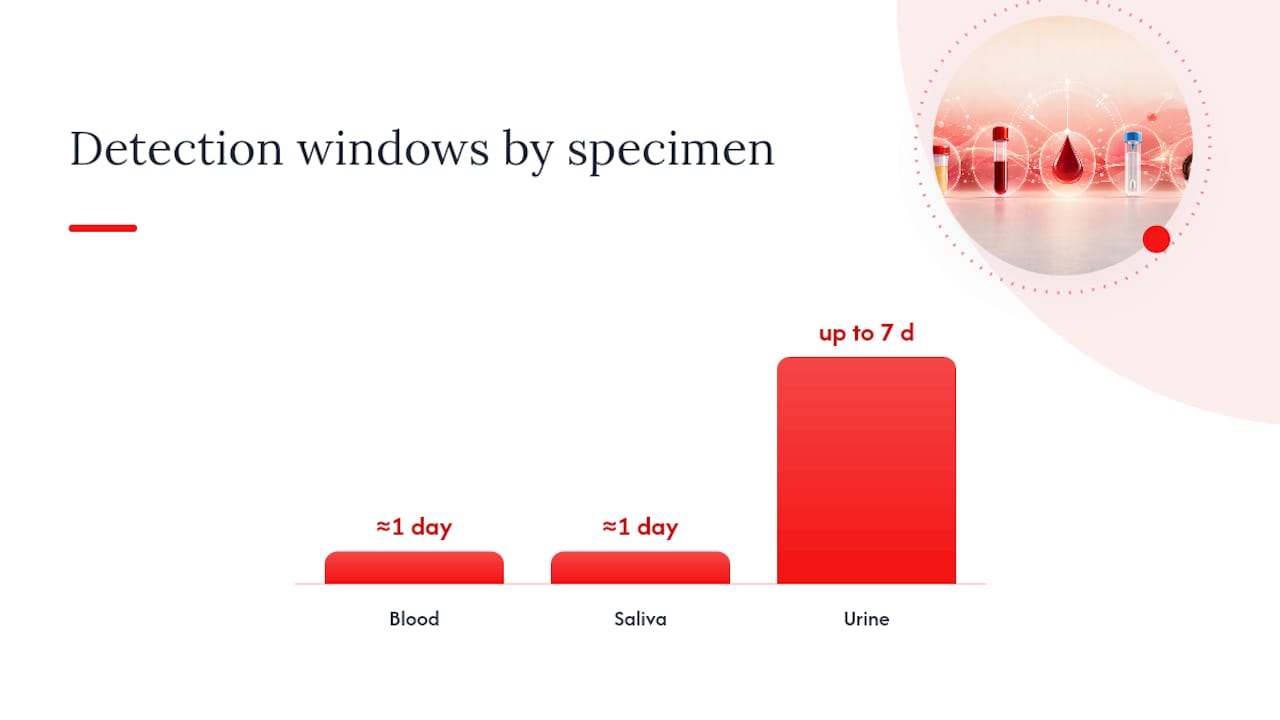
Urine is the workhorse specimen for methadone testing because the drug and its metabolite concentrate there over time. Mayo Clinic Laboratories lists methadone and its metabolite EDDP as detectable in urine for up to about seven days, with both measured at a certain limit of quantitation.
Pro Tip: If you’ve heard the “72-hour rule” for opioid clearance, drop it. That figure gets repeated constantly online, but it has no solid backing for methadone specifically, and it understates how long the drug can linger in urine.
Blood and oral fluid (saliva) tell a different story:
- Blood detects methadone within a relatively short window of hours to a couple of days, and is used mainly in clinical or emergency settings rather than routine screening.
- Oral fluid detection windows generally cover a short period, from a few hours up to about two days, and labs favor it when observed, tamper-resistant collection matters more than a long lookback period.
- Hair testing extends the detection window over several months, but it reflects a much longer history of use rather than a recent dose, which makes it far less useful for questions like “did this person take methadone yesterday.”
MedlinePlus frames this trade-off well: shorter-window specimens answer “recent use,” while hair answers “pattern over time.” Neither replaces the other.
Several factors shift these windows in either direction. Methadone’s half-life varies widely between individuals, sometimes 8 hours, sometimes over 50, because liver enzyme activity (particularly CYP3A4 and CYP2B6) differs person to person. Chronic daily dosing builds up tissue stores that release the drug slowly, stretching detection well past what a single dose would produce. Urine pH also matters. Acidic urine speeds elimination of the parent compound, which is part of why labs lean on the metabolite instead of raw methadone concentration.
What EDDP Tells You That Methadone Alone Doesn’t
EDDP (2-ethylidene-1,5-dimethyl-3,3-diphenylpyrrolidine) is the primary metabolite your liver produces when it breaks down methadone, and labs often trust it more than the parent drug for one practical reason: it’s far less sensitive to urine pH swings, so it gives a steadier read on actual use.
Mayo Clinic Laboratories notes EDDP is preferred for exactly this reason when assessing whether a patient is genuinely taking their prescribed methadone. Guidance from ARUP’s educational resources points to an EDDP-to-methadone ratio, commonly cited as typically above 0.60 in patients who metabolize the drug through normal ingestion.
Here’s what shifts that ratio and why it matters:
- A high methadone concentration paired with little or no EDDP is a red flag for urine spiking, meaning someone may have added methadone directly to a sample rather than metabolizing it naturally.
- Low or absent EDDP with any methadone present at all suggests the specimen doesn’t reflect genuine oral dosing.
- A normal ratio, by contrast, supports a straightforward interpretation: the person swallowed the dose and their body processed it as expected.
One point clinicians stress repeatedly: absolute urine concentration doesn’t reliably indicate dose. Urine concentration numbers can vary widely and do not reliably indicate dose due to individual metabolism and hydration differences. That’s precisely why quantitative or serum testing gets reserved for situations, dosing disputes, suspected diversion, treatment plan changes, where the number will actually change a clinical decision, rather than being run routinely on every sample.
Specimen Integrity: How Labs Catch a Tampered Sample
Every legitimate urine drug test includes validity checks that run independently of the drug panel itself. Temperature gets checked within minutes of collection to confirm it is within a normal physiological range, because a sample that’s cold or reads outside that window suggests it wasn’t freshly produced. pH, specific gravity, creatinine, and nitrite levels get checked next.
Common tampering attempts and how they get caught:
- Submerging pills or film in urine. Some people dissolve a methadone tablet or buprenorphine film directly into a sample to produce a positive that doesn’t reflect actual ingestion. Labs catch this through the EDDP mismatch described above, since a submerged tablet produces methadone with essentially no metabolite.
- Diluting with water. This shows up as abnormally low creatinine and specific gravity, both flagged automatically on a properly run specimen validity panel.
- Adding oxidizers or cleaning agents. Nitrite and pH checks catch most of these, since normal human urine falls within a tight, predictable chemical range.
- Substituting someone else’s urine. Temperature checks at the point of collection remain the single best defense against this, which is why observed or immediately-tested collections matter for high-stakes screening.
When any of these flags trip, a chain-of-custody confirmatory test settles the question. Clinics and employers reduce risk simply by using cups or cards with built-in adulterant strips rather than a bare drug panel.
Why You Might Get a Surprising Result
A few scenarios explain most confusing methadone test outcomes.
- Panel mismatch. A basic opiate screen looks for morphine-derived compounds, so it can miss methadone entirely, producing a negative in someone who is, in fact, taking it as prescribed.
- Undisclosed prescription. If you’re in a methadone maintenance program and haven’t given documentation to whoever ordered the test, a positive on an extended panel can look alarming without context it deserves.
- Cross-reactivity. Certain other medications occasionally trigger a nonspecific reaction on immunoassays, which is one more reason a single screening result should never be treated as final.
- Rare false negatives. Very dilute urine or a specimen collected too soon after a first dose can sit below the cutoff even when methadone is present.
Whenever a result seems inconsistent with what you know to be true, ask for GC-MS or LC-MS confirmation before accepting the screening result as the last word.
What To Do After a Positive Methadone Result
Start by requesting confirmatory testing if it hasn’t already been run. A single immunoassay positive is presumptive, not diagnostic, and GC-MS or LC-MS confirmation, described in Mayo Clinic Laboratories’ methadone confirmation overview, settles the question with molecular specificity.
Next steps depend on context, including coordinating with your clinic’s medication assisted therapy program to provide dosing documentation immediately, especially if the test was ordered by a third party like an employer.
- If you’re in treatment, notify your prescribing clinic or opioid treatment program and provide dosing documentation immediately, especially if the test was ordered by a third party like an employer.
- In a workplace dispute, know that the Americans with Disabilities Act offers some protections for individuals in legitimate medication-assisted treatment, though the specifics are fact-dependent enough that HR or an employment attorney should weigh in rather than relying on general assumptions.
- Ask whether a re-test or chain-of-custody sample is warranted, particularly if adulteration or specimen mix-up seems plausible.
- Keep copies of prescription records and program enrollment paperwork on hand before you need them, not after.
The Gap Between a Cheap Test and a Trustworthy One
Most confusion around methadone testing doesn’t come from the science, it comes from using the wrong tool for the question being asked. A basic opiate cup was never built to catch a synthetic opioid, and no amount of careful reading changes that. What changes outcomes is starting with a panel that actually includes methadone and metabolite indicators, paired with real specimen-validity checks, so a screening result means something before it ever reaches a lab.
Rapidtestcup builds its catalog around that principle: CLIA-waived, FDA-cleared test cups and strips that treat adulterant detection as standard, not optional. Quality screening earns its keep by giving confirmatory testing something worth confirming.
— Justin
Choosing a Test Kit That Actually Catches Methadone
Rapidtestcup exists for exactly the gap this article just walked through: a panel that skips methadone doesn’t help a treatment program, a clinic, or an employer who needs a real answer.
Before you buy, run any kit against four checkpoints. First, confirm methadone (or EDDP) is explicitly listed on the panel, not assumed. Second, check for built-in specimen-validity strips covering temperature, pH, creatinine, and nitrites. Third, verify CLIA-waived and FDA-cleared status on the product page. Fourth, look for adulterant detection strong enough to flag the spiking patterns described earlier.
Rapidtestcup’s 12-panel ADLTX cup meets all four out of the box, and the site’s 22-panel cup with adulterants covers an even broader analyte list for programs screening for multiple synthetic substances at once. Browse the full comparison of urine test kits to match panel size and adulterant coverage to your specific screening needs, and request a bulk quote if you’re outfitting a clinic or testing program.
This article is general information, not a substitute for advice from a qualified doctor. Consult a qualified healthcare professional about your own circumstances before acting on anything here.
Sources
- Methadone – Mayo Clinic Laboratories
- Drugs
- Opioid Testing: MedlinePlus Medical Test
- ARUP educational resources (Methadone confirmation overview)
- How do I interpret and use quantitative buprenorphine and norbuprenorphine urine levels? | CCJM