
Blog
Cutoffs Matter for Clinicians: EtG Urine Test Accuracy at 100–500 ng/mL


EtG urine test accuracy is strong for detecting recent drinking, but the number that matters most is the cutoff, not the test brand. At a 100 ng/mL cutoff, sensitivity for light drinking is high two days after consumption and remains moderate at five days, while a 500 ng/mL cutoff detects only a minority of light drinking within one day. Any unexpected result, positive or negative, deserves confirmatory testing before it drives a real-world decision.
TL;DR:
- The 100 ng/mL EtG cutoff reliably detects light drinking up to two days after consumption, while the 500 ng/mL cutoff misses most light or moderate use within a day.
- Lower cutoffs increase sensitivity but also raise false positives from incidental exposure to products containing ethanol, such as mouthwash or foods with alcohol.
- Laboratory methods like LC-MS/MS offer higher accuracy and should confirm positive point-of-care results, especially in high-stakes legal or employment cases.
- Dilute urine samples and individual metabolism variations can cause false negatives, requiring careful sample collection and creatinine adjustment.
- Choice of cutoff depends on the context: 100-200 ng/mL suits clinical monitoring for any lapse, while 500 ng/mL is better for legal settings to reduce false positives.
Table of Contents
- How Accurate Is the EtG Test, and Why Timing Changes Everything
- Sensitivity and Specificity by Cutoff: What the Studies Actually Found
- Why EtG Tests Produce False Positives and False Negatives
- Lab Mass Spectrometry vs. Point-of-Care Screening: When to Trust Which
- A Practical Interpretation Checklist for Clinicians and Monitored Individuals
- Where RapidTestCup Fits Into Reliable EtG Screening
- The Cutoff Debate Nobody Settles Honestly
- Where to Source EtG Testing Supplies That Match Your Cutoff Strategy
- Key Studies and Guidance Behind This Article
- Sources
How Accurate Is the EtG Test, and Why Timing Changes Everything
EtG, or ethyl glucuronide, is a direct metabolite the liver produces when it breaks down ethanol. Unlike a breathalyzer, which measures active alcohol and clears in hours, EtG lingers in urine long after the drink is gone. That is the whole appeal of ethyl glucuronide testing for monitoring programs. It catches drinking that ethanol testing would completely miss.
The catch is that “long after” depends entirely on how much someone drank and which cutoff the lab or POC device uses. A single glass of wine metabolizes differently than a night of heavy drinking, and a 100 ng/mL cutoff behaves nothing like a 500 ng/mL cutoff on the same sample.
Here is what realistic detection windows look like based on controlled dosing research:
- 100 ng/mL cutoff: Detects light drinking at rates above 76% at two days post-consumption, dropping to 66% by day five. For heavy drinking, detection stays high, from 84% on day one down to 79% by day five, according to research on light and heavy drinking detection.
- 200 ng/mL cutoff: Sits between the two extremes. It reliably catches drinking within the first 24 hours but loses sensitivity faster than the 100 ng/mL threshold as days pass.
- 500 ng/mL cutoff: Identified only 68% of light drinking on day one, with detection falling off sharply after that, making it a poor choice if the goal is catching light or moderate use.
A useful mental model: one or two standard drinks the night before a test, screened at a 100 ng/mL cutoff, will likely still show positive the next morning and the following morning, while the same drinks screened at 500 ng/mL may already yield a negative result by sample collection. Heavy drinking is more forgiving across all three cutoffs simply because there is more ethanol to metabolize into detectable EtG in the first place. Controlled-challenge data confirms EtG reads positive reliably at 12 hours for low cutoffs, but sensitivity for light doses erodes noticeably by the 24 to 48 hour mark, regardless of which cutoff a lab chooses.
Sensitivity and Specificity by Cutoff: What the Studies Actually Found
Sensitivity and specificity move in opposite directions as the cutoff rises, and the peer-reviewed data on this trade-off is more specific than most testing guides let on. A lower cutoff catches more true drinking events but also picks up more incidental exposure. A higher cutoff filters out noise but starts missing real use, especially light or single-occasion drinking.
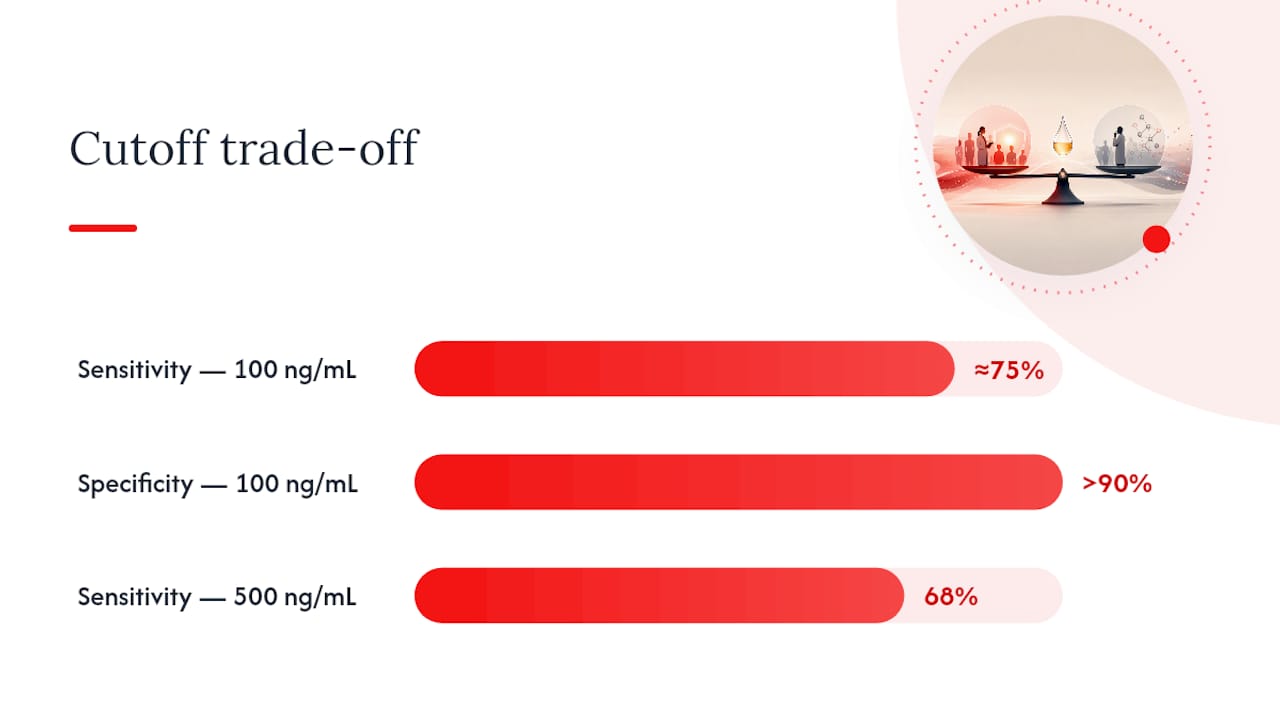
EtG at a 100 ng/mL cutoff, evaluated in a hepatology clinic cohort, showed sensitivity near three quarters and specificity above 90% for detecting drinking within the prior three days, according to a study on urine EtG and EtS performance. That is a meaningfully strong combination for clinical monitoring: it catches roughly three out of four drinking episodes while keeping false alarms low. The same cohort tested EtS at a 25 ng/mL cutoff and found a different balance, sensitivity of 82% and specificity of 86%, showing that the two biomarkers are not interchangeable even though they come from the same metabolic pathway.
The table below summarizes how detection rates shift across cutoffs and days, based on the light and heavy drinking dosing study.
| Cutoff | Drinking level | Day 1 detection | Day 2 detection | Day 5 detection |
|---|---|---|---|---|
| 100 ng/mL | Light drinking | Not separately reported | Greater than 76% | 66% |
| 100 ng/mL | Heavy drinking | 84% | Declining gradually | 79% |
| 500 ng/mL | Light drinking | 68% | Substantially lower | Minimal |
The pattern holds across the broader literature: sensitivity decays with time for every cutoff, but it decays fastest at 500 ng/mL and slowest at 100 ng/mL. This is precisely why forensic labs and clinical monitoring programs choose different thresholds for different goals. A workplace or legal setting that cannot tolerate a false accusation leans toward 500 ng/mL. A treatment program trying to catch any lapse, including a single drink, leans toward 100 or 200 ng/mL.
Method matters as much as threshold. LC-MS/MS, or liquid chromatography tandem mass spectrometry, quantifies EtG down to precise nanogram levels and is the reference method every immunoassay gets validated against. Point-of-care immunoassays, the kind used in a clinic or probation office, approximate that same detection but with more variability. Reported agreement between commercial POC EtG assays and laboratory mass spectrometry ranges from roughly 90.6% to 98%, but that range depends heavily on which cutoff and which product got tested. A dipstick validated at one cutoff in one study is not automatically comparable to a different dipstick brand at a different cutoff.
Context changes how you should read these numbers, too. A clinical monitoring context tolerates more false positives because the cost of a follow-up conversation is low. A forensic or legal context does not, because a positive result there can carry consequences like job loss or probation violation.
Why EtG Tests Produce False Positives and False Negatives
Most people assume a positive EtG result means someone drank alcohol. Most of the time that is correct, but not always, and understanding the exceptions is what separates careful interpretation from a snap judgment.
Incidental exposure is the leading cause of unexpected low-level positives. EtG does not distinguish between beverage alcohol and the ethanol found in everyday products. Clinical literature on alcohol biomarker interpretation flags several common sources:
- Mouthwash and breath sprays containing ethanol, used shortly before sample collection.
- Hand sanitizer, especially gel formulas with high alcohol content applied repeatedly through the day.
- Foods prepared with wine, beer, or liquor, including sauces reduced on the stove.
- Topical products like some cosmetics, aftershaves, and medicated skin treatments.
- Fermented foods and beverages like kombucha, which can contain trace ethanol from natural fermentation.
This is exactly why forensic and legal testing programs tend to favor the 500 ng/mL cutoff. It builds in a buffer against low-level incidental exposure, even though that buffer comes at the cost of missing some light drinking.
False negatives run the other direction and are often overlooked. Dilute urine, whether from a monitored individual deliberately overhydrating or simply drinking a lot of water, can push EtG concentration below the cutoff even after real drinking occurred. Low overall alcohol intake and long delays between drinking and sample collection compound the problem. Individual metabolism also varies. Body composition, liver function, and hydration status all affect how quickly EtG clears.
Pro Tip: A genuine positive from real drinking usually correlates with the person’s own account or other collateral information. An isolated, unexplained low-level positive with no corroborating history is a strong candidate for confirmatory LC-MS/MS testing before any action gets taken. Programs serious about accuracy also track urine creatinine alongside EtG, since creatinine-adjusted results help flag dilute samples that would otherwise read as false negatives.
Lab Mass Spectrometry vs. Point-of-Care Screening: When to Trust Which
Every EtG testing program eventually asks the same question: is a point-of-care result good enough on its own, or does it need lab confirmation? The honest answer depends on the stakes and the cutoff.
LC-MS/MS remains the reference method because it measures the exact concentration of EtG present, not just a positive or negative signal above a threshold. That quantitative precision lets toxicologists distinguish a borderline result near the cutoff from one that is unmistakably high, information a point-of-care immunoassay simply cannot provide.
Point-of-care immunoassays, including dipsticks and cup-based screens, trade some of that precision for speed and cost. The agreement rates with lab testing sound reassuring on paper, but a clinical evaluation of marketed dipsticks found real gaps between advertised performance and actual results. That study reported sensitivity as low as 69% for some dipstick products, and found urine EtG frequently fell below quantifiable limits by 24 to 48 hours after just one to four standard drinks, well short of the 80-hour detection window some manufacturers advertise.
A workable screening workflow looks like this:
- Use point-of-care EtG screening as the first-line tool for routine monitoring, given its speed and low cost.
- Treat any positive result tied to a legal, employment, or high-stakes clinical decision as provisional, not final.
- Send provisional positives, and any result the person disputes, to LC-MS/MS confirmation before acting on it.
- Reassess expectations around detection windows for point-of-care products against real study data, not manufacturer marketing claims, especially for detection window comparisons between EtG and direct ethanol testing.
This two-tier approach, screen first and confirm when it matters, captures most of the cost savings of point-of-care testing without exposing programs to the accuracy gaps that show up in low-dose scenarios.
A Practical Interpretation Checklist for Clinicians and Monitored Individuals
Turning all of this into a working policy comes down to matching the cutoff to the goal, then handling samples in a way that does not introduce new errors.
- Pick the cutoff for the actual purpose. Choose 100 to 200 ng/mL for clinical monitoring where catching any drinking, including a single drink, matters more than avoiding every false alarm. Choose 500 ng/mL or higher for forensic or legal settings where a false accusation carries serious consequences.
- Standardize collection and storage. Collect samples under observed or semi-observed conditions when the setting allows, and refrigerate promptly, since improper storage can affect detection window reliability across specimen types.
- Record creatinine alongside EtG. This flags dilute samples before they get misread as clean results.
- Confirm before consequences. Route any high-stakes positive, or any result the individual disputes, through LC-MS/MS confirmation rather than acting on a point-of-care screen alone.
- Document the cutoff used, not just the result. A positive at 100 ng/mL and a positive at 500 ng/mL mean different things; the file should reflect which threshold triggered it.
Pro Tip: If your program keeps seeing borderline positives clustered right around the cutoff, that pattern itself is informative. It usually means the threshold is set at the edge of what the population’s normal exposure produces, and it may be worth revisiting which cutoff actually serves your goal.
Where RapidTestCup Fits Into Reliable EtG Screening
Point-of-care EtG products are built around the same cutoff logic this article covers, not generic strips sold without context. That includes multi-panel cups with an integrated EtG line and standalone EtG strips for programs that only need alcohol screening.
These products are positioned for CLIA waived, FDA-cleared use in clinical, workplace, and forensic settings. Choosing the right cutoff is only half the job. Following it up with sound documentation and a confirmatory workflow is the other half, and that responsibility sits with the program running the test, not the manufacturer of the cup or strip.
The Cutoff Debate Nobody Settles Honestly
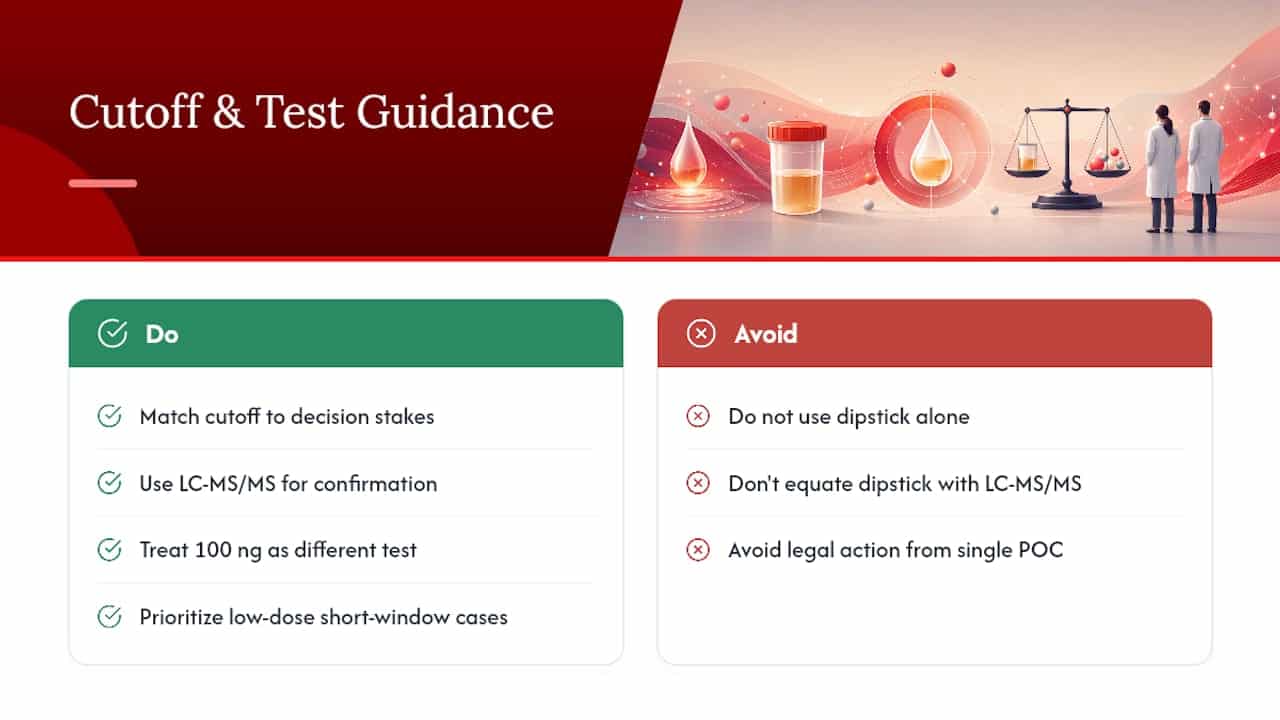
The conventional advice on EtG testing treats accuracy like a single number you can quote, as if the test is either reliable or it is not. That framing is wrong, and the peer-reviewed data proves it. A 100 ng/mL cutoff and a 500 ng/mL cutoff are effectively two different tests wearing the same name, built for different jobs and prone to different failure modes.
Where most guidance falls short is pretending point-of-care dipsticks perform identically to LC-MS/MS. They do not, and the gap widens precisely in the low-dose, short-window scenarios that matter most for catching an isolated lapse. If there is one priority to take from the research, it is this: match the cutoff to the actual stakes of the decision, and never let a single point-of-care positive carry legal or employment consequences without a confirmatory test behind it. The biomarker is sound. The discipline around how it gets used is what determines whether the result means anything.
— Justin
Where to Source EtG Testing Supplies That Match Your Cutoff Strategy
Once you know which cutoff fits your program, sourcing the right product is the easy part. RapidTestCup carries ETG urine test strips for standalone alcohol screening and the 14 panel cup with ETG for programs that need broader drug panels alongside alcohol detection in a single collection.
For clinics and workplace programs running multi-substance panels, the 18 panel drug test cup with ETG/300 and adulterant detection covers fentanyl, ketamine, and common adulterants in the same cup, cutting down on separate purchases and separate collection steps. Bulk pricing is available for labs and treatment programs ordering in volume. Browse the current EtG-capable cup and strip options and request a custom quote if your program needs a specific panel configuration or case volume.
Key Studies and Guidance Behind This Article
- Using Ethyl Glucuronide in Urine to Detect Light and Heavy Drinking in Alcohol Dependent Outpatients
- Ethyl Glucuronide and Ethyl Sulfate Assays in Clinical Trials, Interpretation, and Limitations
- Urine EtG and EtS performance in a hepatology clinic cohort
- Point-of-care EtG immunoassay agreement with laboratory MS
- Clinical considerations for alcohol biomarkers, NCBI Bookshelf
- Alcohol use screening tests, MedlinePlus
- SAMHSA resources on substance use testing guidance
- Clinical usefulness of a urine dipstick to detect ethyl glucuronide
This article is general information, not a substitute for advice from a qualified doctor. Consult a qualified healthcare professional about your own circumstances before acting on anything here.
Sources
- Using Ethyl Glucuronide in Urine to Detect Light and Heavy Drinking in Alcohol Dependent Outpatients
- Ethyl Glucuronide and Ethyl Sulfate Assays in Clinical Trials, Interpretation, and Limitations
- Urine EtG and EtS performance in a hepatology clinic cohort