

Blog
Up to 102 Days: THC Detection Time in Urine and What Labs Use


A single use of marijuana typically clears a standard urine test within a few days, occasional use clears within about a week, daily use may persist up to two weeks, and chronic heavy use can persist for a month or longer. Urine screens do not detect THC itself. They detect THC-COOH, an inactive metabolite, and whether you test positive ultimately hinges on the lab’s cutoff level, not just how many days have passed.
TL;DR:
- Urine tests detect THC-COOH, an inactive metabolite, with cutoff levels influencing the detection window for different use patterns.
- Daily and chronic heavy users, particularly with higher body fat, may test positive for up to a month or longer after stopping use.
- Confirmatory testing with GC-MS offers a more precise detection window and is essential for verifying positive screening results.
- Hydration and exercise can temporarily alter urine concentrations but do not significantly shorten the overall detection period.
- Abstinence of at least one to two weeks is recommended for occasional and daily users, but heavy long-term use may require longer periods to test clean.
Table of Contents
- How Long Is THC Detectable in Urine by Use Pattern?
- What Does a Urine Test Actually Measure?
- What Factors Change How Long THC Stays Detectable?
- How Do Labs Confirm a Positive THC Result?
- What Actually Helps Before a Urine Test (and What Doesn’t)
- What Should You Do If You Test Positive?
- Choosing the Right Test Kit for Your Situation
- Sources
- FAQ
How Long Is THC Detectable in Urine by Use Pattern?
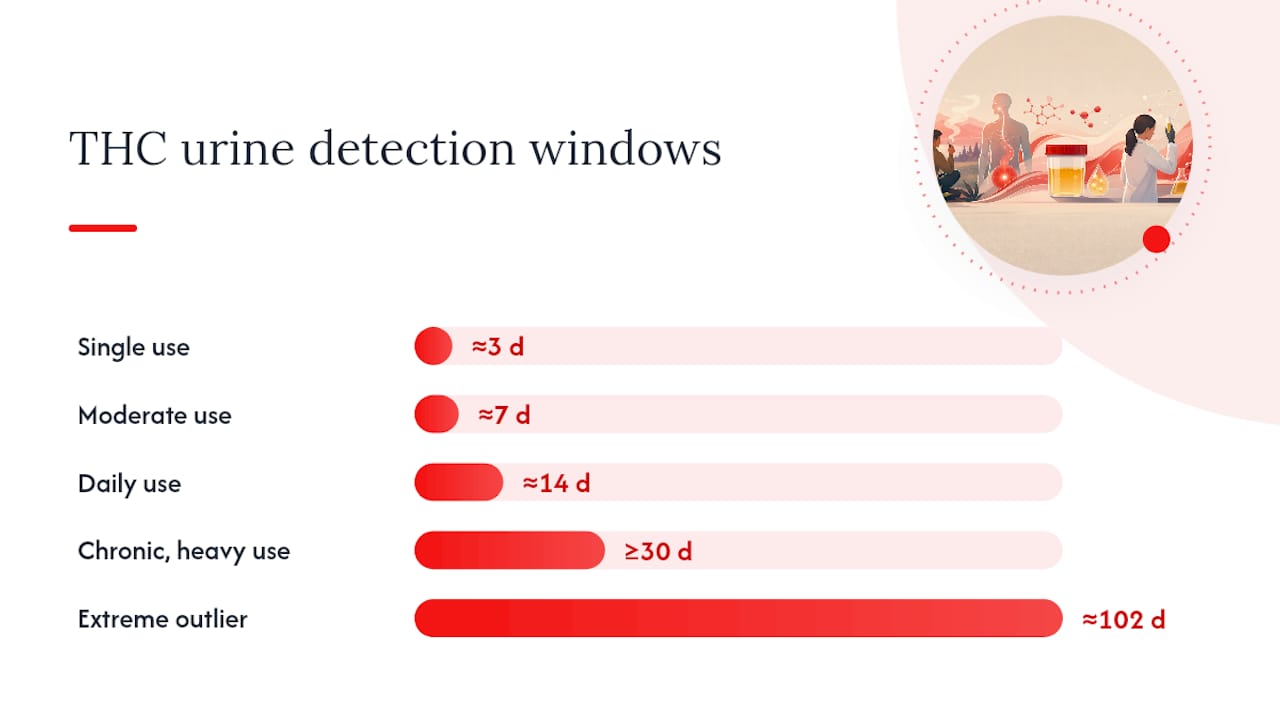
The ranges above come from a mix of controlled dosing research and lab reference data, and they hold up as reasonable estimates for most people. But “detectable” only means something in relation to a cutoff, and that’s where a lot of confusion starts.
Mayo Clinic Laboratories publishes a widely cited detection times table that lines up with these general windows:
- Single use: a few days
- Moderate use (a few times per week): up to about a week
- Daily use: up to two weeks
- Chronic, heavy use: a month or more
Those numbers describe typical cases, not guarantees. A systematic review synthesizing cannabinoid detection data found that weekly users sometimes test negative within a week under higher cutoff thresholds, while the same person could still trigger a positive under a more sensitive workplace cutoff. The window isn’t fixed. It shifts with the test.
Then there are the outliers. A case report documenting prolonged detection found urinary cannabinoids still measurable at roughly 102 days after a chronically heavy user stopped, with concentrations declining slowly over that stretch. These extreme cases involve high body fat and years of near-daily use, where THC-COOH has had time to accumulate deep in fat stores and leach back out gradually. They’re rare, but they explain why “30 days and you’re clear” is a myth for a subset of long-term users.
What Does a Urine Test Actually Measure?
Urine drug tests never look for active THC. They target 11-nor-9-carboxy-THC, known as THC-COOH, the inactive byproduct your body creates after breaking down the psychoactive compound.
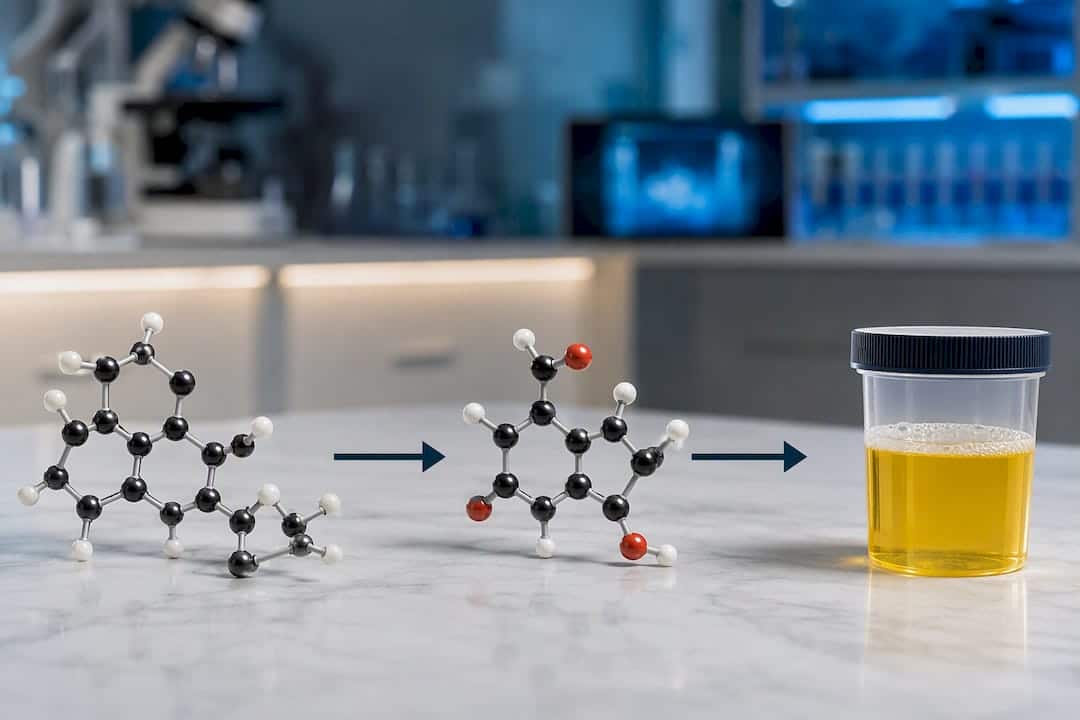
The path looks like this: THC converts to 11-hydroxy-THC, which the liver further metabolizes into THC-COOH. That metabolite shows up in urine fairly fast, typically within 60 minutes and up to about 4 hours after use.
Here’s where cutoffs change everything:
- 15 ng/mL is a common workplace screening threshold and one of the most sensitive in routine use.
- 20, 50, and 100 ng/mL cutoffs appear across different immunoassay screening programs, each producing a different effective detection window for the same person.
- 180 ng/mL, the WADA decision limit for athletes, is high enough that casual users often clear it within days.
A screening immunoassay flags samples above a chosen cutoff, but it’s a preliminary tool, not a final verdict. Confirmatory testing with gas chromatography-mass spectrometry (GC-MS) identifies and quantifies THC-COOH with far more precision, and it’s the method labs use to verify a presumptive positive before anyone acts on it.
What Factors Change How Long THC Stays Detectable?
Two people who smoke the same amount on the same day can clear a urine test at very different speeds. The variables that matter most:
- Dose and frequency. Higher doses and repeated use build up total body burden, meaning there’s simply more THC-COOH for your body to eliminate.
- Body fat percentage. THC-COOH is lipid-soluble and stores in adipose tissue, which is why individuals with higher body fat tend to show longer detection windows even after they stop using.
- Metabolic rate and genetics. People process and excrete metabolites at different speeds for reasons that have nothing to do with how much they used.
- Hydration. Drinking large amounts of water dilutes urine, which can push metabolite concentration below a cutoff. But labs routinely check creatinine levels and specific gravity, and a sample that reads as abnormally dilute often gets flagged for recollection rather than accepted as a clean negative.
- Exercise or rapid weight loss. Burning fat can transiently release stored THC-COOH back into circulation, occasionally raising urine concentrations in the short term rather than lowering them.
Pro Tip: If you’re worried about a dilute-sample flag, don’t overcorrect. Drinking normally and testing at a typical time of day beats chugging water right before your appointment.
How Do Labs Confirm a Positive THC Result?
Most testing programs run a two-step process. Step one is a screening immunoassay set at a specific cutoff, commonly 20, 50, or 100 ng/mL depending on the program. Anything below that line reports negative regardless of what’s actually present in trace amounts.
Step two only happens if the screen flags positive. GC-MS confirmation testing uses a much lower detection limit, often around 15 ng/mL, which means it can pick up trace THC-COOH that a higher-cutoff immunoassay would have missed. A comparison study of immunoassay versus GC-MS detection times found GC-MS consistently produced longer “last positive” windows than screening assays at equivalent doses, sometimes by several days.
- Immunoassay screens are fast and cheap but less sensitive.
- GC-MS confirmation is slower but far more precise, and it’s the standard for disputing or verifying a result.
- Dilute or adulterated samples typically trigger a required recollection under most lab protocols rather than a pass.
What Actually Helps Before a Urine Test (and What Doesn’t)
Abstinence is the only method with real evidence behind it. If you know how often you use, the ranges above give you a reasonable estimate of how long you need to stop before testing clean.
- Stop using and count backward from your typical pattern. Occasional users need roughly a week; daily users should plan for two weeks or more.
- Skip the detox drinks and cleanses. Most lack credible evidence, and some trigger a dilute-sample flag that causes more problems than it solves.
- If you get a positive, ask about confirmatory testing. GC-MS confirmation is standard practice for disputed results, and you’re entitled to ask what cutoff the lab used.
- Medical cannabis patients should keep documentation on hand in case a workplace or clinical program requires it.
- On test day, follow collection instructions exactly. Avoid unusual behavior, like excessive water intake right before the sample, that could raise questions about dilution.
Pro Tip: If you’re a caregiver or employer setting up testing protocols, understanding detection windows across substances helps you set realistic retest intervals instead of guessing.
What Should You Do If You Test Positive?
A positive urine result tells you someone was exposed to THC at some point in the recent window. It says nothing about whether they were impaired at the time of the test, which is a distinction drug testing authorities consistently stress and one most people never hear explained. Before anyone acts on a screening result, ask what cutoff was used and whether it’s been confirmed with GC-MS. That single question resolves more disputes than any home remedy ever will.
— Justin
Choosing the Right Test Kit for Your Situation
Not every situation calls for the same kit. Individuals doing a personal check before a scheduled test often reach for single-panel THC strips because they’re fast and inexpensive, while clinics, treatment programs, and workplaces typically need multi-panel cups that screen for a dozen or more substances plus adulterants in one pass.
There are options available ranging from basic THC-only strips to comprehensive multi-panel cups suitable for higher-volume programs, including some with CLIA waived and FDA-approved designations depending on the product. If you’re not sure which panel count or cutoff sensitivity fits your situation, the guide to selecting drug test kits walks through the decision step by step, and the comparison of top urine drug test kits breaks down options side by side. Any positive screening result, home or clinical, should still be confirmed through a laboratory GC-MS test before anyone treats it as final. Browse the current lineup and pick the kit that matches your testing volume and required panel.
Sources
For deeper detail, consult the Mayo Clinic Laboratories marijuana detection table, the systematic review on cannabinoid cutoffs and detection windows, and the immunoassay versus GC-MS comparison study. Readers interested in responsible use patterns can also review this cannabis education resource.
This article is general information, not a substitute for advice from a qualified doctor. Consult a qualified healthcare professional about your own circumstances before acting on anything here.
- Drug Testing: Marijuana – Mayo Clinic Laboratories
- Systematic review on cannabinoid detection windows and interpretation
- Detection times of marijuana metabolites in urine by immunoassay and GC‑MS
- Case report: prolonged detection up to 102 days
FAQ
How long does THC take to clear a urine test?
It depends on use pattern: about 3 days for a single use, 5 to 7 days for occasional use, 10 to 15 days for daily use, and 30 days or more for chronic heavy use, based on Mayo Clinic Laboratories reference data.
What is the longest time THC has been detected in urine?
A documented case report found measurable cannabinoids in a chronically heavy, high body fat user roughly 102 days after last use, though this is an extreme outlier rather than a typical result.
Is 30 days enough to pass a urine test for THC?
For most daily users, 30 days is usually enough, but chronic heavy users with higher body fat can remain positive well past that mark, so 30 days is a rough guideline rather than a guarantee.
How long can you fail a drug test for THC?
You can fail as long as your THC-COOH concentration stays above the lab’s cutoff, which for chronic heavy users can extend past 30 days and, in rare documented cases, beyond 90 days.