Blog
Avoid OSHA Fines: SOP Steps for U.S. Clinics to Dispose Used Drug Tests


If a used drug-test device contains only urine with no visible blood, OSHA does not classify it as regulated medical waste. Empty the liquid, reseal the device, and discard it as solid waste after basic precautions. If blood or another potentially infectious material is visible, the calculus changes entirely: containerize, label, and route it through regulated-waste channels under 29 CFR 1910.1030. Check your state’s medical-waste rules before finalizing your SOP, since several states go further than the federal floor.
TL;DR:
- Drug-test devices containing only urine without visible blood can be discarded as solid waste after emptying, resealing, and basic precautions, unless visible contamination is present.
- When visible blood or other infectious material is present, the device must be containerized, labeled, and routed through regulated medical waste channels according to OSHA standards.
- Facilities should establish SOPs that distinguish between regulated and non-regulated devices, including proper container types, disposal routes, and recordkeeping for tracking waste.
- Proper PPE use, efficient handling, and controlled storage are critical to minimizing staff exposure between collection and disposal points.
- State regulations can impose stricter disposal procedures than OSHA, requiring facilities to verify local laws and document compliance in their waste management plans.
Table of Contents
- How Do You Dispose of Used Drug Tests With No Visible Blood?
- When Does a Used Drug Test Become Regulated Medical Waste?
- Storage, Transport, and PPE: What Keeps Staff Safe In Between
- Does OSHA Regulate How You Dispose of Drug Tests, or Does the State?
- Building a Simple SOP for Drug-Test Disposal
- Do Oral Swabs and Hair Follicle Tests Get Disposed of Differently?
- A perspective on reducing disposal risk at the source
- Where to find sealed, leak-resistant testing supplies
- Sources
- FAQ
How Do You Dispose of Used Drug Tests With No Visible Blood?
Most drug-test cups, dip cards, and swabs never touch blood. That single fact determines almost everything about how you’re allowed to throw them away. OSHA’s own interpretation letters confirm that urine specimens and their containers don’t automatically become regulated waste just because they held a bodily fluid. The trigger is visible contamination, not the type of specimen.
Here’s the practical sequence clinics, employers, and individuals can follow for a standard, non-contaminated urine test:
- Have the person being tested seal the cup or device themselves right after use. This limits how much staff or family members handle the liquid at all.
- Empty the specimen into a toilet connected to a sanitary sewer, assuming your facility policy and local municipal rules allow it. This is a specimen liquid, not a hazardous pharmaceutical, so the EPA’s sewer-ban rule for hazardous waste pharmaceuticals does not apply here.
- Skip rinsing unless your SOP specifically calls for it. Letting the empty cup drain and air-dry in a secondary tray works fine and avoids extra splash risk.
- Double-bag the empty device in an opaque, leak-resistant trash bag. Opaque bags matter for privacy as much as for containment. Seal it and place it in regular trash unless your state has reclassified test devices as medical waste.
- Label internal collection bins with the date and facility name if your written procedure calls for tracking, and note the disposal decision in your files if there was ever a question about contamination.
Pro Tip: Give the patient a tray or lined bin to place the sealed cup into rather than handing it directly to staff. That one small habit cuts more exposure incidents than any glove policy.
A few extra safeguards worth building into daily practice:
- Keep hand sanitizer or a sink within reach of the collection area.
- Wipe down counters with a facility-approved disinfectant at the end of each testing shift.
- Train front-desk or intake staff on the difference between “used” and “contaminated” so they don’t over-bag routine waste into biohazard bins unnecessarily.
When Does a Used Drug Test Become Regulated Medical Waste?
Visible blood changes the classification instantly. OSHA’s Bloodborne Pathogens Standard defines regulated waste as liquid or semi-liquid blood or other potentially infectious material (OPIM), items that would release blood if compressed, materials caked with dried blood, and contaminated sharps, according to 29 CFR 1910.1030. A drug-test cup that picked up blood during a finger-stick confirmation or an oral swab used on a patient with a mouth injury falls squarely into this category.
Once a device meets that threshold, the container rules get specific. OSHA requires that regulated-waste containers be:
- Closable, so nothing spills during handling or storage.
- Constructed to prevent leakage from the sides or bottom.
- Labeled or color-coded (typically red or marked with the biohazard symbol).
- Closed prior to any movement or removal from the collection area.
From there, facilities generally choose one of three disposal paths: on-site autoclaving where state rules permit it, incineration through a licensed vendor, or transfer to a contracted medical-waste hauler who handles treatment and manifests off-site. Some states require supplemental labeling on treated waste noting the method and date, according to Louisiana’s Department of Environmental Quality guidance, so don’t assume autoclaving alone satisfies every jurisdiction’s paperwork requirements.
One easy mistake: mixing sharps into general regulated waste. Lancets, needles, or broken glass from a finger-stick component need their own puncture-resistant sharps container, never a soft bag, regardless of whether the rest of the collection kit is contaminated.
Regulatory guidance consistently pushes toward a risk-based read rather than a blanket one. Over-classifying every used cup as biohazardous adds cost and hauler fees without adding any real safety margin when no blood is present.
Storage, Transport, and PPE: What Keeps Staff Safe In Between
The gap between collecting a specimen and finally disposing of it is where most exposure risk actually lives. A designated holding area, ideally with a time or volume limit before pickup, keeps regulated waste from piling up in a back room. Use secondary containment (a tray or bin under the primary container) in case a bag leaks.
Transport, even just from an exam room to a storage closet, should happen in a closed, leak-resistant container as outlined in best practices for confidential waste duty of care. If you’re working with an outside hauler for regulated waste, maintain a chain-of-custody log for anything tied to forensic or court-admissible testing.
On the PPE side, keep it simple and consistent:
- Nitrile gloves for anyone handling used cups, dip cards, or swabs directly.
- Eye protection if there’s any splash risk, such as during specimen validity testing.
- Disposable gowns for high-volume collection sites or law-enforcement intake areas.
- Dispose of PPE itself in the same waste stream as what it touched.
Pro Tip: Keep a small spill kit near every collection station, not just in a central supply closet.
Does OSHA Regulate How You Dispose of Drug Tests, or Does the State?
OSHA sets the federal floor: it defines what counts as regulated waste and how you must containerize it. What OSHA does not do is regulate the final disposal method itself. That job falls to the EPA and individual states, and this is exactly where facilities get tripped up. A containerization approach that satisfies OSHA can still violate your state’s medical-waste transport or disposal rules.
Before finalizing any SOP, run through this checklist:
- Confirm how your state legally defines “medical waste” or “biomedical waste,” since definitions vary more than people expect.
- Check required labeling formats and maximum storage durations before pickup.
- Identify which disposal routes (autoclave, incineration, licensed hauler) your state actually permits.
- Verify manifest or transport documentation requirements for regulated waste leaving your facility.
- Confirm your waste hauler’s credentials and licensing are current for your state.
Start with your state health department’s website, then cross-check your state environmental protection agency and any municipal rules that apply to your specific address. Document what you find directly in your exposure-control plan so the next person doesn’t have to redo the research.
Building a Simple SOP for Drug-Test Disposal
A written SOP doesn’t need to be complicated to hold up during an inspection or an internal audit. At minimum, it should define scope (which tests and collection methods it covers), name the responsible role for each step, and separate handling instructions for non-regulated versus regulated items. Include your PPE requirements, storage location and duration, your waste hauler’s contact information, and a clear line for incident reporting if someone gets exposed.
Simple signage helps more than most facilities expect. A label reading “Non-Regulated Waste, Empty Specimens Only” on one bin and “Regulated Medical Waste, Biohazard” on another prevents the guessing that leads to over-classification or, worse, under-classification.
For recordkeeping, retain disposal decisions, hauler manifests, and any treatment records in your exposure-control plan for whatever period your state requires. Facilities managing hazardous or regulated waste often need to keep these records available for inspection well after disposal, per federal hazardous-waste management standards.
| SOP element | Non-regulated device | Regulated (blood/OPIM present) |
|---|---|---|
| Container | Opaque, leak-resistant trash bag | Closable, leak-resistant, labeled/color-coded bin |
| Disposal route | Regular trash (unless state says otherwise) | Autoclave, incineration, or licensed hauler |
| Recordkeeping | Optional, note if uncertainty existed | Required: manifest, treatment date, method |
Home users can follow a stripped-down version of this: empty the cup into the toilet, double-bag the empty device, obscure any personal information on the packaging, and follow your municipal trash rules. There’s no need for a biohazard bag on a routine at-home test that never touched blood.
Do Oral Swabs and Hair Follicle Tests Get Disposed of Differently?
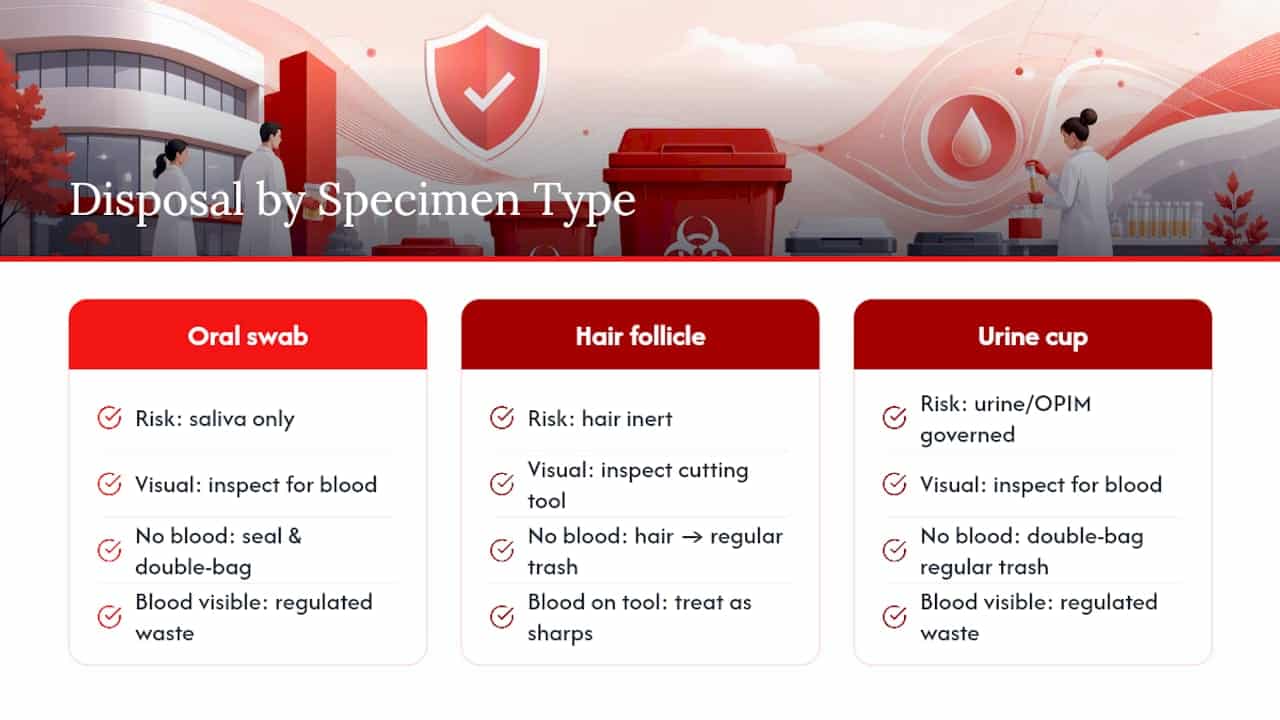
The core rule stays the same across test types, but the physical handling differs enough to matter. Oral fluid swabs carry saliva rather than urine, and OSHA’s blood/OPIM standard still governs the determination: saliva alone, without visible blood, generally does not trigger regulated-waste status. That said, oral collection carries a higher chance of incidental blood exposure from gum irritation or minor mouth injuries, so a quick visual check before disposal matters more here than with urine cups.
For a non-contaminated oral swab, snap the collection stick into its sealed tube if the kit is designed that way, then discard the sealed unit in regular trash following the same double-bagging approach used for urine cups. If blood is visible on the swab or tube, it moves into the regulated-waste stream just like a contaminated urine device would.
Hair follicle testing waste looks different again. The collected hair itself carries essentially no bloodborne pathogen risk once cut, since it isn’t a bodily fluid. The scissors or blade used to collect the sample, however, can pick up scalp contact and should be disinfected between uses or treated as single-use where budget allows. Dispose of hair clippings in regular trash; treat any cutting tool that drew blood as you would a minor sharps incident, isolating it for proper disposal rather than tossing it loose into a waste bin.
Across all specimen types, the same visual-inspection habit protects you: look before you bag, and let what you actually see, not the test category, decide the disposal path.
A perspective on reducing disposal risk at the source
The easiest disposal problem to solve is the one you design out ahead of time. Sealed, click-top specimen cups can cut down on the handling and leakage that create most contamination questions in the first place, since the device closes securely before anyone besides the tested individual touches it. For labs and employers building out a compliant SOP, product suppliers may share basic disposal-template language and product recommendations for bulk or custom orders.
— Justin
Where to find sealed, leak-resistant testing supplies
The disposal steps above only work as well as the equipment you start with. A cup that leaks during collection or a dip card that requires excessive handling creates exactly the contamination risk this guide walks you through managing. Some suppliers stock sealed, click-top specimen cups, dip cards, and oral swabs built to minimize staff contact from collection through disposal, with CLIA-waived and FDA-approved options across many panels.
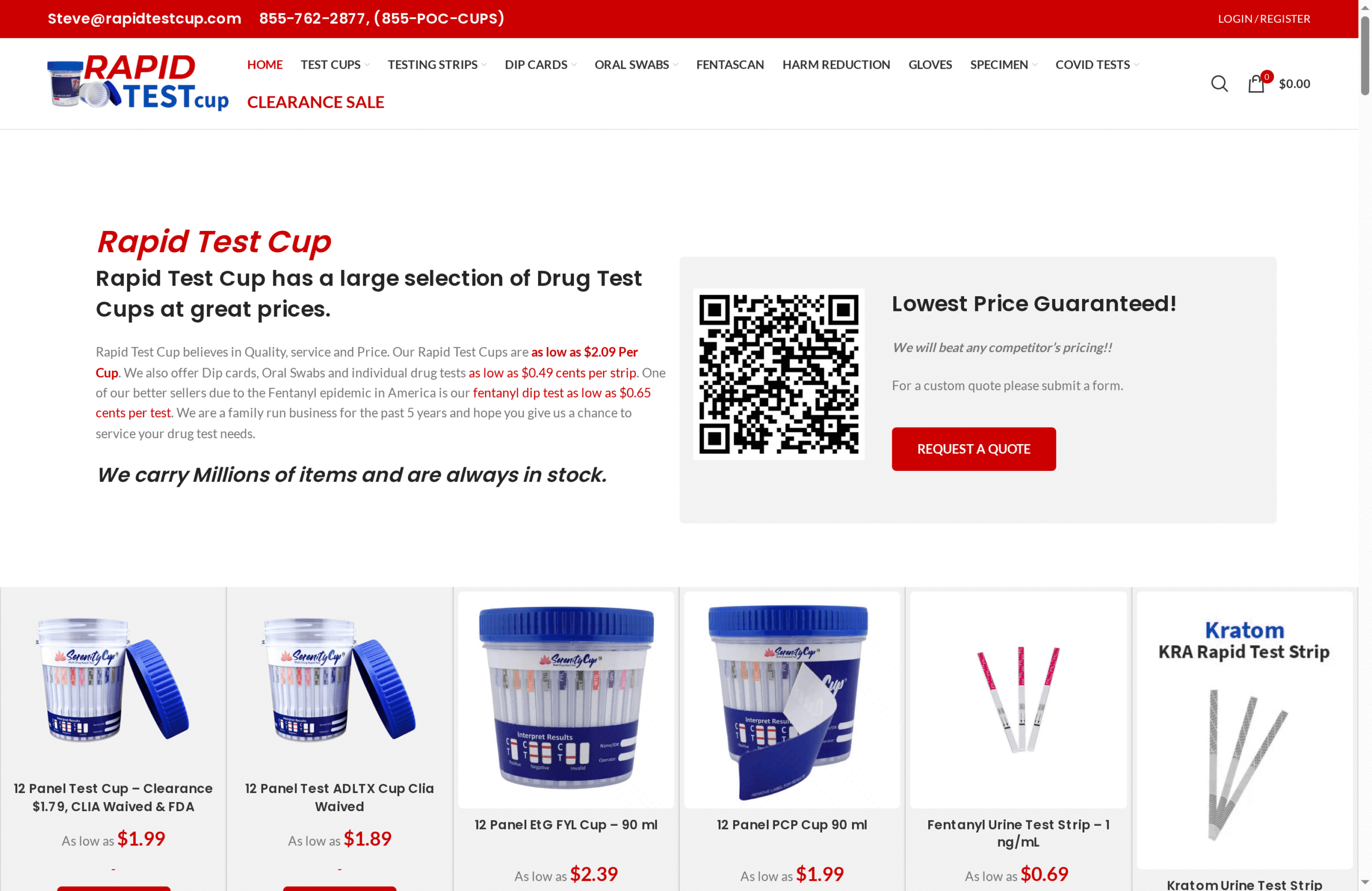
Some suppliers offer volume pricing and quick shipping, so labs and clinics restocking collection supplies aren’t left waiting on a backorder mid-shift. If you’re outfitting an employer testing program or a clinic collection station, the 18-panel click-top economy cup is a solid starting point for reducing handling risk without adding cost per test. Browse the full shop catalog or request a custom quote for bulk orders tailored to your facility’s testing volume.
Sources
Consult 29 CFR 1910.1030 for the federal regulated-waste definition and container standards, and OSHA’s interpretation letters for urine-specific clarifications. For pharmaceutical sewer-ban context, see the EPA’s hazardous waste pharmaceuticals rule. Always confirm final rules with your state health department and licensed medical-waste hauler.
- 29 CFR 1910.1030 — Bloodborne Pathogens (OSHA)
- EPA final rule — Management Standards for Hazardous Waste Pharmaceuticals (2019)
FAQ
Is a Used Urine Drug Test Considered Biohazard Waste?
Not automatically. Under OSHA’s Bloodborne Pathogens Standard, urine without visible blood isn’t regulated waste; visible blood or OPIM changes that classification.
Can You Flush a Used Drug-Test Specimen Down the Toilet?
Yes, in most cases, if your facility policy and municipal sewer rules allow it. The EPA’s sewer-ban rule targets hazardous pharmaceuticals, not routine urine specimens.
What Should You Do if a Drug Test Has Visible Blood On It?
Containerize it in a closable, leak-resistant, labeled biohazard bag or bin, and route it through your facility’s regulated-waste procedure, which typically ends in autoclaving, incineration, or hauler pickup.
Do State Rules Ever Override OSHA on Drug-Test Disposal?
OSHA sets the federal baseline for classifying waste and container standards, but states and the EPA govern actual disposal methods and transport, and some states impose stricter requirements.
Does RapidTestCup Sell Products Designed to Reduce Disposal Risk?
Yes. RapidTestCup’s sealed, click-top specimen cups and dip cards are designed to minimize specimen handling from collection through disposal; current pricing and bulk options are available on the shop page.