Blog
1 in 5 Fentanyl Analogs Go Undetected by Test Strips for Harm Reduction


Fentanyl test strips detect many fentanyl analogs, but not all of them, and sensitivity swings by brand, lot, and how you prepare your sample. A negative result never rules out fentanyl or its analogs. Treat every test conservatively: carry naloxone, avoid using alone, and use a small test dose regardless of what the strip shows.
TL;DR:
- Fentanyl test strips have blind spots due to differences in antibody targeting, missing roughly 20 to 50 percent of tested analogs depending on the brand and lot.
- Proper sample preparation, such as dissolving around 10 mg of drug in 1 mL of water, is critical to reliably detect fentanyl and its analogs, avoiding over-dilution.
- Using two brands with different antibody targets can significantly reduce the chance of false negatives because each brand detects different regions of the fentanyl molecule.
- Lot-to-lot variability can affect sensitivity, making it essential to verify batch certificates and avoid assuming all strips perform identically over time.
- A positive test line should always be read as positive, especially faint or absent lines, and any suspicious or unexpected results should prompt confirmatory laboratory testing.
Table of Contents
- How a Fentanyl Analogs Test Actually Works
- Which Fentanyl Analogs Do Test Strips Actually Catch?
- Getting Sample Prep Right: Ratios, Solvents, and Technique
- Reading the Lines: Why “Faint” Should Mean “Positive”
- What to Do After the Test, Whatever It Shows
- What the Research Actually Tells Us
- Regulatory Approval and Quality Standards Worth Knowing
- Test Strips vs. Lab Instruments: Where Each One Fits
- How to Store Fentanyl Test Strips So They Still Work
- The Gap Between What Strips Promise and What They Deliver
- Choosing the Right Fentanyl Test Kit for Your Situation
- Sources
How a Fentanyl Analogs Test Actually Works
A fentanyl test strip is a lateral-flow immunoassay, the same basic technology as a pregnancy test. A dissolved sample wicks up a paper strip coated with antibodies that bind to fentanyl’s molecular structure. If the target molecule is present in high enough concentration, it blocks antibodies from reaching the control zone, and the test line stays faint or disappears. That inverted logic trips up a lot of first-time users: no line, or a very faint line, means fentanyl was likely detected. Two clear lines means it probably wasn’t.
The strip’s control line is the only fixed reference point. If it doesn’t appear, the test failed and the result is invalid, full stop, regardless of what the test line shows.
Here’s where things get complicated for anyone testing drugs rather than urine. Manufacturers calibrate their cutoffs (often somewhere in the 20 to 200 ng/mL range) against urine, a matrix regulators standardized decades ago for workplace and clinical screening. Dissolve a chunk of powder in water and you’re not replicating urine chemistry. You’re creating a different matrix with different pH, different competing molecules, and no metabolic breakdown. A cutoff validated for urine doesn’t map cleanly onto a drug-checking context, which is exactly why sample prep (covered later) matters so much more here than it does in a clinic.
Fentanyl test strips can be adapted, with care, to several matrices beyond urine:
- Powders and residues: dissolved in water and tested directly.
- Pills: sampled via a wet cotton swab rubbed on the crushed or intact tablet.
- Injection equipment and cookers: rinsed with a small volume of water.
- E-liquids and vape residue: diluted before testing.
Laboratory work confirms this flexibility holds up: one validation study found fentanyl strips reliably detected fentanyl at roughly 45 ng/mL and reacted with 16 of 18 tested analogs when researchers used water extraction and cotton-swab sampling across powders, textiles, and e-liquids. That’s a meaningfully different use case from the clinical dip-and-read urine test the strips were originally built for, and it’s why sampling technique carries so much weight in the sections below.
Which Fentanyl Analogs Do Test Strips Actually Catch?
No test strip on the market catches everything, and the gap is bigger than most harm-reduction guides admit. The most rigorous data comes from a screening of 251 synthetic opioids across two popular strip brands, published in the Harm Reduction Journal. Researchers found:
121 compounds were detected by both brands tested. 50 compounds were missed by both. 80 compounds were caught by one brand but not the other.
That middle number, 50 undetectable analogs, is the one that should change how you think about a negative result. It’s not a rare edge case; it’s a fifth of everything tested. And the 80 compounds caught by only one brand explain why harm-reduction programs increasingly recommend keeping two different brands on hand rather than trusting a single kit.
The mechanism behind those blind spots is chemical, not random. Fentanyl analogs and structurally related nitazenes are built from a core skeleton with substitutions bolted onto specific positions, typically the phenethyl group or the carbonyl moiety. Antibodies on a given strip are trained to recognize a particular region of that skeleton. Bulk up the wrong spot with a large substituent and the antibody can no longer grip the molecule, even though the compound is still a potent opioid. Different manufacturers target different regions, which is exactly why one brand’s blind spot isn’t necessarily the other’s. Using strips from two manufacturers with different antibody targets meaningfully lowers the odds that a real analog slips through both, precisely because the two brands recognize different parts of the fentanyl molecule.

Limits of detection compound the problem. A systematic review of lateral-flow strips for nitazenes and related synthetic opioids found complete agreement with mass spectrometry only under concentrated sample prep, specifically 10 mg of drug dissolved per 1 mL of water. That’s not a rounding error. It’s a demonstration that how you prepare the sample can single-handedly move a true positive into false-negative territory.
Lot-to-lot variability adds a third layer of uncertainty on top of chemistry and dilution. Independent lab testing on one widely used brand found that strips manufactured in 2017 matched the company’s published 20 ng/mL cutoff, but strips from the same manufacturer produced in 2021 showed decreased sensitivity for fentanyl compared to earlier lots. The newer lots also showed different cross-reactivity patterns with common cutting agents. In plain terms: the strip you buy this year may not perform the way a five-year-old review of “fentanyl test strips” said it would. That’s the strongest practical argument for checking lot numbers and certificates of analysis whenever a supplier makes that information available, rather than assuming every box off the shelf behaves identically.
Getting Sample Prep Right: Ratios, Solvents, and Technique
Most false negatives in the field trace back to one mistake: too much water. Dissolve too little drug into too much liquid, and you can push a real fentanyl analog below the strip’s limit of detection even when the strip itself is working perfectly.
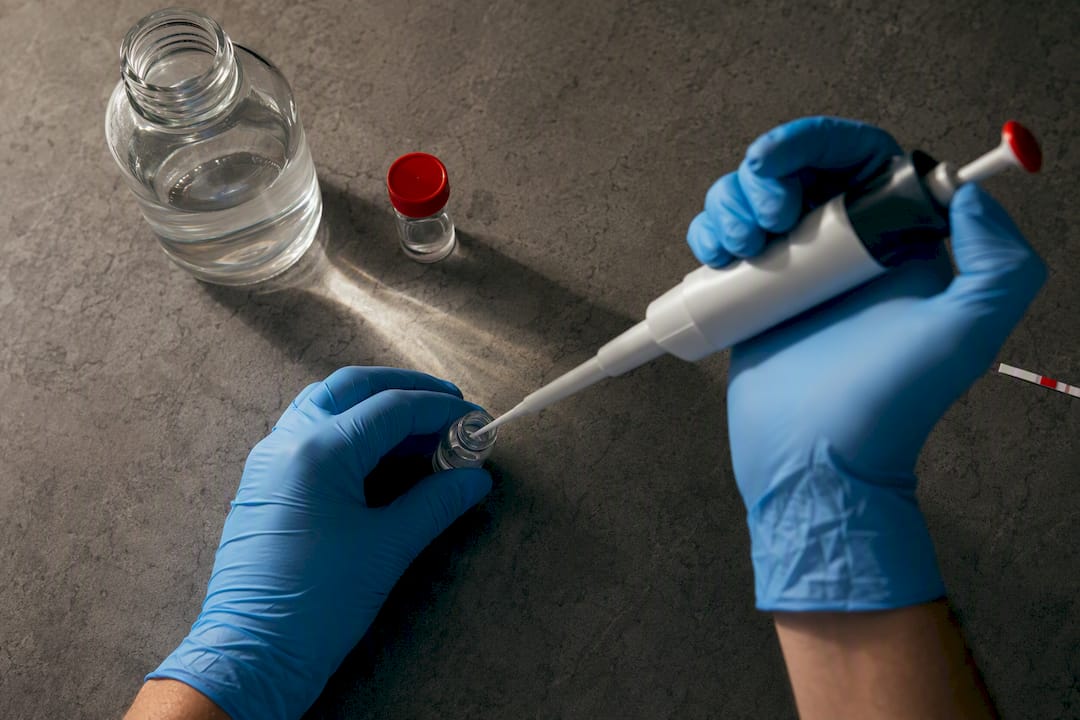
The concentration that performed best in controlled testing was a 10 mg of drug dissolved per 1 mL of water, which produced full agreement with mass spectrometry results. Some harm-reduction programs advise a somewhat gentler ratio, up to 5 mg per 1 mL, when a full 10 mg sample isn’t practical or when the drug quantity is limited. Either way, the direction matters more than the exact number: concentrated beats diluted, every time, when your goal is catching a positive.
A conservative field protocol looks like this:
- Weigh the sample if you have a milligram scale; if not, use a consistent small scoop rather than eyeballing a pinch.
- Dissolve in the smallest practical volume of plain water, targeting roughly 10 mg per 1 mL where the quantity allows it.
- Stir or gently agitate for a full minute rather than a quick swirl. Cold water dissolves slower than room-temperature water, so give it time.
- Dip the strip for the manufacturer-specified duration, usually 15 seconds, then lay it flat.
- Read at the specified window, typically 2 to 5 minutes; results outside that window (especially very late readings) aren’t reliable.
- For pills, textiles, or equipment, wet a cotton swab and rub the surface thoroughly before touching it to the strip, rather than trying to dissolve a whole tablet.
- For e-liquids or thin residue, dilute lightly, since these matrices often carry higher relative concentrations than powder residue and can otherwise overwhelm the strip.
Avoid organic solvents entirely. Acetonitrile, high-percentage isopropyl or ethanol, and similar solvents can denature the antibodies on the strip or interfere with wicking, producing unreliable results even when the target compound is present. Plain water at room or lukewarm temperature is the standard across every validated protocol referenced in the research above. Skip the temptation to speed things up with heat, too. Hot water can degrade the antibody coating on cheaper strips.
Pro Tip: If you only have a small amount of a substance to test, don’t stretch it across a large volume of water to “make it go further.” A concentrated sample from a smaller amount of drug will give you a more trustworthy read than a diluted sample from a larger amount.
Field strips are a triage tool, not a laboratory instrument, and that distinction matters most when the stakes are highest: a large batch intended for redistribution, an unknown substance with no history in your area, or a result that doesn’t match what you expected. In those cases, confirmatory laboratory testing (FTIR, or mass spectrometry methods like LC-MS/MS or GC-MS) is the only way to get a definitive answer. If you’re testing powders regularly rather than one-off, a dedicated powder testing kit built around consistent extraction volumes reduces the guesswork built into eyeballing ratios every time.
Reading the Lines: Why “Faint” Should Mean “Positive”
The control line is non-negotiable. If it doesn’t show up, the test failed, and no interpretation of the test line means anything. Retest with a fresh strip before drawing any conclusion.
Beyond that, the safest reading rule in harm reduction is also the simplest: any test line that is absent or faint should be read as positive. Don’t hold out for a completely blank line before you get concerned, and don’t talk yourself into a borderline read being “probably fine.” Lab work on strip performance found that subjective interpretation of faint lines is one of the most common sources of reading error, and that training people specifically on control-versus-test-line logic measurably improves accuracy. If you’re testing regularly, that’s worth ten minutes of practice with a known sample before you rely on your own judgment in the field.
False positives happen, and knowing the usual suspects saves you from either panicking unnecessarily or, worse, dismissing a real positive because you assume it’s “probably just the lidocaine.” Documented interferents include:
- Diphenhydramine (a common cutting agent and over-the-counter antihistamine)
- Lidocaine (a numbing agent frequently used to bulk product)
- MDMA, at certain concentrations, depending on strip lot
The concentrations at which these substances trigger a false positive aren’t fixed. Lab testing found that 2021-era strip lots reacted to diphenhydramine and lidocaine at lower concentrations than 2017 lots from the same manufacturer, meaning a strip that used to shrug off a cutting agent might not anymore. That’s a direct consequence of the lot variability discussed earlier, and it’s the practical reason to note the lot number on any box you buy. If you can find a certificate of analysis for that specific lot, even better.
False negatives cluster around three causes: over-dilution during sample prep, testing an analog that falls into a brand’s blind spot, and poor wicking, usually from using too little liquid or a strip that’s expired or was stored somewhere hot and humid. None of these failure modes announce themselves. The strip looks and behaves exactly the same whether it’s working at full sensitivity or badly degraded, which is precisely why a negative result deserves the same caution as an ambiguous one.
What to Do After the Test, Whatever It Shows
A positive result changes your next move immediately. Reduce your dose substantially below what you’d normally take, since fentanyl potency varies batch to batch and a strip can’t tell you concentration, only presence. Never use alone. Have naloxone on hand and make sure someone nearby knows how to use it. Avoid combining with other depressants, including alcohol or benzodiazepines, since respiratory depression compounds fast. If a supervised consumption site is available in your area, that’s the safer setting for a substance that’s already tested positive.
A negative result should not relax any of those same habits. Given that roughly a substantial portion of tested synthetic opioid compounds go undetected by strips entirely, and that lot-to-lot sensitivity can drop tenfold, a clean test tells you the strip didn’t find fentanyl. It does not tell you the drug is safe.
- Start with a small test dose regardless of what the strip showed, and wait to gauge effects before taking more.
- Keep naloxone accessible every time, positive or negative result alike.
- Don’t use alone, and if you must, use a service that checks in by phone or app.
- Escalate to confirmatory testing (FTIR or lab-based mass spectrometry) if you’re dealing with an unfamiliar supply, a large quantity meant for others, or any result that seems inconsistent with what you expected. Technical reviews of detection methods consistently recommend this tiered approach: field strips for fast triage, laboratory instruments for the final word.
- Seek support resources when use has become unmanageable; supervised opioid detox and treatment programs exist specifically for the physical realities of dependence, and reaching out doesn’t require a crisis point first.
What the Research Actually Tells Us
Pull together the lab validations and the systematic reviews, and a few conclusions hold up consistently rather than depending on which single study you read:
- Strip performance depends heavily on concentration; diluted samples produce measurably worse agreement with lab-grade mass spectrometry than concentrated ones.
- No single brand catches every fentanyl analog; blind spots are chemical, tied to which part of the molecule a brand’s antibodies target, and different brands miss different compounds.
- Sensitivity is not fixed over a product’s lifetime. Lot-to-lot differences of tenfold or more in limit of detection have been documented on the same branded product across a few years.
- Matrix effects (temperature, solvents, competing chemicals like caffeine) reduce signal strength independent of whether the target opioid is actually present.
Rapidtestcup’s catalog is built around the practical implications of that evidence rather than treating every fentanyl strip as interchangeable. That means offering CLIA-waived options alongside field-oriented products, giving buyers cutoff information up front, and pointing customers toward lot verification rather than treating a box of strips as a black box. None of that replaces a laboratory instrument. It’s the difference between a screening tool used with informed caution and one used on blind faith.
Regulatory Approval and Quality Standards Worth Knowing
Fentanyl test strips occupy an unusual regulatory space. Some are cleared by the FDA and CLIA-waived for use in clinical and workplace drug screening on urine, which means they’ve passed a formal review for accuracy and ease of use in that specific context. Field-oriented strips marketed for drug checking, by contrast, often aren’t reviewed under that same clinical framework, since they’re designed for a different sample type entirely (dissolved powders and residues rather than bodily fluid).
That split matters practically. A CLIA-waived cartridge carries documentation and a validated cutoff for urine testing, useful for clinics, treatment programs, and workplaces that need defensible, auditable results. A strip marketed for checking street drugs is doing something the original clinical validation never covered, which is exactly why the conservative sample-prep habits covered earlier carry so much weight. Quality assurance in this second context comes down to the manufacturer’s own lot testing, published limits of detection, and whether a certificate of analysis is available for the specific batch you’re holding. Ask for one if it isn’t offered up front. Programs and individual buyers alike benefit from treating CLIA-waived cartridges as the standard for clinical use cases and reserving field strips for their intended triage role.
Test Strips vs. Lab Instruments: Where Each One Fits
A test strip and a mass spectrometer aren’t competing for the same job, they’re doing two different jobs at two different speeds. Strips give a yes-or-no answer in minutes, cost a few dollars, and require no equipment beyond water and a container. That’s exactly why they work as a triage tool at the point of use, whether that’s a harm-reduction outreach table or a home test before use.

Laboratory methods like FTIR spectroscopy, LC-MS/MS, or GC-MS identify the exact compound present, often down to specific analog and approximate concentration, but they require specialized equipment, trained technicians, and turnaround measured in hours or days rather than minutes. Portable FTIR and Raman devices split the difference, offering more chemical detail than a strip in the field, though they still carry real limits around detection thresholds and interference from mixed substances. The honest framing that shows up across technical reviews of these methods is tiered, not either/or: strips for immediate triage, spectrometry or portable instruments for more detail, full laboratory mass spectrometry when a definitive answer actually changes what happens next.
How to Store Fentanyl Test Strips So They Still Work
Heat and humidity are the two things that quietly wreck a fentanyl test strip’s sensitivity long before the printed expiration date arrives. Antibodies are proteins, and proteins degrade faster in warm, damp conditions. A box left in a hot car or a humid bathroom cabinet for a summer can lose meaningful sensitivity even though it looks physically identical to a fresh strip.
Store strips at room temperature, in their original sealed packaging, away from direct sunlight and moisture. Most manufacturers specify a shelf life in the range of one to two years from the date of manufacture, not from the date you opened the box, so check the printed date rather than assuming a fresh delivery means a fresh strip. Once you open an individual foil pouch, use that strip promptly rather than leaving it exposed to ambient humidity for later use. If you’re stocking strips for a harm-reduction program or personal supply that might sit for months, buying smaller batches more frequently beats bulk-buying a year’s worth and hoping storage conditions stay ideal the whole time.
The Gap Between What Strips Promise and What They Deliver
Most harm-reduction messaging treats fentanyl test strips as a binary safety check: test, get an answer, act accordingly. The research doesn’t support that framing, and pretending otherwise does readers a disservice.
What the data actually shows is a tool with real, quantified limits: a fifth of tested synthetic opioids missed entirely, sensitivity that can shift tenfold between manufacturing lots, and a false-negative risk baked directly into how most people naturally prepare a sample (diluting more than they should). None of that makes strips useless. It makes them a first filter, not a verdict.
The overlooked fix isn’t a better strip. It’s better habits: concentrated sample prep, conservative line-reading, dual-brand testing when the stakes are high, and treating every negative as “no signal detected” rather than “confirmed safe.” Combine those habits with naloxone on hand and not using alone, and a strip becomes genuinely useful. Skip the habits, and it becomes a false sense of control.
— Justin
Choosing the Right Fentanyl Test Kit for Your Situation
Different testing situations call for different tools, and matching the kit to the matrix is half the battle. For checking powders and residue directly, a fentanyl powder testing kit built around a consistent extraction ratio removes the guesswork of eyeballing dilution every time. For programs or clinics that need urine screening at a defensible, documented cutoff, 1 ng/mL CLIA-waived strips and FDA-approved cartridges give you results that hold up in a clinical or workplace context. Budget-focused buyers testing at higher volume often start with 20 ng/mL strips, trading some sensitivity for a lower per-test cost.
Before buying anywhere, run through a short checklist: What’s the published limit of detection, and does it match your use case? Is the product CLIA-waived or FDA-cleared, and does that matter for how you’ll use it? Can you get a lot number or certificate of analysis for the batch you’re purchasing? Are the instructions specific enough for your matrix, whether that’s urine, powder, or residue, rather than generic dip-and-read language?
Rapidtestcup carries both the urine-based strips built for clinical cutoffs and the harm-reduction-oriented 10 ng/mL powder strips suited to field checking, along with practical drug detection guidance for anyone still working out which cutoff and matrix fit their situation. If you already know your use case, check current cutoff options and lot documentation on the product page and order the quantity that matches how often you’ll actually test.
Sources
The Harm Reduction Journal’s 251-compound screening is the single best source for understanding brand-specific blind spots in analog detection. The systematic review of lateral-flow strip performance backs the concentration and dilution guidance in this piece. Independent lab testing across manufacturing lots documents the sensitivity drift and false-positive interferents referenced above. The PubMed validation study supports matrix-specific sampling technique. For public-health framing and naloxone guidance, the CDC’s fentanyl overdose prevention page is the authoritative starting point, and the technology review in Molecules covers how field strips fit alongside lab-based confirmatory methods.
This article is general information, not a substitute for advice from a qualified doctor. Consult a qualified healthcare professional about your own circumstances before acting on anything here.
- Assessment of two brands of fentanyl test strips with 251 synthetic opioids reveals “blind spots” in detection capabilities | Harm Reduction Journal
- Decoding the Unseen: A Systematic Review of the Analytical Performance of Nitazene Test Strips for Identifying Synthetic Opioids in Seized Drug Materials – PMC
- Evaluation of fentanyl immunoassay test strips for rapid in-situ detection of fentanyl and fentanyl analogs in seized samples and alternative matrices – PubMed