Blog
Three-Hour Window, 40 Ounces: U.S. DOT Shy Bladder Rules & Paperwork


Under Department of Transportation rules, a donor who can’t produce a specimen gets a limited three-hour window to provide the required minimum urine volume, drinking up to 40 ounces of water in that window. If the three hours pass with no valid specimen, the collector stops the test and notifies the Designated Employer Representative, and CDL drivers have a limited time to see a physician who reports findings to the Medical Review Officer.
TL;DR:
- Donors have three hours from the first failed attempt to produce the required urine volume, with fluids limited to 40 ounces and attempts spaced 30 to 45 minutes apart.
- Specimens under three hours are discarded if insufficient, and collection must follow strict federal rules without combining partial voids or adding substances.
- The employer’s DER notifies the Medical Review Officer within the window, who then decides whether to cancel the test, record a refusal, or request further medical documentation.
- Paruresis is a social anxiety disorder, treatable with therapy, and documentation from a mental health professional is crucial for challenging a shy bladder diagnosis.
- Tracking water intake, practicing breathing techniques, and requesting privacy can improve chances during the three-hour window, but attempting to manipulate samples violates regulations.
Table of Contents
- The Shy Bladder Procedure Under DOT and 49 CFR Part 40
- What to Expect Minute by Minute at the Collection Site
- After the Three-Hour Window: DER, MRO, and What Comes Next
- Understanding Paruresis: The Medical Reality Behind Shy Bladder
- Your Rights and the Paperwork You Should Never Skip
- Smart Moves at the Collection Site (and Mistakes to Avoid)
- A Donor’s Account: One Shy Bladder Event, Start to Finish
- Where to Verify These Rules Yourself
- Sources
The Shy Bladder Procedure Under DOT and 49 CFR Part 40
The minimum volume labs need to run a full panel plus a validity check is a required minimum volume, and anything short of it gets tossed rather than tested. DOT regulation 49 CFR Part 40, Section 40.65, along with §40.193 and §40.195, spells out exactly how a collector handles a donor who can’t fill the cup on the first try.
Here’s what actually governs the process:
- The donor gets a three-hour clock starting from the first unsuccessful attempt, not from arrival at the collection site.
- Water intake is capped at a reasonable amount, generally up to 40 ounces, spread across the window rather than gulped at once.
- Collectors cannot combine two partial voids into one sample. Each attempt is a separate event.
- When the shy bladder procedure applies, the original insufficient specimen gets discarded rather than retained for testing.
- Temperature and tamper checks still apply to any specimen the donor does produce, shy bladder rules or not.
None of this is discretionary on the collector’s part. A site that lets someone “top off” a partial sample with a second void, or that skips the temperature strip because the donor seemed stressed, isn’t following federal specimen integrity rules. Knowing these mechanics matters if you ever need to challenge how an event was handled.
What to Expect Minute by Minute at the Collection Site
A shy bladder event has a rhythm to it, and knowing the sequence takes some of the dread out of the room.
- First attempt fails. The collector documents the insufficient volume, discards that specimen, and starts the three-hour timer immediately.
- You’re offered fluids. Water, within the 40-ounce limit, gets offered and logged. Some sites track intake on a simple sheet with timestamps.
- You reattempt at intervals. There’s no fixed schedule in the regulation, but most collectors give you a chance every 30 to 45 minutes rather than making you sit in a bathroom the whole time.
- Observed collection rules kick in only under specific triggers, such as a prior test showing signs of tampering. Otherwise, standard collection stays unobserved.
- The clock runs out, or you succeed. If the time window passes without the required urine volume, the collector ends the attempt, records the outcome, and contacts the DER the same day when possible.
The collector’s paperwork at each stage matters more than most donors realize. That documentation becomes the record the MRO eventually reviews.
After the Three-Hour Window: DER, MRO, and What Comes Next
Once the collector notifies the Designated Employer Representative, the file moves into administrative territory, and two roles take over from there. The DER is the employer’s point person, responsible for receiving the notification and setting the process in motion. The Medical Review Officer, a licensed physician trained in substance testing rules, makes the final call on how the incomplete test gets classified.
For non-CDL employees, the outcome often depends on employer policy layered on top of DOT rules. For CDL drivers specifically, FMCSA guidance grants a limited time from notification to obtain a medical evaluation from a licensed physician, who reports findings to the MRO.
The MRO generally has a few paths available:
- Cancel the test if a physician documents a legitimate medical explanation, such as a diagnosed condition affecting urination.
- Record it as a refusal to test if no medical evidence arrives within the window, or if the explanation doesn’t hold up.
- Request additional records before deciding, particularly if the physician’s note is vague or incomplete.
Track your evaluation window from the moment you’re notified, not from your last attempt at the collection site. Missing that window by even a day can turn a medical issue into a refusal.
Understanding Paruresis: The Medical Reality Behind Shy Bladder
Paruresis is the clinical name for shy bladder, and it’s classified as a form of social anxiety disorder rather than a physical urinary problem. The mechanism is physiological: anxiety triggers sympathetic nervous system arousal, which tightens the urinary sphincter at exactly the moment you need it to relax. Clinical literature describes this as a performance anxiety response, similar in structure to stage fright, just aimed at a different muscle group.
Treatment tends to center on cognitive behavioral therapy and graduated exposure, gradually practicing urination in progressively less private settings. Clinical sources report meaningful improvement in a large share of patients who stick with structured therapy, though timelines vary person to person. For an MRO evaluation, a physician’s note typically needs to cover diagnostic history, any prior treatment attempts, and a current treatment plan.
Pro Tip: If you’ve never been formally diagnosed with paruresis before a testing event forces the issue, ask your physician for a referral to a therapist who specifically treats anxiety disorders. A generalist’s note carries less weight with an MRO than one from someone who treats this condition regularly.
One safety note: if you experience genuine urinary retention with physical pain rather than simple difficulty starting, that’s a medical emergency, not a testing inconvenience. Seek urgent care.
Your Rights and the Paperwork You Should Never Skip
DOT rules give you specific protections during a shy bladder event, but only if you know to ask for the right documentation.
- Request a copy of the collector’s report noting the insufficient specimen and the exact time your three-hour or five-day window started.
- Ask for written confirmation of when the DER was notified, since that timestamp anchors your CDL evaluation deadline.
- Get any physician evaluation submitted directly to the MRO in writing, and keep a personal copy.
- Understand that employers can require you to complete the medical evaluation process but cannot demand details of your therapy beyond what’s relevant to the testing determination.
- Save every email, fax confirmation, or dated letter tied to this process. A folder with timestamps beats memory if the case gets disputed later.
Privacy protections limit what your employer can access. The MRO reviews medical evidence, not your employer directly, and DOT rules don’t require you to disclose an anxiety diagnosis to coworkers or supervisors beyond what the DER needs administratively.
Smart Moves at the Collection Site (and Mistakes to Avoid)
A few things genuinely help during the three-hour window, and a few things will sink your case if you try them.
- Pace your water intake rather than chugging it all in the first ten minutes. Steady sips over the window work better physiologically anyway.
- Use breathing techniques between attempts. Slow, controlled breathing directly counters the sympathetic arousal driving the retention.
- Ask about privacy accommodations if the setting feels unusually exposed. Standard collection is unobserved unless specific triggers apply.
- Never attempt to combine voids, substitute a sample, or add anything to a specimen. That converts a medical issue into a testing violation, and there’s no walking it back.
- Request a clinical referral immediately if you suspect this will happen again, rather than waiting for the next testing cycle to catch you off guard.
Pro Tip: Keep a simple running log during the event: time of each attempt, ounces of water consumed, and names of staff you interacted with. This becomes useful if the physician evaluation or MRO review requires you to reconstruct the timeline.
A Donor’s Account: One Shy Bladder Event, Start to Finish
A donor who couldn’t produce a specimen within the three-hour window described the process as disorienting mostly because nobody explained the timeline in advance. The collector’s report went to the DER that afternoon. Because the job required a CDL, the five-day clock started immediately, and the donor scheduled a physician visit within two days rather than waiting.
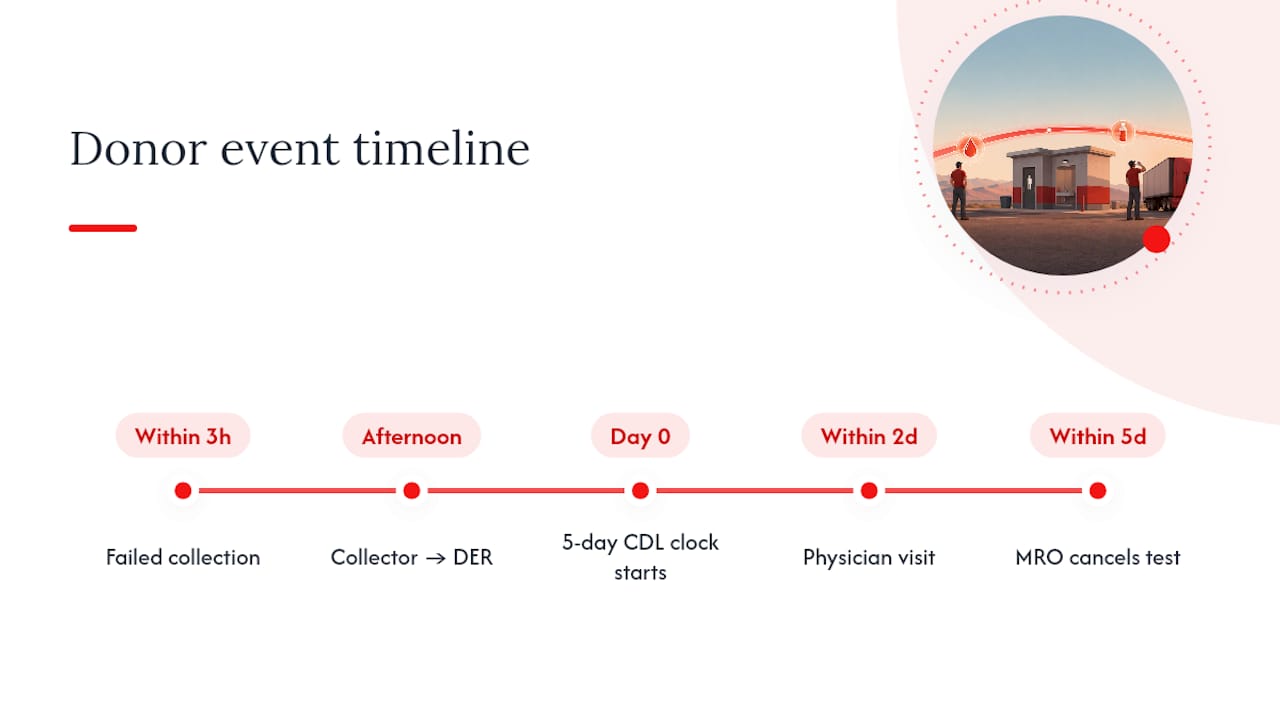
The physician documented a prior history of situational anxiety and recommended a course of structured anxiety treatment. The MRO reviewed the records and canceled the test rather than recording a refusal. The donor’s advice afterward was simple: keep every document, and don’t assume the process will explain itself.
For anyone facing repeat shy bladder events, this is worth treating as a medical issue to address, not just a testing hurdle to survive.
If your workplace runs its own collection process, using validated specimen cups and CLIA waived test kits reduces the ambiguity that makes shy bladder events harder to document correctly. Rapidtestcup’s multi-panel drug test cups include built in temperature strips and adulterant checks, which keep the paper trail clean if a collection needs to be reviewed later by an MRO.
— Justin
Where to Verify These Rules Yourself
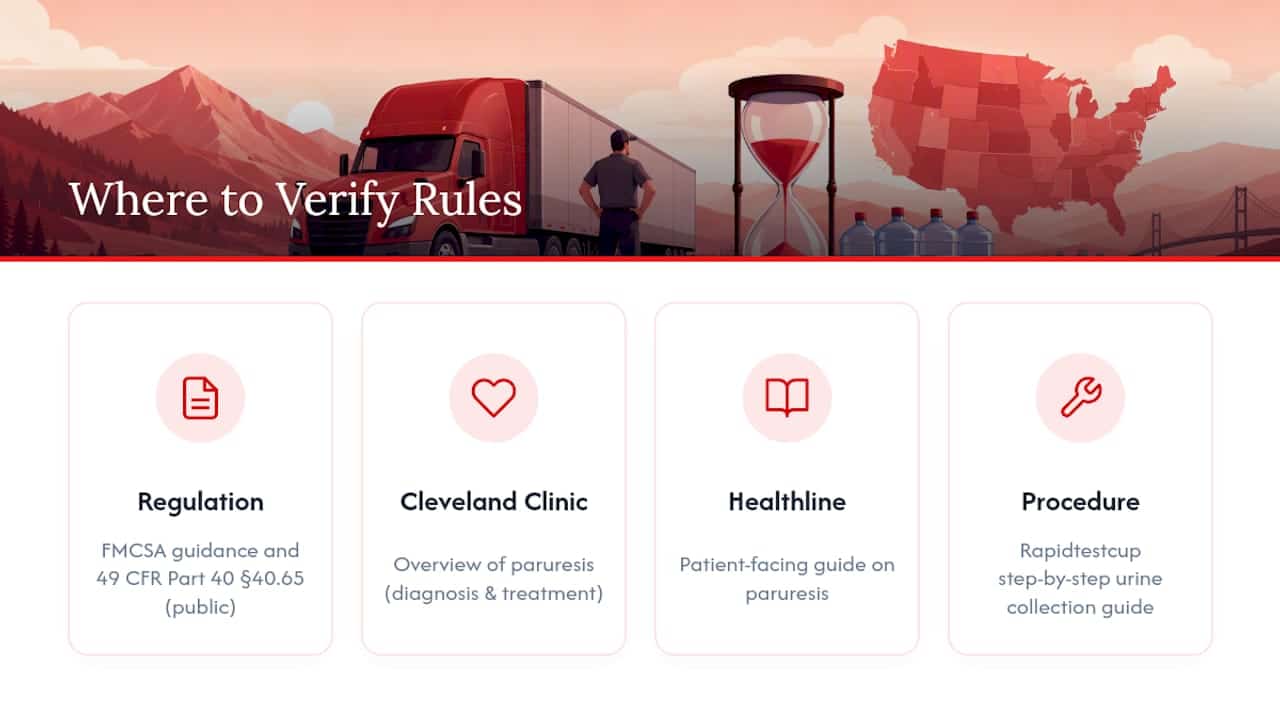
Don’t take secondhand summaries at face value on something with this much riding on it. The FMCSA’s official shy bladder guidance and the full text of 49 CFR Part 40, Section 40.65 are both public and written for regular readers, not just lawyers.
For the medical side, the Cleveland Clinic’s overview of paruresis and Healthline’s patient-facing guide cover diagnosis and treatment in plain language. Rapidtestcup also maintains a step-by-step guide to urine collection procedures for anyone managing testing programs directly.
This article is general information, not a substitute for advice from a qualified doctor. Consult a qualified healthcare professional about your own circumstances before acting on anything here.
Sources
- Shy Bladder | FMCSA – Department of Transportation
- DOT Rule 49 CFR Part 40 Section 40.65
- Shy bladder (paruresis): Causes, symptoms & treatment — Cleveland Clinic
- Clinical perspectives on paruresis (peer-reviewed article) — PMC
- Shy bladder (paruresis): Causes, tricks, and treatments — Healthline