Blog
Nitrite Drug Test: Read 200–500 µg/mL Cutoffs and When to Confirm


A nitrites drug test is an adulterant-detection assay that identifies oxidizing agents, chiefly nitrite salts, added to urine to beat a drug screen. Nitrite above forensic cutoffs can invalidate a specimen or, at higher concentrations, mark it adulterated, and it can mask THC-COOH, morphine, and 6-acetylmorphine on immunoassay panels. The moment a nitrite result flags out of range, the correct move is to confirm on a fresh aliquot and route the case to a Medical Review Officer before reporting anything final.
TL;DR:
- Concentrations of nitrite above 200 micrograms per milliliter indicate invalid results, while levels above 500 micrograms per milliliter confirm adulteration.
- Forensic specimens often show nitrite levels around 1,910 to 12,200 micrograms per milliliter, far exceeding natural background levels.
- Single-parameter nitrite tests are inadequate alone; multi-parameter panels that include creatinine and pH are essential for reliable detection.
- Confirmatory testing with spectrophotometry or ion chromatography is necessary before any adverse employment decision based on adulteration.
- Proper collection and handling procedures, including immediate temperature recording and secondary aliquoting, are critical to uphold evidence integrity.
Table of Contents
- Why Nitrite Adulteration Throws Off Drug Screening
- How Nitrite Screening and SVT Panels Actually Work
- Reading the Numbers: Cutoffs, Invalid vs. Adulterated
- What Collection Sites Must Do the Moment Nitrite Flags
- Laboratory Confirmation and the MRO’s Final Call
- Buying and Running Adulterant Strips Without the Guesswork
- Stocking Up on Nitrite and Adulterant Detection Supplies
- Sources
Why Nitrite Adulteration Throws Off Drug Screening
Nitrite shows up in commercial “detox” and cleansing products sold specifically to defeat urine drug tests, usually as potassium or sodium nitrite in powder or liquid form. It works as an oxidizer, and oxidizers are chemically destructive in ways that matter a great deal to an immunoassay.
The mechanism is straightforward once you see it: nitrite either degrades the enzymes and antibodies an immunoassay depends on, or it directly oxidizes the drug metabolites themselves before the assay ever gets a clean read. Either way, the test comes back looking clean when the specimen is not.
Three analyte groups take the biggest hit from nitrite adulteration:
- THC-COOH, the marijuana metabolite most workplace panels screen for
- Morphine, which nitrite can suppress below cutoff even in genuine opioid use
- 6-acetylmorphine, the unique heroin metabolite labs rely on to distinguish heroin from other opioids
Here is the part that trips up a lot of first-time reviewers: nitrite occurs naturally in urine at low background levels, so a raw “nitrite detected” result is not proof of cheating on its own. Forensic labs handle this by measuring concentration, not just presence, because the gap between what a body produces naturally and what a bottle of adulterant produces is enormous.
How Nitrite Screening and SVT Panels Actually Work
A standalone nitrite check tells you one thing. A specimen validity testing (SVT) panel tells you whether the whole sample makes physiological sense. That is why most forensic and workplace programs run nitrite alongside creatinine, pH, specific gravity, and a general oxidant or PCC (pyridinium chlorochromate) screen, sometimes with a glutaraldehyde check added for good measure, as reflected in standard SVT component lists.
Three test formats cover most real-world use cases:
- Semi-quantitative dipsticks and adulterant strips. These give a fast color-change read at the collection site, often bundled directly into a multi-panel cup alongside drug analyte strips. They are cheap, quick, and genuinely useful for catching obvious tampering, but they are presumptive by design, not confirmatory, as rapid spot test research makes clear.
- Lab-based spectrophotometry. Reference labs calibrate results in nitrite equivalents (µg/mL) using reagent-specific wavelengths, which gives a defensible number instead of a color band.
- General oxidant assays. These catch a broader category of oxidizing adulterants beyond nitrite alone, which matters because people mixing adulterants often combine more than one product.
That last point is the real reason single-parameter testing falls short. Someone determined to beat a screen rarely relies on nitrite by itself; they may add a pH buffer or a second oxidant at the same time, and a nitrite-only strip will miss that combination entirely.
Pro Tip: If your program only runs a nitrite strip and skips creatinine and specific gravity, you are leaving an easy evasion route open. Multi-parameter panels close that gap for a marginal cost increase per cup.
Reading the Numbers: Cutoffs, Invalid vs. Adulterated
The distinction between “invalid” and “adulterated” comes down entirely to concentration, and getting this wrong on a report can create real legal exposure for an employer or program.
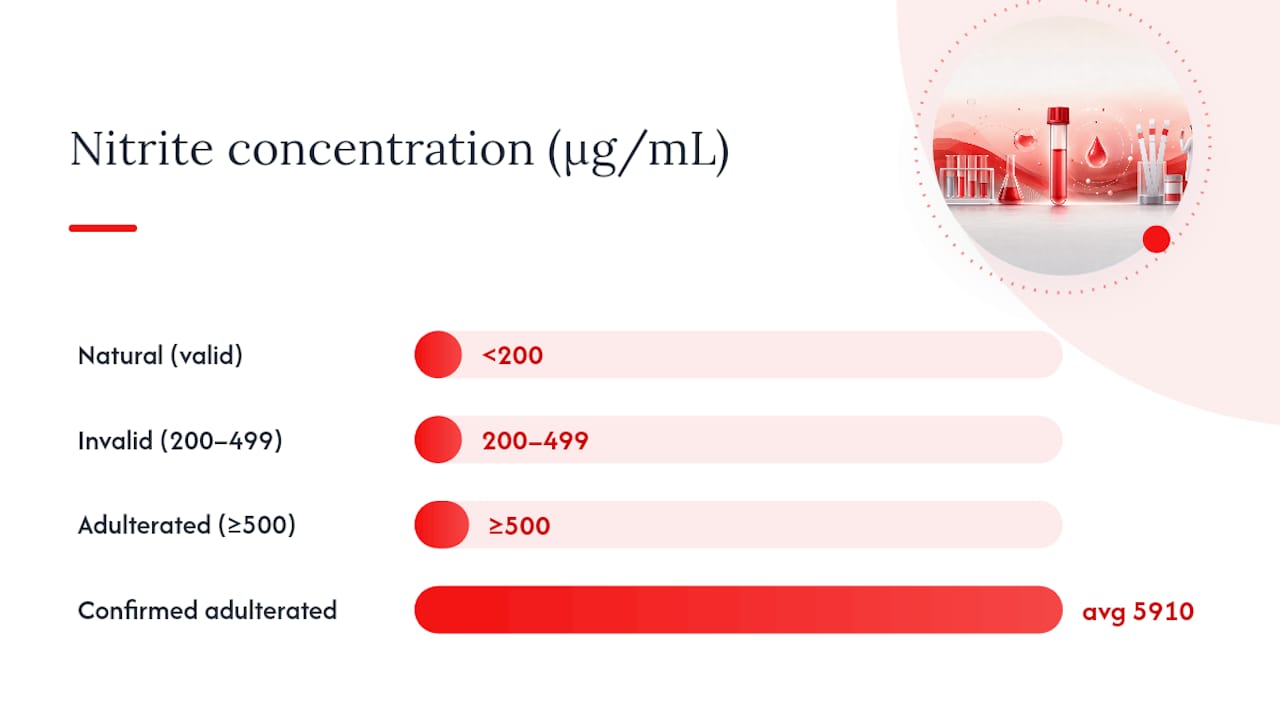
Guidance from the National Laboratory Certification Program uses a two-tier nitrite threshold: concentrations at or above roughly 200 micrograms per milliliter are treated as an invalid result, while concentrations at or above 500 micrograms per milliliter cross into adulterated territory, per NLCP specimen validity guidance. The two-tier structure exists because “invalid” leaves room for an innocent explanation while “adulterated” is a stronger finding meant to reflect deliberate tampering.
That gap between natural and deliberate levels is not subtle. Forensic toxicology research measured nitrite in confirmed adulterated specimens at 1,910 to 12,200 µg/mL, averaging around 5,910 µg/mL, against natural background levels typically under 200 µg/mL. A specimen sitting at 6,000 µg/mL is not explained by diet or a urinary tract condition.
| Nitrite level | Forensic classification | Typical source |
|---|---|---|
| Under 200 µg/mL | Normal / valid | Natural background |
| 200 to 499 µg/mL | Invalid result | Borderline; requires review |
| 500 µg/mL and above | Adulterated | Deliberate additive, per NLCP thresholds |
| 1,910 to 12,200 µg/mL | Confirmed adulteration range | Measured in adulterated specimens |
Once a result lands in the invalid or adulterated range, the recommended path is:
- Repeat the colorimetric oxidant test on a separate aliquot from the same specimen
- Escalate to quantitative lab methods, such as spectrophotometry or ion chromatography, when the case may go to arbitration or court
- Document the exact concentration, method, and repeat result in the report, not just a pass/fail flag
- Route the finding to the MRO for adjudication before it becomes a final employment or legal decision
Skipping the repeat-test step is one of the more common shortcuts that gets a result challenged later, since a single colorimetric read without confirmation is a thin basis for an adverse employment action.
What Collection Sites Must Do the Moment Nitrite Flags
The specimen itself becomes the evidence the second a strip flags out of range, and how it is handled in the next few minutes determines whether that evidence holds up.
- Record temperature immediately using the strip or device built into the collection cup, since an out-of-range temperature paired with a nitrite flag strengthens the tampering case.
- Aliquot the sample into a properly labeled secondary container before the primary specimen is opened again for any reason, preserving a clean portion for confirmatory testing later.
- Photograph and document the strip result, the container, and any visible signs of tampering (unusual color, odor, or foaming).
- Maintain unbroken chain of custody paperwork from the moment of collection through transfer to the lab, with every handoff signed and timestamped.
- Decide reject versus retest. A borderline invalid result on a first-void specimen may warrant a witnessed recollection, while a clearly adulterated result under program policy typically gets rejected outright pending MRO review.
- Notify the MRO and the employer or program administrator promptly, using the exact concentration and method, not a vague “failed adulterant check” note.
Retention timelines matter just as much as the collection-day steps. Programs should hold confirmed adulterated specimens according to their lab’s forensic retention policy, since a legal challenge to a termination or program dismissal can surface months after the original test.
Pro Tip: Train collectors to treat every out-of-range strip result the same way regardless of who the donor is. Inconsistent handling between cases is exactly what gets flagged in an arbitration hearing.
Rapidtestcup’s own step-by-step guide to detecting adulterants walks through this aliquoting workflow in more detail for staff building out a formal procedure.
Laboratory Confirmation and the MRO’s Final Call
Not every collection site or lab keeps ion chromatography running in-house, and the field has settled into a fairly consistent workflow because of it.
The common path runs like this: a presumptive positive on a dipstick or field strip triggers a repeat colorimetric test on a preserved aliquot, and if that confirms, the sample either gets reported as invalid or adulterated based on concentration, or it goes to a reference lab for quantitative confirmation when the case needs a defensible number for arbitration or court.
- Spectrophotometry gives a quantitative nitrite-equivalent reading and is the most commonly available confirmatory method.
- Ion chromatography offers higher specificity and is generally reserved for contested or high-stakes forensic cases.
- Repeat colorimetric testing on a second aliquot is an accepted, lower-cost confirmation strategy many labs use when specialized instrumentation is not maintained on-site, per NLCP guidance.
The MRO’s job at this stage is not procedural, it is judgment. An MRO reviews the out-of-range result and decides whether a rare clinical explanation is plausible or whether the finding points to deliberate subversion, a distinction that LabCorp’s SVT guidance describes as central to the review process. That determination is what actually closes out the case for an employer or treatment program, not the raw lab number by itself.
Buying and Running Adulterant Strips Without the Guesswork
Most of the mistakes I see in the field trace back to one thing: treating a nitrite strip result as a final verdict instead of a starting point. A color change on a dipstick is a screening signal, nothing more, and programs that skip the confirmation step are the ones who end up defending a termination decision months later with nothing but a presumptive test in hand.
Pick validated multi-parameter strips over single-analyte nitrite checks whenever the budget allows. The extra creatinine, pH, and specific gravity readings catch the donors who combine adulterants, and combination tampering is more common than most program managers assume. Pair that with a written aliquoting procedure, because a preserved secondary sample is what lets you confirm later without reopening a specimen and compromising chain of custody.
Train your collectors like this matters, because it does. A collector who documents a suspicious result properly on day one saves a lab tech, an MRO, and possibly a lawyer a lot of trouble on day sixty.
— Justin
Stocking Up on Nitrite and Adulterant Detection Supplies
Programs that catch adulteration consistently are the ones that build it into the cup itself rather than bolting on a separate strip. Rapidtestcup carries multi-panel cups with integrated adulterant strips, including the 18-panel cup with KRA/500, K2/50, TRA/100, ETG/300, FEN/20, and adulterants and the 15-panel cup with adulterant screening, both built to flag nitrite alongside creatinine, pH, and specific gravity in one collection.
For sites that prefer separate on-site adulterant screening, Rapidtestcup also stocks standalone adulteration test strips that cover the full SVT parameter set. Every product page lists CLIA-waived status where applicable, along with datasheets and bulk pricing tiers, so labs and treatment programs scaling up collection volume can compare options before committing. If your program needs volume pricing beyond what is listed, Rapidtestcup takes custom quote requests directly. Browse the full catalog or request a bulk quote today to get your collection sites equipped before the next audit finds a gap in your SVT coverage.
Sources
- Nitrite adulteration of workplace urine drug-testing specimens (Journal of Analytical Toxicology, 1998)
- Rapid spot tests for detecting adulterants in urine specimens (PubMed)