

Blog
Benzo Detection Time for Labs: Test Windows, Cutoffs, Confirmation


Most benzodiazepine screens catch use for 2 to 10 days in urine, though a heavy diazepam habit can push that window past a month. Blood picks up recent use for roughly a day or two. Saliva lands somewhere between the two in detection duration. Hair can flag use going back several months. The single biggest variable is half-life: short-acting drugs clear fast, long-acting ones linger, and dose, frequency, and your own liver function shift every number from there.
TL;DR:
- Detection windows vary significantly across test types, with urine testing capturing use from a few days to several weeks based on drug half-life and use pattern.
- Long-acting benzodiazepines like diazepam can produce detection times lasting several weeks in chronic users due to metabolite buildup in fat tissue.
- Blood tests mainly detect recent use within hours to two days, making them unsuitable for identifying long-term or past consumption.
- Hair testing offers a detection window of up to three months, but it is poor at identifying isolated doses and better suited for long-term usage patterns.
- Variability in detection times depends heavily on individual liver and kidney function, dose, use frequency, and whether interacting medications inhibit or induce metabolic enzymes.
Table of Contents
- Benzo Detection Time by Test Type: Urine, Blood, Saliva, and Hair
- Half-Life and Drug-by-Drug Benzo Detection Windows
- What Changes Your Personal Detection Window
- Screening vs. Confirmation: Why Lab Cutoffs Matter
- What a Positive or Negative Benzo Test Actually Means
- Our Take on Benzo Screening Supplies
- Screening Supplies Worth Checking Before You Buy
- Sources
- FAQ
Benzo Detection Time by Test Type: Urine, Blood, Saliva, and Hair
Urine is the default for a reason. It’s cheap, non-invasive, and the window is wide enough to catch use that a blood draw would miss entirely. According to Mayo Clinic Laboratories, a short-acting benzodiazepine is typically detectable in urine for a couple of days after last use, an intermediate-acting one for several days, and a long-acting one for about a week or so. Chronic, daily use of a long-acting drug like diazepam changes the math substantially.
That’s not a typo readers expect. A drug with a multi-day half-life, taken every day for months, builds up metabolite reserves in fat tissue that keep leaching into urine long after the last pill.
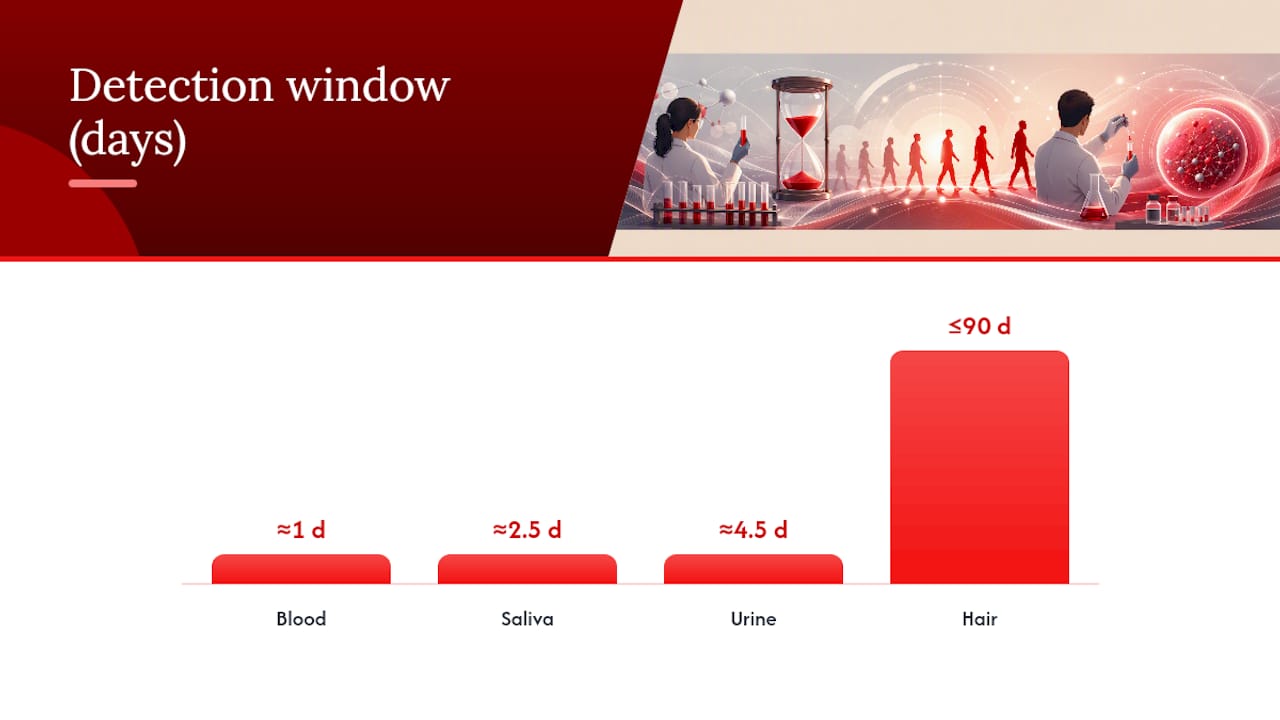
Blood tests work differently. They’re built for recency, not history, which is why hospitals and forensic examiners use them to answer “is this person impaired right now” rather than “did this person use benzodiazepines last month.” Typical blood detection windows run from several hours up to two days, based on clinical detection summaries, making blood the go-to for DUI cases, ER overdose workups, and situations where timing matters more than history.
Saliva sits in between. It tracks closer to blood for catching very recent use, generally for a few days, but sensitivity depends heavily on which specific benzodiazepine the assay targets and how it’s calibrated. Saliva testing shows up less often in workplace programs than urine, mostly because collection under observation is simpler and windows are better documented for urine.
Hair testing plays a completely different game. It doesn’t care about last night. It cares about the last three months. Detection windows of up to about three months are typical, which makes hair the tool of choice for custody disputes, long-term monitoring programs, or any situation asking “has this person used regularly over an extended period” rather than “did they use this week.” The tradeoff: hair testing is poor at catching a single, isolated dose, since it takes time for hair to grow out past the scalp and incorporate detectable metabolite.
Sweat patch testing exists but stays niche. It’s used mostly in probation and parole monitoring, where a patch worn for days to weeks gives a continuous read on use rather than a single snapshot. You won’t run into it in a typical clinic or workplace program.
A quick summary of what each sample type is actually good for:
- Urine: broadest use, days to weeks depending on the drug and use pattern
- Blood: recency and impairment, hours to about 2 days
- Saliva: recent use, roughly 1 to 4 days, drug-dependent
- Hair: long-term use pattern, up to about 90 days, poor for single doses
- Sweat patch: continuous monitoring over days to weeks, mostly forensic/probation settings
If you’re trying to figure out which window applies to your situation, our detection window breakdown walks through how these timelines get calculated across drug classes generally.
Half-Life and Drug-by-Drug Benzo Detection Windows
Half-life is the number that actually drives everything above. It’s the time it takes the body to clear half of a drug dose, and the standard clinical rule of thumb is that it takes about 5 to 7 half-lives to eliminate roughly 98% of a dose, according to ARUP Consult’s guidance on drug half-lives. A drug with a 24-hour half-life clears in about a week. A drug with a 40 to 100 hour half-life, which describes several common benzodiazepines, can take weeks.
Benzodiazepines split into three rough categories based on this number, and knowing which bucket your medication falls into tells you more than any generic “how long do benzos stay in urine” chart ever could.
Short-acting (half-life under about 12 hours): triazolam is the clearest example here.
Intermediate-acting (half-life roughly 12 to 40 hours): alprazolam (Xanax), lorazepam, and temazepam fall here, with moderate detection times. These are the drugs behind most of the “how long does 1 mg of Xanax stay in urine” searches, and the honest answer is that a single low dose typically clears within a few days, while regular use extends that window meaningfully.
Long-acting (half-life over 40 hours, sometimes multiple days): diazepam (Valium) and clonazepam anchor this group. Diazepam’s active metabolites, including nordiazepam, temazepam, and oxazepam, each have their own clearance timelines, which explains why chronic diazepam use can produce extended detection windows lasting several weeks.
Here’s how the estimates generally break down for common drugs:
One catch that trips people up: standard immunoassay screens don’t always detect every benzodiazepine equally well. Clonazepam and lorazepam, in particular, are sometimes missed at typical cutoff concentrations because assays are tuned to detect specific metabolites, and not every benzodiazepine produces the same metabolite in the same concentration, according to Rehab. If you’re prescribed one of these two and worried about a negative result that should be positive, that’s the mechanism to ask the lab about. Our breakdown of drug metabolites covers why the parent drug versus metabolite distinction matters so much for accuracy.
What Changes Your Personal Detection Window
Published ranges are population averages, not a guarantee for any one person. Your actual detection window depends on how your body processes the drug, and that varies more than most charts admit.
Hepatic metabolism does most of the heavy lifting. Nearly all benzodiazepines get broken down in the liver before the kidneys can clear them out, so anything that slows liver function stretches detection time. Renal clearance handles the final step, filtering metabolites out through urine, and reduced kidney function backs that process up too.
Chronic, repeated use is the single biggest amplifier. Each dose adds to a growing reservoir of metabolite stored in fat and slowly released back into circulation, which is exactly why a single Xanax dose clears in days while months of daily use can stretch the window considerably longer. Dose size works the same way. A higher dose simply means more drug and more metabolite that the body has to process before levels drop below a lab’s cutoff.
A handful of other factors shift the timeline in predictable directions:
- Age: older adults tend to metabolize more slowly, extending detection windows
- Liver disease: any condition that impairs hepatic function slows clearance
- Kidney disease: reduced renal function backs up the final elimination step
- Higher BMI: fat tissue stores lipophilic metabolites longer, which can extend detection
- Enzyme-inhibiting medications: drugs that block liver enzymes (certain antifungals, some antibiotics) can slow benzodiazepine breakdown
- Enzyme-inducing medications: drugs that speed up those same liver enzymes can shorten detection windows
Pro Tip: If you’re on a long-acting benzodiazepine like diazepam and also taking a medication known to inhibit liver enzymes, don’t assume the standard “10 day” window applies to you. Ask your prescriber or the testing lab directly, because interacting medications are one of the most overlooked reasons someone tests positive well past the timeline they expected.
Variability between individuals is well documented enough that ARUP Consult treats detection windows as estimates rather than fixed rules, precisely because age, liver function, kidney function, and use pattern can shift the numbers substantially from one person to the next.
Screening vs. Confirmation: Why Lab Cutoffs Matter
Not every “benzo urine test” works the same way, and that’s the source of a lot of confusion when two tests on the same person give different answers. Labs generally run two distinct stages.
Screening uses an immunoassay, a fast, inexpensive chemical test designed to flag samples above a set threshold. Confirmation uses GC-MS or LC-MS/MS, instrumentation that identifies the exact compound and concentration rather than just flagging “something benzodiazepine-like crossed the line.” Mayo Clinic Laboratories runs its targeted benzodiazepine screen as exactly this kind of two-stage process, because immunoassays alone aren’t specific enough to stand as a final answer in a clinical or legal context.

Standard urine benzodiazepine screens commonly use a cutoff around 200 ng/mL according to UNC McLendon Clinical Laboratories. That means a sample with metabolite concentration just under that line reports negative, even if trace amounts of the drug are technically present. Move the cutoff, and you move the reported detection window. This is why two facilities testing the same person on the same day can occasionally disagree.
Metabolite targeting compounds the issue. An immunoassay is built to react to specific chemical structures, and not every benzodiazepine metabolite triggers the same reaction with equal sensitivity. That’s part of why clonazepam and lorazepam sometimes slip past routine screens at standard cutoffs. If you know which specific drug you need detected, or need to rule out, ask the lab which benzodiazepines its particular assay is validated for and what the limit of quantification is for each. Don’t assume “benzodiazepine screen” means every benzodiazepine gets equal treatment.
What a Positive or Negative Benzo Test Actually Means
A positive result means metabolite concentration met or exceeded the assay’s cutoff. That’s it. It does not mean the person is currently impaired, and it does not tell you exactly when the last dose was taken, according to UR Medicine’s clinical guidance on benzodiazepine urine testing.
If a result looks wrong, here’s the practical sequence to follow:
- Check for legitimate explanations first: a current prescription, recent chronic use, or a drug the screen is known to cross-react with can all produce a “true” positive that still surprises the person taking the test.
- Request confirmation testing: GC-MS or LC-MS/MS will identify the specific compound rather than a generic “benzodiazepine class” flag, which resolves most disputes. Our guide on identifying false positives walks through common cross-reactivity culprits.
- Share your medication list with the lab: interacting drugs and dosing history change how a result should be interpreted, and the lab can’t factor that in unless you tell them.
If you’re considering stopping benzodiazepine use because of a testing concern, don’t do it alone. Abrupt discontinuation, especially after chronic use, carries real withdrawal risk and needs medical supervision.
Our Take on Benzo Screening Supplies
Some suppliers sell to clinics, substance abuse programs, employers, and individuals who need a reliable first-line screen, not a courtroom-grade final answer. That distinction matters more than most buyers realize when they’re choosing a kit.
A CLIA-waived multi-panel cup or a BZO strip does exactly one job well: it flags samples that need a closer look. It was never meant to replace GC-MS or LC-MS/MS confirmation, and any program treating a screening strip as a legal verdict is using the wrong tool for the job. Responsible use means pairing point-of-care screening with a laboratory confirmation pathway whenever a result carries real consequences for someone’s job, custody case, or treatment plan, especially considering Drug Rehab Programs & Disability Protections under California Law which explain legal protections and workplace considerations around rehab and disability.
— Justin
Screening Supplies Worth Checking Before You Buy
If you’re stocking up for a clinic, program, or workplace, Rapidtestcup’s 12 panel test cup covers benzodiazepine screening alongside the other classes most programs are required to check, and it’s currently running at clearance pricing for bulk orders.
If your program needs broader coverage plus built-in adulterant checks, the 18 panel cup with adulterants adds fentanyl, ketamine, tramadol, and alcohol markers to the same collection cup, which cuts down on the number of separate tests staff need to run per sample.
Before ordering any batch, verify three things: which specific benzodiazepines the panel is validated to detect, the limit of quantification listed on the insert, and whether lot numbers are tracked for chain-of-custody purposes. Those three details predict how a kit will actually perform far better than the panel count on the box.
Specimen collection matters as much as the test itself. A compromised sample makes every downstream result meaningless, so pair your BZO strips or multi-panel cups with proper collection supplies and, where the situation calls for it, adulterant checks. If a broader panel or adulteration kit fits your program better than the two above, browse the full catalog to find the right combination and request a bulk quote for larger orders.
Sources
For cutoff concentrations and drug-specific detection ranges, Mayo Clinic Laboratories and ARUP Consult are the most authoritative references. For confirmation testing methodology, see Mayo’s targeted screen overview. For plain-language interpretation of results, UR Medicine’s encyclopedia entry is a solid starting point, and UNC McLendon’s lab page shows a real-world cutoff example.
This article is general information, not a substitute for advice from a qualified doctor. Consult a qualified healthcare professional about your own circumstances before acting on anything here.
- Mayo Clinic Laboratories — Benzodiazepines (drug-book)
- ARUP Consult — Drug half-lives and urine detection windows
- UR Medicine — Benzodiazepine urine testing
- UNC McLendon Clinical Laboratories — Benzodiazepine urine screen
FAQ
How long does 1 mg of Xanax stay in urine?
A single 1 mg dose of alprazolam typically clears from urine within a few days, since it’s classified as intermediate-acting, though regular daily use extends that window considerably.
Can you fail a drug test because of Xanax?
Yes, prescribed or unprescribed alprazolam use will trigger a positive benzodiazepine screen, since standard immunoassays don’t distinguish between legitimate prescription use and unauthorized use without a documented prescription on file.
Why am I still testing positive for benzodiazepines?
The most common reasons are chronic use that built up stored metabolite over time, a long-acting drug like diazepam with its extended metabolite clearance, or a low lab cutoff catching trace concentrations other assays would miss.
Do all benzos show up the same in a urine test?
No. Standard immunoassays target specific metabolites, so drugs like clonazepam and lorazepam are sometimes missed at typical cutoffs even though the drug is present, which is why confirmation testing exists for cases where accuracy matters.