

Blog
Sudafed False Positive: What It Triggers and How to Sort It Out


Yes, Sudafed can cause a false positive, but only on one kind of test and only at the screening stage. The active ingredient, pseudoephedrine, is structurally close to amphetamine and methamphetamine. An immunoassay (the technology inside most rapid test cups, dip cards and strips) can mistake it for them. A confirmation test by mass spectrometry tells the two apart. So a non-negative result after a cold pill is a reason to confirm, not a verdict.
This guide explains why it happens, how long pseudoephedrine stays in urine, what to do if you are the person tested or the person reading the result, and where phenylephrine and Wellbutrin fit in.
TL;DR
- Pseudoephedrine (Sudafed) can cause a presumptive positive on an amphetamine or methamphetamine urine screen because the antibody reacts to its similar structure.
- Rapid tests are preliminary by design. FDA review documents say that medications can interfere and that results need confirmation by a more specific method such as GC/MS or LC/MS.
- Phenylephrine, the other common decongestant, is far less likely to be the cause. Bupropion (Wellbutrin) is a better-known prescription culprit.
- Tell the collector or the Medical Review Officer about every medication you took, then ask for confirmation testing before anyone acts on the screen.
Table of Contents
- Why Sudafed can look like methamphetamine to a test
- How long pseudoephedrine stays in urine
- Sudafed, phenylephrine and other common culprits
- Wellbutrin and bupropion false positives
- What confirmation testing does
- If you are the person who took the pill
- If you are the one reading the result
- Our perspective: a screen is a question, not an answer
- Choosing a screening format that fits your workflow
- FAQ
- Sources
Why Sudafed can look like methamphetamine to a test
A rapid urine screen does not identify molecules the way a lab instrument does. It uses antibodies built to bind a target drug or its metabolite. In the competitive format used by most cups and strips, the drug in the sample competes with a drug-protein conjugate for limited antibody sites on a colored particle. When enough of the target drug is present, it saturates the antibody and no test line forms. The FDA clearance summary for a rapid test describes this mechanism.
The weakness is that an antibody recognizes a shape, not a name. Pseudoephedrine and methamphetamine share a similar backbone, so at high enough concentrations some antibodies bind the decongestant too. That is called cross-reactivity. The FDA documentation for an immunoassay states that certain foods or medications may interfere and cause false positive results, and that other substances not listed may also interfere.
The National Institute on Drug Abuse makes the same point in plain terms: an initial urine drug screen gives rapid results but can be affected by factors such as certain medications that produce incorrect results.
Not every test reacts the same way
Cross-reactivity is not uniform. Manufacturers choose different antibodies, cutoffs and specificity, so a substance may trigger one brand and leave another negative. The FDA document above makes this point. That has a practical consequence: you cannot say “Sudafed always fails” or “Sudafed never fails”. It depends on the dose, the timing, the person’s urine and the specific test.
How long pseudoephedrine stays in urine
Pseudoephedrine has an estimated half-life of roughly 4 to 8 hours in adults, and between 43% and 96% of an oral dose leaves the body unchanged in urine, according to a pharmacology review in the British Journal of Clinical Pharmacology. Because so much is excreted unchanged, the parent drug can be present in a urine sample for several hours and, depending on dose and physiology, possibly more than a day.
The same review notes that elimination varies with urinary pH and kidney function. Several things push the window longer or shorter:
- Dose and form. A single 30 mg tablet and a 12-hour extended-release product put different amounts into your system.
- Frequency. Taking doses around the clock for several days keeps urine concentration higher than one dose the night before.
- Kidney function. Slower clearance stretches the window.
- Urine concentration. A dilute sample carries less of everything, which matters for borderline results.
There is no honest single number of hours that guarantees a clean screen. If you have an upcoming test, the safer route is to disclose the medication, not to time it.
Sudafed, phenylephrine and other common culprits
People often ask whether the “PE” version of a cold medicine is safer. For urine screens, it largely is. The same review reports that phenylephrine is heavily metabolized before it reaches the bloodstream: only about 3% of an oral dose is excreted unchanged, and systemic bioavailability is about 25% to 40%, against roughly 80% for pseudoephedrine. Less of the parent compound in urine means a much lower chance of cross-reactivity, which is why phenylephrine is far less likely to explain a positive amphetamine screen.
Here is how the usual suspects compare on amphetamine screens:
| Substance | Type | Role in amphetamine false positives |
|---|---|---|
| Pseudoephedrine (Sudafed) | OTC decongestant | Well recognized; much of the dose is excreted unchanged |
| Phenylephrine | OTC decongestant | Much less likely, because little is excreted unchanged |
| Bupropion (Wellbutrin) | Prescription antidepressant | Frequently reported, including in clinical studies |
| Vicks-type inhalers | OTC inhaler | Listed in the clinical literature on OTC causes |
| Ibuprofen | OTC pain reliever | Reported more often for cannabinoid screens than for amphetamines |
The nasal decongestant and inhaler entries come from a case report and review on amphetamine-positive urine screens and the clinical literature it draws on. Nasal sprays that contain oxymetazoline are a different drug from pseudoephedrine, and a pill-versus-spray distinction matters when you list what you took.
Wellbutrin and bupropion false positives
Readers who ask about Wellbutrin are usually not taking a cold pill at all. Bupropion is a prescription antidepressant and smoking-cessation aid whose metabolites can cross-react with amphetamine antibodies. A review in PubMed Central identifies bupropion as a significant source of false-positive amphetamine screens in certain clinical populations.
The consequences are the same as with Sudafed. The screen is presumptive, the confirmation test is definitive, and the prescriber’s record is evidence. If you take bupropion, tell the collection site or the MRO up front, and keep the prescription information handy.
What confirmation testing does
Gas chromatography or liquid chromatography paired with mass spectrometry separates compounds by their chemistry and then identifies them by mass. Pseudoephedrine and methamphetamine are different molecules, and a mass spectrometer sees that. NIDA describes laboratory confirmation by mass spectrometry as the recognized standard for exactly this reason. We explain the method in more depth in our guide to GC-MS confirmation.
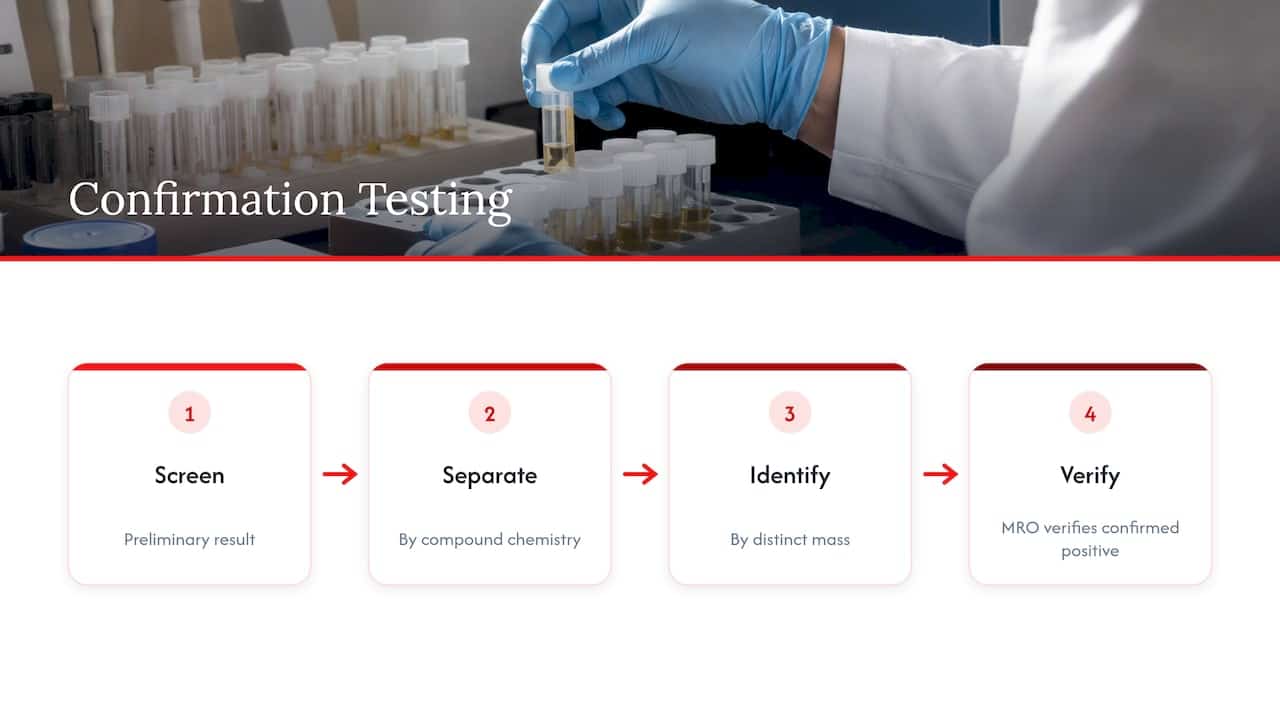
In regulated workplace testing, this is not optional. Under DOT rules at 49 CFR 40.137, a Medical Review Officer verifies a confirmed positive for amphetamines, and may find a legitimate medical explanation. A preliminary screen alone never becomes a verified positive.
If you are the person who took the pill
You cannot control what the test does. You can control how well you document what you took.
- List everything. Include prescriptions, cold and allergy products, inhalers, supplements and anything a family member gave you. Check the “Drug Facts” label for pseudoephedrine.
- Say it before the collection, not after. Many collection forms have a place for medications. Use it.
- Keep the packaging or receipt. For Sudafed, note the product and the date. Pharmacies in the United States keep pseudoephedrine behind the counter, so a sale record may exist too, as one pharmacist-written guide points out.
- Ask whether the sample was sent for confirmation. If the first result came from an instant test, the answer should be that a lab will check it.
- Talk to the MRO when one is involved. In a DOT-regulated test, the MRO must conduct a medical interview as part of verification. A prescription or a documented OTC use is the kind of information that interview exists to evaluate.
One caution that people miss: the DOT rule on unknowing ingestion bars an MRO from accepting stories such as “someone slipped it into my drink”. A properly documented medication you took on purpose is a different matter. Be specific and truthful about it, and never describe a legitimate cold pill vaguely.
If a result is already affecting your job, your custody case or your treatment, speak with the MRO, your prescriber or an employment attorney in your state. Rules for non-DOT employers vary.
If you are the one reading the result
Laboratories, clinics, treatment programs and employers are the readers who carry the real risk here. Acting on a presumptive positive has costs on both sides: a missed use, or an accusation that is wrong.
Practitioners writing in the clinical literature stress the same sequence: when a screen is positive and the patient denies use, do not assume illicit drug use. Review the full medication list first, including OTC products and inhalers, and then confirm. NIDA warns that relying on immunoassay alone for high-stakes decisions is hazardous.
A workable routine looks like this:
- Record the result as “presumptive” or “non-negative”, not “positive”.
- Ask about OTC decongestants, bupropion and inhalers in the last several days.
- Send the same specimen for confirmation when the consequence is significant.
- Keep the original split sample or aliquot, per your own protocol.
- Document the decision and the reason.
Our articles on how to identify false positives, interpreting urine drug test results and false positives and lab accuracy go further. If your question is the reverse, whether a real prescription stimulant would show, see Adderall detection in urine and methamphetamine detection time.
Our perspective: a screen is a question, not an answer
We sell rapid screening products, so we have a stake in saying this plainly: a cup or dip card is a triage tool. It does one job well, which is to sort samples quickly into “clearly negative” and “needs a closer look”. That is a real benefit. Most samples in most settings are negative, and an instant result saves a lab or clinic a great deal of time and cost.
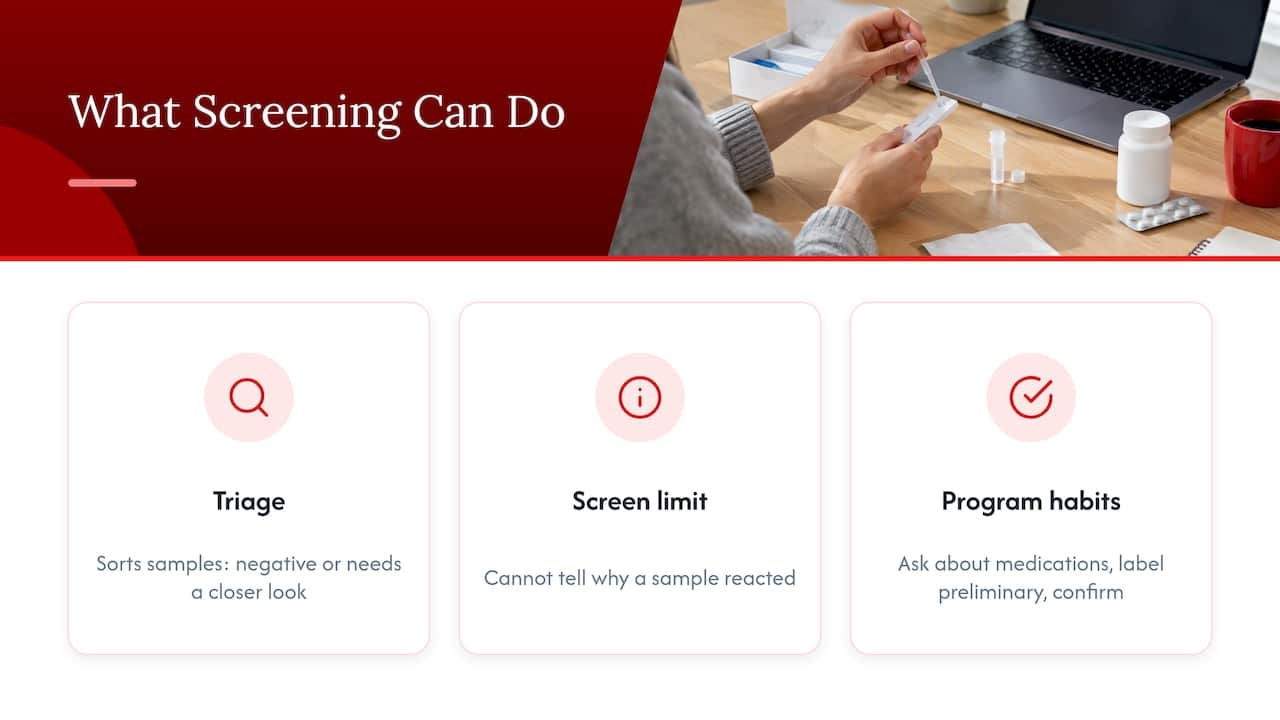
What a screen cannot do is tell you why a sample reacted. We would rather our customers understand that than be surprised by it. In practice, the programs that handle Sudafed and Wellbutrin cases well share three habits: they ask about medications before testing, they label screen results as preliminary, and they have a confirmation route ready before they need it.
If you run a clinic or program, choose a panel that matches your decisions. Where amphetamine or methamphetamine results drive consequences, plan the confirmation step into your policy from the start. Where you only need to know whether to look further, a screen is exactly right. And remember that cross-reactivity differs by brand, so when a result surprises you, note which test was used.
— Justin
Choosing a screening format that fits your workflow
If you collect samples for a lab, clinic, treatment program or workplace, the format matters less than having a consistent process. Multi-panel cups give you an on-the-spot read across several drug classes with temperature checking and optional adulterant checks. Dip cards and strips suit lower-volume or single-analyte needs, and our guide to cup versus dip card tests explains the trade-offs.
For amphetamine specifically, we carry AMP drug test strips and MET drug test strips, along with multi-panel options. You can browse everything, including cups, dip cards, oral swabs and specimen collection supplies, in our shop, and request a custom quote for bulk orders. Pair whichever you choose with a documented confirmation path.
FAQ
Does Sudafed show up on a drug test?
It can show up as a presumptive positive for amphetamines or methamphetamine on an immunoassay urine screen, because pseudoephedrine is structurally similar. It will not show as methamphetamine on a confirmation test by GC/MS or LC/MS. Results vary by test brand and by dose.
How long will Sudafed stay in urine?
Pseudoephedrine has a half-life of about 4 to 8 hours, and much of each dose is excreted unchanged. That means it can remain detectable for hours and possibly beyond a day, depending on dose, urine pH and kidney function. No timeline is guaranteed for any individual.
Will phenylephrine make me fail a drug test?
It is much less likely to. Only about 3% of an oral phenylephrine dose is excreted unchanged in urine, versus a much larger share for pseudoephedrine. Still, tell the collector about every product you took, since some cold remedies combine several ingredients.
Can Wellbutrin cause a false positive for amphetamines?
Yes. Bupropion is one of the prescription drugs most often linked to false-positive amphetamine screens. A confirmation test can distinguish it from true amphetamine, and your prescription record supports the explanation.
Does a false positive from Sudafed count at work?
For DOT-regulated tests, a screen must be confirmed, and then the MRO interviews the employee before verifying the result. For other employers, policies differ, so ask for confirmation testing and give your medication information to whoever reviews results.
Sources
- FDA review document for an immunoassay, noting medication interference and confirmation
- FDA clearance summary describing rapid test mechanism
- NIDA: Drug Testing
- British Journal of Clinical Pharmacology: pseudoephedrine and phenylephrine review
- PubMed Central: bupropion and false-positive amphetamine screens
- PubMed: amphetamine-positive urine screen clinical review
- DOT 49 CFR 40.137
- DOT 49 CFR 40.141
- DOT 49 CFR 40.151
- Pharmacist guide to allergy medicine and drug tests