Blog
6-MAM Heroin Test: What It Detects and How to Read It


A 6-MAM test looks for 6-monoacetylmorphine, a metabolite that only heroin produces. If it shows up in urine, the person very likely used heroin recently. If it doesn’t, you can’t conclude much, because the window is short, often about a day or less. This guide covers what the test measures, how long it works, how it differs from a standard opiate screen, and what labs, clinics and employers should do with a result.
TL;DR
- 6-MAM (also written 6-AM or 6-acetylmorphine) is a heroin-specific metabolite. A confirmed positive is definitive evidence of recent heroin use, while morphine alone is not.
- The window is narrow. 6-MAM is typically detectable in urine for about 24 hours, and morphine can stay detectable for another 1 to 2 days. A negative 6-MAM result does not rule out heroin.
- A generic “OPI” or “MOP” screen is not a heroin test. Look for 6-MAM, 6-AM or 6-acetylmorphine on the label, and read the cutoff on the package insert.
- A rapid test is a screen. Regulated workplace, legal and forensic decisions need laboratory confirmation, chain of custody and, for workplace programs, Medical Review Officer review.
Table of Contents
- What 6-MAM is and why it matters
- How long a 6-MAM test can detect heroin
- 6-MAM test vs. opiate screen vs. “6-panel” test
- Choosing a rapid 6-MAM test
- How to run the test properly
- What to do with a positive result
- Perspective: where a 6-MAM screen fits
- Get the right test for your program
- FAQ
- Sources
What 6-MAM is and why it matters
Heroin (diacetylmorphine) does not last long in the body. It breaks down within minutes into 6-monoacetylmorphine, which then converts to morphine. Morphine is also what you get from prescription morphine and from codeine, so a positive morphine result alone cannot tell you where the drug came from.
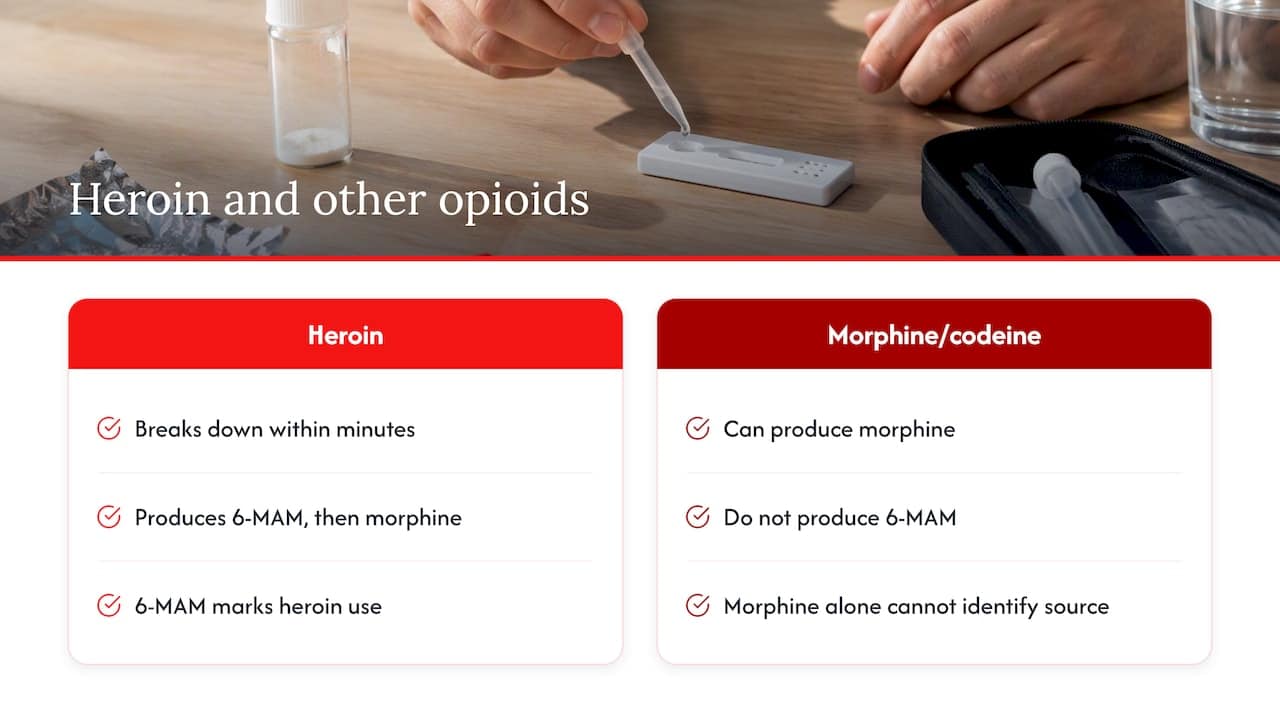
6-MAM is different. No legitimate opioid medication produces it. That is why laboratories treat it as the marker that separates heroin from everything else in the opiate family. SAMHSA’s 2024 Medical Review Officer case study states that a laboratory-reported positive 6-AM result is proof of heroin use and that there is no legitimate medical explanation for it.
You will see the same molecule under several names on lab reports: 6-MAM, 6-AM, 6-acetylmorphine, or simply “heroin metabolite.” Labcorp lists it as Heroin Metabolite (6-AM), and a lab may report a qualitative screen, a quantitative confirmation, or both. They all refer to the same analyte.
How long a 6-MAM test can detect heroin
This is the most important thing to understand before you buy or order anything. Heroin and 6-MAM are both short-lived. Mayo Clinic Laboratories notes that 6-MAM is typically detectable for about 24 hours, while morphine may remain detectable for another 1 to 2 days. Published figures vary with dose, hydration, metabolism and the cutoff used, and some sources quote windows well under 24 hours. Treat any single number as a rough guide, not a guarantee.
| Marker | What a positive tells you | Typical urine window |
|---|---|---|
| 6-MAM (6-AM) | Heroin specifically | About 24 hours or less |
| Morphine | Heroin, morphine or codeine | Roughly 1 to 3 days |
| Generic opiate screen | Morphine-class compounds, source unknown | Depends on the drug and cutoff |
The practical consequence is asymmetry:
- A positive is strong. Mayo’s interpretation describes 6-MAM as highly specific, so a confirmed positive is powerful evidence.
- A negative is weak. The metabolite may already have converted to morphine before collection, so a negative should be read against collection timing, dilution, dose and metabolism, not as proof of no heroin exposure.
If the question is whether someone used heroin in the past several days, a 6-MAM test alone may miss it. In that case, programs often look at morphine and the overall pattern together, and send questionable results to a laboratory.
6-MAM test vs. opiate screen vs. “6-panel” test
Three labels cause most of the confusion.
6-MAM vs. a standard opiate screen
A standard opiate immunoassay is built to detect morphine-like compounds. Clinical guidance from the CDC describes immunoassays as qualitative and prone to cross-reactivity, while mass spectrometry directly identifies drugs and metabolites. So a positive opiate screen might be heroin, but it might also be codeine, morphine or a poppy-seed-related result. Only a 6-AM assay answers the heroin question directly.
The reverse also matters. Opiate screens can miss semi-synthetics. Our own write-up on why 300 ng/mL opiate screens miss oxycodone walks through a two-tier plan, and the same logic applies here: pick the assay for the question you are asking.
What a “6-panel” test actually covers
Searchers often type “6 panel drug test” and “6-MAM test” as if they were the same thing. They are not. “6-panel” is not a universal standard. The six analytes vary by manufacturer, employer and jurisdiction, and a federal HHS panel does not define a consumer six-panel format. If your goal is detecting heroin, read the analyte list. It must name 6-AM, 6-MAM or 6-acetylmorphine. “Opiates” alone points to morphine and codeine-class detection.
If you want a multi-drug format with a different analyte mix, compare the listed analytes on our 6 panel rapid drug test page against what you actually need to screen for.
Federal workplace panels
For US federal workplace testing, the 2025 HHS authorized panel includes 6-acetylmorphine in both urine and oral fluid. For urine, the initial and confirmatory cutoffs are each 10 ng/mL. For oral fluid, the initial cutoff is 4 ng/mL and the confirmatory cutoff is 2 ng/mL. The panel took effect on July 7, 2025. Those separate numbers show that urine and oral fluid cannot be treated as interchangeable.
A rapid cup or strip is not automatically a federally compliant test. If you run a DOT or federal program, follow the program’s own rules on specimens, laboratories and reporting.
Choosing a rapid 6-MAM test
Rapid 6-MAM tests are lateral-flow immunoassays: you apply urine, wait for the time printed in the instructions, and read the lines. They are useful for fast, low-cost screening in clinics, treatment programs and other settings where a quick answer helps. Before you order, check these points.
- Analyte name. The label must say 6-MAM, 6-AM or 6-acetylmorphine.
- Cutoff. Confirm the concentration printed on the insert. Different products use different cutoffs, and the cutoff determines what a line means.
- Specimen type. Urine and oral fluid have different cutoffs and windows. Buy for the specimen you will actually collect.
- Format. Strips are the most economical for single analytes. Cups add a built-in container, and dip cards sit in between. Our guide to cups versus dip cards explains the trade-offs.
- Intended use. Verify whether the product is intended for clinical point-of-care screening, and what your governing program requires. Point-of-care tests are not automatically suitable for employment, legal or forensic decisions.
- Validity checks. If you suspect substitution or dilution, use an adulterant-capable product or send the specimen to a lab.
If you want a stand-alone heroin metabolite screen, our 6 MAM drug test strips are built for exactly that. Check the product page for the current specification and bulk options.
How to run the test properly
A rapid test is only as good as the collection behind it. A short routine prevents most disputed results.
- Confirm the donor’s identity and note the collection time.
- Have the donor wash and dry their hands, and keep coats and bags out of the collection area where your policy allows.
- Collect a fresh urine specimen in a clean container and check the volume.
- Follow the insert’s timing exactly. Do not read the result after the stated window, because faint lines can appear later and mislead.
- Record the result, the lot number and the reader’s name the same way every time. Our guide to documenting drug and toxicology test results covers a record format, and the reporting workflow guide covers how results move through a lab.
- Keep the remaining specimen if confirmation may be needed, and follow the performing laboratory’s container, volume, storage and transport instructions.
Laboratories differ on specimen requirements. Mayo requests a random, preservative-free urine specimen and lists 10 mL, while Labcorp lists 20 mL in a preservative-free plastic container for its screen and confirmation service. Do not carry one lab’s requirements over to another assay.
What to do with a positive result
A positive on a rapid test is a presumptive result. The right next step depends on who is asking.
Clinics and treatment programs
In a treatment or pain-management setting, a presumptive positive is a reason to talk with the patient and, where it will change care, send a specimen for confirmation. Immunoassay screening followed by mass-spectrometry confirmation is the usual workflow. Labcorp lists a 3 to 4 day usual turnaround for its urine screen-and-confirmation service, so plan for a gap between the bedside result and the final report. Note that this specific assay is designed for pain management and is explicitly not intended for workplace testing.
When a confirmed result points to opioid use, the clinical conversation usually turns to withdrawal risk and medication planning. Clinicians weighing that step may find a tramadol withdrawal management checklist useful for the monitoring habits it describes, even though the drug differs.
Employers and regulated programs
In a regulated workplace or forensic setting, a rapid test should not be the basis for action on its own. Use documented chain of custody, validity checks where applicable, laboratory confirmation and Medical Review Officer review. The MRO weighs the analytical results, timing, paperwork and the applicable testing standard.
One nuance trips people up: interpretation is not a simple “6-AM plus morphine” checklist. SAMHSA’s 2024 case study discusses a 17 ng/mL 6-AM positive with morphine below its reporting cutoff. A valid 6-AM positive should not be dismissed just because morphine is absent. For the wider compliance picture, see our laboratory drug testing protocols guide.
Individuals
If you are testing yourself or a family member, treat a positive as a prompt for a conversation and a confirmatory lab test, not a verdict. A negative does not mean there was no use in the last day or two. If you or someone you know is using heroin or other opioids and is at risk, contact a doctor, a local treatment provider or the SAMHSA National Helpline, and call 911 in an emergency.
Perspective: where a 6-MAM screen fits
We sell drug testing supplies every day to labs, clinics, treatment programs and employers, and the most common mistake we see is buying by panel count. A 12-panel or 18-panel cup looks like it covers everything, but if heroin is the question, the analyte list matters more than the number on the box. Many multi-drug cups report “opiates” only, and that is a morphine-class result.
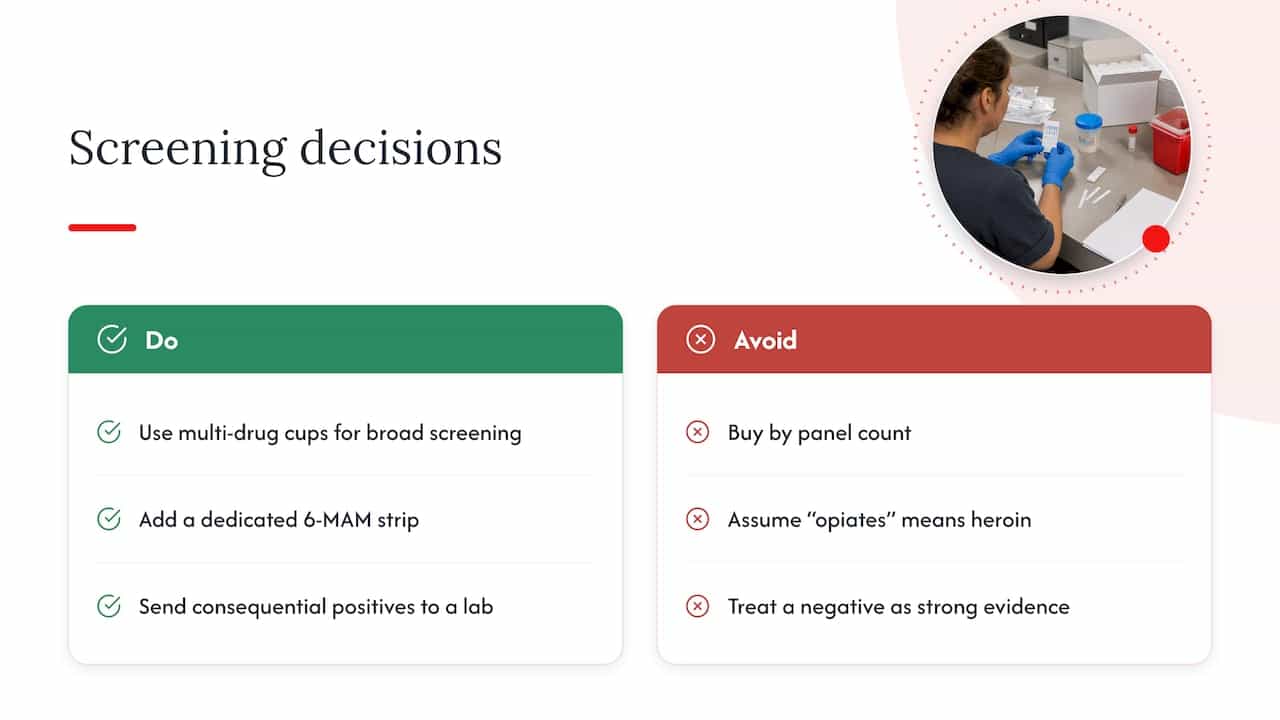
Our view is simple. Use a multi-drug cup for broad screening, and add a dedicated 6-MAM strip when you need to know whether an opiate positive is heroin. Keep the expectations honest: the window is short, a negative is weak evidence, and every presumptive positive that carries consequences should go to a laboratory. A good screening program is cheap, quick and documented. The test is only one part of it.
We are a family business and we keep a large inventory in stock, with same-day shipping and bulk pricing for programs that test regularly. If a product’s cutoff or intended use isn’t clear to you, ask us before you order. That is a faster fix than a wrong box.
— Justin
Get the right test for your program
For heroin-specific screening, start with our 6 MAM drug test strips. If you want a broad screen with the opiate class and more drugs in one device, browse the full shop of test cups, dip cards, strips and oral swabs, or look at the 12 panel cup and 10 panel dip card. Programs with regular volume can request bulk pricing or a custom quote through the site.
FAQ
What is 6-MAM on a drug test?
6-MAM is 6-monoacetylmorphine, the metabolite that forms when the body breaks down heroin. Because legitimate medications do not produce it, a confirmed positive is treated as definitive evidence of recent heroin use. Reports may list it as 6-AM, 6-MAM or heroin metabolite.
What drug test shows heroin?
Order a test that specifically measures 6-AM or 6-MAM, usually in urine. A standard opiate panel detects morphine-class drugs but cannot by itself separate heroin from codeine or morphine. The usual workflow is a screen followed by mass-spectrometry confirmation.
What does a 6-panel drug test look for?
There is no universal six-drug panel. The analytes depend on the manufacturer, employer or jurisdiction, so read the product’s analyte list. If you need heroin detection, confirm that it names 6-AM, 6-MAM or 6-acetylmorphine, because “opiates” alone does not guarantee it.
Can a 6-MAM urine test be negative if someone used heroin?
Yes. The metabolite is short-lived and may disappear before collection, while morphine can remain detectable longer. A negative result should be read alongside collection timing, specimen dilution, dose and metabolism, and it is much weaker evidence than a positive.
Is a rapid 6-MAM test enough for a workplace or legal decision?
No. Rapid tests are screens and can cross-react. Regulated workplace and forensic decisions call for chain of custody, laboratory confirmation and, in workplace programs, Medical Review Officer review under the governing program’s rules.
Sources
- Mayo Clinic Laboratories: 6-Monoacetylmorphine Confirmation, Random, Urine
- Labcorp: Heroin Metabolite (6-AM), Screen and Confirmation, Urine
- Federal Register: Mandatory Guidelines for Federal Workplace Drug Testing Programs, Authorized Testing Panels (2025)
- SAMHSA: MRO Case Studies, Urine (2024)
- CDC Stacks: clinical guidance on immunoassays and definitive testing