Blog
DOT Drug Test Cutoffs: Urine and Oral Fluid Levels


A DOT drug test uses fixed cutoff concentrations set in federal rules. For urine, the initial screen for marijuana metabolite is 50 ng/mL and the confirmation cutoff is 15 ng/mL. Cocaine metabolite is 150 ng/mL and 100 ng/mL. Every other regulated drug has its own pair of numbers, and all of them are listed below. Oral fluid tests have a separate, lower set of cutoffs.
This guide gives you the full tables, explains what “at or above the cutoff” means in practice, and shows how DOT levels compare with probation programs and instant tests.
TL;DR
- DOT urine tests screen five drug classes (marijuana, cocaine, amphetamines, opioids and PCP) and use a two-step process: an initial test, then a confirmation test on any result at or above the initial cutoff.
- Key urine cutoffs under 49 CFR § 40.85: THC metabolite 50/15 ng/mL, cocaine metabolite 150/100, PCP 25/25, amphetamine and methamphetamine 500/250.
- Oral fluid cutoffs under § 40.91 are much lower, for example 4 ng/mL for the THC screen and 15 ng/mL for cocaine.
- Probation and clinical programs have no single national cutoff standard. Many borrow the federal workplace numbers, but the program sets its own.
- An instant cup or dip card is a presumptive screen. A preliminary positive should go to a laboratory for confirmation.
Table of Contents
- What a cutoff level actually is
- DOT urine cutoffs: the full table
- DOT oral fluid cutoffs
- DOT cutoffs versus non-DOT cutoffs
- Probation drug test cutoffs
- Instant tests versus laboratory cutoffs
- Choosing instant tests that match your cutoffs
- Where Rapidtestcup fits
- Our perspective
- FAQ
- Sources
What a cutoff level actually is
A cutoff is a preset concentration that separates a negative result from a positive one. NIDA explains that a result at or above the cutoff counts as positive, while a result below it is reported as negative, even when trace amounts of the substance are present.
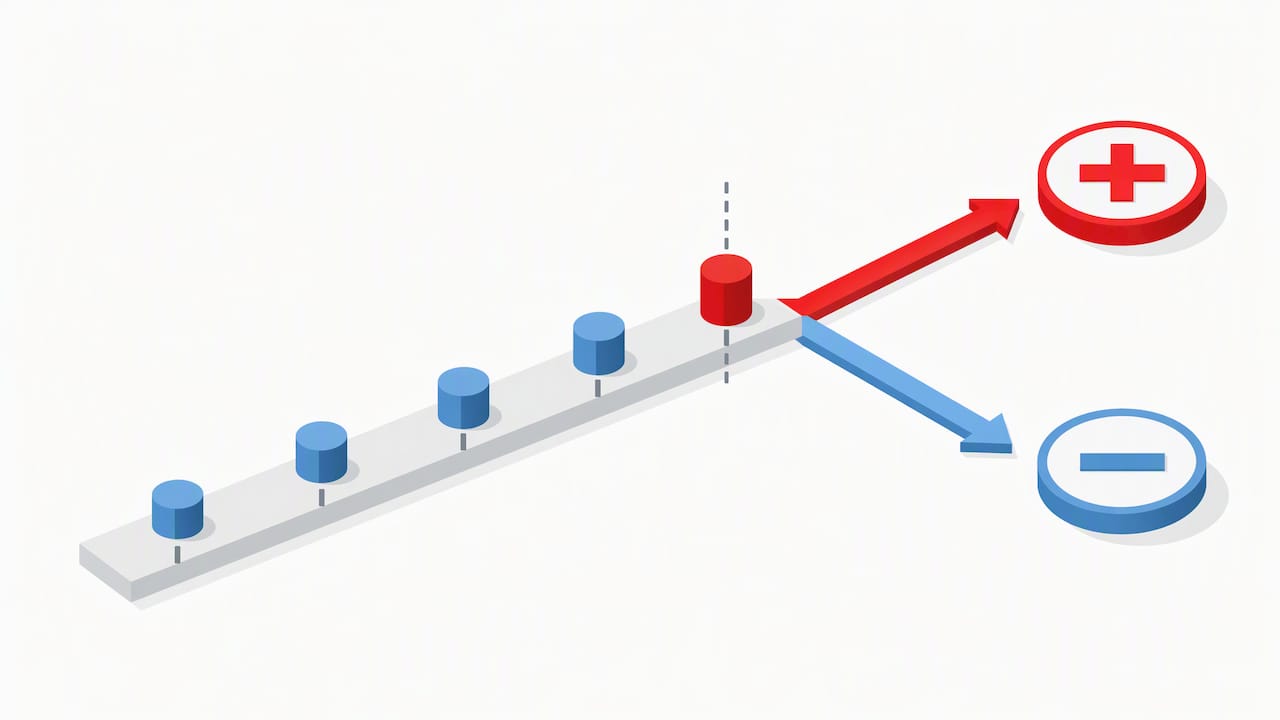
That sounds like a loophole, but it is a safeguard. Tests cannot tell whether a single molecule is present, so a true zero-tolerance standard is unattainable. Standardized cutoffs protect evidentiary standards and the rights of the person tested. Without them, two labs could call the same specimen positive and negative depending on how sensitive their equipment happened to be.
Two terms come up constantly:
- Initial (screening) cutoff: the threshold on the first test. At or above it, the specimen is not yet called positive. It goes on to confirmation.
- Confirmatory cutoff: the threshold on the second, more specific test. Only a result at or above this level is reported as confirmed positive.
The confirmation cutoff is often lower than the screening cutoff. That is not an error. The screen is a broad immunoassay that reacts to a family of related compounds. The confirmation measures one specific compound with a more selective method.
DOT urine cutoffs: the full table
The numbers below come from 49 CFR § 40.85, which sets the cutoff concentrations for DOT urine tests. All values are in nanograms per milliliter (ng/mL).
| Drug or metabolite | Initial test cutoff | Confirmatory test cutoff |
|---|---|---|
| Marijuana metabolite (THCA) | 50 | 15 |
| Cocaine metabolite (benzoylecgonine) | 150 | 100 |
| Codeine | 2,000 | 2,000 |
| Morphine | 2,000 | 2,000 |
| Hydrocodone | 300 | 100 |
| Hydromorphone | 300 | 100 |
| Oxycodone | 100 | 100 |
| Oxymorphone | 100 | 100 |
| 6-acetylmorphine (6-AM) | 10 | 10 |
| Phencyclidine (PCP) | 25 | 25 |
| Amphetamine | 500 | 250 |
| Methamphetamine | 500 | 250 |
| MDMA | 500 | 250 |
| MDA | 500 | 250 |
The DOT’s own Part 40 page for § 40.85 states the same marijuana and cocaine figures, and confirms the basic rule: an initial result at or above the cutoff requires confirmation, and a confirmation at or above its cutoff is confirmed positive.
Why “5 panel” has more than five lines
The “5 panel” name refers to five drug classes: marijuana, cocaine, amphetamines, opioids and PCP. Each class can include several analytes. Opioids alone cover codeine, morphine, hydrocodone, hydromorphone, oxycodone, oxymorphone and 6-AM, and the amphetamine class includes methamphetamine, MDMA and MDA. That is why a table for a 5 panel test lists 14 rows.
What a reading means in practice
Here is how the rule applies to a few made-up numbers, for illustration only:
- Initial THC result of 42 ng/mL. Below 50, so the laboratory reports it negative. Nothing is confirmed.
- Initial THC result of 65 ng/mL. At or above 50, so it goes to confirmation. If confirmation measures 12 ng/mL, that is below 15, and the result is not a confirmed positive.
- Initial methamphetamine result of 600 ng/mL. Above 500, so it goes to confirmation. A confirmation of 300 ng/mL is above the 250 cutoff, so it is a confirmed positive.
In a real DOT test there is a further step after the laboratory: a medical review before anything is reported to the employer. This guide covers only the laboratory cutoffs.
DOT oral fluid cutoffs
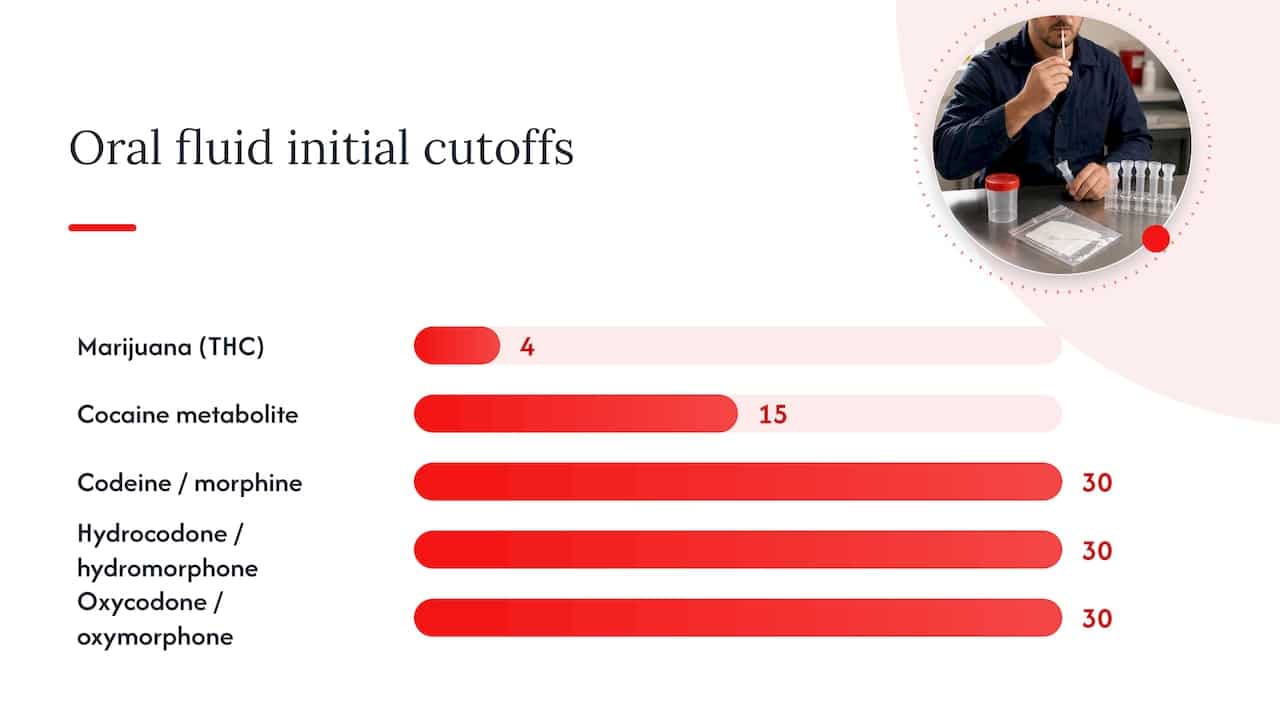
DOT also allows oral fluid testing. The laboratory cutoffs are set in 49 CFR § 40.91 and are far lower than urine values, because drugs appear in saliva at much smaller concentrations.
| Drug or metabolite | Initial test cutoff | Confirmatory test cutoff |
|---|---|---|
| Marijuana (THC) | 4 | 2 |
| Cocaine / benzoylecgonine | 15 | 8 |
| Codeine / morphine | 30 | 15 |
| Hydrocodone / hydromorphone | 30 | 15 |
| Oxycodone / oxymorphone | 30 | 15 |
The same table also covers 6-AM, PCP and the amphetamine group. Check the regulation for the complete list before you build a policy around it.
Note that oral fluid targets THC itself, while urine tests target a metabolite. That difference is one reason oral fluid is tied more closely to recent use, and it is why you cannot compare the urine and oral fluid numbers side by side as if they measured the same thing.
DOT cutoffs versus non-DOT cutoffs
The DOT numbers apply to DOT-regulated testing. Outside that framework, cutoffs depend on who orders the test.
SAMHSA’s primary care guidance notes that clinical drug testing has no set panel and cutoff concentrations vary. The same document says most laboratories and many point-of-care tests use the federal workplace cutoffs. So in practice, a private employer’s non-DOT 5 panel often looks a lot like the DOT one, but nothing forces it to.
Where non-DOT programs usually differ:
- Panel size. Many employers and programs add benzodiazepines, barbiturates, methadone, buprenorphine, fentanyl or other drugs that are not in the DOT 5 panel.
- Cutoff values. A program may choose lower thresholds for sensitivity, or higher ones to cut down on borderline results.
- Collection and chain of custody. DOT testing follows a strict protocol. Other programs may use a simpler process.
If you manage a program, put your chosen cutoffs in writing. Agencies do this themselves: one example is a police department directive that reserves the right to change cutoff levels and add or remove drugs as technology or other considerations warrant. Our guide to workplace drug test compliance covers how to set that policy up.
Probation drug test cutoffs
Probation is where readers expect a national standard and do not find one. The National Drug Court Institute’s benchbook says that a search for cutoff levels designed specifically for criminal-justice programs yields few results, and that workplace cutoffs routinely work well for those applications.
The same benchbook lists commonly accepted urine screening cutoffs:
| Drug class | Common screening cutoff (ng/mL) | Common confirmation cutoff (ng/mL) |
|---|---|---|
| Amphetamines | 500 or 1,000 | 500 |
| Barbiturates and benzodiazepines | 200 or 300 | 100 to 300 |
| Cannabinoids | 20 to 50 | 15 |
| Cocaine metabolite | 150 or 300 | 150 |
| Opiates | 300 | 100 to 300 |
| PCP | 25 | 25 |
Two things stand out. First, cannabinoid screening in criminal-justice settings can run as low as 20 ng/mL, which is below the DOT screen of 50. Second, amphetamine confirmation at 500 is above the DOT’s 250.
So a person on probation cannot assume DOT numbers apply. The supervising court, agency or treatment program decides, and the person should ask for the written cutoffs.
Federal probation has a confirmation rule
For federal probationers, 18 U.S.C. § 3563(e) requires that a drug test confirmation be a urine test confirmed by gas chromatography/mass spectrometry (GC/MS) or an equivalent method approved by the Administrative Office of the U.S. Courts. The statute requires confirmation only when the initial result is positive, the defendant faces possible imprisonment for the failure, and the defendant denies the result or there is cause to question it.
State and county probation rules differ. If you are on state supervision, your supervising officer or attorney is the person to ask what confirmation rights apply to you.
Instant tests versus laboratory cutoffs
This is where most confusion happens. An instant cup or dip card is an immunoassay. NIDA describes point-of-care and instant tests as presumptive screens, while laboratory confirmation is more specific and sensitive and typically uses GC-MS or LC-MS. FDA likewise advises that a preliminary positive from a home or rapid test be sent to a laboratory for confirmation.
The practical rules:
- An instant result is a screen, not a final answer. The NDCI benchbook says presumptive positives should be confirmed with a different method, and that GC-MS is more sensitive and selective than screening.
- Cutoffs differ by product. An instant test has its own printed cutoff for each drug. Always read the labeled value on the device and compare it with the program’s required cutoff before you buy.
- A negative on a device with a higher cutoff is not proof of a negative at a lower one. If your policy needs a 20 ng/mL THC screen, a 50 ng/mL device will miss results in between.
For confirmation, see our explainer on why labs trust GC-MS for final results. For how to describe a screen versus a confirmed result in your records, see how to document test results.
Choosing instant tests that match your cutoffs
If you run a clinic, treatment program, probation office or non-regulated workplace program, match the device to the policy, not the other way round.
- Write down the cutoff you need for each drug, in ng/mL.
- Check the printed cutoff on each cup, card or strip. Our cutoff levels guide for professionals helps you read them.
- Pick the format. Cups suit higher volume and observed collection; dip cards suit lower-cost screening. Our cup versus dip card comparison lays out the trade-offs.
- Plan the confirmation path. Decide in advance which lab handles non-negative screens.
- Train collectors. Our specimen collection guide covers temperature checks and handling.
If cannabis is the main concern and you need a lower screening threshold, a 20 ng/mL THC test strip is an example of a lower-cutoff option. For opioid screening, the hydrocodone strip at 300 ng/mL corresponds to the DOT initial value for that drug.
Where Rapidtestcup fits
We sell instant screening products for clinics, treatment centers, employers, law enforcement and individuals, in cup, dip card, strip and oral swab formats, with bulk pricing and custom quotes available. If you need a 5 panel style screen for a non-regulated program, or a wider panel, start with our 10 panel dip card or browse the full shop and compare the labeled cutoffs against your policy. These products are screens: a result that is not negative should go to a laboratory.
Our perspective
We talk to program managers every week, and the most common mistake we see is not choosing the wrong test. It is never writing down which cutoffs the program is supposed to use.
The federal tables are a good starting point because they are public, widely used and defensible. Most point-of-care tests are built around those numbers. But a table is only useful if everyone in the program reads the same one. We encourage buyers to list the cutoff for every drug they screen, check that against the label on the device, and keep that list with the lot number and the result.
We also push back on the idea that an instant test is lesser because it is a screen. A screen does its job when it is fast, consistent and followed by confirmation when it matters. Being honest about that is what protects the person tested and the program.
— Justin
FAQ
What are the DOT 5 panel cutoff levels?
For urine, they are THC metabolite 50/15 ng/mL, cocaine metabolite 150/100, PCP 25/25, amphetamine and methamphetamine 500/250, and a set of opioid values from 10 to 2,000 ng/mL, all in 49 CFR § 40.85. The first number is the initial test and the second is the confirmation. Oral fluid has its own, lower table.
What is a positive cutoff?
It is the concentration at or above which a result is called positive. Below it, the result is reported negative even if a trace is present. On a DOT test, a result at or above the initial cutoff does not make it positive by itself; it triggers a confirmation test.
Do DOT cutoffs apply to probation drug tests?
Not automatically. Standardized cutoffs designed for criminal-justice programs are scarce, so many programs borrow workplace values, but the supervising agency or court sets its own. Ask for the written cutoffs and the confirmation policy.
Is an instant test result as reliable as a lab result?
An instant test is a presumptive screen. It is useful for fast decisions, but a preliminary positive should be confirmed by a laboratory using a method such as GC-MS or LC-MS before anyone acts on it as final.
Can an instant cup be used for a DOT test?
For DOT-regulated testing, the cutoffs in Part 40 govern the laboratory process, so you should follow your employer’s DOT program and the rules at transportation.gov. Use instant cups and cards for non-regulated screening.
Sources
- Drug Testing, National Institute on Drug Abuse
- NDCI Benchbook, Chapter 6: The Fundamentals of Drug Testing
- 49 CFR § 40.85, cutoff concentrations for urine drug tests
- DOT Part 40, Section 40.85
- 49 CFR § 40.91, cutoff concentrations for oral fluid drug tests
- Clinical Drug Testing in Primary Care, SAMHSA
- Philadelphia Police Department Directive 6.5
- 18 U.S.C. § 3563