Blog
Vape THC Drug Test: Will It Show Up, and How to Check


Yes, a THC vape can fail a drug test. Standard urine tests do not care how THC entered your body. They look for a byproduct of THC, and vaping, smoking and eating cannabis all produce it. How long it stays detectable depends mostly on how often you use, not on the device.
This guide explains what a test actually detects, how long to expect a positive for different kinds of tests, why “low-THC” and “CBD” vapes are not a safe bet, and which screening tools make sense if you need to check for THC yourself.
TL;DR
- Urine tests detect the THC metabolite THC-COOH, not the vape or the THC itself, so a vape pen can trigger the same positive as smoked cannabis.
- Occasional users may clear in days, while chronic users can stay positive for weeks. Nobody can promise an exact number.
- A “legal” hemp or low-THC vape is no guarantee: in a Johns Hopkins study, 2 of 6 people tested positive after a single session.
- Oral fluid tests catch only very recent use, and a negative result does not prove someone has not vaped.
- If you are an employer, clinic or program that needs to screen, match the test type (urine, oral swab) to the question you are asking.
Table of Contents
- What a THC drug test actually looks for
- How long a THC vape stays detectable
- Does a “low-THC” or CBD vape make you safe?
- Oral fluid and other test types
- Secondhand vapor and accidental exposure
- How to screen for THC when you need an answer
- Our perspective
- Stocking up for your program
- FAQ
- Sources
What a THC drug test actually looks for
Most workplace and clinical screens use urine. The urine test is built to find 11-nor-delta-9-tetrahydrocannabinol-9-carboxylic acid, usually shortened to THC-COOH, a metabolite of delta-9-THC, the main active compound in marijuana. The test is not looking for your vape pen, your cartridge or even THC itself.
That is why people are surprised. The metabolite can accumulate in fat tissue and be released slowly, so a person can test positive days or weeks after the last session. The delivery method changes how much THC gets into your blood in the first place, but once your body processes it, the marker in urine is the same.
Federal drug-free workplace programs use set cutoffs. According to a November 2025 SAMHSA memo, the urine initial screen is 50 ng/mL and the confirmation cutoff is 15 ng/mL for THC-COOH. Many private employers and programs follow similar numbers, though they are free to choose their own.
Screen versus confirmation
A rapid test is an immunoassay screen. It gives a fast preliminary result. A lab confirmation using GC/MS or LC/MS/MS is far more specific. A positive on a rapid cup or strip is a presumptive result, and anything that carries consequences for a job, custody or a treatment plan should go to the lab for confirmation.
How long a THC vape stays detectable
There is no single answer, and anyone quoting you a guaranteed clearance date is guessing. Standard urine tests cannot reliably tell you when someone last used or whether they were impaired, because of differences in metabolism, urine dilution and how much metabolite sits in fat tissue. According to UW Medicine, casual users may be detectable for up to about 10 days, while chronic users may test positive for two to four weeks or longer.
Here is a practical way to think about it:
| Pattern of use | What to expect on a urine screen |
|---|---|
| A single session | Often negative within days, but not guaranteed |
| Occasional (a few times a month) | Roughly up to a week or so, varying by person |
| Regular (several times a week) | Can run past a week into multiple weeks |
| Daily or heavy | Two to four weeks or longer is common |
The table is a planning guide drawn from the ranges above, not a promise. For a deeper look at how long ranges stretch in the longest cases and what labs use to measure them, see our breakdown of THC detection time in urine.
What stretches or shortens the window
- Frequency of use. The strongest factor by far.
- Potency and amount. Concentrates and high-potency cartridges deliver more THC per puff than flower does.
- Body fat. THC metabolites are stored in fat and released slowly.
- Hydration and dilution. A very dilute sample can lower a reading, but labs check for dilution, and a dilute sample may simply be reported as dilute and need a retest.
- Timing of the collection. A first-morning sample tends to be more concentrated.
Does a “low-THC” or CBD vape make you safe?
No, and this is where many people get caught. A 2019 study from Johns Hopkins found that vaping hemp-type cannabis with 0.39% THC led to two of six participants testing positive for THC-COOH on a urine screen at the standard 50 ng/mL and 15 ng/mL confirmation cutoffs. The researchers cautioned that users should not assume a “pure” CBD product or low-THC vape is safe, because of possible mislabeling or contamination as well as individual metabolism.
A separate study discussed at a federal advisory meeting found no evidence that pure CBD converts to THC when swallowed or vaped. But a CBD product that contained 3.7 milligrams of delta-9 THC produced some positives. So the risk is usually the THC in the product, not the CBD itself. Our guide on whether CBD shows up on a drug test goes further into that.
Delta-8 and other “legal” vapes
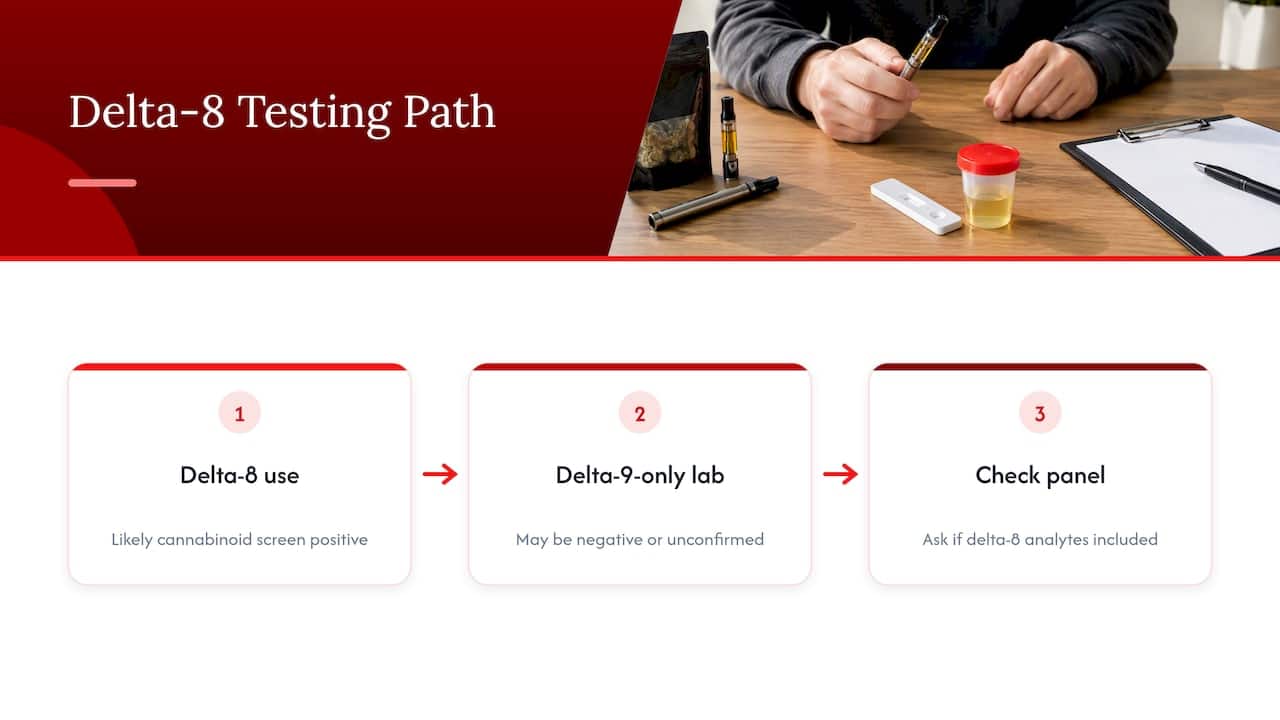
Delta-8 THC vapes are sold widely as a legal alternative, but they do not give you a pass. A drug court fact sheet notes that delta-8 produces a metabolite similar to the one from cannabis, so people using it will likely screen positive for cannabinoids. Interestingly, a delta-8 product may screen positive and then come back negative or unconfirmed on a lab test designed to detect only delta-9 metabolites. If you are in that situation, ask whether the confirmation panel includes delta-8 analytes.
SAMHSA has also said that unregulated hemp and synthetic products create real difficulties for drug-free workplace programs, since impurities or delta-9 THC above federal limits can produce positives that are legally indistinguishable from marijuana use in federal settings. The same memo states that, other than a verified prescription for an FDA-approved medication, there is no legitimate medical explanation for a positive from marijuana or THC products.
Oral fluid and other test types
Urine is not the only option. Oral swabs test saliva and are used where recent use is the question, such as post-incident or reasonable-suspicion situations. They are easy to observe and hard to adulterate.
The tradeoff is timing. THC concentrations in oral fluid drop rapidly within an hour after vaporization, and studies of point-of-collection devices have found they can give false negatives. A negative swab does not guarantee that someone has not recently consumed cannabis.
Neither blood nor oral fluid levels map neatly onto impairment either. Research reviewed by traffic safety experts shows that THC concentrations correlate poorly with driving impairment: some people who test positive are not impaired by objective measures, and some who test negative may be. A drug test tells you about exposure. It does not tell you about fitness for work or driving.
Secondhand vapor and accidental exposure
People often ask whether being around someone else’s vape can cause a positive. Air sampling at outdoor stadium events by NIOSH found measurable THC in 19 of 29 personal air samples, so exposure is real, but that report evaluated police officers’ exposure to secondhand smoke and does not establish a urine positive. If you believe a result came from incidental exposure, bring it up with the medical review officer or a physician, along with the circumstances. Do not try to guess at it yourself.
How to screen for THC when you need an answer
Who you are changes what you need.
Employers and occupational health providers. Pre-employment and random screens usually run on urine. A multi-panel cup tests several drugs at once and gives a result in minutes. Pick a panel that matches your written policy, and send any non-negative result to a lab for confirmation. Our cup versus dip card comparison lays out the practical differences.
Clinics, treatment programs and probation settings. Frequent, low-cost monitoring suits dip cards and test strips. A THC strip at 20 ng/mL is a lower-cutoff option, while a multi-level THC dip card helps show whether levels are trending down between visits. For the basics of the format, see how dip card tests work.
Recent-use questions. If the question is whether someone used today, an oral swab fits better than urine. A 5 panel oral swab with THC/50 covers the common drugs, and a 13 panel swab with THC/40, fentanyl and alcohol widens the net.
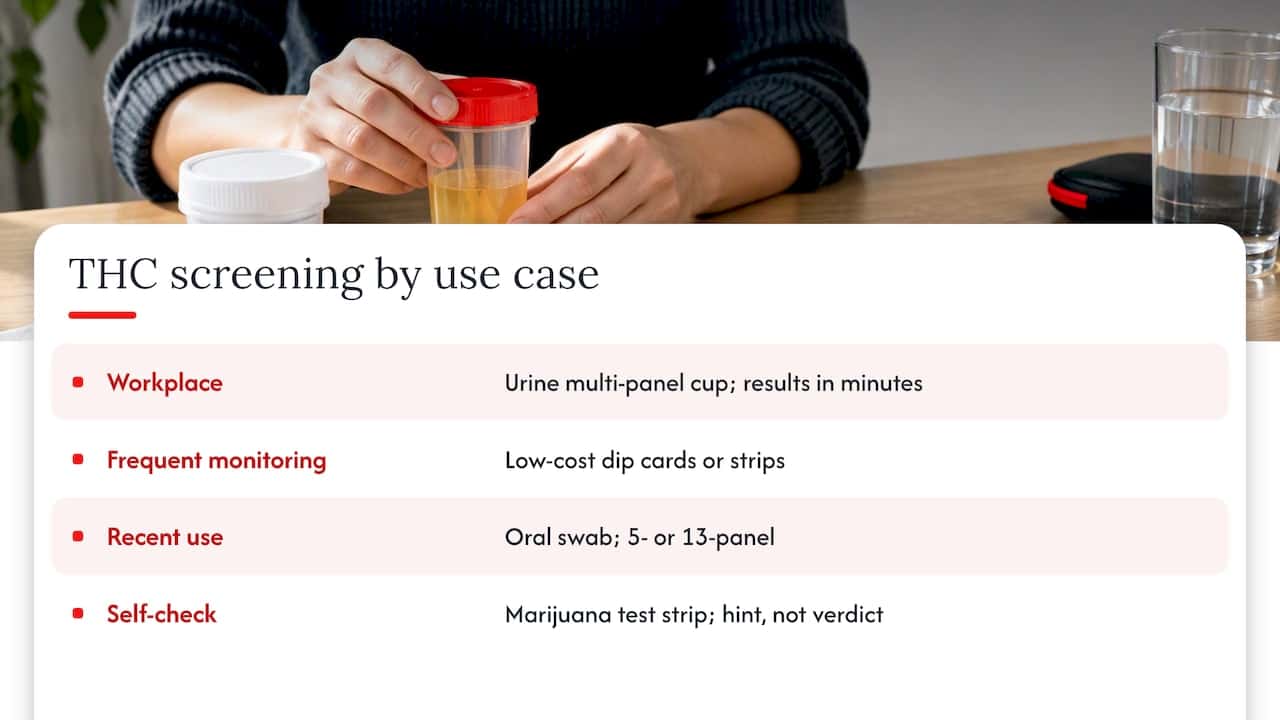
Individuals checking themselves. A simple marijuana test strip can show whether you are likely to be positive before a scheduled test. Read the result as a hint, not a verdict. A negative strip does not guarantee a negative lab result, because cutoffs differ from one test to another.
Reading a rapid test correctly
- Check the cutoff printed on the product, and compare it with the cutoff in your policy or program.
- Follow the read window exactly. A line read too late can mislead you.
- Remember that on a cup or strip, a faint test line still counts as negative for that drug on most formats. Check the instructions for your device.
- Treat any positive as presumptive and send it for confirmation when the stakes are high.
- Record the lot number and time, since good documentation protects both sides.
CLIA waived and FDA-cleared status matters when a test is used in a clinical or professional setting. We cover the reasons in why FDA-cleared tests matter in substance abuse programs and the advantages of FDA approved kits.
Our perspective
We are a family business that sells drug tests every day, and the most common mistake we see is treating a rapid test as a lie detector. It is a screening tool. It answers one narrow question, whether a drug marker is above a cutoff in this sample, and it does that quickly and cheaply.
Vapes add a second problem: the product label. Customers tell us they used a “CBD” or “legal” cartridge and are shocked by a positive. The research bears this out, and we would rather you know that before a test than after. If a result will affect someone’s job or treatment, confirm it with a lab, and let a medical review officer or physician handle disputed results.
For programs, our advice is to pick the test for the question. Urine for a longer look back, oral fluid for recent use, and a consistent cutoff across your whole program so results are comparable over time.
— Justin
Stocking up for your program
If you run a clinic, workplace program or lab, we carry multi-panel cups, dip cards, strips and oral swabs, with CLIA waived and FDA-approved options and bulk discounts. Browse the full range in our drug test shop, or if you need a particular panel or quantity, ask us for a custom quote.
FAQ
How long does vape THC show up in urine?
It depends on how often you use. Casual users may be detectable for up to about 10 days, and chronic users may test positive for two to four weeks or longer, according to UW Medicine. Individual metabolism makes any exact figure unreliable.
Will a THC vape fail a drug test?
It can. Urine tests detect the THC-COOH metabolite regardless of how THC entered the body. Even a single session of low-THC hemp-type cannabis produced positives in some participants in a Johns Hopkins study.
Why did I test positive if I do not smoke?
The likeliest explanation is a vape, edible or hemp product that contained THC, sometimes mislabeled. Delta-8 products can also produce a similar metabolite. Tell the medical review officer about every product you used, and ask whether a confirmation test was run.
Will a nicotine vape show up on a THC test?
No. A THC test looks for cannabis metabolites, not nicotine. A nicotine vape will only matter if the liquid also contains THC or a cannabinoid product that cross-reacts, and you would need a separate cotinine test to detect nicotine.
Can a rapid test replace a lab test?
A rapid test is a screen that gives a preliminary result within minutes. Lab confirmation by GC/MS or LC/MS/MS is more specific, so use it whenever a result will have serious consequences.
Sources
- CDC: Urine Testing for Detection of Marijuana, An Advisory
- SAMHSA: Synthetic Cannabis-Related Products Memo (November 13, 2025)
- All Rise: Delta-8 THC Fact Sheet
- UW Medicine: Cannabinoid Screen and Confirmation (Urine)
- Johns Hopkins Medicine: Some CBD Products May Yield Cannabis-Positive Urine Drug Tests
- SAMHSA DTAB open session transcript, September 2020
- Drug Testing and Analysis: THC in oral fluid following vaporized cannabis
- The failings of per se limits to detect cannabis-induced driving impairment
- NIOSH HHE Report HETA-2017-0174-3335