
Blog
Hair vs Urine Drug Test: Differences, Accuracy and When to Use Each


A urine test shows what someone used recently, usually in the past one to three days. A hair test shows a longer pattern, typically about 90 days, but it misses the last week or so. Neither is “better” across the board. The right choice depends on whether you need to know about last weekend or the last three months, and on what the rules for your workplace or program allow.
This guide compares the two on the points that decide the choice: detection window, accuracy, drugs covered, collection, turnaround, cost, tampering, and federal workplace rules.
TL;DR
- Urine catches recent use (about 1 to 3 days for most drugs) and is the practical default for screening, on-site testing and most workplace programs.
- Hair reflects roughly 90 days of use with a typical 1.5-inch sample, but it generally cannot show the most recent week and can miss occasional use.
- Accuracy depends on the question. Urine picked up more marijuana, benzodiazepine and methadone use in one U.S. study; hair picked up more cocaine use.
- DOT-regulated testing does not accept hair. Only urine and oral fluid are authorized under federal transportation rules.
- Both need lab confirmation of a presumptive positive before anyone acts on it.
Table of Contents
- What each test actually measures
- Detection window: how far back each test looks
- Which is more accurate?
- Which drugs each test covers
- Collection: what the donor does
- Turnaround and confirmation
- Tampering and sample validity
- Cost and practicality
- Workplace rules: what the law allows
- Our perspective: why we recommend urine for most programs
- Which should you choose?
- Stock the right urine tests
- FAQ
- Sources
What each test actually measures
The two tests look at different records of drug exposure.
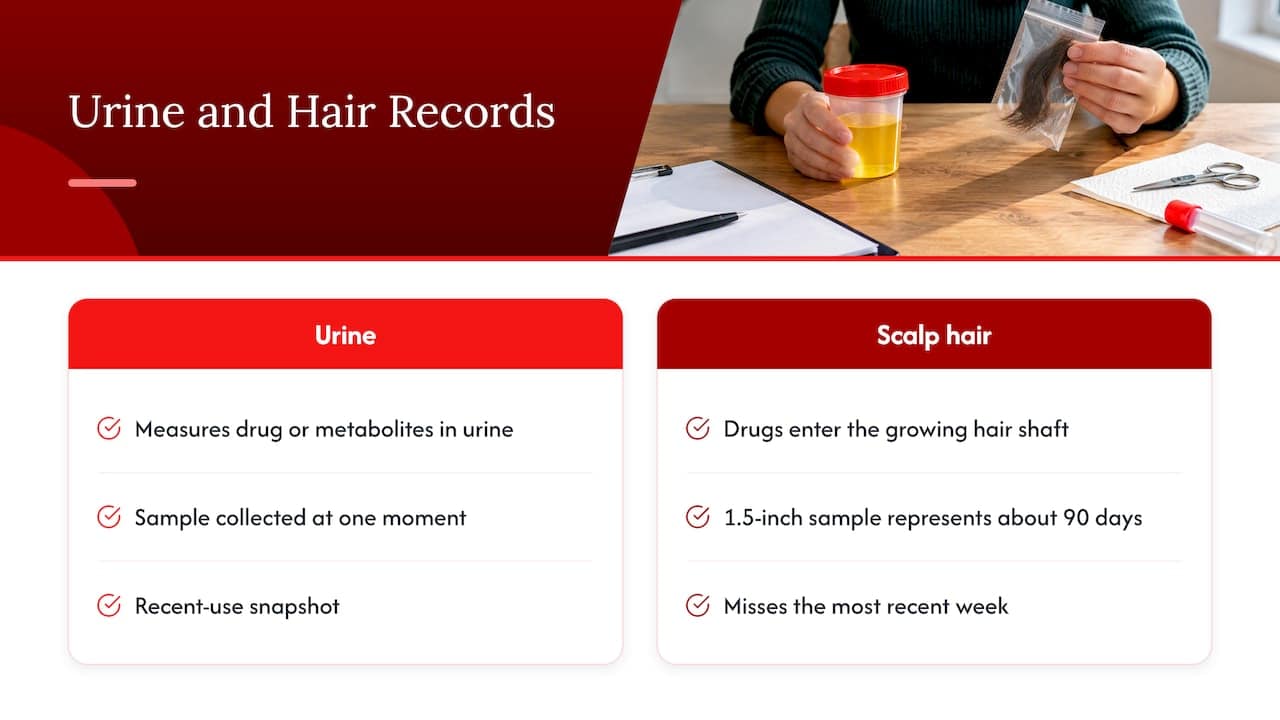
When you use a drug, your body metabolizes it and eliminates it in urine. A urine test measures the drug or its metabolites in a sample collected at one moment. It answers: has this person used recently enough that something is still being excreted?
Hair works differently. Drugs and metabolites from the bloodstream are incorporated into the growing hair shaft. Because hair grows at a roughly steady rate, a section of hair is a timeline. A typical 1.5-inch scalp-hair sample represents about 90 days, but hair usually cannot capture the most recent week because that segment has not yet grown out of the scalp.
That single difference explains almost everything else in this comparison. Urine is a snapshot with a short memory. Hair is a long memory with a blind spot at the end.
Detection window: how far back each test looks
A 2016 clinical review by Hadland and Levy describes urine as usually detecting use from about one day to several weeks, depending on the substance, while hair offers the longest windows, from weeks to months and sometimes years if long hair is analyzed.
| Factor | Urine test | Hair test |
|---|---|---|
| Typical window | About 1 to 3 days for most drugs | About 90 days with a 1.5-inch sample |
| Longer windows | Chronic heavy cannabis use can extend detection to weeks | Longer hair can cover more months |
| Blind spot | Use older than the window | The most recent week or so before collection |
| Best at showing | Recent use | Pattern of repeated use over time |
Substance, dose and frequency all move the urine window. Cannabis is the best-known example: occasional use clears quickly, while frequent heavy use can stay detectable far longer. If you want drug-by-drug timelines, our guides on drug detection windows and substance detection windows lay them out, and there are deeper pages on cocaine in urine, methamphetamine and benzodiazepines.
The practical upshot: someone who used a drug two days ago will often show on urine and not on hair. Someone who used regularly last month but stopped three weeks ago may show on hair and not on urine.
Which is more accurate?
“Accurate” can mean two things: does the test correctly identify the substance in the sample, and does the sample catch the use that happened. Both methods are chemically reliable when a laboratory confirms results. The real difference is sensitivity to different patterns of use.
A 2019 peer-reviewed U.S. study of 532 young adults who reported opioid or heroin use compared self-reported past-month use with test results. Urine confirmed reported use more often than hair for:
- heroin or opioids: 85.5% versus 80.9%
- marijuana: 73.9% versus 22.9%
- benzodiazepines: 51.3% versus 15.1%
- methadone: 77.0% versus 48.7%
Hair, in that study, detected reported cocaine use more often. Keep the context in mind: this was a specific population reporting past-month use, so a 30-day self-report window favors urine for some drugs. Over a longer window, and for people who use regularly, hair tends to flag more users. That is why the Quest-style employer arguments for hair emphasize chronic use, and why Hadland and Levy note that hair is useful for chronic or long-term use but may miss sporadic use and may require relatively heavy use for detection.
So the honest answer to “which is more accurate” is: urine is more accurate for recent use, hair is better at showing sustained use, and neither alone tells you how much someone used. A 2025 review in the Journal of Applied Laboratory Medicine stresses that hair drug concentration does not strongly correlate with dose, and that hair color, cosmetic treatment and environmental contamination can affect results. It also flags potential racial bias in hair testing, a concern anyone designing a policy should weigh.
Which drugs each test covers
Both tests can screen for the main drug classes. According to Cleveland Clinic, common urine tests cover marijuana, cocaine, opioids, amphetamines, benzodiazepines and alcohol, while hair tests can detect cocaine, PCP, amphetamines, opioids and MDMA. Panels vary with the reason for testing.
Two gaps are worth knowing:
- Cannabis in hair is harder to detect because the active compound reaches hair in low concentrations. A hair test can come back negative for someone who uses cannabis occasionally.
- Newer and niche substances are generally easier to add to a urine panel, since urine screening is the more established, flexible format. Expanded cups now cover synthetic cannabinoids, fentanyl, tramadol, ketamine and more. For example, our 18-panel cup with KRA, K2, TRA, ETG and FEN screens for several of these in one sample.
Always match the panel to your purpose. A pre-employment screen, a treatment-program check and a clinic intake rarely need the same list.
Collection: what the donor does
Urine. The donor provides a sample in a restricted-access or controlled restroom, and the sample is sealed for transport to a laboratory. With an instant cup, the screen happens on site in minutes. If you run collections, our specimen collection guide for professionals covers the handling steps.
Hair. Per the Labcorp specimen summary, collection generally uses about 100 strands, roughly a quarter of a pencil’s diameter, cut close to the scalp with the root end identified. Hadland and Levy say hair is usually taken from the back of the head, and that body hair from the armpit, face or another unshaven site may be used when scalp hair is unavailable.
Hair collection is observed by default, so there is little room for swapping a sample. It also has no on-site instant option: the specimen goes to a lab.
Turnaround and confirmation
The same Labcorp summary gives approximate laboratory turnaround of 24 to 72 hours for urine results and 48 to 72 hours for hair, with extra time possible when confirmation is needed. Urine has one more speed advantage: an on-site cup or dip card gives a presumptive result within minutes, which hair cannot do.
Both methods work in two steps. Initial testing uses immunoassay, and presumptive positives are confirmed by chromatography combined with mass spectrometry. An instant screen, whatever the sample type, is a screen. Send non-negatives to a laboratory before taking any adverse action.
Tampering and sample validity
Urine’s weak point is that the donor controls the sample for a moment. Dilution, substitution and adulteration are the known risks. Laboratories address them with specimen-validity checks on creatinine, specific gravity, pH and nitrites. Those checks do not apply to hair in the same way.
On-site programs can build the same checks into the device. Several of our cups include adulterant strips, such as the 18-panel cup with adulterants and the 12-panel ADLTX cup, so a suspicious sample is flagged at the point of collection.
Hair has its own validity issues. Cosmetic treatment, pigmentation and external contamination can affect incorporation and interpretation, which is why the 2025 review urges cautious reading of hair results.
Cost and practicality
Urine is generally the more economical and practical routine matrix. Collection and laboratory workflows are well established, and rapid testing is available. Hair offers a longer window and observed collection, but it needs specialized laboratory analysis, enough hair, and careful interpretation of timing, contamination and cosmetic treatment, as Hadland and Levy summarize. Prices for hair panels vary by laboratory and panel, so ask for a current quote rather than relying on a general figure.
The cost gap compounds with volume. If you screen many people, a test that gives a first answer on site and sends only non-negatives to a lab keeps both cost and wait time down.
Workplace rules: what the law allows
This is where the choice is sometimes made for you.
For federally regulated transportation testing, the U.S. Department of Transportation states that only urine or oral-fluid specimens are authorized, and hair is not an accepted substitute. 49 CFR 40.210 adds that specimens must be screened and confirmed at HHS-certified laboratories, and that point-of-collection urine, instant tests and hair testing are not authorized under Part 40.
The trucking industry has pushed for hair. In a December 23, 2022 decision, FMCSA denied a request to treat positive hair tests as reportable for the Drug and Alcohol Clearinghouse, finding it lacked statutory authority to grant the exemption. SAMHSA’s forms page lists the 2023 urine Mandatory Guidelines and shows hair separately as a 2020 proposed guideline.
Two takeaways for employers:
- If you are DOT-regulated, follow the DOT specimen rules. Our page on DOT oral fluid testing covers the oral-fluid side and an employer checklist.
- If you are not DOT-regulated, you may have a choice, subject to state law and your own written policy. Many employers use urine for pre-employment and for-cause screening, and some add hair for safety-sensitive roles. Our workplace testing timing guide helps with when to test.
Check your state’s rules and your policy before adopting a hair program.
Our perspective: why we recommend urine for most programs
We sell drug testing supplies to labs, clinics, treatment centers, employers and individuals, so we see what people actually need on a Tuesday morning. Most of them need an answer today, from a sample collected on site, at a price that works across dozens or hundreds of tests. That is urine.
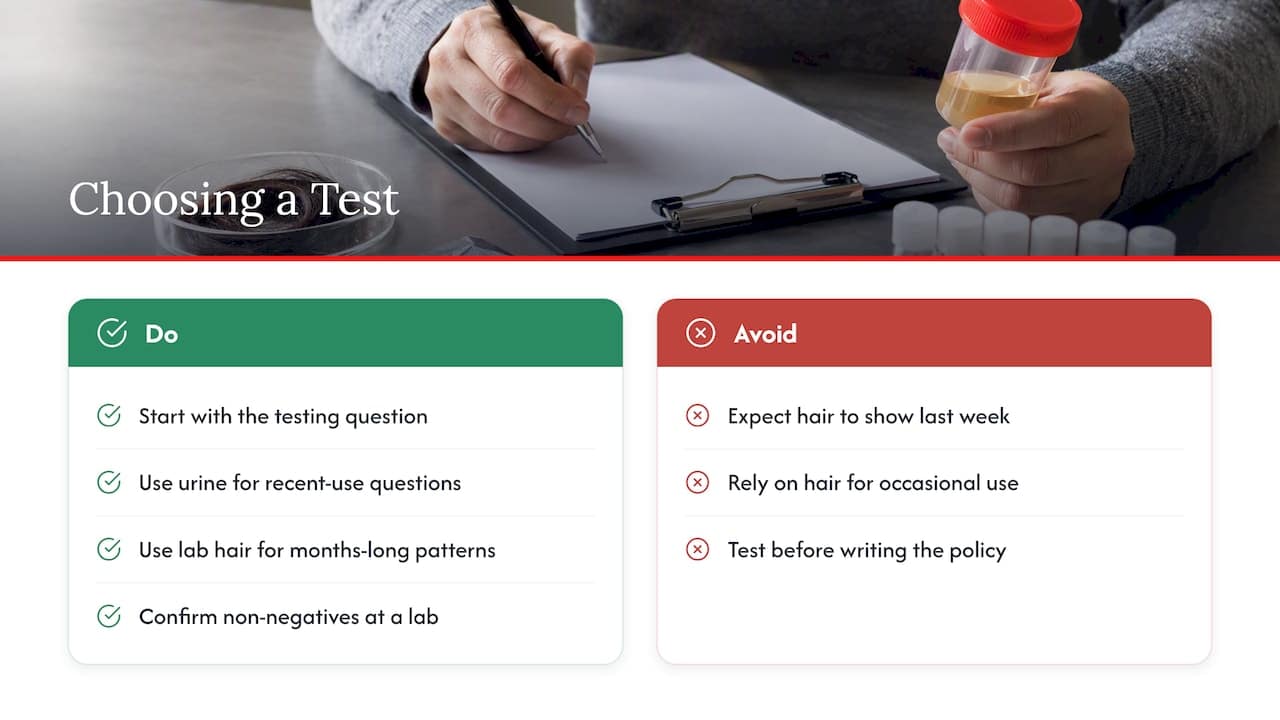
We do not pretend hair has no place. If a court, a custody evaluator or a safety-sensitive employer wants a 90-day picture, hair gives it, and a laboratory is the right place to run it. But hair is a different tool for a different question. It cannot show last week, it can miss occasional use, and it cannot be done on the spot.
Our advice to a buyer is to start with the question, not the matrix. If the question is “is this person under the influence of, or recently using, something now?”, use urine, with adulterant checks, and confirm non-negatives at a lab. If the question is “has there been a pattern over months?”, a laboratory hair test is worth the extra cost and wait. Whichever you choose, write the policy down before you test anyone.
— Justin
Which should you choose?
Use this as a quick decision guide.
Choose urine when:
- you need results on site or within a day or two
- you are testing for recent use, such as post-incident, reasonable suspicion or random testing
- you are DOT-regulated
- you screen at volume and cost matters
- you need a wide, flexible panel that includes newer substances
Choose hair when:
- you need a roughly 90-day history rather than recent use
- you want observed collection with little chance of substitution
- you can wait for laboratory results and accept the added cost
- you are not bound by DOT rules, and your state and policy allow it
Consider using both when a decision carries high stakes: urine shows the last few days, hair covers the months before them. Together they cover the blind spots of each.
Stock the right urine tests
If urine fits your program, we carry the formats most buyers use. Multi-panel cups give a full on-site screen with a temperature strip. Dip cards are a lighter option, such as the 10-panel dip card. Single-drug strips cover targeted needs, like fentanyl at 1 ng/mL. Our offerings include CLIA-waived and FDA-approved options and bulk pricing, and you can browse the full shop or request a custom quote for larger orders.
FAQ
Is a hair or urine drug test more accurate?
Neither wins outright. Urine is more sensitive to recent use, and in one U.S. study it confirmed reported marijuana, benzodiazepine and methadone use more often than hair. Hair is better at showing repeated use over about 90 days, and it picked up reported cocaine use more often. Both need laboratory confirmation of a presumptive positive.
How far back can a hair test detect drug use?
A typical 1.5-inch scalp-hair sample represents about 90 days. Because the newest growth has not yet emerged from the scalp, hair usually cannot show the most recent week before collection. Longer hair covers more time.
Which drug test is easier to pass?
The honest answer is that neither is a test to “pass” if someone has used a drug within its window. Urine has a shorter window, but laboratories check for dilution and adulteration. Hair has a long window and observed collection, though occasional use and cannabis can be missed. Prescription medications should be disclosed to the medical review process.
What drugs don’t show on a hair follicle test?
Hair tests are weakest for cannabis, which reaches hair in low concentrations, and for light or occasional use of any drug. Recent use within about the last week may also be missed. Panels differ by laboratory, so confirm which substances are included before ordering.
Can an employer use a hair test for DOT drug testing?
No. DOT rules authorize only urine and oral-fluid specimens, screened and confirmed at HHS-certified laboratories. Hair is not an authorized substitute for federally regulated transportation testing.
Sources
- Objective Testing: Urine and Other Drug Tests (PMC)
- A comparison of the utility of urine- and hair testing (PMC)
- Drug Test: What It Is, Purpose, Procedure and Types (Cleveland Clinic)
- Drug Testing Options Summary (Labcorp)
- Review on Toxicology Testing in Hair (Journal of Applied Laboratory Medicine)
- Employees (U.S. Department of Transportation)
- 49 CFR Part 40, Section 40.210 (U.S. Department of Transportation)
- Controlled Substances and Alcohol Use and Testing, FMCSA decision (Federal Register)
- Drug Free Workplace Forms (SAMHSA)