Blog
SAMHSA Drug Testing in 2026: Panels, Labs and Rules


SAMHSA drug testing means the federal workplace program, which HHS and SAMHSA set up through the Mandatory Guidelines. These Guidelines fix which drugs are tested, which specimens are allowed and which laboratories may run the tests. In 2026 the authorized panels did not change. Only urine and oral fluid are permitted, and only HHS-certified laboratories can analyze federal specimens. If you test outside the federal program, you can use the SAMHSA panel as a model without being bound by it.
TL;DR
- The March 2026 Federal Register notice made no revisions to the urine or oral fluid panels. The panels in effect since July 7, 2025 still apply.
- The federal urine panel covers marijuana, cocaine, opioids, PCP, amphetamines and, since that update, fentanyl and norfentanyl.
- Federal testing needs an HHS-certified lab and a certified Medical Review Officer (MRO). Instant cups and dip cards are screening tools for other settings.
- Private employers, clinics, treatment programs and individuals are not automatically bound by SAMHSA rules. Some state laws and federal agencies such as DOT do point to them.
Table of Contents
- What SAMHSA drug testing covers
- Did anything change for 2026?
- The federal panel: which drugs are tested
- Specimens and who may test them
- How a lab becomes SAMHSA-certified
- Who must follow SAMHSA rules, and who doesn’t
- What happens after a non-negative result
- Where instant screening fits
- Perspective
- Choose your screening supplies
- FAQ
- Sources
What SAMHSA drug testing covers
SAMHSA does not run drug tests. Under Executive Order 12564 and Section 503 of Public Law 100-71, HHS writes the scientific and technical rules for drug testing of federal employees. SAMHSA’s Workplace Drug Testing Resources page explains that HHS also set the standards for certifying the laboratories that test federal specimens.
The rules sit in two documents:
- UrMG: the Mandatory Guidelines for urine, effective February 1, 2024.
- OFMG: the Mandatory Guidelines for oral fluid, effective October 10, 2023.
Both dates come from SAMHSA’s FAQ on federal workplace drug testing, last updated May 2026. The same FAQ says the Guidelines give the structure for testing employees in all civilian Executive Branch positions. That includes safety-sensitive jobs designated for random testing, where even a momentary lapse could cause serious harm.
The program is not huge. SAMHSA’s National Laboratory Certification Program document estimates that federal agencies test about 275,000 urine specimens a year. Its influence is much wider than that number suggests. Regulated industries and many private employers borrow its panel, cutoffs and procedures.
Did anything change for 2026?
The short answer is no for the panels. HHS published its annual review of the authorized panels on March 13, 2026. The notice states that no drugs were added or removed for urine or oral fluid. The panels and report nomenclature that took effect July 7, 2025 stay in force. Only two footnotes were edited for clarity and correctness.
The 2025 update is why you still read about “new” requirements. It brought fentanyl and norfentanyl into the urine panel. If your policy or kit selection was built before that, check that it covers them. Our own take on the opioid side is covered in this piece on opioids in the workplace.
Two other 2026 items are worth knowing:
- SAMHSA’s Drug-Free Workplace page lists a 2026 Model Plan for a comprehensive drug-free workplace program, dated March 2026.
- A February 2026 notice repeated that HHS does not allow instrumented initial test facilities to test oral fluid for federal agencies (more on this below).
Rules can be revised at any time. Before you change a policy, confirm the current text on SAMHSA’s site.
The federal panel: which drugs are tested
SAMHSA’s resources page groups federal testing into five drug categories: amphetamines, cocaine, marijuana, opiates and opioids, and phencyclidine (PCP). The urine panel in the Federal Register notice lists these analytes:
| Category | Urine analytes |
|---|---|
| Marijuana | Marijuana metabolite (THCA) |
| Cocaine | Cocaine metabolite (benzoylecgonine) |
| Opioids | Codeine, morphine, hydrocodone, hydromorphone, oxycodone, oxymorphone, 6-acetylmorphine (heroin marker) |
| Synthetic opioid | Fentanyl, norfentanyl |
| PCP | Phencyclidine |
| Amphetamines | Amphetamine, methamphetamine, MDMA, MDA |
The analyte list comes from the March 2026 notice. The resources page adds that federal tests include required specimen validity testing for urine.
Routine versus case-by-case testing
The March 2026 Model Plan says an agency tests for marijuana and cocaine on a routine basis. It may, and is encouraged to, test for the full authorized panel. For other Schedule I or II drugs, testing is allowed case by case in reasonable suspicion, post-accident or follow-up situations. Routine testing for any other drug needs advance written approval from the HHS Secretary.
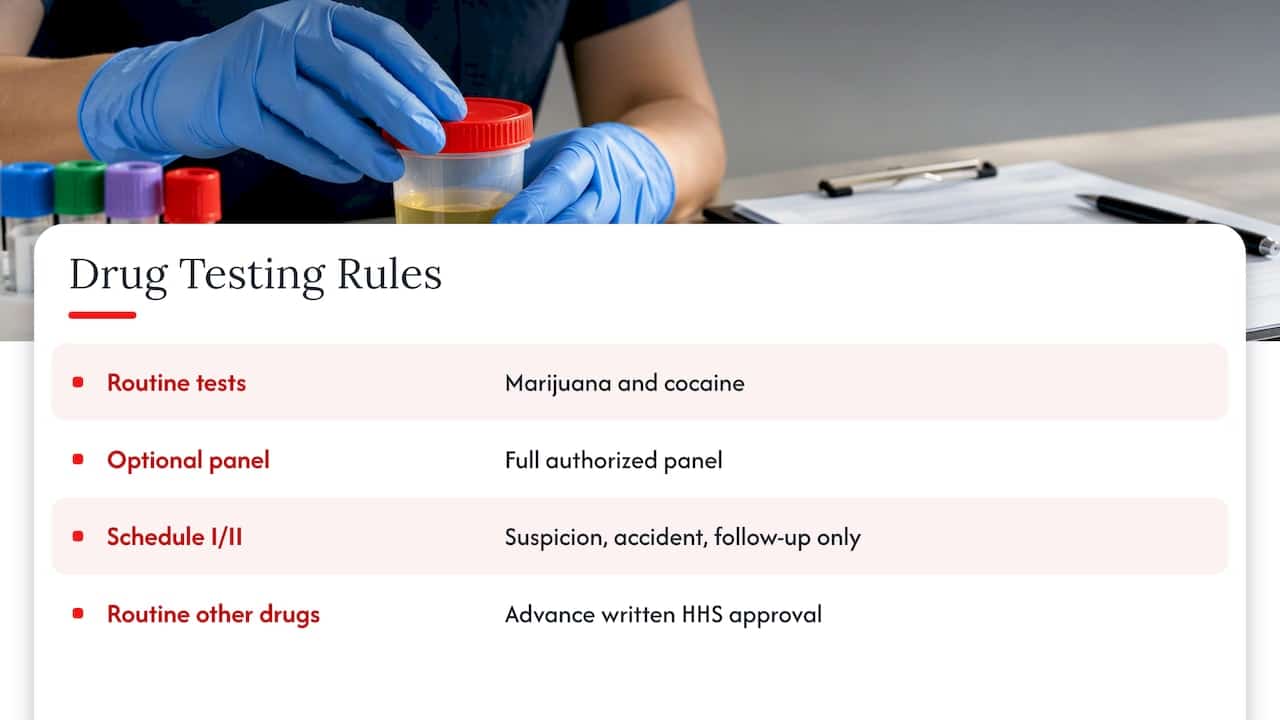
The 2023 Federal Register document says the same thing from the regulatory side: an agency must petition the Secretary in writing to routinely test for a drug class that is not on the panel.
Cutoffs
A panel names the drugs. Cutoffs decide at what concentration a result counts as positive. If you are matching a screening product to your policy, read our guides on drug test cutoff levels and cutoff levels for professionals before you pick a panel size.
Specimens and who may test them
Urine and oral fluid are the only two specimen types authorized by the Mandatory Guidelines. SAMHSA’s FAQ notes that federal agencies have been able to collect oral fluid since January 1, 2020. Hair, sweat and blood are not authorized for federal workplace testing.
Three points shape how federal tests work:
- Testing happens at an HHS-certified laboratory. The FAQ states that testing must be done by a lab in the National Laboratory Certification Program (NLCP).
- A certified MRO reviews and reports results. The lab does not report straight to the employer.
- Each specimen is split into a primary (A) and a split (B) specimen. The donor has a way to have the second portion checked.
For urine, instrumented initial test facilities (IITFs) can run the initial drug test and first validity tests. According to the resources page, they report only negative and negative-dilute results. They forward everything else to an HHS-certified urine laboratory. A February 2026 Federal Register notice confirms that IITFs cannot test oral fluid for a federal agency.
The notice of March 2026 also adds that no biomarker has been authorized for routine testing yet. A lab can request authorization to test for one when an MRO asks, by sending validation records to the NLCP for SAMHSA review.
If you handle oral fluid collection and want to see what the DOT side currently looks like, our DOT oral fluid checklist walks through it.
How a lab becomes SAMHSA-certified
The phrase “SAMHSA-certified” is shorthand. The accurate term is HHS-certified, through the NLCP, which SAMHSA’s Division of Workplace Programs administers. According to the NLCP document, an applicant must:
- Pass three rounds of performance testing.
- Pass an inspection during the third round.
- Pass another inspection three months after certification.
To stay certified, the lab or IITF must pass quarterly maintenance performance testing and do well on every semiannual inspection.
How to check a lab’s status
HHS publishes the list of certified labs and IITFs in the Federal Register every month, per the February 2026 notice. The same notice gives the list’s web address on SAMHSA’s site. A facility whose certification is suspended or revoked drops off later lists until it is fully restored, as the April 2026 notice explains. So a lab that appeared on last year’s list may not be on this month’s.
A quick routine: ask the lab for its certification, then confirm it on the current monthly list before you sign a contract or run a federal collection.
Who must follow SAMHSA rules, and who doesn’t
The confusion around “SAMHSA drug testing” nearly always comes from this question.
| Setting | Do the Mandatory Guidelines apply? |
|---|---|
| Civilian federal agencies | Yes, under Executive Order 12564 and Public Law 100-71 |
| DOT-regulated employers | Testing follows 49 CFR Part 40, which uses HHS-certified labs. DOT runs its program separately |
| Other regulated industries (energy, nuclear) | Required to use HHS-certified labs, per the NLCP document |
| Private employers | Only where a law or contract refers to the SAMHSA rules |
| Clinics and treatment programs | Not for clinical care. Confirmation is the practitioner’s call |
| Individuals | No |
The MRO Guidance Manual states that it applies to federal agency programs but not to DOT specimens under 49 CFR Part 40, and that DOT coordinates its requirements with SAMHSA’s workplace division. The NLCP document adds that the Department of Transportation, Department of Energy and Nuclear Regulatory Commission require the industries they regulate to use HHS-certified labs.
Clinical settings
SAMHSA’s primary care guidance on clinical drug testing draws the line clearly. In federal workplace testing, every positive initial screen must be followed by a confirmation test. In clinical settings, confirmation is at the practitioner’s discretion. The same document says it is written for primary care offices and community health centers, and it does not cover law enforcement or legal testing.
State laws and private employers
A private employer is only bound to the SAMHSA panel if a mandatory testing law or contract refers to SAMHSA regulations. Many employers choose it anyway, because it is a defensible baseline. If you take that route, write the policy down: which drugs, which specimen, when you test (pre-employment, random, reasonable suspicion, post-accident), and what happens after a non-negative result. Our workplace drug test compliance guide and laboratory protocols guide go through policy items one at a time. State law varies widely, so confirm yours with employment counsel.
What happens after a non-negative result
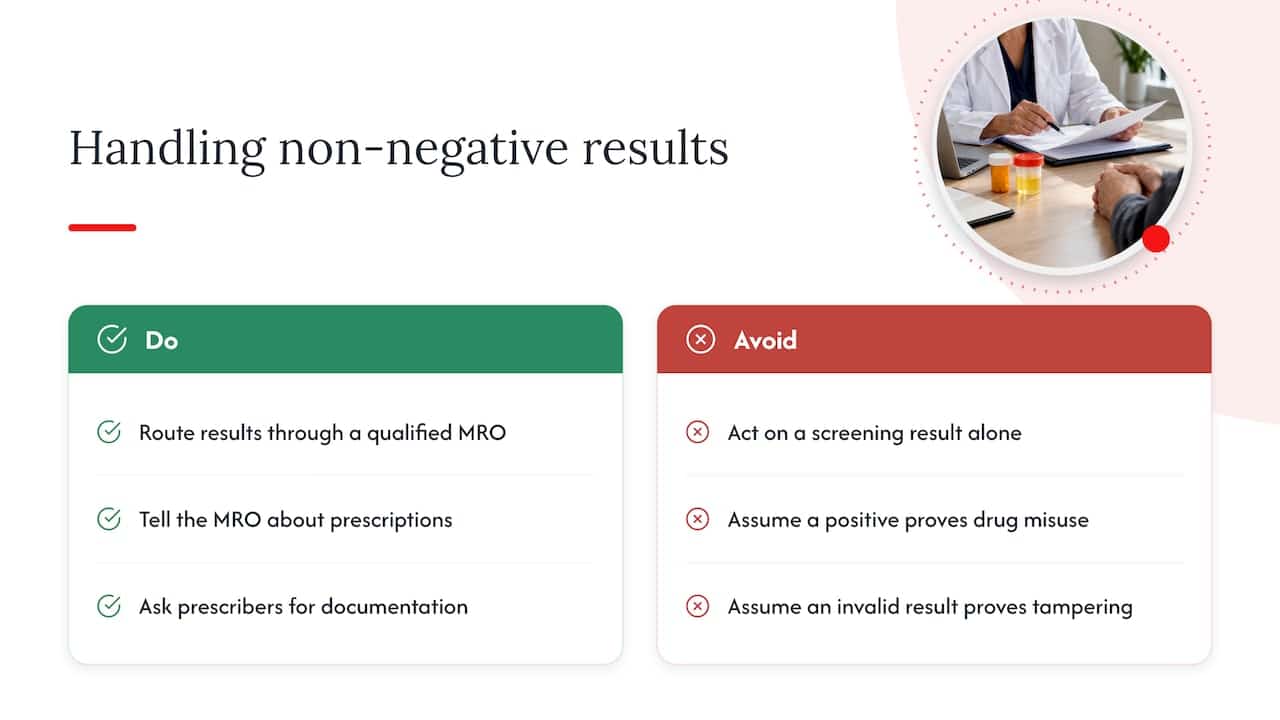
A positive lab result is not the end of the story. The MRO Guidance Manual says a confirmed positive does not automatically show that an employee or applicant misused drugs. A lab result of invalid, adulterated or substituted does not automatically show tampering. A physician who knows the possible legitimate medical explanations must interpret the result alongside the donor interview and other information.
This matters for prescription medicines. Opioids, amphetamine-class prescriptions and others can produce a lab-positive result that has a valid medical explanation. If you are an employer, route results through a qualified MRO, and do not act on a screening result alone. If you are a worker who takes a prescribed medication, tell the MRO during the interview, and ask your prescriber for documentation. For background on how prescription misuse affects working adults, this overview of prescription drug abuse among professionals is a helpful read for HR teams building support alongside testing.
Collection quality affects results too. Our guides on how collection methods shape validity and the specimen collection process cover temperature checks, chain of custody and the errors that cost you a valid test.
Where instant screening fits
Federal testing and everyday screening do different jobs. A federal collection goes to a certified lab. Instant tests give an answer in minutes where a lab trip is not practical or not required.
Typical places an instant cup, dip card or strip is used:
- Employers running pre-employment or reasonable-suspicion screens under their own policy.
- Treatment centers and sober living programs monitoring abstinence.
- Clinics deciding whether to order confirmation.
- Probation, court-related and law enforcement programs with their own protocols.
- Individuals checking at home.
When you pick a product, borrow the SAMHSA structure. Match the panel to your policy. If your policy follows the federal drugs, make sure the product includes marijuana, cocaine, opiates, PCP and amphetamines, plus fentanyl where your policy covers it. Choose the format that fits your volume. Our comparison of cups versus dip cards and the urine cup comparison will help. Where your protocol includes oral fluid, there is a 12 panel oral swab with alcohol and an 11 panel oral swab with fentanyl.
A presumptive positive from any screening device should go to laboratory confirmation before anyone makes a decision about a person’s job, treatment or legal status.
Perspective
We sell screening supplies to labs, clinics, treatment centers, employers and individuals, and the most common mistake we see is not a bad test. It is a mismatched one. Someone buys a panel before deciding what their policy actually tests for.
Start from the rule, then pick the product. If you follow the federal drug list, our multi-panel cups and dip cards are designed to cover those categories, and our fentanyl options are there for the opioid side of the panel. Our offering is CLIA waived and FDA-approved selection, and we are a family business that stocks a large inventory so orders ship quickly.
Screening and certified lab testing work together. Fast on-site screening tells you where to look. Confirmation by a certified lab and review by an MRO settle the cases that matter. Build your program with both, and write the steps down.
Justin
Choose your screening supplies
We stock multi-panel test cups, dip cards, urine strips, oral swabs, fentanyl tests and specimen collection supplies, with bulk pricing and custom quotes. A good starting point for federal-style coverage is the 15 panel cup with fentanyl and adulterant checks. For smaller programs, the 10 panel dip card is a quick option. Browse everything in our shop.
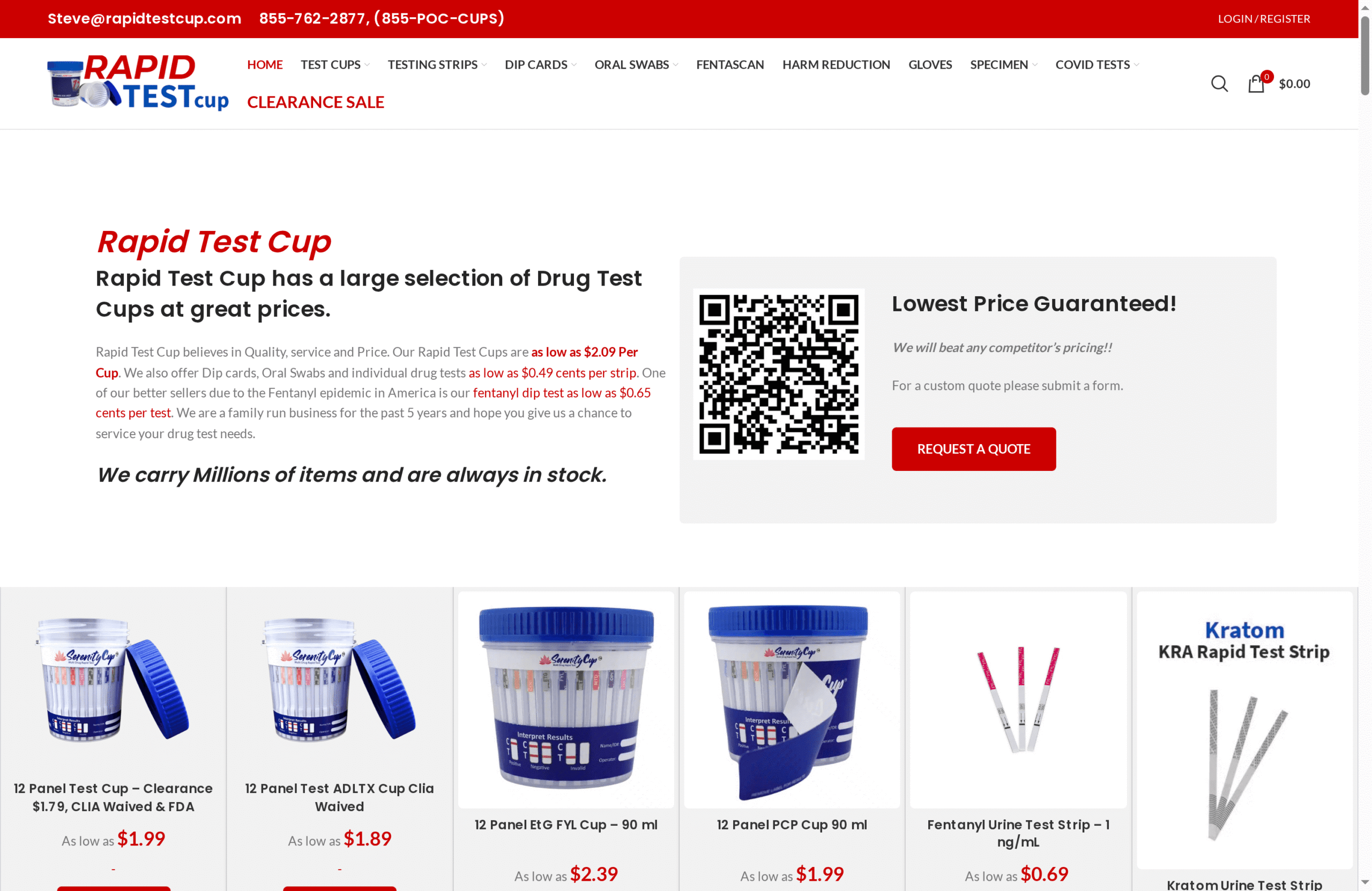
If you need volume, ask for a custom quote through the site, and we will help match products to your policy.
FAQ
Does SAMHSA require my private company to drug test?
No. SAMHSA’s Mandatory Guidelines govern federal agency programs. A private employer follows them only when a law, regulation or contract refers to them. Many companies still use the SAMHSA panel as a model for their own policy.
Are the SAMHSA drug panels different in 2026?
No. The March 13, 2026 Federal Register notice made no revisions to the urine or oral fluid panels. The panels effective July 7, 2025 remain in effect, and that includes fentanyl and norfentanyl for urine.
Can a hair or blood test be used for federal workplace testing?
No. Under the Mandatory Guidelines only urine and oral fluid are authorized specimens. Those tests must be done at an HHS-certified laboratory and reviewed by a certified MRO.
How do I know a laboratory is SAMHSA-certified?
Check the current list of HHS-certified laboratories and IITFs. HHS publishes it monthly in the Federal Register and on SAMHSA’s site. Suspended or revoked facilities are removed until restored, so check the latest version.
Sources
- SAMHSA: FAQs about federal workplace drug testing
- SAMHSA: Drug-Free Workplace Programs
- SAMHSA: Workplace Drug Testing Resources
- Federal Register: Authorized testing panels, March 13, 2026
- SAMHSA: Model Plan for a Comprehensive Federal Drug-Free Workplace Program, March 2026
- Federal Register: Mandatory Guidelines, October 12, 2023
- Federal Register: HHS-certified laboratories and IITFs, February 2, 2026
- Federal Register: HHS-certified laboratories and IITFs, April 2, 2026
- SAMHSA: National Laboratory Certification Program
- SAMHSA: Medical Review Officer Guidance Manual
- SAMHSA: Clinical Drug Testing in Primary Care
- Opioids in the Workplace: What Employers Should Do
- Busy Professionals: Prescription Drug Abuse