Blog
Opiate Cutoff 300 vs 2000 ng/mL: Which One Applies


A 2,000 ng/mL opiate cutoff is the federal workplace standard. A 300 ng/mL cutoff is the level most clinical laboratories and many rapid tests use. The lower number catches far more morphine and codeine, including poppy-seed and prescription exposure. The higher number was set to cut those false alarms in workplace programs. Pick the cutoff by the question you are asking: “did this person have any recent opiate exposure?” or “is this result safe to act on in a regulated program?” We stock both kinds of screening formats on our shop page, and the right one depends on that question.
TL;DR
- A cutoff is the concentration at which a test reports “positive.” Below it, the result is negative, even if some drug is present.
- 300 ng/mL is more sensitive and produces more positives, including from poppy seeds and prescribed codeine or morphine. 2,000 ng/mL produces fewer, and is the federal workplace standard for the codeine/morphine group.
- In one lab’s data, codeine-and-morphine confirmations fell from 7.1% to 2.1% after the switch to 2,000 ng/mL.
- Morphine and codeine screens do not reliably detect oxycodone, fentanyl, buprenorphine or methadone. Those need separate assays.
- A screening result is preliminary. It does not show dose, timing, source or impairment.
Table of Contents
- What a cutoff actually is
- Why 2,000 ng/mL exists
- What the numbers do to your results
- Which cutoff applies where
- What an opiate screen does and does not detect
- Why a positive is only the start
- How to choose between 300 and 2,000 ng/mL
- Getting the right test in your hands
- Our view on cutoffs
- FAQ
- Sources
What a cutoff actually is
A urine drug test reports “positive” when the concentration of a drug or metabolite is above a set threshold, called the cutoff. The ACMT position statement on urine opiate and opioid testing describes a screening test as preliminary and generally qualitative, reported positive if above the cutoff. A confirmatory test is definitive and generally quantitative. It also notes that regulatory cutoffs are set by a scientific advisory panel and are not necessarily a laboratory’s limit of detection, nor used in clinical practice.
That last point matters here. A cutoff is a policy choice about how much drug counts as a positive. It is not the lowest amount a test could see.
There are two stages:
- Screen (initial test). Usually an immunoassay, meaning an antibody-based test that reacts to a drug class. Rapid cups, dip cards and strips are in this group. Screening immunoassays use a single cutoff, according to ASCP educational material.
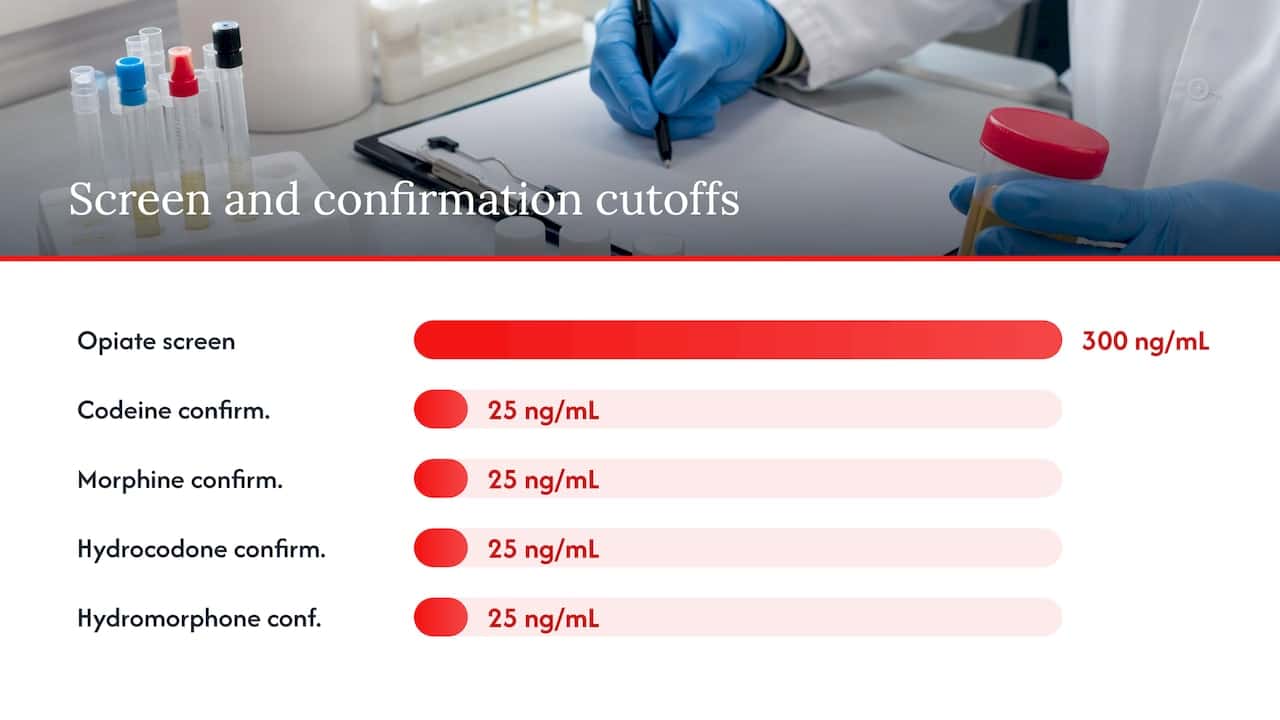
- Confirmation. Mass-spectrometry methods (GC-MS or LC-MS/MS) that identify and measure the specific drugs and metabolites. The same ASCP slides show a clinical lab running a 300 ng/mL opiate screen, then confirming with in-house LC-MS/MS cutoffs of 25 ng/mL for codeine, morphine, hydrocodone and hydromorphone.
So “300 vs 2000” usually means the screening cutoff, expressed as morphine equivalents. Confirmation cutoffs are a separate number, and they are often lower than the screen.
Why 2,000 ng/mL exists
The 2,000 ng/mL level came from the federal workplace system. In its 1998 rulemaking, as published in the Federal Register, HHS noted that 87% of laboratory-positive opiate specimens under the old 300 ng/mL standard were verified negative by medical review officers (MROs), the physicians who review lab positives in workplace programs. The change, effective December 1, 1998, raised the initial and confirmatory opiate thresholds from 300 to 2,000 ng/mL and added a 6-acetylmorphine (6-AM) confirmation at 10 ng/mL.
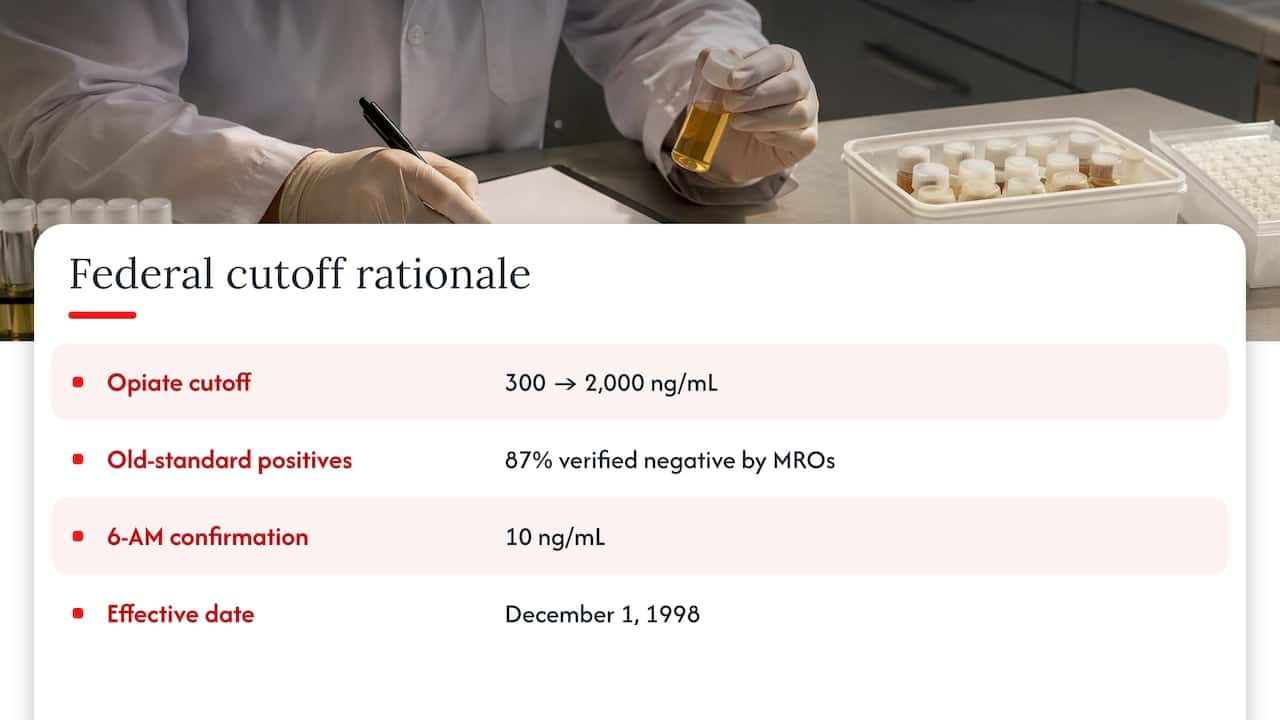
6-AM is a heroin-specific marker. Morphine and codeine can come from poppy seeds or prescriptions. 6-AM does not. That is why the rule pairs a high morphine/codeine cutoff with a very low 6-AM cutoff: it screens out food and medicine, but not heroin.
A review by Milone (2012) explains the goal. The higher cutoff was meant to improve positive predictive value, the share of positives that are true, without hurting negative predictive value in the heroin-era workplace.
What the numbers do to your results
The effect is measurable. Fraser and Worth (1999) reviewed workplace specimens before and after the change:
| Measure | 300 ng/mL era (1994 to 1996) | 2,000 ng/mL era (1997 to 1998) |
|---|---|---|
| Codeine and morphine both confirmed | 7.1% | 2.1% |
| Codeine only confirmed | 6.6% | 3.4% |
A 2021 Türkiye study by Karakükcü and colleagues compared a CEDIA opiate immunoassay with LC-MS/MS. Sensitivity was 100% at each cutoff. Specificity, the ability to avoid false positives, was 54.9% at a 300 ng/mL screening cutoff and 75% at 2,000 ng/mL. The false-positive rate was 45.1% at 300 ng/mL and 17.6% at 2,000 ng/mL when judged against LC-MS/MS at 300 ng/mL. All samples positive for 6-AM read at or above 2,000 ng/mL on the screen.
A later retrospective study of 11,348 samples by Ovat and colleagues found 3.45% of cases opiate-positive at 300 ng/mL. About 39.8% of those were reclassified negative at 2,000 ng/mL. Most positives came from addiction clinics, which shows how much the setting matters.
Read those figures as a trade-off, not a verdict:
- 300 ng/mL gives you wider coverage and more positives that need follow-up. It suits questions like “has this person taken any opiate lately?”
- 2,000 ng/mL gives you fewer positives and fewer innocent explanations. It suits regulated programs where a positive carries employment or legal consequences.
The UIC Drug Information Group adds that a negative at federal workplace values does not rule out drug use, and that clinical purposes such as medication adherence call for lower thresholds than the workplace standard.
A worked example
Suppose a patient ate a poppy-seed bagel the morning of a visit. Per the ACMT statement, at a 300 ng/mL cutoff dietary morphine can produce a positive immunoassay screen, but it is very unlikely to exceed 2,000 ng/mL. The same urine could read positive on a 300 ng/mL cup and negative on a 2,000 ng/mL cup. Neither cup is wrong. They answer different questions. We cover the food side in more detail in our guide on whether poppy seeds can cause a positive drug test.
Which cutoff applies where
Federal workplace testing
Under 49 CFR 40.85, the DOT rule for transportation workplace testing, labs use these opiate cutoffs:
| Analyte group | Initial test | Confirmatory test |
|---|---|---|
| Codeine / morphine | 2,000 ng/mL | 2,000 ng/mL each |
| Hydrocodone / hydromorphone | 300 ng/mL | 100 ng/mL each |
| Oxycodone / oxymorphone | 100 ng/mL | 100 ng/mL each |
| 6-acetylmorphine | 10 ng/mL | 10 ng/mL |
The rule also requires labs to report quantitative values when morphine or codeine is at 15,000 ng/mL or above. Note that 300 ng/mL appears in the federal table too, but for hydrocodone/hydromorphone, not for morphine.
HHS also revised its own Mandatory Guidelines for federal workplace programs using urine, in a final rule published October 12, 2023 and effective February 1, 2024. Among other changes, it revised the morphine confirmatory cutoff and MRO verification for codeine and morphine positives. The SAMHSA MRO guidance manual (2024) describes the HHS confirmatory cutoffs as 2,000 ng/mL for codeine and 4,000 ng/mL for morphine. If you run a regulated program, check the current DOT and HHS tables for the exact figures that apply to your employees, because the two rule sets are updated separately.
Clinical and treatment settings
Milone reports that most clinical laboratories still use 300 ng/mL morphine as the positive opioid screen cutoff, while the 2,000 ng/mL threshold is used in workplace testing and is probably not appropriate in most clinical settings. The reason is who is tested. Workplace testing looks for illicit use in a low-prevalence population where a false positive has medico-legal consequences. Clinical testing often asks whether a patient is taking a prescribed opioid or not.
A practical guide to urine drug monitoring also notes that clinical immunoassay cutoffs can be set differently from the federal panel, for example at 3,000 ng/mL for opiates in some settings, while GC-MS can detect trace amounts of opioids and metabolites. Your lab or test supplier should state the cutoff for the exact assay you use.
Personal testing
If you are testing at home, the 300 ng/mL level is the more common rapid-test design, so a positive can come from a poppy-seed pastry or a prescription cough medicine containing codeine. Treat a screen as a first indication, and take any positive to a doctor or lab for confirmation.
What an opiate screen does and does not detect
A morphine/codeine assay, at either cutoff, is built around morphine and codeine. The ACMT statement explains that separate assays are needed to reliably detect buprenorphine, fentanyl and analogs, hydrocodone, methadone, tramadol, oxycodone and other structurally different semisynthetic or synthetic opioids. Cross-reactivity, where an antibody reacts to a related compound, can cause false positives. It depends on concentration and can differ between manufacturers.
In practice:
- A negative “OPI” result does not mean oxycodone, fentanyl or methadone are absent.
- If your question involves those drugs, use a panel with the right dedicated line. Our guides explain why 300 ng/mL opiate screens miss oxycodone and how to read fentanyl test cutoffs correctly.
- For hydrocodone specifically, we carry a hydrocodone urine dip stick with a 300 ng/mL cutoff, a pack of 25.
Why a positive is only the start
The ACMT statement is clear: a positive urine test shows that a class agent is present within the assay’s limits. It does not identify dose, route, source, specific timing or intent, and it does not by itself establish impairment. Impairment is judged from observed behavior and performance. It should never delay treatment of a suspected acute opioid poisoning.
This is the point where confirmation matters. The same screening limits are discussed in the context of medication-assisted treatment by a New Hampshire addiction treatment practice, where urine results inform care but do not replace a clinical conversation.
For DOT-regulated workplace tests, 49 CFR 40.139 spells out how the MRO verifies a lab-confirmed opiate result:
- If 6-AM is present, the result is verified positive.
- Without 6-AM, morphine or codeine at 15,000 ng/mL or above in urine is verified positive unless there is a legitimate medical explanation. Poppy-seed consumption is explicitly not accepted as one at those concentrations.
- For lower confirmed codeine or morphine positives, the MRO needs clinical evidence of unauthorized use. If none is established, the result is verified negative.
If you are an employer, this means a lab positive is not a final decision. The review by the MRO is a required step in the federal process, and that physician handles it, not the employer or the test supplier.
How to choose between 300 and 2,000 ng/mL
Use this as a decision guide:
| Your situation | Cutoff logic |
|---|---|
| DOT or federally regulated workplace program | Follow the federal tables, with lab testing and MRO review |
| Non-regulated employer policy | Match the cutoff to your written policy, and confirm positives at a lab |
| Pain management or treatment clinic | 300 ng/mL screening is typical, with confirmation when the result changes care |
| Law enforcement or forensic screening | Use the cutoff your agency protocol names, with lab confirmation |
| Personal or family testing | 300 ng/mL panels are common, and a positive needs a clinician’s follow-up |
For clinics building a monitoring routine, our piece on baseline testing before opioids walks through how a baseline screen fits patient care. For the general logic of thresholds across drug classes, see drug test cutoff levels explained for professionals.
Getting the right test in your hands
We sell cups, dip cards, strips and oral swabs for workplace, clinical, forensic and personal use, with CLIA-waived and FDA-approved options and bulk pricing. Cups and dip cards both suit on-site screening, and our cup vs dip card comparison explains the difference. Each product page lists its panel and cutoffs, so you can match the opiate line to the policy you follow.
For a common starting point, look at our 5-panel rapid drug test cup or browse the full range on our shop page. We also offer custom quotes for larger orders.
If you buy for a lab, clinic or treatment program, bulk discounts apply, and we ship the same day.
Our view on cutoffs
Most of the questions we hear about opiate cups are really cutoff questions. Someone has a 300 ng/mL result and wants to know if it “counts,” or runs a 2,000 ng/mL test and wonders what it missed.
Our answer is to decide the purpose first. A clinic watching prescribed opioid use wants broad sensitivity and a lab to confirm. A regulated workplace wants the federal number and a physician review. Having both kinds of formats on the shelf lets you match the test to the job instead of bending the job to the test.
We also tell buyers that a screen is a screen. Pair it with the right drug-specific lines for oxycodone, hydrocodone and fentanyl, and keep a confirmation route ready. That is how you get a result you can act on.
Justin
FAQ
What does “confirm cutoff” mean on a drug test?
It is the concentration a confirmatory method, usually GC-MS or LC-MS/MS, must measure before the lab reports a positive. It is separate from the screening cutoff and often lower. Under 49 CFR 40.85, the federal confirmatory cutoff for codeine and morphine is 2,000 ng/mL each.
Can poppy seeds cause a positive at 300 ng/mL?
Yes, they can produce a positive immunoassay screen at 300 ng/mL, per the ACMT statement. A result above 2,000 ng/mL from poppy seeds is very unlikely. Federal MRO rules do not accept poppy seeds as an explanation at 15,000 ng/mL or above.
Does a positive opiate screen mean the person is impaired?
No. Urine results show that a drug class was present, not the dose, timing or intent, and not the degree of impairment. Impairment is assessed from behavior and performance. Anyone with symptoms of an overdose needs emergency care right away.
Will an opiate test detect oxycodone or fentanyl?
Not reliably. Standard opiate assays target morphine and codeine. Oxycodone, fentanyl, methadone and buprenorphine need their own assays, as the ACMT statement explains.
Sources
- ACMT Position Statement: Interpretation of Urine Opiate and Opioid Testing
- ASCP educational slides on drug testing cutoffs
- Federal Register, November 25, 1998
- Milone (2012), Laboratory Testing for Prescription Opioids
- Fraser and Worth (1999), Journal of Analytical Toxicology
- Karakükcü et al. (2021), opiate cutoff evaluation
- Ovat et al., impact of opiate cut-off values
- UIC Drug Information Group, May 2021
- eCFR, 49 CFR 40.85
- DOT, 49 CFR 40.139
- A Practical Guide to Urine Drug Monitoring
- SAMHSA MRO Guidance Manual 2024