

Blog
Baseline Before Opioids: Pain Management Drug Testing for Clinicians


Urine drug testing is a risk-stratified monitoring tool for patients on opioid therapy, not a one-time gatekeeping exercise. Order a baseline panel before initiating opioids, then follow up on a schedule matched to each patient’s risk profile. Any unexpected result needs confirmatory testing and a PDMP check before you act. Treat the result as a starting point for a conversation, never as grounds for automatic discharge.
TL;DR:
- Universal baseline testing is essential before initiating opioid therapy and for ongoing monitoring, especially for patients with higher risk factors like substance use history or co-prescriptions.
- Immunoassay screening is quick and affordable but can miss synthetic opioids like fentanyl, so confirmatory chromatography is necessary when results are unexpected or clinically inconsistent.
- Unexpected UDT results often stem from pharmacologic variability or specimen issues and should trigger a systematic review rather than immediate punitive action.
- A tailored testing schedule based on patient risk level, with documented rationale, improves accountability and supports defensible clinical decisions.
- Proper specimen collection and on-site adulterant checks are critical; invalid samples should be documented and addressed before relying on the test outcomes.
Table of Contents
- The Clinical Case for Urine Drug Testing in Pain Management
- Who Needs Testing, and How Often
- Screening Versus Confirmatory Testing: Choosing the Right Method
- Reading the Report: What Expected and Unexpected Results Actually Mean
- Building a Monitoring Schedule You Can Defend in the Chart
- What to Do When a Result Doesn’t Match Expectations
- Specimen Collection and Guarding Against Adulteration
- Where Urine Drug Testing Falls Short
- Sourcing the Right Kits for Clinical Testing Workflows
- What I’ve Learned Watching This Process Play Out
- Where to Find CLIA-Waived Kits and Specimen Supplies
- Sources
The Clinical Case for Urine Drug Testing in Pain Management
Urine drug testing (UDT) serves three distinct clinical goals: confirming adherence to the prescribed regimen, flagging nonprescribed or illicit substance use that raises overdose risk, and generating data that shapes the ongoing treatment plan. None of those goals resemble what a workplace or forensic drug test is built to do, and conflating the two models is where a lot of clinics go wrong.
A workplace test asks a binary question: pass or fail. A clinical pain-management test asks a much more nuanced one. You expect the prescribed opioid to show up. You’re watching for what’s missing, what’s extra, and what pattern is emerging over time. A patient who tests positive for hydrocodone because you prescribed hydrocodone isn’t a “positive” in the way an employer would use the word. The clinical monitoring context inverts the usual framework: high positivity for the prescribed drug is the expected, reassuring outcome.
That reframing matters because it changes what you’re actually scanning for on the report:
- Confirmation that the prescribed medication is present at a plausible level
- Absence of substances that would suggest diversion (someone else is taking the pills, or the patient is selling them)
- Presence of nonprescribed controlled substances or illicit drugs
- Patterns across visits that either support or undercut the story the patient is telling you
UDT works best when it’s woven into the broader pain-assessment visit rather than treated as a stand-alone lab errand. That means pulling the state PDMP report at the same visit, recalculating the patient’s morphine milligram equivalent (MME) dose, and reviewing functional status alongside the UDT result. A test result in isolation tells you less than a test result read against the patient’s chart trajectory. Guidelines from the NCBI clinical pain management reference frame UDT this way deliberately: as one input among several, never the sole determinant of whether a patient continues therapy.
Who Needs Testing, and How Often
Every patient starting opioid therapy for chronic pain needs a baseline urine drug test before the first prescription is written, and again if you’re assuming care for a patient already on opioids from another prescriber. That baseline establishes what’s actually in the patient’s system and gives you a reference point for every test that follows. Skipping it means you’re monitoring blind.
Risk stratification determines what happens after that baseline. Several factors push a patient into a higher-frequency testing category:
- A personal or family history of substance use disorder
- A morphine milligram equivalent dose above your clinic’s or state’s threshold for enhanced monitoring
- Concurrent prescriptions for benzodiazepines or other sedatives, which compound overdose risk
- Aberrant behaviors: early refill requests, reports of lost prescriptions, or reluctance to try non-opioid options
- Co-occurring psychiatric conditions, particularly untreated depression or anxiety
- A history of prior unexpected UDT results
A practical schedule most clinics can defend looks something like this: low-risk, stable patients get tested annually, at a minimum. Moderate-risk patients move to testing roughly twice per year, timed around medication reviews. High-risk patients, and anyone with a history of aberrant behavior, go on more frequent or random testing, with additional tests triggered at any transition point, such as a dose increase, a switch in opioid formulation, or a new co-prescribed sedative.
This isn’t arbitrary. As of 2022, some states had statutory mandates specifically requiring UDT for opioid prescriptions, but most did not, which means most of this schedule rests on clinical judgment rather than legal obligation. That’s actually a point in favor of documenting your rationale carefully. Guidelines converge on annual testing as a floor, with frequency scaling up as risk factors accumulate, and defensible charting is what separates a sound clinical decision from an arbitrary one if it’s ever questioned.
Screening Versus Confirmatory Testing: Choosing the Right Method
Immunoassay screening is the workhorse of point-of-care pain management testing, and for good reason. Results come back in minutes, the test cups are inexpensive, and class-level detection catches most of what you need to know at a routine visit. The tradeoff is specificity. Immunoassays are built to detect drug classes, not individual compounds, which creates blind spots that matter a great deal in an opioid-prescribing context.
Fentanyl and its analogs are the clearest example. Standard opiate immunoassays are calibrated against morphine-type molecules and frequently miss fentanyl entirely unless the panel includes a dedicated fentanyl strip. A patient could be using an illicit fentanyl-laced substance and still show a “clean” opiate screen. Clinicians should keep a low threshold for ordering fentanyl-specific testing whenever the clinical picture doesn’t match what the immunoassay reports.
Confirmatory testing resolves that ambiguity. Gas chromatography-mass spectrometry (GC-MS) and liquid chromatography-tandem mass spectrometry (LC-MS/MS), sometimes referred to as tandem mass spectrometry (TMS), identify specific compounds rather than drug classes, and they report actual concentrations instead of a simple positive or negative. That’s a meaningful upgrade whenever the screen result is unexpected, whenever the patient disputes the finding, or whenever you suspect a synthetic or semi-synthetic opioid that immunoassays are known to miss. The ARUP laboratory white paper on analytical methods for pain management testing makes the case plainly: confirmatory chromatography catches what screening cups are not designed to catch, and it should be the default follow-up for any result that changes a clinical decision.
Urine remains the preferred specimen for most pain management monitoring, largely because its detection windows are well characterized and collection doesn’t require specialized equipment. Alternative matrices have their place, but only in specific circumstances:
- Oral fluid works for shorter detection windows and observed collection, useful when you suspect very recent use
- Blood offers precise quantitation but is invasive and rarely justified outside acute clinical concern
- Hair extends detection to weeks or months, which can help evaluate a longer-term pattern but adds cost and turnaround time
Pro Tip: Ask your reference lab to flag metabolite relationships on the report itself, not just raw compound names. Codeine metabolizes to morphine, and a patient prescribed codeine who tests positive for morphine isn’t necessarily using two drugs. Without that flag on the report, you’re left guessing.
Reading the Report: What Expected and Unexpected Results Actually Mean
An expected result confirms the prescribed drug is present and nothing else concerning shows up. An unexpected result is any deviation from that: a prescribed medication that’s absent, a nonprescribed substance that’s present, or a level that doesn’t fit the dosing history. The clinical weight you give each of those three categories should differ.
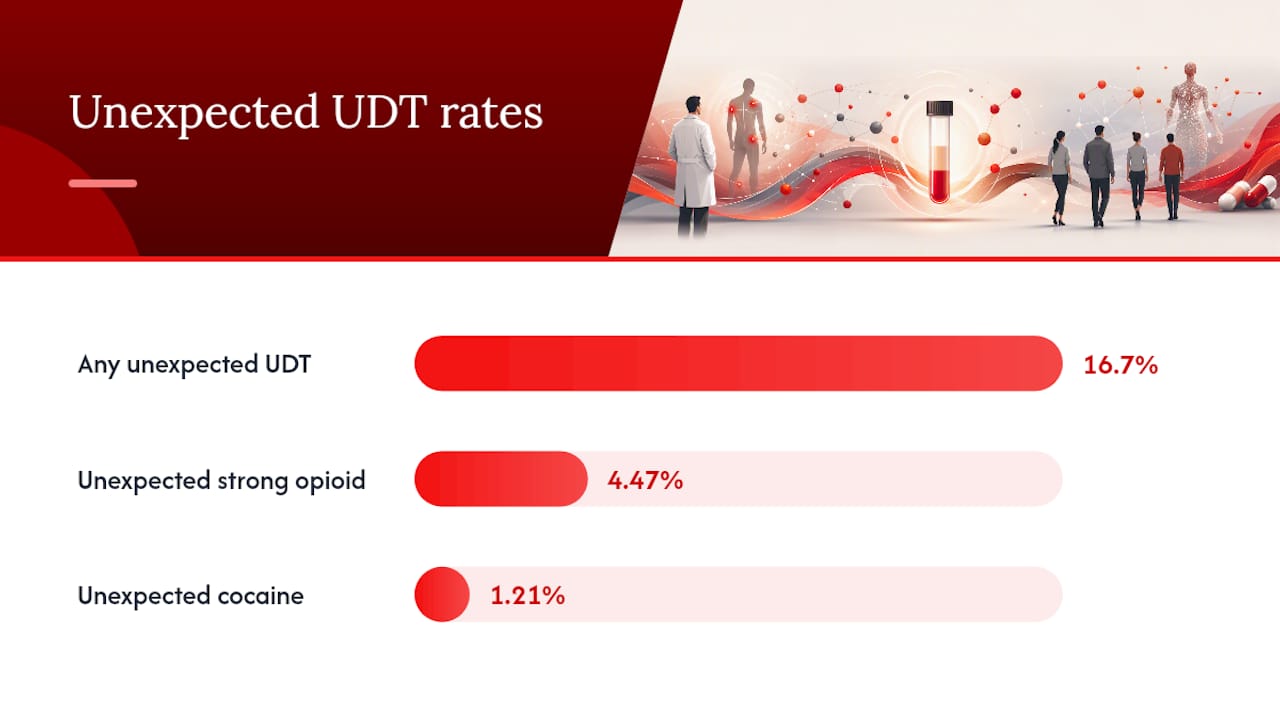
In a general pain management population, roughly 16.7% of patients returned at least one unexpected UDT result in one study, with 4.47% unexpectedly positive for a strong opioid and 1.21% unexpectedly positive for cocaine. That’s a meaningful minority, and it tells you two things at once: unexpected results are common enough that you shouldn’t panic over a single occurrence, but frequent enough that routine monitoring genuinely catches things that would otherwise go unnoticed.
Work through unexpected results systematically rather than reacting to the first explanation that comes to mind:
- Rule out analytic causes first. Immunoassays cross-react with structurally similar compounds, and cutoff concentrations vary by lab. A result near the cutoff threshold deserves a second look before it’s treated as definitive.
- Consider pharmacologic explanations. Metabolite conversion (codeine to morphine, for instance), variable metabolism rates, and the timing of the last dose relative to specimen collection can all produce results that look aberrant but aren’t.
- Check for specimen dilution. A creatinine level below the normal range suggests either excessive fluid intake or deliberate dilution, and either way, the result needs to be interpreted with that caveat attached.
- Order confirmatory quantitative testing whenever the screen result doesn’t reconcile with the prescribing history, the patient’s account, or your clinical impression. Quantitative concentration data, especially near cutoff thresholds, can distinguish active ingestion from incidental exposure in some cases, according to research comparing confirmatory methods to immunoassay accuracy.
- Weigh the consequence before you act. An unexpected negative for the prescribed opioid might mean the patient isn’t taking it as directed, or it might mean they ran out early and are borrowing from someone else’s supply. Those two scenarios call for very different next steps.
Universal baseline testing, applied to every patient rather than only those flagged as high risk, tends to catch some of these unexpected findings that a narrower, targeted approach would miss entirely. That said, the clinical utility of any single unexpected result varies widely; not every aberrant finding changes the treatment plan, and treating every deviation as a crisis burns trust with patients who have a legitimate pharmacologic explanation.
Building a Monitoring Schedule You Can Defend in the Chart
A testing schedule only holds up if it’s tied to something concrete, risk level, visit cadence, MME thresholds, rather than applied uniformly regardless of patient circumstance. Start with the baseline test at initiation, then set the follow-up interval according to the risk categories established earlier.
For most clinics, the workflow breaks down into three tiers:
- Low risk, stable patients: annual UDT, paired with an annual PDMP check and MME review
- Moderate risk: UDT at least twice yearly, timed to coincide with medication reconciliation visits
- High risk or history of aberrant results: quarterly or random UDT, with PDMP checks at every prescribing encounter
Tie the testing cadence to something that already happens on the calendar, a quarterly medication review, a dose-change visit, rather than scheduling it as a separate administrative task. That single change improves compliance more than almost any other workflow adjustment, simply because it removes an extra step from the patient’s and staff’s to-do list.
Documentation deserves as much attention as the testing itself. For every UDT ordered, the chart should reflect:
- The clinical rationale for testing at that particular interval (risk category, recent dose change, new aberrant behavior)
- How the result reconciled with the prescribing history and the PDMP report
- Any follow-up action taken, confirmatory testing ordered, dose adjustment, referral, and the reasoning behind it
That paper trail does two things simultaneously. It protects the practice if a decision is ever second-guessed, and it forces a genuine review of the result rather than a rubber-stamp glance at a pass/fail flag.
What to Do When a Result Doesn’t Match Expectations
An unexpected UDT result triggers a sequence, not a snap decision. The order matters because skipping a step, jumping straight to confrontation before confirming the specimen was even valid, is how clinics end up damaging a therapeutic relationship over a false alarm.
- Check for immediate safety concerns first. If the result suggests concurrent use of sedatives, alcohol, or other CNS depressants alongside the prescribed opioid, assess the patient for over-sedation risk before anything else. This step takes priority over documentation or discussion.
- Verify specimen integrity. Confirm the temperature was in range at collection and that creatinine and pH fall within expected bounds. An invalid specimen invalidates the result before you even get to interpretation.
- Order confirmatory testing selectively, focused on the specific substance in question rather than a blanket repeat of the full panel. Quantitative chromatography resolves most of the ambiguity a screening immunoassay leaves behind.
- Pull the PDMP report and reconcile it against your medication list. A discrepancy between what the pharmacy dispensed and what you prescribed often explains an otherwise puzzling result.
- Have the conversation directly, without leading with an accusation. Ask the patient to explain the result before you present it as a finding. There’s often a pharmacologic or logistical explanation you haven’t considered.
- Document the entire encounter, the result, the confirmatory testing ordered, the conversation, and the decision reached, in the chart at the time it happens, not retrospectively.
- Refer to addiction medicine when indicated, particularly if the pattern suggests an emerging substance use disorder rather than an isolated incident. A referral is a treatment step, not a punitive one.
Pro Tip: Keep a standard, nonjudgmental opening line ready for these conversations: “Your test came back with something we didn’t expect. Can you help me understand what might explain that?” It signals partnership instead of interrogation, and patients are far more forthcoming with an explanation when they don’t feel accused first.
Immediate discharge from care based on a single unexpected result is rarely the right call, and it can be actively harmful: patients cut off from a prescriber without a taper plan face a documented spike in overdose risk from seeking opioids elsewhere. Structured escalation, confirmatory testing, PDMP review, and a specialist referral when warranted protects the patient far more effectively than an abrupt termination.
Specimen Collection and Guarding Against Adulteration
A perfectly run confirmatory test is worthless if the specimen wasn’t valid to begin with. Collection integrity starts the moment the cup is handed to the patient, not when the sample reaches the lab.
Record three data points at every collection: specimen temperature (should read between 90 and 100 degrees Fahrenheit within four minutes of voiding), creatinine level (a level below 20 mg/dL suggests dilution), and pH (values outside the 4.5 to 8.0 range flag possible adulteration). These three checks catch most tampering attempts without requiring a send-out to a reference lab.
Common adulteration attempts and what to watch for:
- Dilution, drinking excessive water or adding water directly to the cup, shows up as low creatinine and low specific gravity
- Oxidizing agents like nitrites or pyridinium chlorochromate can be detected with dedicated adulterant test strips built into many multi-panel collection cups
- pH manipulation, adding acidic or basic substances, produces readings well outside the normal physiological range
- Substitution (bringing in someone else’s urine) is the hardest to catch on-site; an out-of-range temperature reading is often the only tell
Any specimen that fails one of these on-site checks counts as invalid, not negative, and should be documented as such rather than recorded alongside a clean result. For results that carry legal or employment implications beyond routine clinical monitoring, follow chain-of-custody procedures: sealed specimen bags, signed collection forms, and a documented handoff to the reference lab. Most in-clinic pain management monitoring doesn’t require full forensic chain-of-custody, but any case headed toward a dispute or legal proceeding does.
Where Urine Drug Testing Falls Short
No test is infallible, and pretending otherwise sets clinics up for bad decisions. Standard immunoassay screens miss synthetic and semi-synthetic opioids often enough that a “clean” result shouldn’t be read as definitive reassurance when the clinical picture suggests otherwise. Cutoff concentrations vary by lab and by substance, which means a technically negative result can still reflect recent, lower-level use.
The more consequential pitfalls tend to be behavioral rather than analytic:
- Acting on a single result without confirmatory testing or a conversation with the patient
- Applying punitive policies, automatic discharge or reporting, that discourage honest disclosure and push patients toward riskier behavior
- Overlooking privacy considerations, particularly around how UDT results are stored, shared, and discussed with third parties like insurers or employers
The strongest protection against all three is the same: documented, shared decision-making. State guidelines, including those referenced in California’s Medical Board pain management materials, consistently point back to treatment agreements signed at the start of therapy and a documented, nonpunitive response protocol for unexpected results. A clinic that can show a consistent, evidence-based process for every patient is in a far stronger position, both clinically and legally, than one relying on case-by-case improvisation.
Sourcing the Right Kits for Clinical Testing Workflows
Getting reliable UDT results starts with the kit itself. Rapidtestcup supplies CLIA-waived, FDA-approved test cups and strips built for exactly this kind of clinical monitoring, including multi-panel cups that screen for a dozen or more substances in a single pass and dedicated adulterant strips that flag dilution or pH tampering before the sample ever leaves the room.
For point-of-care visits, a multi-panel test cup with built-in adulterant checks covers most routine monitoring needs on the spot. Clinics managing higher-risk patients or larger caseloads often route confirmatory work to a reference lab and reserve on-site cups for the screening tier. Bulk ordering and custom quotes make sense for practices testing dozens of patients weekly, where per-unit cost adds up fast on individually purchased kits.
What I’ve Learned Watching This Process Play Out
The clinics that handle unexpected results well aren’t the ones with the strictest policies. They’re the ones with the best relationship with their lab. When a report flags metabolite conversion or a near-cutoff concentration and the lab actually explains it, you avoid the reflexive overreaction that damages trust with a patient who did nothing wrong.
Two things speed this up: ask your lab for interpretation notes on every confirmatory result, not just numbers, and build the PDMP check into the same five minutes as the UDT review so you’re never reading one without the other. I’ve seen a single confirmatory test, ordered because a screen flagged an “unexpected opiate,” turn out to be a codeine-to-morphine conversion the patient’s own prescriber hadn’t accounted for. No dose change was needed. Just a documented explanation.
— Justin
Where to Find CLIA-Waived Kits and Specimen Supplies
Running a defensible testing program means having the right supplies on hand before the patient walks in, not scrambling after an unexpected result forces the question. Rapidtestcup stocks CLIA-waived, FDA-approved test cups built specifically for clinical monitoring workflows like the ones described above.
If you’re setting up or refreshing a testing protocol, the guide to selecting drug test kits walks through panel selection based on the substances most relevant to your patient population. For fentanyl detection specifically, the CLIA-waived fentanyl test strip closes the blind spot standard opiate immunoassays routinely miss. Clinics testing higher volumes should look into bulk pricing and custom quotes, which bring the per-test cost down meaningfully compared to ordering kits individually each month. Reach out to Rapidtestcup for a custom quote sized to your clinic’s monthly testing volume.
This article is general information, not a substitute for advice from a qualified doctor. Consult a qualified healthcare professional about your own circumstances before acting on anything here.
Sources
- Pain management guidelines (NCBI Bookshelf, NBK572296)
- Demystifying analytical approaches for urine drug testing to evaluate medication adherence in chronic pain management (ARUP lab white paper)