
Blog
THC Cutoff 50 vs 20 ng/mL: What the Difference Means


A 50 ng/mL THC cutoff is the federal standard for urine screening. A 20 ng/mL cutoff is a more sensitive screen that flags lighter or more recent use. The same urine sample can read negative at 50 and positive at 20, so the cutoff you test at matters as much as the test itself.
This guide explains what a cutoff is, how the two levels compare, what federal workplace programs actually require, and how to choose between them for an employer, clinic or home program.
TL;DR
- A cutoff is the concentration line between “positive” and “negative.” A negative result can still contain some THC metabolite below that line.
- Federal workplace urine testing screens at 50 ng/mL and confirms at 15 ng/mL. A 20 ng/mL screen is a more sensitive, non-federal choice.
- In one Johns Hopkins single-use study, detection averaged under 1 to 2 days at 50 ng/mL and 1 to 6 days at 20 ng/mL, depending on dose.
- Lower cutoffs catch more real use but can raise the number of non-confirmed screens. Pick the level that matches your policy, then confirm positives in a lab.
Table of Contents
- What a THC cutoff actually measures
- 50 ng/mL vs 20 ng/mL side by side
- What the research says about detection time
- How long to get from 50 ng/mL down to 20 ng/mL?
- What federal workplace testing requires
- What a positive result does and does not tell you
- Perspective: how we would choose between 50 and 20
- Choosing a test at each cutoff
- A quick checklist before you set your cutoff
- FAQ
- Sources
What a THC cutoff actually measures
A urine THC test does not look for THC itself. It looks for metabolites, mainly THC-COOH, and compares the concentration to a fixed threshold. NIDA explains that a result at or above the cutoff is reported positive and a result below it is reported negative. The cutoff exists to limit false positives, but NIDA also warns that a cutoff set too high can miss small amounts and produce false negatives.
So “negative” does not mean “no THC.” The Mayo Clinic Proceedings review of urine drug tests notes that results below the cutoff are reported negative even when some drug or metabolite is present.
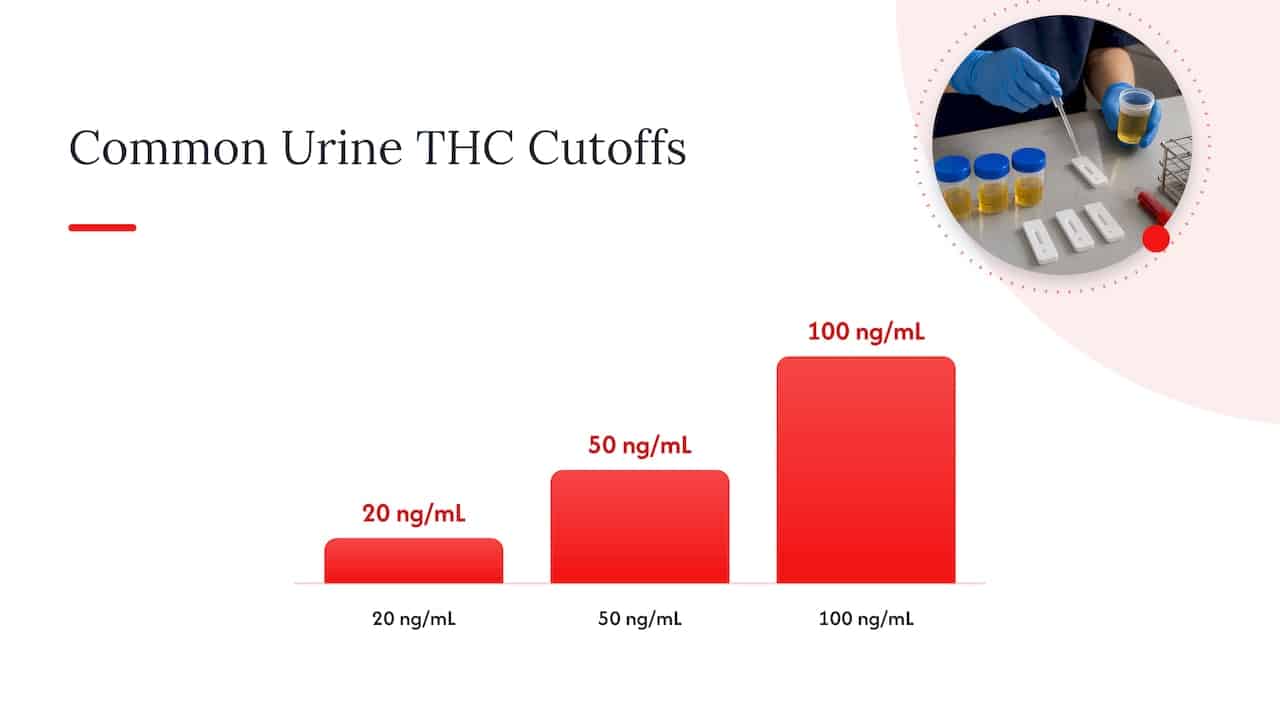
Cutoffs are expressed in nanograms per milliliter (ng/mL). Common screening levels for THC in urine are 20, 50 and 100 ng/mL, according to a University of Missouri toxicology review, which also states that lower cutoffs make testing more sensitive and extend the detection window.
For a wider look at how cutoffs work across drugs, see our explainer on drug test cutoff levels for professionals.
50 ng/mL vs 20 ng/mL side by side
| 50 ng/mL | 20 ng/mL | |
|---|---|---|
| Role | Federal workplace initial screen | More sensitive screen used by some labs and programs |
| Sensitivity | Catches more recent or heavier use | Catches lighter and older use too |
| Detection window | Shorter | Longer |
| Risk | More false negatives | More screens that fail to confirm |
| Typical fit | DOT and federally regulated testing, standard employer policy | Zero-tolerance programs, treatment and monitoring, cautious home screening |
The Mayo Clinic Proceedings review says some laboratories use a 20 ng/mL initial cutoff, below the federal 50 ng/mL, and that lower cutoffs may reduce false negatives but can increase false positives.
One point of precision: at the screening stage, a “false positive” often just means the immunoassay flagged a sample that a more specific lab method does not confirm. That is why the second step matters, covered below.
What the research says about detection time
The clearest numbers come from a Johns Hopkins study of single-use exposure that compared 20, 50 and 100 ng/mL immunoassay cutoffs. Mean detection times were:
| Exposure | At 20 ng/mL | At 50 ng/mL |
|---|---|---|
| Low dose | 1 to 5 days | Under 1 day |
| High dose | 3 to 6 days | Under 2 days |
The authors found that detection times varied substantially by assay, person, dose and cutoff, and that lower cutoffs increased both detection time and sensitivity. They also found GC-MS detection times were about twice as long as the mean times for a 50 ng/mL immunoassay, which shows that the lab method matters as well as the cutoff.
These are single-exposure figures. Frequent or heavy use stretches detection far beyond them. Our guide on THC detection time in urine and what labs use covers repeated use and the longer windows seen there, and our overview of substance detection windows puts THC next to other drugs.
How long to get from 50 ng/mL down to 20 ng/mL?
This is the question readers type most, and nobody can answer it with one number. A specimen at 50 ng/mL is, by definition, above 20, and it falls below 20 only when the metabolite concentration drops. We found no study that times that specific drop for people, so treat any promise of “X days” with suspicion.
The pieces we can support:
- Dose and frequency drive it. The research described above shows detection windows shifting with dose, duration and frequency of use, metabolism, and test sensitivity.
- Urine concentration moves the number. The ACMT position statement lists urine concentration, extent and duration of exposure, time since last exposure and individual factors among the things that affect results.
- Occasional users clear faster. In the Hopkins single-use data, the gap between the 50 and 20 ng/mL windows was a few days, not weeks.
- Heavy users can stay above both lines for a long time. Concentrations can also bounce around a cutoff from one sample to the next, so one low reading does not guarantee the next one.
If you are a person trying to predict your own test, the honest answer is that you cannot calculate it. If you manage a testing program, the takeaway is different: a 20 ng/mL screen will keep flagging people for several more days than a 50 ng/mL screen, and your policy should say whether that is what you want.
What federal workplace testing requires
For U.S. federal workplace urine testing, the initial marijuana-metabolite screen is 50 ng/mL. A specimen at or above that level goes to confirmation with a 15 ng/mL cutoff for the THC metabolite, as set out in 49 CFR 40.85. Below 15 ng/mL is negative, at or above is a confirmed positive.
The HHS Mandatory Guidelines published January 16, 2025 list the same 50 and 15 ng/mL levels, and a 2026 Federal Register notice states that the current panels and these cutoffs remain in effect.
Two details trip people up:
- Screening and confirmation use different methods. Confirmation by GC-MS or LC-MS/MS is more specific and more sensitive, which is why its cutoff is lower. Abbott Toxicology explains that screening cutoffs are set higher on purpose, to filter large volumes of specimens and reduce positives from trace contamination or passive exposure.
- A screen above 50 that confirms below 15 is negative. A peer-reviewed review of workplace cannabinoid testing explains that this outcome is reported negative by definition, not as a false negative.
Federal specimens must go to HHS-certified laboratories, and SAMHSA’s 2024 Medical Review Officer guidance distinguishes initial screening at an instrumented initial testing facility from laboratory testing and reporting. For a plain-language walk through the sequence for drivers, see this overview of CDL drug testing requirements.
Where 20 ng/mL fits
A 20 ng/mL screen is not part of the federal urine panel. Employers outside federal rules, treatment programs, probation offices and parents often choose it deliberately because they want to catch lighter use. That is a policy choice, and it should be written down so that nobody is surprised by a screen that a federal-style 50 ng/mL test would have called negative.
An old but still cited paper by Smith and colleagues from 1989 argued for a 20 ng/mL screen confirmed at 5 ng/mL, reporting 88% sensitivity and 94% specificity in that sample. That is history, not current federal practice, but it shows why the lower level keeps coming back.
What a positive result does and does not tell you
Whichever cutoff you use, a urine THC result is limited. The ACMT position statement says a positive urine THC-metabolite result indicates exposure to cannabis, but does not identify the route, source, timing, dose, intent or impairment. A positive immunoassay screen can be confirmed by chromatography.
That has practical consequences:
- Do not treat a positive urine screen as proof someone was impaired at work or behind the wheel.
- Do not act on a non-confirmed screen alone when the stakes are high, such as employment or custody. Send the sample for laboratory confirmation.
- Ask a medical review officer or the treating clinician to interpret any result with medical history in mind.
Perspective: how we would choose between 50 and 20
We sell test cups, dip cards and strips to labs, clinics, treatment centers, employers and individuals, and the cutoff question comes up constantly. Our view is simple.
If your program mirrors federal rules, or you want a result that lines up with the standard workplace screen, use 50 ng/mL and confirm presumptive positives in a lab. If your goal is early detection of any recent use, as in many treatment and monitoring settings, 20 ng/mL gives you a wider net, and you should expect more people to flag and plan confirmation capacity for it.
What we would not do is switch cutoffs midstream without telling anyone. A person who tested negative on a 50 ng/mL cup last month and positive on a 20 ng/mL cup this month has not necessarily used more. They may simply be on a more sensitive line. Document the cutoff on every result, and keep the lot and cup type in your records.
— Justin
Choosing a test at each cutoff
A rapid test is a screen. It tells you a specimen is presumptively positive or negative at its cutoff, and positives that matter should go to a lab. Within that role, the choice looks like this:
- Individuals and families who want a sensitive check can use 20 ng/mL THC test strips.
- Workplaces and clinics that screen several drugs at once usually want a multi-panel cup or dip card. Our cup vs dip card comparison explains which format suits which setting.
- Programs that need on-site collection controls should look at adulterant checks and collection supplies alongside the test itself.
We carry cups, dip cards, strips, oral swabs and collection supplies in one catalog, with bulk pricing and custom quotes for larger programs. Confirm the cutoff printed on the specific product page before you order, since THC panels are offered at different levels.
Browse the full drug test catalog to match a panel and cutoff to your program, or request a quote if you buy in volume.
A quick checklist before you set your cutoff
- Decide whether your policy is federal-style (50 then 15) or deliberately more sensitive (20).
- Write the cutoff into the policy and onto every result form.
- Choose a lab for confirming presumptive positives before you start testing.
- Check the cutoff printed on the product, not just the product name.
- Train staff to read results at the time stated in the instructions, on a level surface, and to treat faint lines according to the manufacturer’s guidance.
- Remember that a result cannot show impairment or exact timing of use.
For how metabolites are detected in the first place, our clinical guide to how drug metabolites are detected is a good next read.
FAQ
Is 20 ng/mL or 50 ng/mL better?
Neither is better in every case. 50 ng/mL is the federal workplace screening level and fits standard employment testing, while 20 ng/mL is more sensitive and suits programs that want to catch lighter or more recent use. The right one is the one your policy names.
Can a sample test negative at 50 ng/mL and positive at 20 ng/mL?
Yes. If the metabolite concentration falls between 20 and 50 ng/mL, the 50 ng/mL test reads negative and the 20 ng/mL test reads positive. That is why Johns Hopkins researchers saw longer mean detection times at the lower cutoff.
What is the federal THC cutoff for urine?
The federal initial screening cutoff is 50 ng/mL. Confirmation testing uses 15 ng/mL, under 49 CFR 40.85 and the HHS Mandatory Guidelines. A screen at or above 50 that confirms below 15 is reported negative.
How long does it take to drop below 50 ng/mL?
There is no universal time. In the Johns Hopkins single-use study, mean detection at 50 ng/mL was under 1 day after a low dose and under 2 days after a high dose, but frequent use, metabolism and urine concentration can extend that considerably.
Does a positive THC urine test mean the person was impaired?
No. A positive urine THC-metabolite result shows exposure, not impairment, timing, dose or route, according to the American College of Medical Toxicology.
Sources
- NIDA: Drug Testing
- Mayo Clinic Proceedings: Clinical Interpretation of Urine Drug Tests
- University of Missouri toxicology review, Drug Court Review
- Johns Hopkins: Detection times of marijuana metabolites in urine by immunoassay
- ACMT Position Statement: Interpretation of Urine for Cannabis
- eCFR: 49 CFR 40.85
- Federal Register: HHS Mandatory Guidelines, January 16, 2025
- Federal Register notice, March 2026
- SAMHSA Medical Review Officer Guidance Manual, 2024
- Abbott Toxicology FAQ
- Interpretation of Workplace Tests for Cannabinoids, PMC
- CDL drug testing requirements guide