

Blog
Emerging Drug Trends 2025: What Professionals Must Know


TL;DR:
- Emerging drug trends in 2025 involve a rise in ultra-potent synthetic opioids like nitazenes and cychlorphine. Seizures of methamphetamine and ketamine have reached record highs in Asia, while poly-drug mixtures like Tusi pose increasing overdose risks in South America. Digital platforms such as Telegram now facilitate global drug trafficking, requiring new investigative approaches and enhanced testing methods.
Emerging drug trends in 2025 are defined by a sharp shift toward ultra-potent synthetic opioids, record-breaking seizures of methamphetamine and ketamine across Asia, and the rapid spread of complex poly-drug mixtures in South America. The CDC confirmed that U.S. overdose deaths declined for a third consecutive year, yet seven states recorded increases, with Arizona reporting a 17% overall rise and a 30% spike in fentanyl-specific deaths. The United Nations Office on Drugs and Crime (UNODC) documented record synthetic drug seizures globally. Federal drug laboratories identified 27 new compounds throughout all of 2025, and 23 new compounds appeared in just the first five months of 2026. These numbers signal acceleration, not stabilization.
What are the most potent new synthetic opioids in 2025?
The 2025 drug supply is now dominated by two synthetic opioids that outpace fentanyl in raw potency. Nitazenes are up to 500 times more potent than heroin. Cychlorphine reaches potency up to 10 times that of fentanyl. Both substances are frequently used as cutting agents in street drugs, meaning people consume them without any knowledge of their presence.
The health consequences are severe. A dose too small to see with the naked eye can trigger fatal respiratory depression. Emergency responders report that standard naloxone doses sometimes require multiple administrations to reverse overdoses involving nitazenes. Healthcare professionals treating overdose patients must account for these compounds even when a patient reports using a “known” substance.
Detection is the central challenge. Standard immunoassay panels do not detect nitazenes, which means routine urine drug screens miss them entirely. Labs relying on legacy panels are effectively blind to a growing share of the illicit supply. Broader-spectrum testing, including panels that cover novel synthetic opioids, is no longer optional for clinical or forensic settings. A full overview of ultra-potent synthetic opioids and their clinical implications is available for healthcare teams updating their protocols.
Key risks associated with nitazenes and cychlorphine:
- Covert use as cutting agents in heroin, counterfeit pills, and stimulants
- Undetectable by most standard immunoassay drug tests
- Require higher or repeated naloxone doses for overdose reversal
- Rapid onset increases the window for fatal outcomes before help arrives
- No established tolerance threshold data for clinical reference
Pro Tip: If your facility uses a standard 10 or 12-panel urine test, request a supplemental confirmatory screen for novel synthetic opioids on any overdose case where the initial panel returns negative.
How have synthetic drug seizures evolved across Asia and South America?
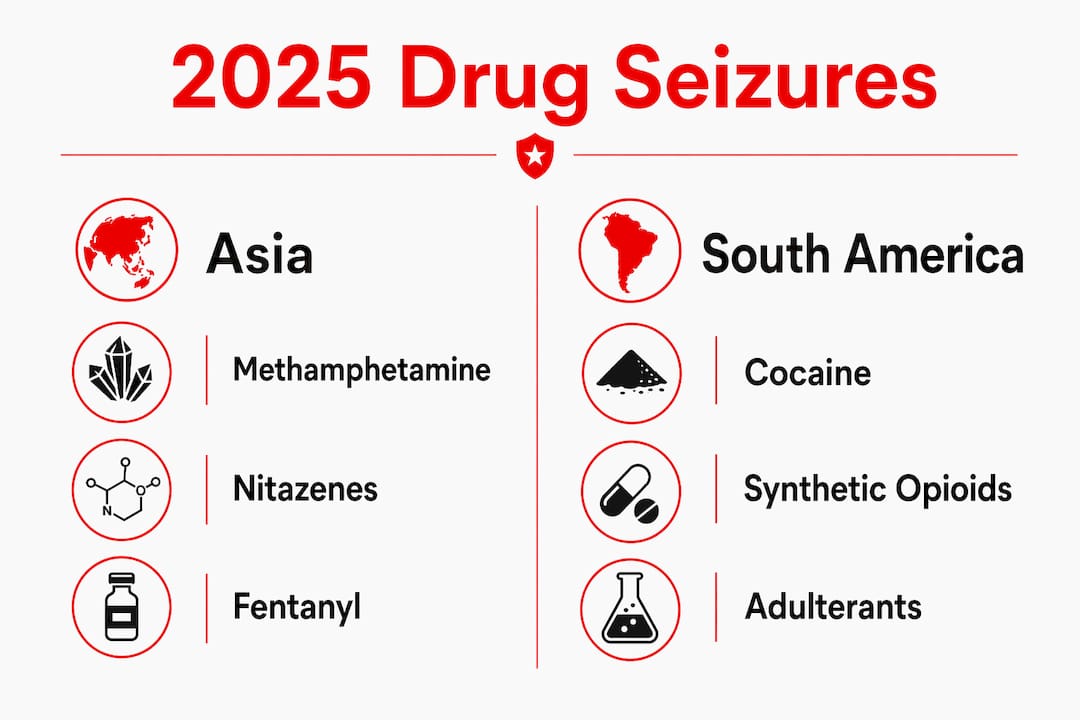
Asia produced the most dramatic drug seizure numbers of 2025. Methamphetamine seizures in East and Southeast Asia reached a record 349 tons, a 48% increase over 2024. Ketamine seizures surged 185% to 52.5 tons, with Malaysia and Myanmar accounting for nearly 60% of those totals. These figures confirm that production capacity in the region has not been disrupted despite enforcement pressure.
Myanmar remains the geographic anchor of Southeast Asian drug production. Ongoing political instability has created ungoverned zones where manufacturing operates without interference. Maritime routes carry the bulk of finished product to transit countries and onward to consumer markets across Asia, Australia, and beyond. The UNODC notes that drug trafficking networks in the region are consolidating with other illicit economies, including online fraud operations, creating layered criminal enterprises that are harder to disrupt.
| Region | Substance | 2025 Seizure Volume | Change vs. 2024 |
|---|---|---|---|
| East & Southeast Asia | Methamphetamine | 349 tons | +48% |
| East & Southeast Asia | Ketamine | 52.5 tons | +185% |
| South America | Tusi (poly-drug mix) | Not centrally reported | Rapidly expanding |
South America presents a different but equally serious picture. Tusi, commonly called “pink cocaine,” is not cocaine at all. It typically contains ketamine, MDMA, and an unpredictable mix of contaminants. The composition of Tusi varies by batch and by region, making overdose risk extremely difficult to predict. Youth and nightclub populations are the primary affected groups. Naloxone access in many South American communities remains limited, which compounds the public health risk when opioid adulterants appear in a batch.
Critical factors driving Tusi-related harm:
- No standardized composition across batches or countries
- Opioid adulterants may appear without warning in any given supply
- Limited harm reduction infrastructure in affected communities
- Conventional single-substance tests miss most of its components
- High social acceptability in nightlife settings reduces perceived risk
What role do encrypted platforms play in drug trafficking in 2025?
Drug trafficking has moved decisively from physical markets to digital ones. Telegram has become the primary platform for advertising and coordinating illicit drug transactions globally. Dealers post product listings, prices, and delivery options openly in channels that reach thousands of subscribers. The platform’s encryption and pseudonymous accounts make traditional surveillance methods largely ineffective.
Law enforcement faces a structural problem. Decentralized networks operating through encrypted apps do not have a single point of failure. Taking down one channel produces dozens of replacements within hours. The India Narcotics Control Bureau’s 2025 annual report specifically identified Telegram-based networks as a top operational challenge, noting that the Myanmar trafficking route feeds directly into these digital distribution systems.
Effective responses require a shift in investigative approach:
- Digital forensic capability — Agencies must train investigators to analyze metadata, payment trails, and account linkages across encrypted platforms.
- Intelligence-led operations — Reactive seizures alone do not disrupt digital networks. Proactive intelligence gathering on platform activity is necessary.
- Cross-border coordination — Telegram channels operate across jurisdictions. Bilateral and multilateral data-sharing agreements are the only way to build cases against network operators.
- Financial investigation — Cryptocurrency payments fund most Telegram-based transactions. Following the money remains the most reliable path to identifying key actors.
Pro Tip: Law enforcement units without dedicated cyber-narcotics investigators should partner with national cybercrime units. The technical skills required to work encrypted platform cases are distinct from traditional drug enforcement expertise.
How are overdose trends and drug policies shaping the 2025 drug landscape?
The national overdose picture in 2025 is cautiously positive but structurally fragile. U.S. overdose deaths fell for a third consecutive year, a meaningful achievement given the potency of the current drug supply. The decline reflects expanded naloxone distribution, fentanyl test strip programs, and increased access to medication-assisted treatment in many states. However, the progress is uneven.
“Seven states recorded overdose increases in 2025, with Arizona reporting a 17% overall rise and a 30% spike in fentanyl-specific deaths. The national decline masks significant regional divergence that demands localized policy responses.”
Federal policy shifts now threaten the infrastructure behind the decline. Harm reduction funding for drug testing kits and fentanyl test strip programs has been reduced under the current administration’s priorities. Public health officials warn that removing these tools while the drug supply grows more potent is a direct contradiction. The gains made since 2022 rest on a foundation of community-level interventions, and cutting that foundation mid-crisis carries real risk.
Key policy and trend factors for 2025:
- National overdose decline is real but concentrated in states with strong harm reduction infrastructure
- Seven states saw increases, confirming that geography and local policy determine outcomes
- Reduced federal funding for test strips and harm reduction programs creates gaps in the safety net
- More potent synthetic opioids mean the margin for error in any given overdose event is smaller
- Healthcare systems in high-burden states face rising demand without proportional resource increases
Understanding why synthetic drug testing matters for public health outcomes helps frame the policy stakes clearly.
What innovations exist for drug testing to address emerging threats?
The core problem with current drug testing is that the technology has not kept pace with the supply. Standard immunoassay panels were designed around the drug landscape of the 2000s and 2010s. Nitazenes, cychlorphine, and Tusi’s variable adulterants fall outside the detection range of most legacy panels. Labs and clinicians using those panels are generating false negatives on a regular basis without knowing it.
Broader-spectrum multi-panel tests represent the most practical near-term solution. Panels that include kratom (KRA), fentanyl (FEN), ketamine (KET), and adulterant detection cover a wider share of the current threat profile. AI-enhanced oral fluid testing is also advancing, with improved sensitivity for novel compounds and faster turnaround in field settings. These technologies do not replace confirmatory lab analysis but significantly improve the first-pass detection rate.
| Testing approach | Strengths | Limitations |
|---|---|---|
| Standard immunoassay (10–12 panel) | Fast, low cost, widely available | Misses nitazenes, cychlorphine, and most poly-drug adulterants |
| Broad-spectrum multi-panel cup | Covers fentanyl, ketamine, kratom, and adulterants | Higher per-unit cost; still may miss newest compounds |
| AI-enhanced oral fluid testing | High sensitivity, non-invasive, field-deployable | Requires device investment; not yet universal |
| Confirmatory GC-MS/LC-MS lab analysis | Definitive identification of any compound | Slow turnaround; not practical for point-of-care use |
The unpredictable composition of poly-drug mixtures like Tusi means no single test will catch everything. The practical standard is layered testing: a broad-spectrum panel at point of care, followed by confirmatory mass spectrometry on any case with clinical suspicion. Labs should also review their panels against the UNODC’s annual new psychoactive substances (NPS) list and update accordingly. Staying current with key drug testing trends helps labs and clinicians make informed decisions about panel selection.
Pro Tip: When procuring multi-panel cups, prioritize kits that include adulterant detection alongside substance panels. Adulteration of urine samples is rising alongside the sophistication of the drug supply itself.
Key Takeaways
The most urgent response to 2025 drug trends is upgrading detection capability, because standard immunoassay panels now miss a growing share of the illicit supply, including nitazenes and poly-drug adulterants.
| Point | Details |
|---|---|
| Nitazenes demand broader panels | Standard 10–12 panel tests do not detect nitazenes; upgrade to broad-spectrum panels immediately. |
| Asia seizure records signal supply growth | A 48% meth increase and 185% ketamine surge confirm production is outpacing enforcement. |
| Tusi composition is unpredictable | Pink cocaine contains variable adulterants; single-substance tests routinely miss hazardous components. |
| Digital trafficking requires digital response | Telegram-based networks need cyber-forensic investigation, not just traditional drug enforcement. |
| Policy cuts threaten overdose progress | Reduced harm reduction funding risks reversing a three-year national decline in overdose deaths. |
The hardest part of 2025 is what we still can’t see
What strikes me most about the 2025 drug trend picture is not what we know. It’s the speed at which what we know becomes outdated. Twenty-three new compounds identified in five months of 2026 tells you that the chemistry is moving faster than any regulatory or testing framework can follow. That is not a solvable problem with a single policy fix.
The professionals I respect most in this space share one habit: they treat their testing protocols as living documents, not fixed procedures. They review panel coverage quarterly. They cross-reference UNODC and CDC updates. They ask their lab partners directly whether their current panels would catch a nitazene. Most get a sobering answer.
The policy dimension worries me more than the chemistry. Cutting harm reduction funding while the drug supply grows more lethal is a decision that will show up in overdose statistics within 12–18 months. The three-year decline in U.S. overdose deaths was hard-won and fragile. It was built on naloxone access, test strips, and community outreach. Removing those tools does not make the drugs less dangerous. It makes the people using them more exposed.
The integrated approach works: surveillance, testing innovation, digital intelligence, and community harm reduction operating together. Pulling any one of those threads weakens the whole structure. For healthcare professionals and law enforcement, the practical answer is to stay current, push for broader panels, and advocate loudly for the funding that keeps harm reduction programs running.
— Justin
Rapidtestcup’s testing solutions for the 2025 drug supply
The 2025 drug supply demands testing tools that match its complexity. Rapidtestcup offers a full catalog of multi-panel drug test cups, adulterant detection kits, and specimen collection supplies built for labs, clinics, substance abuse programs, and law enforcement.
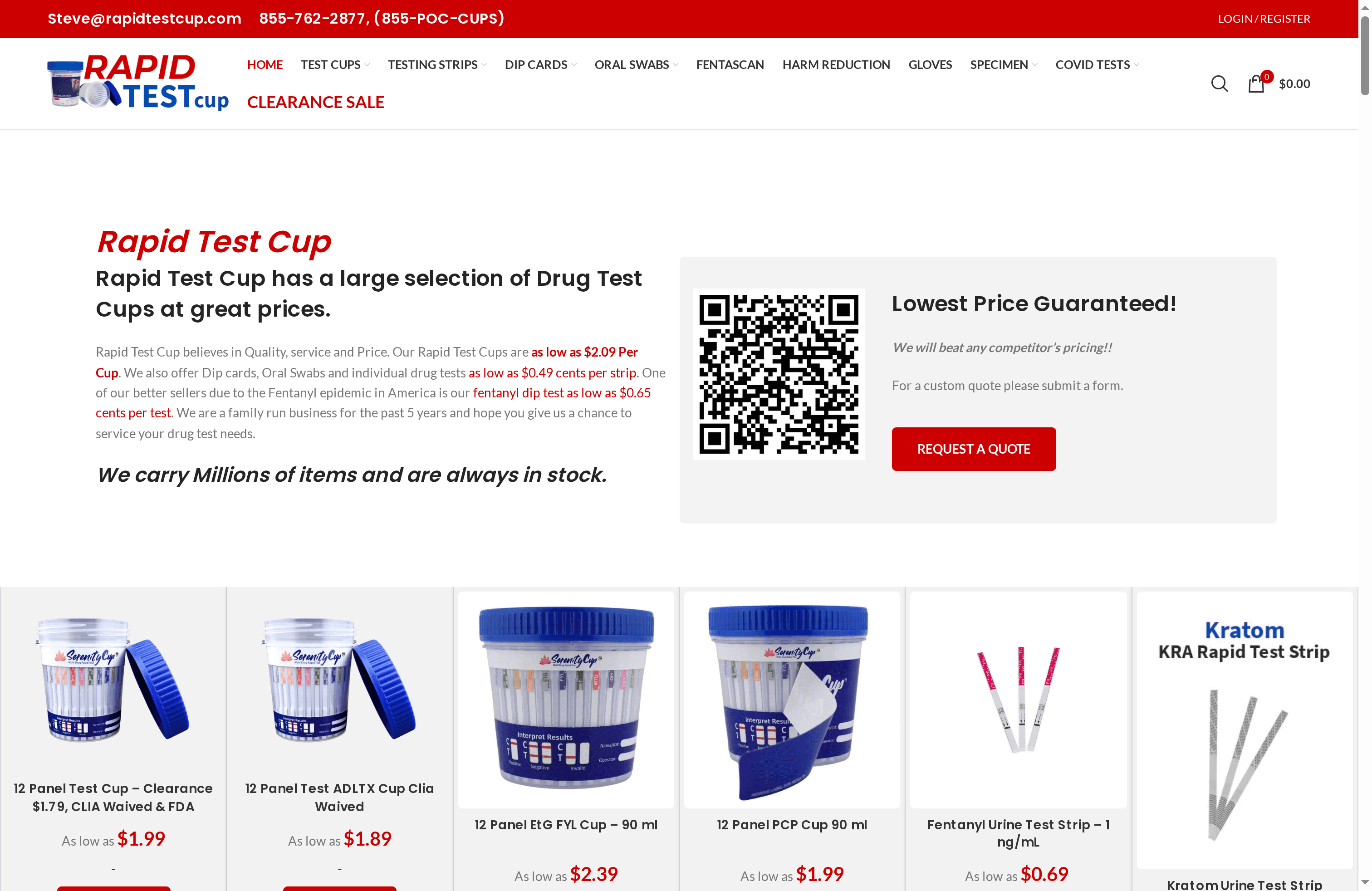
For professionals dealing with synthetic opioids, ketamine, and poly-drug adulterants, the 22-panel test with adulterants covers Zaza, fentanyl, kratom, xylazine, and a wide range of adulterants in a single cup. Labs updating their full testing lineup can review the top drug testing products for labs to find CLIA waived, FDA-cleared options that address the current threat profile. Rapidtestcup ships fast, offers bulk pricing, and provides custom quote options for high-volume programs.
FAQ
What are nitazenes and why are they dangerous?
Nitazenes are synthetic opioids up to 500 times more potent than heroin. They are frequently used as undetectable cutting agents in street drugs and are not identified by standard immunoassay panels.
Why did overdose deaths still rise in some states in 2025?
Seven states, including Arizona, recorded overdose increases despite a national decline. Arizona saw a 17% overall rise and a 30% increase in fentanyl-specific deaths, reflecting uneven harm reduction infrastructure and a more potent local drug supply.
What is Tusi and how does it affect drug testing?
Tusi, called “pink cocaine,” typically contains ketamine, MDMA, and variable contaminants. Its unpredictable composition means conventional single-substance tests routinely miss its most dangerous components.
How is Telegram changing drug enforcement?
Telegram is now the primary platform for advertising and coordinating illicit drug sales globally. Its encryption and decentralized structure make traditional surveillance insufficient, requiring digital forensic and intelligence-led approaches.
What drug test panels best address 2025 threats?
Broad-spectrum multi-panel cups that include fentanyl, ketamine, kratom, and adulterant detection cover the widest share of the current illicit supply. Confirmatory mass spectrometry remains the standard for definitive identification of novel compounds.