Blog
Timing for Workplace Drug Tests: HR Guide 2026


TL;DR:
- Effective workplace drug testing depends on precise timing tailored to test type, substance detection windows, and regulatory demands. Employers must implement clear policies, pre-arranged collection sites, and well-trained supervisors to ensure timely testing within strict legal and procedural windows. Proper scheduling and documentation safeguard legal compliance, maintain deterrence, and uphold the integrity of drug screening programs.
Timing for workplace drug tests refers to the specific windows and frequencies employers use to conduct drug screenings, directly determining whether results are accurate, legally defensible, and compliant with federal or state regulations. Get the timing wrong on a post-accident test and you lose the evidentiary value entirely. Nail the scheduling on random tests and you create a genuine deterrent. This guide covers every major testing scenario, from pre-employment drug test timing to return-to-duty protocols, so HR professionals can build a program that holds up under audit and in court.
What are the timing windows for different types of workplace drug tests?
The timing window for each drug test type is not interchangeable. Each scenario carries its own standard, and deviating from it creates legal exposure or renders results meaningless.
Pre-employment testing follows the most flexible timeline. Most employers require candidates to complete testing within 24 to 72 hours of receiving a conditional job offer. Extending that window beyond 72 hours increases the chance that recent substance use clears the detection threshold before the specimen is collected, which defeats the purpose of the screen entirely.
Random and reasonable suspicion testing demand speed. Post-accident and reasonable suspicion tests should ideally occur within 2 hours of the incident or observation. Most compliance advisors treat a 2 to 4 hour collection window as the outer boundary. Beyond 4 hours, alcohol dissipates and short-window drugs like cocaine metabolites begin to clear, making results unreliable as evidence of impairment at the time of the incident.
Post-accident testing carries the strictest urgency. Under DOT rules, breath alcohol testing must begin within 2 hours of an accident, and urine collection must begin within 8 hours. If collection cannot happen within those windows, supervisors must document why and stop attempting the test. Failing to document the delay is treated as a procedural violation, not an excuse.
Follow-up and return-to-duty testing operates on a longer timeline but with no less precision. Follow-up testing requires a minimum of six unannounced tests in the first 12 months after an employee returns to duty. Delayed appearance for any of those tests can produce false negatives because short detection windows close quickly. Prompt, unannounced scheduling is the only way to preserve the integrity of this phase.
Pro Tip: Pre-identify at least two collection facilities near each worksite before you need them. Scrambling to find a lab during a post-accident situation is one of the most common reasons employers miss the 2-hour window.
How do detection windows and test types affect timing decisions?
Detection windows are the single most misunderstood variable in drug test timing guidelines. Employers often assume a positive result means recent use. It does not always. And a negative result does not always mean the employee is clean. The window depends on the substance, the specimen type, and the individual.
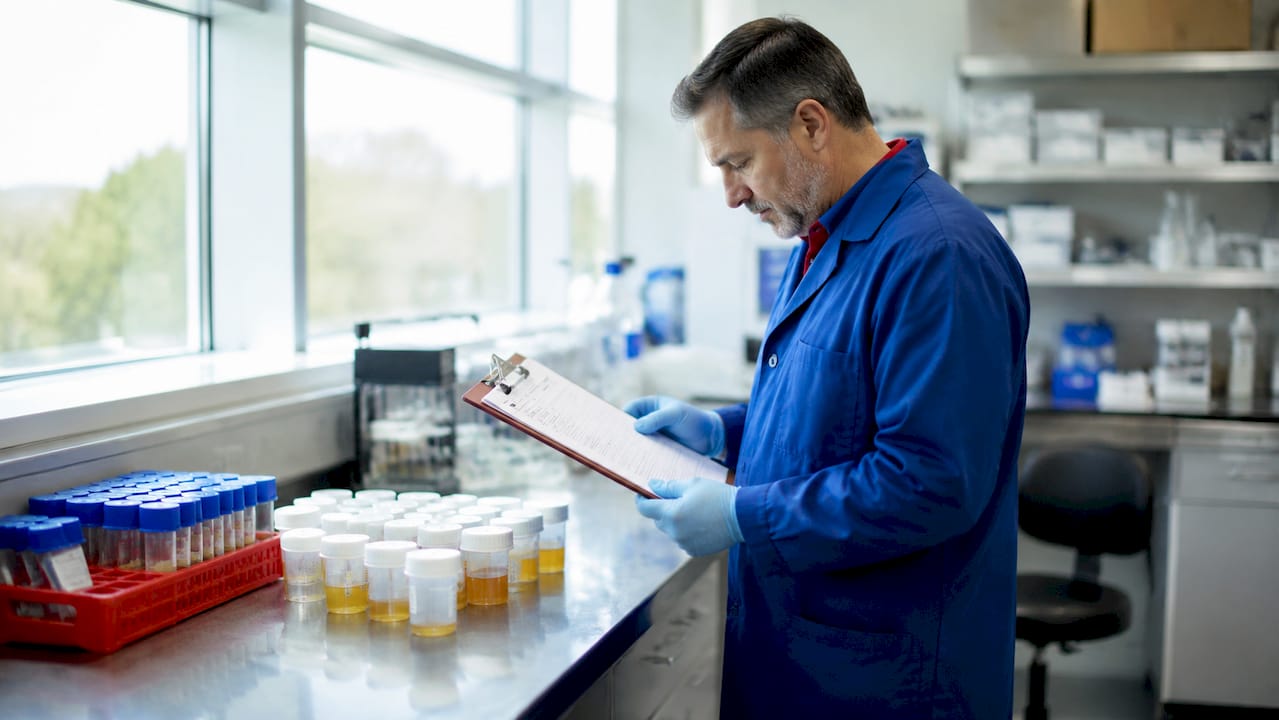
Detection windows vary by substance and specimen type; in urine tests, most drugs are detectable for 2 to 30 days. Hair tests extend that range to up to 90 days. The table below shows how specimen type and substance interact to shape timing strategy.
| Specimen type | Detection window | Best use case |
|---|---|---|
| Urine | 2 to 30 days depending on substance | Pre-employment, random, post-accident |
| Oral fluid | 24 to 48 hours for most substances | Reasonable suspicion, post-accident |
| Hair | Up to 90 days | Pre-employment, return-to-duty history |
| Breath alcohol | Minutes to hours | Post-accident, reasonable suspicion |
Oral fluid testing has gained traction for reasonable suspicion and post-accident scenarios precisely because its short detection window reflects very recent use. A positive oral fluid result is harder to dispute as residual exposure from days prior. Urine remains the standard for most workplace programs because it is cost-effective and widely accepted, but its longer window means a positive result does not pinpoint when use occurred.
Detection windows are probabilistic and vary by individual metabolism, hydration, body composition, and frequency of use. A daily cannabis user may test positive on urine for 30 days after last use. An occasional user may clear in 3 days. This variability is why the timing of collection matters so much. The closer the collection is to the triggering event, the more defensible the result.
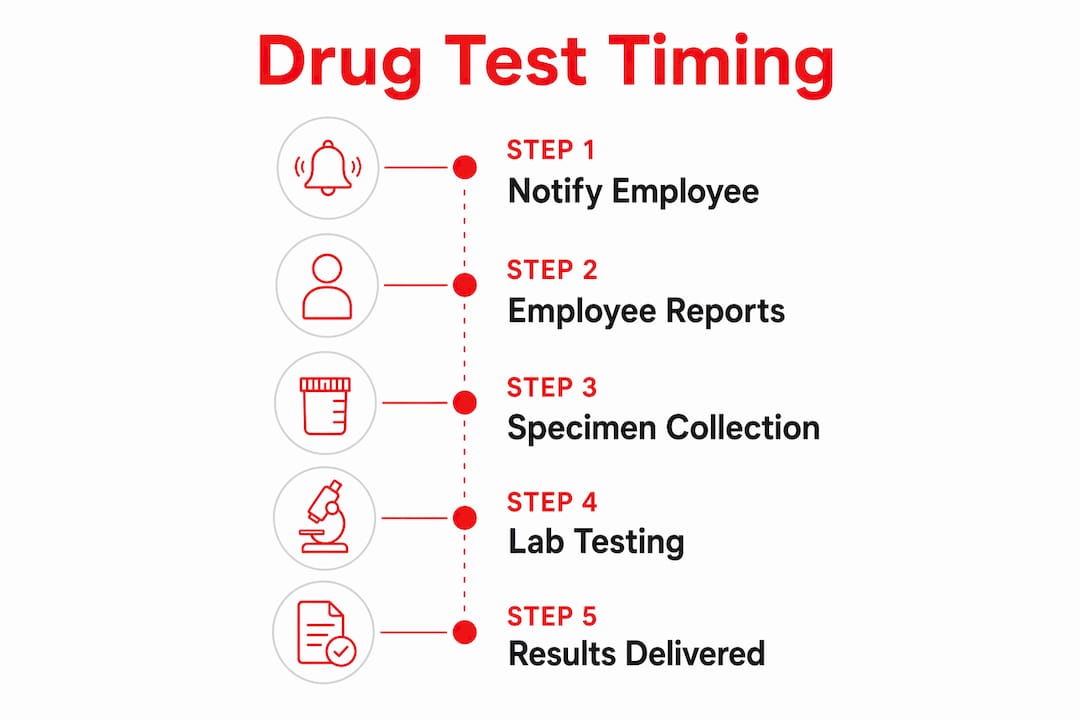
Negative results are typically available within 24 to 48 hours. Positive results needing confirmation may take 3 to 5 business days due to MRO review. HR professionals need to build this turnaround time into their hiring and return-to-duty timelines, not treat it as a surprise.
What regulatory and compliance timing requirements must employers follow?
Federal regulations set the floor for timing, not the ceiling. Employers who assume silence in the regulations means flexibility are taking on significant legal risk.
The DOT framework is the most prescriptive. DOT-regulated employers must meet minimum annual random testing rates of 50% for drugs and 10% for alcohol, applied to the average pool size across the year. Non-regulated employers commonly use 25% as a benchmark. These rates are not optional targets. Missing them during an audit triggers compliance findings that can affect operating authority.
Beyond rates, the timing of individual tests within a random program must follow a specific sequence:
- Selection must occur through a scientifically valid random process, such as a random number generator applied to the employee pool.
- Notification must be immediate. The employee is told to report for testing with no advance warning.
- Collection must occur within 2 to 4 hours of notification. Employers should explicitly require that tests be collected within this window to avoid legal ambiguity, since regulations are often silent on the exact timeframe.
- Refusal to test within the required window is treated as a positive result under DOT rules and most well-written private policies.
- Documentation of the notification time, collection time, and any delays must be retained for the minimum required period, typically 5 years under DOT.
Pro Tip: Your written policy should state the exact notification-to-collection window, such as “employee must report to the collection site within 2 hours of notification.” Vague language like “promptly” has been successfully challenged in arbitration.
The legal risk of predictable scheduling is underappreciated. Fixed interval testing can be flagged as discriminatory during audits and reduces deterrent effect. If employees know tests happen every Monday morning or at the start of each quarter, the program loses its core function. Courts and arbitrators have also found that predictable schedules can constitute constructive notice, weakening the employer’s position in termination disputes.
For a deeper look at building a compliant program from the ground up, the HR guide to drug testing from Rapidtestcup covers regulatory frameworks across industries.
How can employers design an effective workplace drug testing schedule?
A well-designed workplace drug testing schedule balances deterrence, compliance, and operational reality. The goal is a program that catches genuine impairment, survives legal scrutiny, and does not grind HR operations to a halt.
Frequency should balance industry risk and administrative impact. Testing too infrequently increases safety risk. Testing too frequently strains resources and damages employee relations, particularly in industries where labor markets are tight. Safety-sensitive industries like transportation, construction, and healthcare typically run higher rates. Office-based employers often run lower rates with more emphasis on reasonable suspicion protocols.
Practical scheduling principles that hold up under audit:
- Spread tests across all shifts and days of the week. True random selection requires distributing tests through the year on all shifts. Night shift employees who are never selected will notice, and so will auditors.
- Use a third-party administrator (TPA) for random selection. TPAs remove the appearance of favoritism and provide documentation that the selection process was genuinely random.
- Pre-identify collection facilities for every shift and location. Most collection facilities operate 8 AM to 5 PM on weekdays. Rural or remote worksites may require advance coordination with mobile collectors or extended-hours labs.
- Set clear arrival expectations in writing. Employees should know exactly where to report, how long they have to get there, and what happens if they do not appear.
- Train supervisors on immediate referral. Reasonable suspicion tests fail most often because supervisors delay the referral while they gather more evidence or consult HR. The observation and referral should happen within the same shift.
Pro Tip: Use a scheduling platform that generates random selections and timestamps notifications automatically. Manual selection processes are difficult to defend as truly random and create documentation gaps that surface during DOT audits.
For practical guidance on building the scheduling infrastructure, Rapidtestcup’s random drug testing HR guide covers notification systems, TPA coordination, and collection site logistics.
Key takeaways
Effective timing for workplace drug tests requires matching collection windows to the test type, regulatory framework, and detection science, with written policies that close every gap regulators leave open.
| Point | Details |
|---|---|
| Post-accident window is critical | Collect specimens within 2 hours of an incident to preserve evidentiary value. |
| Detection windows vary by specimen | Oral fluid reflects recent use; urine covers 2 to 30 days; hair extends to 90 days. |
| DOT sets minimum random rates | Drug testing at 50% and alcohol at 10% of the pool annually are non-negotiable floors. |
| Written policies close timing gaps | Specify the exact notification-to-collection window to prevent legal ambiguity. |
| Random means truly random | Spread selections across all shifts and days to maintain deterrence and pass audits. |
What most HR teams get wrong about drug test timing
I have reviewed a lot of workplace drug testing policies over the years, and the most common failure is not ignorance of the regulations. It is the assumption that silence in the regulations means flexibility. DOT rules say post-accident breath alcohol testing should begin within 2 hours. They do not say what happens if you wait 3 hours. HR teams read that silence as permission. Auditors and plaintiff attorneys read it as an undocumented deviation.
The second failure is supervisor training, or the lack of it. Reasonable suspicion testing has the tightest timing requirements and the most human variables. A supervisor who observes impairment at 2 PM but waits until 4 PM to make the referral because they are uncomfortable with the confrontation has likely let the detection window close for alcohol entirely. The observation, documentation, and referral need to happen in sequence, within the same shift, every time.
The third thing I would push back on is the instinct to centralize all testing at one facility to simplify logistics. That works fine for pre-employment screens. It fails badly for post-accident and reasonable suspicion tests, where a 45-minute drive to the collection site can be the difference between a defensible result and a dismissed case. Pre-planning for timely test collection at multiple locations is not administrative overhead. It is the foundation of a program that actually works when it matters most.
— Justin
Get the right tools for time-sensitive workplace testing
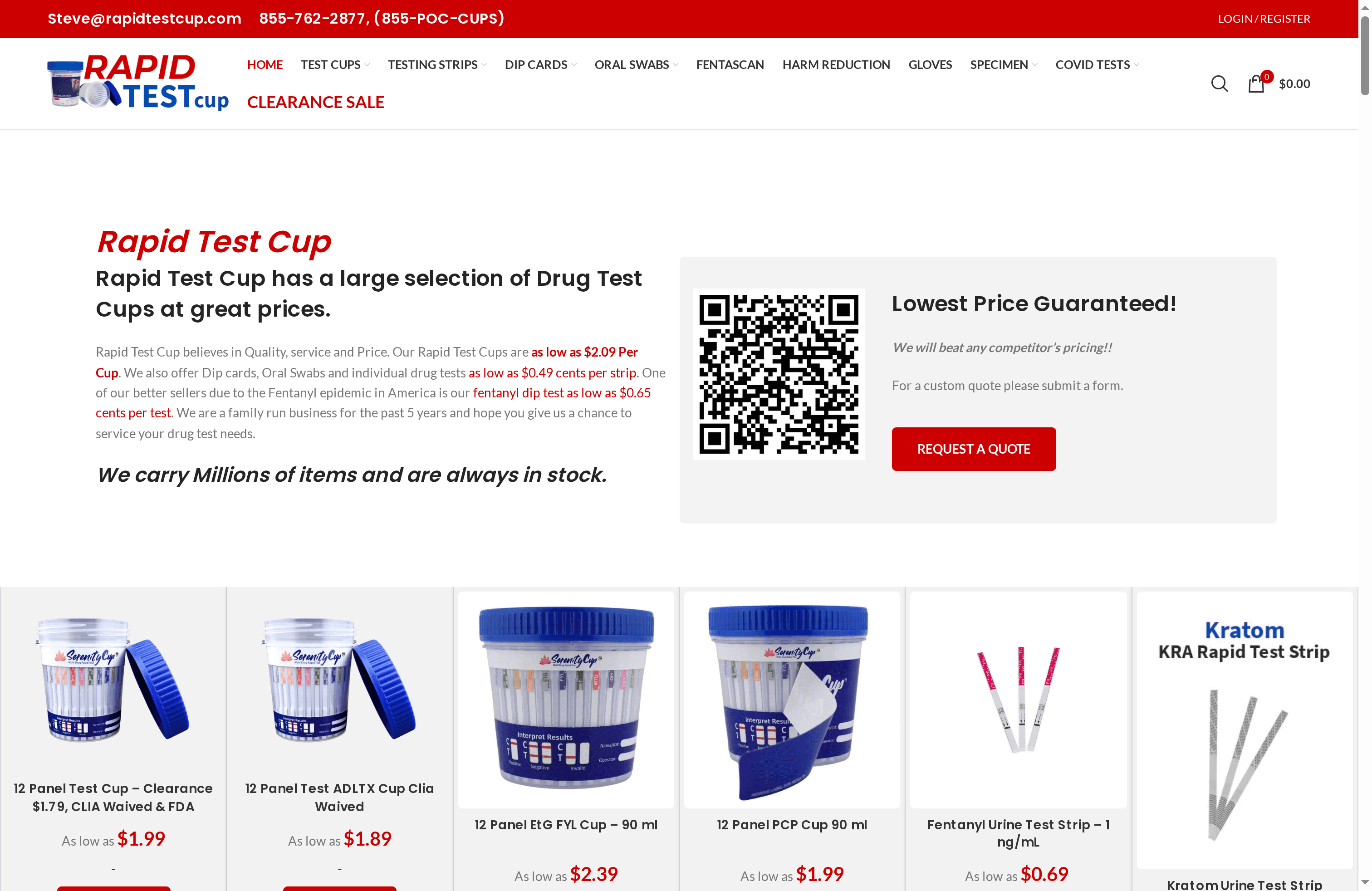
When timing is everything, the quality and speed of your testing supplies cannot be an afterthought. Rapidtestcup carries CLIA waived, FDA-approved drug testing products built for workplace programs that need fast, reliable results. The 12 Panel ADLTX Cup delivers broad-spectrum urine screening in a single collection, covering the most common substances in one step. For programs that need to screen for methamphetamine quickly, the MET Drug Test Strip provides accurate results at the collection point. Browse the full selection of top workplace testing products to find the right fit for your testing volume and panel requirements.
FAQ
What is the timing window for a post-accident drug test?
Post-accident drug tests should be collected within 2 hours of the incident for alcohol and within 8 hours for urine under DOT rules. Missing these windows requires documented justification and may invalidate the result for compliance purposes.
How soon must an employee report after random drug test notification?
Most compliance standards and well-written policies require the employee to report to the collection site within 2 to 4 hours of notification. Employers should specify this window explicitly in their written policy, since regulations often do not state an exact timeframe.
How long do drugs stay detectable in a urine test?
Most drugs are detectable in urine for 2 to 30 days, depending on the substance and the individual’s metabolism. Cannabis can remain detectable for up to 30 days in frequent users, while cocaine metabolites typically clear within 3 to 5 days.
How often are random drug tests required under DOT rules?
DOT requires random drug testing at a minimum rate of 50% of the covered employee pool for drugs and 10% for alcohol annually. These rates apply across the calendar year and are subject to adjustment by the relevant DOT agency.
How many follow-up tests are required after return to duty?
Return-to-duty employees must complete a minimum of six unannounced follow-up tests in the first 12 months after returning to safety-sensitive work. Delays in scheduling these tests risk false negatives due to short detection windows closing before collection occurs.