Blog
Workplace drug testing compliance guide: Stay legally secure


TL;DR:
- Failing to update drug testing policies after legal changes cost one HR manager’s company $340,000 in wrongful termination lawsuits. Ensuring policies reflect current federal, state, and safety-sensitive requirements, along with proper documentation and verification, is essential to legal compliance. Regular policy review, staff training, and use of certified testing supplies help organizations maintain a compliant and defensible workplace drug testing program.
One HR manager’s failure to update a drug testing policy after a state cannabis law changed cost her company $340,000 in wrongful termination litigation. The policy was sound when written, but the law had moved and the policy hadn’t. That gap, just a few paragraphs out of step with current state statute, was all it took. This guide walks you through exactly how to avoid that outcome: understanding your legal obligations, building a policy that holds up, running tests that generate clean documentation, and verifying your program stays current as the legal landscape shifts.
Table of Contents
- Know the laws: Federal, state, and safety-sensitive roles
- Set compliant policies: Preparation for testing
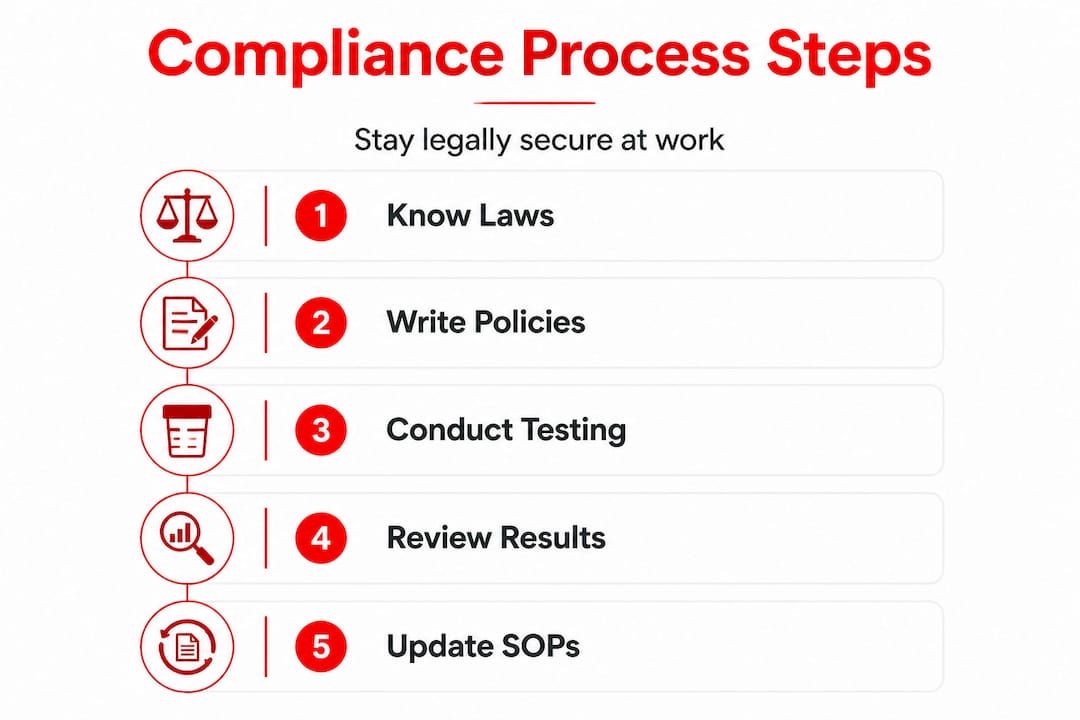
- Step-by-step: Conducting compliant workplace drug testing
- Verify compliance and handle test results properly
- Expert perspective: Why a “set and forget” approach fails in 2026
- Ensure your workplace drug testing program is backed by compliance-ready tools
- Frequently asked questions
Key Takeaways
| Point | Details |
|---|---|
| Know federal, state, and DOT rules | Understand all applicable regulations to avoid costly violations in workplace drug testing programs. |
| Create robust, clear policies | Your drug testing policy must be comprehensive, up-to-date, and reflect both federal and state-specific requirements. |
| Follow stepwise, well-documented testing procedures | Consistent process and chain-of-custody documentation are key to defensible compliance. |
| Use MRO review for all positive tests | MRO review protects against wrongful disciplinary actions and supports fair workplace practices. |
| Review, verify, and update regularly | Annual reviews and ongoing audits ensure your program remains compliant with the evolving legal landscape. |
Know the laws: Federal, state, and safety-sensitive roles
Compliance starts with knowing which rules apply to your organization, because the answer is rarely simple. The legal drug testing requirements facing most employers today come from at least three directions at once: federal statutes, agency-specific mandates, and a growing set of state laws that don’t always point in the same direction.
At the federal level, the Drug-Free Workplace Program under Executive Order 12564 and Public Law 100-71 requires federal agencies to implement drug testing for certain positions, using HHS-certified labs and following Mandatory Guidelines for urine and oral fluid testing. If your organization holds a federal contract or grant above $100,000, you’re subject to these rules whether you know it or not.
For transportation employers, the stakes are higher and the rules more specific. DOT employers must conduct pre-employment, random, reasonable suspicion, post-accident, return-to-duty, and follow-up drug tests using urine or oral fluid specimens at HHS-certified labs, with MRO review and SAP referral for violations. No shortcuts, no substitutes.
Then there’s cannabis, which is where most employers get tripped up. State cannabis laws restrict pre-employment THC testing in California, New York, Washington, New Jersey, and Nevada through off-duty use protections, though DOT and safety-sensitive roles remain exempt and federal law preempts where applicable. What’s legal in one state can create liability in another, and the list of states expanding these protections keeps growing.
Here’s a consolidated view to orient your compliance planning:
| Requirement type | Who must comply | Substances tested | Key standard |
|---|---|---|---|
| Federal DFWP | Federal contractors, grantees | Marijuana, cocaine, opioids, amphetamines, PCP | HHS-certified labs only |
| DOT (FMCSA, FAA, FRA, etc.) | Safety-sensitive transportation roles | Same five federally mandated | ODAPC rules, MRO required |
| State law | All employers (varies by state) | Varies; cannabis restrictions common | Differs by state; some ban pre-employment THC |
| Private employer (non-regulated) | Voluntary, no federal mandate | Employer’s choice | Must follow applicable state rules |
Key traps to watch for include testing for substances not authorized under your applicable state law, using non-certified labs for federally regulated positions, and failing to apply state cannabis protections to eligible workers while exempting safety-sensitive roles. These aren’t edge cases. They’re among the most common sources of legal exposure HR teams face, according to drug testing expert insights on workplace compliance trends.
A critical stat worth knowing: MRO review data shows that a significant share of positive results on opioids, amphetamines, and other drug classes are eventually verified as legitimate prescription use. Skipping MRO review isn’t just a procedural shortcut; it’s a fast route to wrongful disciplinary action.
Set compliant policies: Preparation for testing
Once you’ve mapped your legal obligations, the next step is translating those obligations into a written policy that can actually be implemented and defended. The Drug-Free Workplace Program guidelines make clear that documentation and consistency are non-negotiable for covered organizations. But the principles apply broadly, regardless of whether you’re federally mandated.

The most common policy failures aren’t about intent. They’re about execution. One-size-fits-all templates that don’t distinguish between safety-sensitive and general roles routinely fail audits. Outdated job definitions that no longer reflect how work is actually performed create enforcement inconsistency. Missing state-specific language leaves gaps that plaintiff attorneys know how to exploit. Following workplace drug testing best practices means treating your policy as a living document, not a one-time checkbox.
A compliant policy needs to include, at minimum:
- Scope and applicability: Which employees, contractors, and roles are covered
- Substances tested: Specific drug panels and cutoff levels for each testing type
- Testing circumstances: Pre-employment, random, reasonable suspicion, post-accident, return-to-duty
- Consent and acknowledgment: Written confirmation from employees that they’ve received and understood the policy
- Consequences for violations: Clear, consistent outcomes with no ambiguity
- State-specific provisions: Cannabis restrictions, accommodation requirements, and any state-mandated procedures
- MRO and SAP referral process: How positive results are handled and by whom
- Confidentiality protections: How results are stored, who can access them, and how long they’re retained
Pro Tip: When you issue a new or updated policy, collect a signed acknowledgment from every covered employee and store it in their personnel file. A timestamped digital record works, too. If you’re ever challenged, the acknowledgment is your first line of defense.
Compliance warning: A policy that describes procedures your team doesn’t actually follow is worse than no policy at all. Courts and regulators look for consistency between written policy and real-world practice. Document what you do, and do what you document. Mismatches have resulted in $500,000+ jury awards in employment discrimination cases linked to inconsistent testing enforcement.
Streamlining compliance for HR also means getting legal counsel to review your policy whenever a relevant state law changes, not just when you’re starting from scratch. The role of workplace drug testing in your broader compliance strategy depends on a policy foundation that’s current, specific, and consistently applied.
Step-by-step: Conducting compliant workplace drug testing
With your policy in place, the focus shifts to execution. Compliance during the actual testing process depends on following documented steps for each testing type and generating records that can withstand scrutiny.
Pre-employment testing:
- Notify candidates in the job posting that the position requires drug testing
- Extend a conditional offer of employment before testing
- Use a certified collection site and HHS-certified lab for federally regulated roles
- Collect a signed consent form before specimen collection
- Ensure chain-of-custody documentation is completed at the collection site
- Route all positive results through an MRO before taking adverse action
- Follow applicable state notice requirements before withdrawing an offer
Random testing:
- Use a scientifically valid random selection method, a vendor or software tool
- Notify selected employees on the same day testing is required
- Escort employees directly to the collection site with no advance warning
- Document selection method, notification time, and collection completion
- Maintain annual random testing rate records (DOT requires specific minimum rates)
Post-incident testing:
- Assess whether the incident meets your policy’s threshold for required testing
- Arrange testing as soon as possible, within two hours for alcohol and eight hours for drugs under DOT rules
- Document the incident, the decision to test, and the timeline
- Preserve chain-of-custody documentation throughout
The drug screening workflow for each type has specific documentation requirements. Here’s a summary of what you need to retain:
| Testing type | Required documentation | Retention period |
|---|---|---|
| Pre-employment | Consent form, CCF, lab result, MRO verification | 5 years (DOT); 1-3 years general |
| Random | Selection records, notification log, CCF, results | 5 years (DOT); per state law otherwise |
| Post-accident | Incident report, testing decision log, CCF, results | 5 years (DOT); per state law otherwise |
| Return-to-duty | SAP evaluation, follow-up test schedule, results | 5 years from return date |
DOT regulations require that every specimen go through HHS-certified lab analysis and that positives are reviewed by a licensed Medical Review Officer before any employer action. No exceptions. MRO review data from SAMHSA shows that 71% of opiate positives, 63% of amphetamine positives, and 44% of benzodiazepine positives are ultimately verified as legitimate prescription use, meaning they should not result in disciplinary action.
Pro Tip: Never take adverse employment action based on a preliminary positive from a rapid test cup. Rapid tests are powerful screening tools, but a confirmed lab result reviewed by an MRO is what makes the action legally defensible. Build that step into your written procedure so it’s never skipped under pressure.
Digital tools for HR can automate random selection, track testing deadlines, and store documentation in audit-ready formats, which reduces the manual burden and the margin for human error significantly.
Verify compliance and handle test results properly
Testing once and assuming your program stays compliant is how organizations end up with a problem they didn’t know they had. Ongoing verification closes the loop between policy and practice and keeps HR protected.
At minimum, conduct a formal self-audit once per year. Review your policy against any state or federal law changes, check your documentation for completeness, verify that your labs and collection sites remain certified, and confirm that your MRO agreements are current. For handling positive test results and broader program review, assign a specific person or role to own this process so it doesn’t fall through the cracks.
Common mistakes in result handling that HR teams should actively avoid:
- Acting on preliminary results: Taking action before MRO review is complete is a major liability trigger
- Inconsistent application of consequences: Treating one employee differently from another for the same result creates discrimination exposure
- Failure to protect confidentiality: Sharing test results outside of need-to-know channels violates both policy and often state law
- Missing follow-up testing: For return-to-duty employees, skipping scheduled follow-up tests violates DOT rules and leaves safety gaps
- Not documenting the MRO review outcome: If there’s no record of MRO verification, you can’t prove it happened
SAMHSA’s drug testing resources emphasize that MRO review is not optional for federally regulated programs. Given that prescription-related positives make up a substantial share of confirmed results across multiple drug classes, bypassing this step virtually guarantees a wrongful action at some point.
Pro Tip: After every audit or incident, update your standard operating procedures to reflect what you learned. Training staff for compliance on any procedural change should follow within 30 days, with signed acknowledgment that the training occurred. This creates a continuous improvement record that regulators respond well to during inspections.
Expert perspective: Why a “set and forget” approach fails in 2026
Here’s the uncomfortable truth most compliance guides won’t tell you: a drug testing policy that was perfectly compliant two years ago could be costing you money right now. Cannabis law reform isn’t slowing down. Employee privacy protections are expanding. And courts are increasingly scrutinizing testing programs that weren’t designed with modern employment realities in mind.
The companies we see facing the biggest legal exposure aren’t the ones with no policy. They’re the ones with an outdated policy they think is still good. There’s a false confidence that comes from having documentation in place. It discourages the kind of regular review that would catch the problem early.
Real-world examples of this playing out: A logistics company in New Jersey continued pre-employment THC testing after the state passed off-duty use protections in 2021, resulting in multiple challenged hiring decisions. A healthcare employer failed to update its reasonable suspicion training after new state guidance changed the behavioral indicators required to trigger a test, leading to a contested termination. Neither of these situations involved bad intent. Both involved static policies in a dynamic legal environment.
The shift HR needs to make is from treating compliance as a project to treating it as a program. Projects end. Programs have owners, calendars, and review cycles. Build an annual compliance calendar that includes policy review, lab certification verification, MRO contract renewal, and staff retraining. Check HR compliance benefits for a broader view of what a well-maintained program delivers beyond legal protection.
The organizations that stay out of trouble aren’t necessarily the ones with the biggest legal budgets. They’re the ones that treat compliance as a recurring operational responsibility and build the systems to support it.
Ensure your workplace drug testing program is backed by compliance-ready tools
Every compliant testing program needs reliable, audit-ready supplies at its foundation. No matter how solid your policy and documentation are, the quality of your testing products directly affects the defensibility of your results.
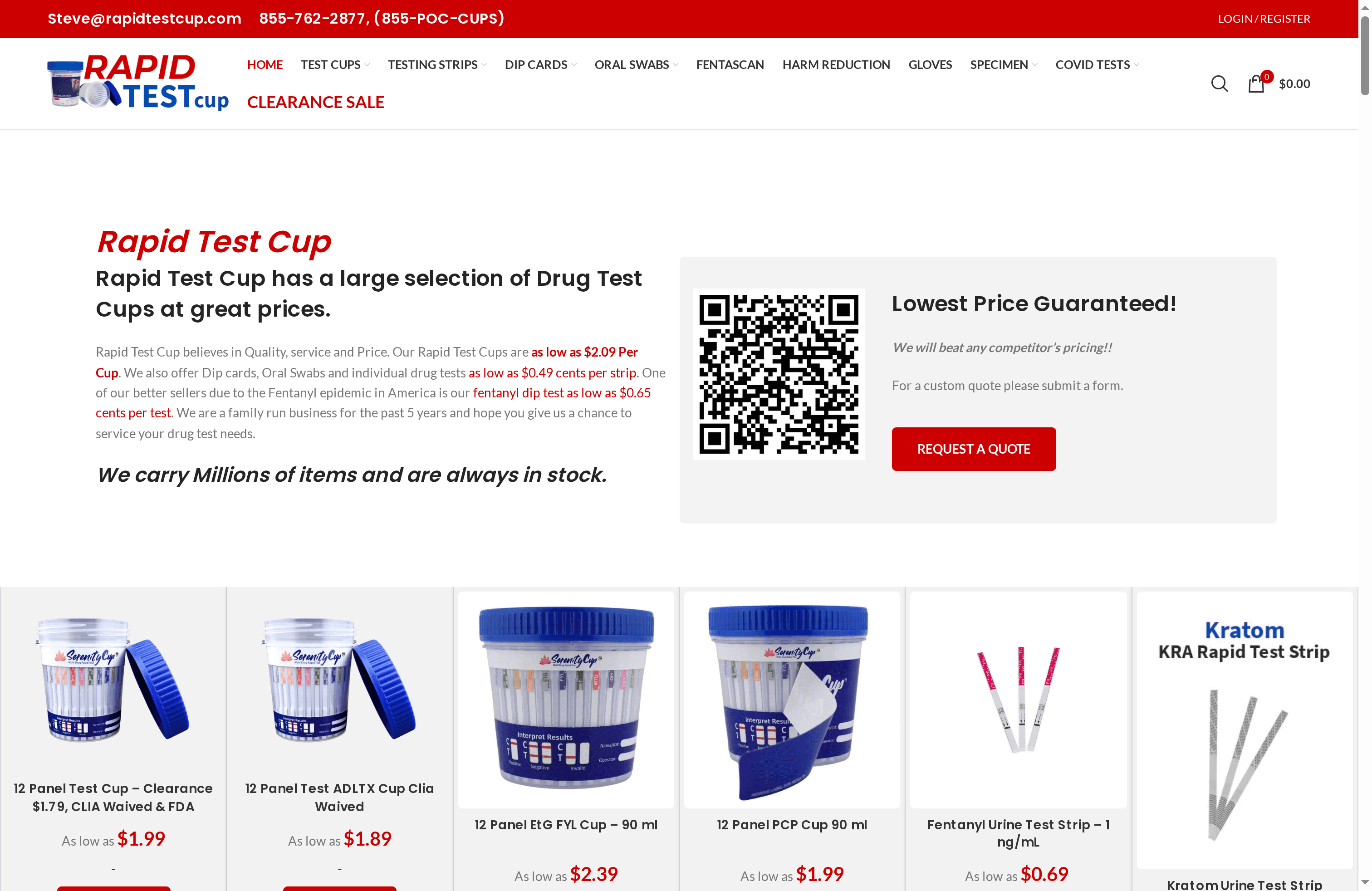
At rapidtestcup.com, we stock FDA-approved, CLIA waived drug test cups built for professional compliance use. Our 12 panel compliance cups cover the most common federally mandated and employer-selected substances with built-in adulteration testing, making them a strong fit for both regulated and non-regulated workplace programs. For broader screening needs, our 18 panel rapid compliance cup adds emerging substances including K2, Kratom, and Fentanyl alongside ETG alcohol detection. Bulk pricing and fast shipping mean you can keep your collection sites stocked without delays. If your program is up for audit, you want certified supplies on hand before the inspector arrives, not on order.
Frequently asked questions
Are employers required to update drug testing policies annually?
Annual updates aren’t explicitly required by most regulations, but regular reviews are essential to stay aligned with new state cannabis laws, federal guideline updates, and changing case law before gaps create liability.
What role does the MRO play in workplace drug testing?
The Medical Review Officer verifies all positive lab results before any employer action is taken. MRO review data shows that 71% of opiate positives and 63% of amphetamine positives are attributed to legitimate prescriptions, making this step critical for avoiding wrongful disciplinary actions.
Can an employer test for cannabis in states where it’s legal?
It depends on the state and the role. Several states restrict pre-employment THC testing to protect off-duty use, but safety-sensitive roles and federal contractors remain exempt from those state protections.
What types of drug tests are required for DOT-regulated employees?
DOT-regulated employers must conduct pre-employment, random, reasonable suspicion, post-accident, return-to-duty, and follow-up drug tests using HHS-certified laboratory analysis of urine or oral fluid specimens.
How do you prove compliance if tested by regulators?
Maintain a complete paper trail: written policy with employee acknowledgments, chain-of-custody forms for every test, lab certification records, MRO review documentation, and training records. Regulators audit the records, not just the intent.