Blog
Drug Test Cutoff Levels Explained for Professionals


TL;DR:
- Drug test cutoff levels are the minimum concentrations that determine positive or negative results and are set by federal agencies to ensure accuracy and fairness. Screening uses higher cutoffs for quick detection, while confirmatory tests employ lower thresholds for precision and legal reliability. Following federal standards and confirming positive results are essential practices for defensible drug testing programs.
Drug test cutoff levels are the minimum concentration thresholds that determine whether a specimen is reported as positive or negative. Explaining cutoff levels in drug tests is not optional knowledge for employers, healthcare providers, or legal authorities. It is the foundation of every defensible testing decision you make. Federal agencies like SAMHSA and the DOT set these thresholds to balance detection accuracy with fairness, and deviating from them carries real legal risk. This article covers how cutoff levels work, why they differ between screening and confirmation, how they vary across substances and specimen types, and what professionals need to know to apply them correctly.
What are drug test cutoff levels and how do they work?
A cutoff level is the concentration point, measured in nanograms per milliliter (ng/mL), at which a drug test reports a positive result. Any specimen with a drug metabolite concentration below that threshold is reported as negative, even if trace amounts are present. This is not a flaw in the system. It is a deliberate design choice to prevent false positives from incidental exposure, passive contact, or legal dietary sources.
The standard industry term for this threshold is the “decision concentration” or simply the cutoff value. SAMHSA and the DOT publish specific cutoff values for federally regulated workplace programs. These values are not suggestions. They are the legal floor for programs subject to federal oversight, and they define what counts as a positive drug test result.
Understanding drug test limits requires knowing that cutoffs apply at two distinct stages: initial screening and confirmatory testing. Each stage uses a different threshold and a different technology. Getting this distinction right is what separates a defensible result from a legal liability.
How do screening and confirmatory cutoffs differ?
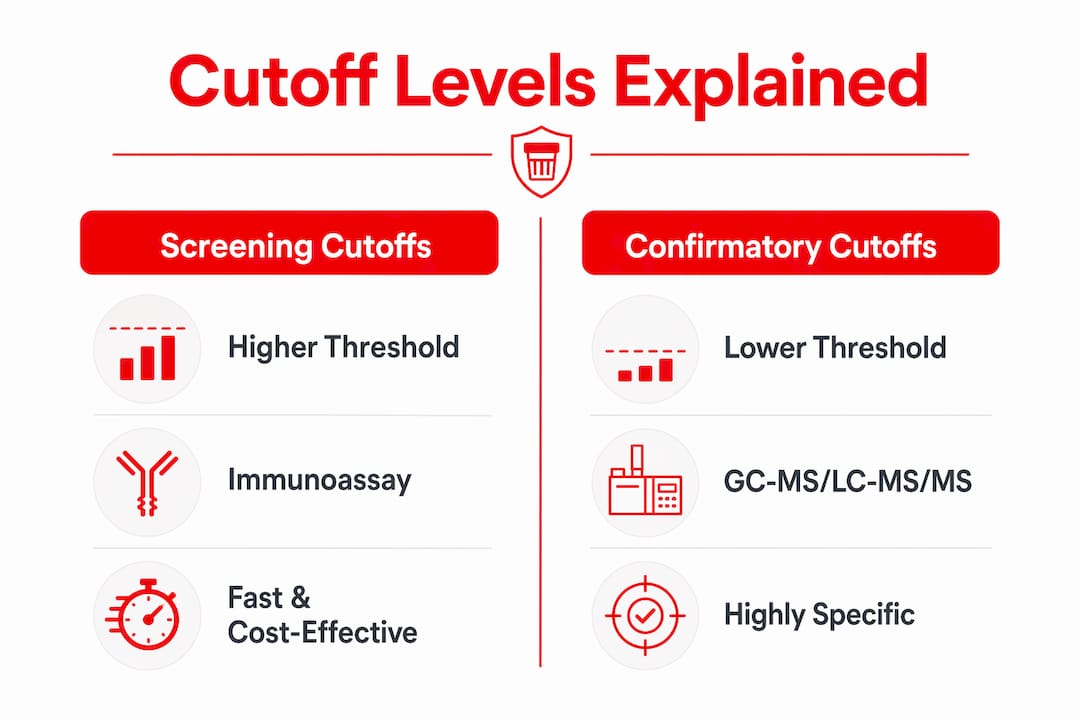
The two-stage testing process is the backbone of accurate drug testing. Initial screening uses immunoassay technology with higher cutoff thresholds. Confirmatory testing uses GC-MS (gas chromatography-mass spectrometry) or LC-MS/MS (liquid chromatography-tandem mass spectrometry) with lower, more specific thresholds.
Why the screening cutoff is set higher
Immunoassay screens are fast and cost-effective, but they are not perfectly specific. They can react to structurally similar compounds, producing a cross-reactivity false positive that does not reflect actual drug use. Setting the screening cutoff higher reduces the chance that a borderline result triggers an unnecessary confirmation.
Why the confirmatory cutoff is set lower
Confirmatory methods like GC-MS and LC-MS/MS identify the exact molecular structure of a compound. They are far more specific, so a lower cutoff is scientifically defensible. A specimen can screen positive but confirm negative when the initial signal was caused by cross-reactivity rather than the actual target drug. This is why confirmation is legally required before any adverse action in federally regulated programs.
The practical result of this two-stage design is a system that catches real positives while filtering out noise. Here is what each stage requires in practice:
- Initial immunoassay screen: Fast, broad, uses higher cutoffs to flag specimens for review
- Confirmatory GC-MS or LC-MS/MS: Specific, legally binding, uses lower cutoffs to verify the exact compound
- Medical Review Officer (MRO) review: Required in DOT programs before a confirmed positive is reported to the employer
- Adverse action: Cannot legally occur based on a screen alone in federally regulated programs
Pro Tip: Never take action based on a presumptive positive screen alone. A confirmed positive from GC-MS or LC-MS/MS is the only result that holds up in a legal or employment dispute.
Cutoff levels by substance and specimen type
Drug testing thresholds vary significantly by substance and by the type of specimen collected. Knowing these numbers is not just academic. It directly affects how you interpret results and communicate findings to stakeholders.

Standard urine cutoff values
Federal workplace standards set the following urine cutoff levels for common substances:
| Substance | Initial Screen (ng/mL) | Confirmatory (ng/mL) |
|---|---|---|
| THC-COOH (marijuana) | 50 | 15 |
| Cocaine metabolites | 150 | 100 |
| Amphetamines | 500 | 250 |
| Morphine (opiates) | 2,000 | 2,000 |
| Fentanyl | 1 | 1 |
The fentanyl cutoff stands out immediately. At 1 ng/mL, it is 2,000 times lower than the morphine cutoff. That gap reflects fentanyl’s extreme potency and the clinical risk it poses even at trace concentrations.
The morphine cutoff at 2,000 ng/mL is set deliberately high. Poppy seed consumption from common foods can produce detectable morphine levels in urine. A lower cutoff would generate false positives for people who ate a bagel that morning. The 2,000 ng/mL threshold filters out dietary exposure while still catching genuine opiate use.
How oral fluid cutoffs differ from urine
Oral fluid testing uses lower cutoffs than urine because saliva contains lower drug concentrations than urine. The THC cutoff in oral fluid is 4 ng/mL for initial screening, compared to 50 ng/mL in urine. That difference is not a stricter standard. It reflects the biology of how drugs concentrate in different biological matrices.
Oral fluid testing also detects more recent use than urine. THC appears in saliva within minutes of use and clears within hours. Urine testing detects the metabolite THC-COOH, which can persist for days or weeks in frequent users. Choosing the right specimen type depends on whether you need to detect recent impairment or past use.
Why are cutoff levels set where they are?
Cutoff values are not arbitrary. They are calibrated to exclude background noise from legal sources while reliably detecting genuine drug use. The science behind this calibration involves population studies, metabolite pharmacokinetics, and regulatory consensus.
Employers who set custom cutoffs below federal standards face a specific legal problem. Lower cutoffs increase sensitivity but also increase false positives from incidental exposure or legitimate medications. Without the scientific validation that SAMHSA and the DOT have built into their standards, those false positives become indefensible in court or arbitration.
“Cutoff levels are the scientific and legal guardrails of drug testing. Moving them without regulatory backing removes both protections at once.”
The key reasons cutoffs are set at specific levels include:
- Avoiding dietary false positives: High morphine cutoffs exclude poppy seed exposure
- Accounting for passive exposure: THC cutoffs are set above levels from secondhand smoke
- Reflecting metabolite half-life: Faster-clearing substances may have lower cutoffs to maintain detection windows
- Matching assay technology: Cutoffs align with the sensitivity limits of the specific immunoassay or confirmatory method used
Lower cutoffs are not always better. A cutoff set too low catches more trace exposures but also flags more innocent people. The goal is not maximum sensitivity. The goal is accurate identification of genuine drug use at concentrations consistent with actual consumption.
How to interpret cutoff results accurately in practice
Accurate interpretation starts before you read a single result. You need to know the specific cutoffs your lab uses, because lab-specific cutoff limits can vary based on assay calibration and instrumentation. A result that is negative at one lab’s threshold might be positive at another’s. Always request the cutoff documentation from your contracted laboratory before interpreting results.
Here is a numbered process for applying cutoff data responsibly:
- Obtain lab-specific cutoff values before any testing cycle begins. Do not assume federal defaults apply to every panel or every lab.
- Distinguish presumptive negatives from confirmed positives. A negative screen means the specimen fell below the screening cutoff. It does not mean zero drug presence.
- Require confirmation before adverse action. Any positive screen must be confirmed by GC-MS or LC-MS/MS before it is used in an employment, legal, or clinical decision.
- Communicate cutoff context to stakeholders. HR teams, legal counsel, and clinical staff often misread results without understanding that a negative result below cutoff is not the same as drug-free.
- Document the cutoff values used for every testing event. This documentation is your first line of defense in any legal challenge.
Pro Tip: When reviewing drug test results with legal counsel or HR, always present the cutoff value alongside the result. A number without context invites misinterpretation.
Key Takeaways
Drug test cutoff levels are the legally and scientifically defined concentration thresholds that determine positive or negative results, and using federally recognized values from SAMHSA or the DOT is the only defensible approach for regulated programs.
| Point | Details |
|---|---|
| Cutoff levels define positivity | Any concentration below the threshold is reported negative, regardless of trace presence. |
| Two-stage testing is required | Screening uses higher cutoffs; confirmation uses lower, method-specific thresholds before adverse action. |
| Substance cutoffs vary widely | Fentanyl is set at 1 ng/mL while morphine is set at 2,000 ng/mL, reflecting potency and dietary exposure risk. |
| Specimen type changes the threshold | Oral fluid THC cutoff is 4 ng/mL versus 50 ng/mL in urine, due to concentration differences in biological matrices. |
| Custom cutoffs carry legal risk | Employers using non-standard cutoffs below federal mandates face increased false positives and legal challenges. |
What 15 years of drug test programs taught me about cutoffs
The most common mistake I see in professional drug testing programs is treating the cutoff as a technicality rather than the core of the entire system. Organizations spend money on testing panels and collection procedures, then undermine everything by not verifying the cutoffs their lab actually uses. I have reviewed cases where an employer took adverse action based on a screen result, without confirmation, and without knowing that the lab’s assay was calibrated differently than the federal standard. Every one of those cases created legal exposure that was entirely avoidable.
The second mistake is assuming that a lower cutoff makes a program more rigorous. It does not. It makes it more vulnerable. The 2,000 ng/mL morphine cutoff exists because regulators spent years studying real-world false positive rates from dietary sources. When an employer decides to cut that in half without equivalent scientific backing, they are not being stricter. They are being reckless with someone’s livelihood.
My strong recommendation: build your program around SAMHSA or DOT cutoff standards, require GC-MS or LC-MS/MS confirmation on every positive screen, and document the cutoff values used for every testing event. These three practices will not eliminate every dispute, but they will give you a defensible position in every one. The confirmatory testing process is not a cost center. It is your legal protection.
— Justin
Drug testing products calibrated to federal cutoff standards
Accurate cutoff monitoring starts with the right testing tools. Rapidtestcup supplies CLIA waived, FDA-approved drug test cups, dip cards, and urine test strips built to align with federal screening thresholds across multi-panel configurations.
Whether you run a workplace screening program, a clinical lab, or a substance abuse treatment facility, Rapidtestcup’s catalog covers the panels and cutoff configurations you need. The top drug testing products for labs include multi-panel cups with documented cutoff levels for substances from THC and cocaine to fentanyl and amphetamines. For programs that screen for fentanyl at the 1 ng/mL threshold, Rapidtestcup offers a dedicated fentanyl urine test strip calibrated to that exact cutoff. Bulk pricing and fast shipping make it practical to maintain consistent supply for high-volume programs.
FAQ
What is a cutoff level in a drug test?
A cutoff level is the minimum drug metabolite concentration, measured in ng/mL, required for a specimen to be reported as positive. Any result below that threshold is reported as negative.
Why do screening and confirmatory cutoffs differ?
Screening cutoffs are set higher to reduce false positives from cross-reactive compounds in immunoassay tests. Confirmatory cutoffs are lower because GC-MS and LC-MS/MS methods identify exact molecular structures with greater specificity.
What is the standard THC cutoff for urine drug tests?
The federal standard sets the initial urine screening cutoff for THC-COOH at 50 ng/mL and the confirmatory cutoff at 15 ng/mL, per SAMHSA and DOT guidelines.
Can a drug test be negative even if drugs are present?
Yes. If the concentration of a drug metabolite falls below the cutoff threshold, the result is reported as negative. A negative result means the specimen did not meet the minimum concentration for a positive report, not that the specimen contains zero drug metabolites.
Why is the fentanyl cutoff so much lower than other opioids?
Fentanyl’s cutoff is set at 1 ng/mL because of its extreme potency. Even very small concentrations carry significant clinical risk, which is why its detection threshold is 2,000 times lower than the morphine cutoff of 2,000 ng/mL.