Blog
Detecting Adulterants Step by Step: 2026 Forensic Guide


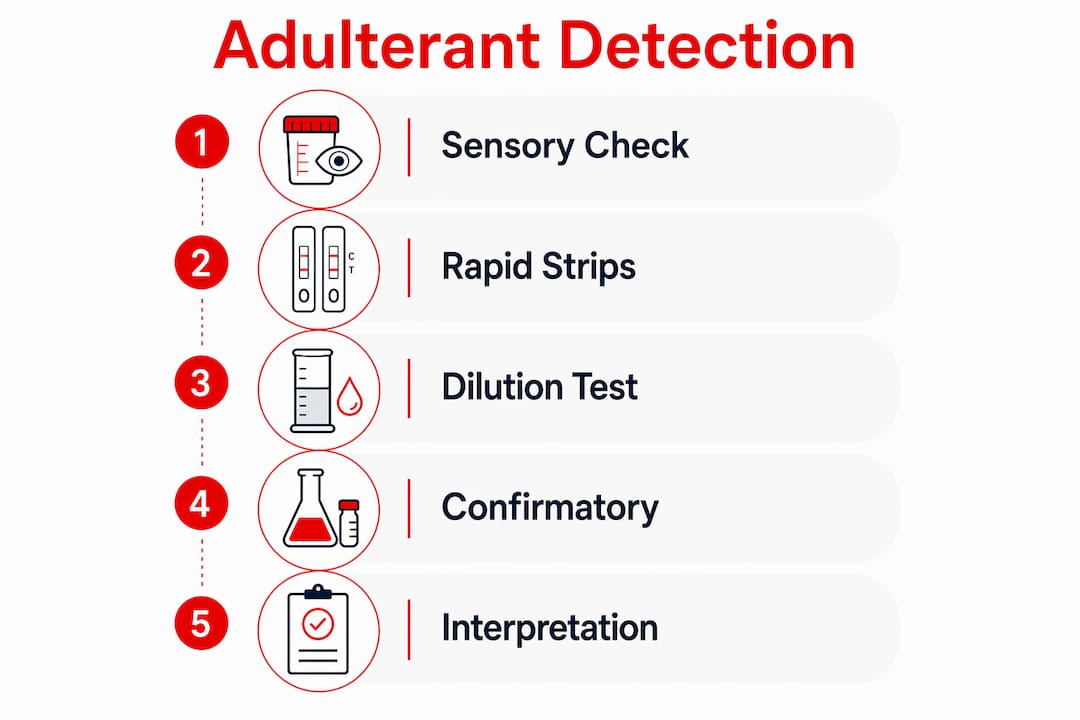
Detecting adulterants step by step in urine drug testing follows a three-phase sequence: sensory inspection, rapid biochemical screening, and confirmatory forensic analysis. Each phase catches what the others miss. Skipping any one of them creates gaps that a determined donor can exploit.
Specimen validity testing (SVT) is the formal term for this process. Per the SAMHSA Mandatory Guidelines and 2023 NLCP standards, required SVT measurands include creatinine, specific gravity, pH, and at least one oxidant screen. The goal is to classify specimens as valid, dilute, substituted, or adulterated before any drug result is reported.
The main stages, in order:
- Sensory inspection: temperature, color, odor, foam
- Rapid biochemical screening: adulterant test strips covering pH, creatinine, specific gravity, nitrite, oxidants
- Confirmatory forensic analysis: pH meter, GC-MS, HPLC, spectrophotometry
- Result interpretation and documentation: classification, chain of custody, reporting
Combining all three phases is what produces results that hold up in court or a compliance review.
Table of Contents
- 1. How to conduct sensory inspection of a urine specimen
- 2. How to use rapid adulterant test strips correctly
- 3. How to measure creatinine and specific gravity to detect dilution
- 4. What confirmatory forensic testing methods reveal
- 5. How to interpret results and decide next steps
- 6. Where to find expert resources and professional supplies
- Rapidtestcup has the supplies your program needs
- Key Takeaways
1. How to conduct sensory inspection of a urine specimen
Sensory evaluation happens at the collection site, before any strip or instrument touches the sample. It takes under two minutes and catches substitution and gross adulteration that biochemical strips can miss entirely.
- Temperature: Fresh urine should read 90°F–99°F within four minutes of collection. Anything outside that range suggests substitution or a cold-water flush.
- Color: Normal urine ranges from pale yellow to amber. Green, blue, or colorless specimens warrant immediate flagging.
- Odor: A bleach smell points to hypochlorite adulteration. A sharp vinegar odor suggests acetic acid, one of the most evasive adulterants in strip-based screening.
- Foam: Excessive, persistent foam after gentle agitation can indicate detergent or soap contamination. Normal urine produces minimal, short-lived bubbles.
Forensic toxicologists confirm that sensory checks remain essential because modern immunoassays, while sensitive, are vulnerable to masking agents that leave no visible trace on a dipstick.
Pro Tip: Document sensory findings on the chain-of-custody form immediately. A written record of an unusual odor or color at collection can support a rejection decision even before lab results arrive.
2. How to use rapid adulterant test strips correctly
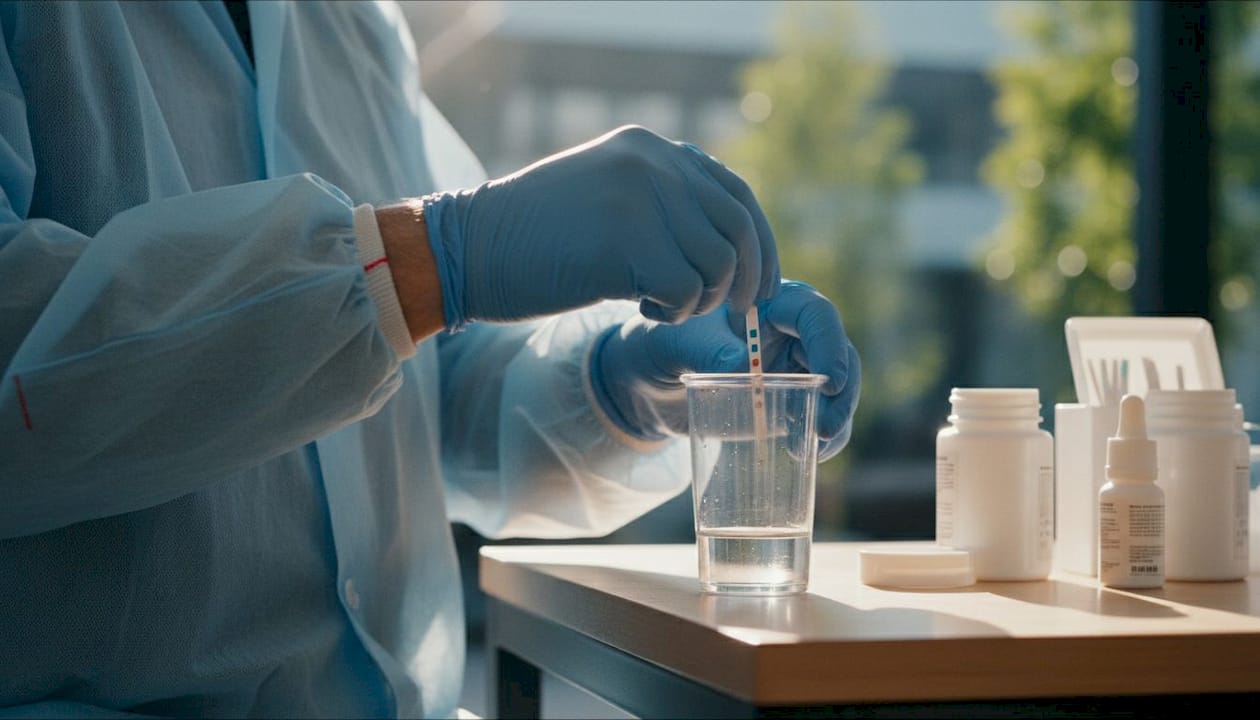
Rapid adulterant strips are the workhorse of on-site specimen validity testing. They screen for the most common identifying illegal additives in seconds, without instrumentation.
What strips detect:
- Nitrite: Oxidizing agent found in commercial adulterant products. Normal urine nitrite is below 200 mcg/mL; specimens at or above 500 mcg/mL are reported adulterated per SAMHSA criteria.
- Glutaraldehyde: Detected via characteristic immunoassay response or aldehyde-specific pads.
- PCC (pyridinium chlorochromate): A chromium-based oxidant that destroys drug metabolites.
- Bleach (hypochlorite): Detected by oxidant pads; higher concentrations are more reliably flagged.
Stepwise procedure:
- Remove the strip from its foil pouch immediately before use.
- Dip all pads into the urine specimen for the time specified by the manufacturer (typically 30–60 seconds).
- Lay the strip flat and read results at the exact time window stated in the instructions.
- Compare pad colors against the reference chart; record each result.
- Flag any pad showing an abnormal reading for confirmatory follow-up.
Strip sensitivity varies by device and adulterant. Research shows that multi-assay dipstick devices differ in sensitivity, with some missing adulterants at low concentrations. The cocaine immunoassay resists adulteration best, while cannabis testing produces the most false negatives when adulterants like vinegar are present. Vinegar can pass standard validity tests and remain undetected because it alters pH only modestly at low concentrations.
Strips cannot precisely quantify concentrations. They flag abnormal ranges, not exact values. Any positive or borderline result requires escalation to confirmatory testing.
3. How to measure creatinine and specific gravity to detect dilution
Dilution is the most common sample manipulation strategy, and creatinine plus specific gravity are its primary markers. These two parameters work together because a donor who dilutes in vivo will show low values on both.
Normal reference ranges per forensic guidelines:
- Creatinine: below 5 mg/dL indicates substitution; below 20 mg/dL along with specific gravity below 1.003 indicates dilution. These cutoffs reflect forensic guidelines.
- Specific gravity: below 1.003, especially with low creatinine, supports dilution; values outside 1.001–1.020 with very low creatinine (below 5 mg/dL) signal substitution.
- Substituted specimen criteria: Creatinine below 5 mg/dL and specific gravity outside 1.001–1.020 are considered substituted specimens per standard criteria.
Creatinine is measured using the colorimetric Jaffé reaction, where creatinine and picric acid in an alkaline solution form a red-orange chromophore. Specific gravity screening uses a refractometer: a 3-decimal-place instrument when creatinine is between 5 and 20 mg/dL, and a 4-decimal-place instrument when creatinine is at or below 5 mg/dL. One complication worth knowing: creatine supplementation can artificially raise urinary creatinine, potentially masking a dilution attempt. When light-colored urine shows creatinine just above the 20 mg/dL threshold, cross-checking specific gravity and urinary creatine levels adds a meaningful layer of confidence.
4. What confirmatory forensic testing methods reveal
Rapid strips provide a screen. Confirmatory methods provide the answer you can defend in court. The 2023 NLCP guidelines are explicit: the pH meter is the only accepted confirmatory pH method for federally regulated testing.
| Method | Primary use | Specificity | Legal acceptance |
|---|---|---|---|
| pH meter | pH confirmation | High | Required for regulated testing |
| GC-MS | Chemical adulterant ID (glutaraldehyde, PCC) | Very high | Gold standard |
| HPLC | Nitrite, chromium VI quantification | High | Accepted |
| Spectrophotometry | Oxidant detection (chromate, nitrite, peroxide) | Moderate | Accepted, not routine |
| ICP-MS | Chromium species in PCC | Very high | Specialized forensic use |
GC-MS is the definitive tool for identifying chemical adulterants such as glutaraldehyde and PCC. When an immunoassay shows a characteristic abnormal response, the lab must use GC-MS to confirm the specific adulterant. For nitrite and chromium VI, HPLC with a conductivity detector or ion chromatography provides quantitative confirmation. Spectrophotometric methods cover a broader oxidant panel but are less common in routine workflows due to cost.
Chain of custody is non-negotiable throughout this phase. Strict handling protocols minimize tampering risk and establish the traceability that makes results legally admissible. Every transfer, aliquot, and storage condition gets logged.
5. How to interpret results and decide next steps
Interpretation means comparing measured values against established thresholds and physiological norms, then classifying the specimen correctly. The four categories matter because each triggers a different response.
- Valid: All parameters within normal ranges. Proceed with drug result reporting.
- Dilute: Creatinine below 20 mg/dL and specific gravity below 1.003. Report as dilute; a recollection under direct observation is typically required.
- Substituted: Creatinine below 5 mg/dL and specific gravity outside 1.001–1.020. Report as substituted; the specimen is rejected.
- Adulterated: pH below 4.0 or at or above 11.0, nitrite at or above 500 mcg/mL, or confirmed presence of an exogenous chemical. Report as adulterated; reject and document.
The trickiest calls involve physiological variation versus manipulation. A donor with renal disease may show low creatinine legitimately. Bacterial growth during delayed transport can raise pH. Federal research has shown that summer heat during transport contributes to elevated specimen pH. When borderline values appear, confirmatory testing and a documented clinical review are the appropriate path, not an automatic rejection.
When adulteration is confirmed, the sequence is: reject the specimen, document findings on the chain-of-custody form, notify the medical review officer (MRO), and initiate a recollection under direct observation. Every communication with the donor or employer gets logged with timestamps.
6. Where to find expert resources and professional supplies
The foundation of a defensible adulterant detection program is validated supplies and current guidelines. The SAMHSA Mandatory Guidelines for Federal Workplace Drug Testing Programs and the NLCP Manuals are the authoritative references for SVT criteria, reporting categories, and validation requirements. The Substance Abuse and Mental Health Services Administration updates these periodically; the 2023 revision is the current operative standard.
For professional supplies, CLIA waived and FDA-approved testing kits are the baseline requirement for any regulated or forensic application. Rapidtestcup.com offers a catalog of adulterant detection tools aligned with forensic standards, including multi-panel cups with integrated validity checks and standalone adulterant strips. Their product guides and educational articles support implementation of standard operating procedures without requiring a separate consultant.
Continuing education through organizations like the Society of Forensic Toxicologists (SOFT) and the American Association for Clinical Chemistry (AACC) keeps your team current on emerging adulterants and updated detection methods. Adopting a written standard operating procedure (SOP) for SVT, reviewed annually against current guidelines, is the single most effective quality assurance measure a lab or collection site can implement.
Rapidtestcup has the supplies your program needs
Running a forensic-grade adulterant detection program means you cannot afford supplies that cut corners on sensitivity or documentation. Rapidtestcup stocks FDA-approved, CLIA waived drug testing products built for exactly this workflow, from multi-panel cups with integrated adulterant checks to standalone validity strips. The 22-panel cup with adulterant detection covers a broad drug and adulterant panel in a single collection, reducing handling steps and chain-of-custody complexity. Bulk pricing keeps per-test costs manageable for high-volume programs. Browse the full catalog at Rapidtestcup.com or request a custom quote for your lab’s volume and panel requirements.
Key Takeaways
The most defensible adulterant detection combines sensory inspection, calibrated strip screening, and GC-MS or pH meter confirmation, with every step documented on a chain-of-custody form.
| Point | Details |
|---|---|
| Three-phase SVT sequence | Sensory inspection, rapid strip screening, and confirmatory testing must all be completed for a forensically defensible result. |
| Critical threshold values | pH below 4.0 or at or above 11.0, nitrite at or above 500 mcg/mL, and creatinine below 5 mg/dL each indicate adulteration or substitution. |
| Strip limitations | Adulterant strips miss low-concentration adulterants and cannot precisely quantify; vinegar can evade standard validity tests entirely. |
| pH meter is mandatory | The pH meter is the only confirmatory pH method accepted for federally regulated urine drug testing per 2023 NLCP guidelines. |
| Rapidtestcup supplies | Rapidtestcup offers CLIA waived, FDA-approved multi-panel cups and adulterant strips suited to forensic and clinical SVT programs. |