Blog
False Positives: Ordering Sterile vs Nonsterile Specimen Cups for Labs


Any test that cultures, identifies, or counts living organisms requires a sterile container. Routine urinalysis, most drug screens, and many chemistry panels do not. What decides acceptance beyond that is often the same thing that gets overlooked: clean-catch technique, a leak-proof lid, tamper evidence, and correct labeling. A urine culture needs a sterile cup handled aseptically; a workplace drug test needs a non-sterile, leak-proof cup handled correctly.
TL;DR:
- Sterile cups are essential for microbiology tests that involve growing or identifying organisms, such as urine culture and tissue samples.
- Non-sterile leak-proof cups are suitable for routine urinalysis, drug screening, and chemistry panels where contamination will not affect results.
- Proper collection technique, including avoiding contact with the interior of the cup and immediate labeling, is crucial to maintain specimen integrity.
- Transport specifications like leak resistance, tamper-evidence, and correct labeling are vital to prevent specimen rejection or compromised results.
- Most clinics should stock sterile cups for microbiology and bulk non-sterile cups for routine testing, with clear differentiation and handling protocols.
Table of Contents
- Sterile vs. Non-Sterile Specimen Cups: A Quick Comparison
- Which Specimen Types Actually Require a Sterile Container?
- How to Collect and Handle Specimens Without Breaking Sterility
- What Makes a Specimen Cup Acceptable for Transport?
- Matching Sterile and Non-Sterile SKUs to Real Clinical Workflows
- How to Order Sterile and Non-Sterile Cups for Your Lab
- Sources
- FAQ
Sterile vs. Non-Sterile Specimen Cups: A Quick Comparison
A sterile specimen cup is individually packaged and validated sterile at the point of manufacture, usually through ethylene oxide or gamma sterilization, then sealed until a clinician breaks the wrapper at the point of collection. A non-sterile cup goes through standard manufacturing and is often bulk-packaged in sleeves or cases, with no sterility claim and no individual wrap.
That packaging difference drives almost everything downstream:
- Shelf life and storage: Sterile cups typically carry a defined sterility expiration date and need dry, undamaged packaging to remain valid; non-sterile bulk cups have longer practical shelf life since there’s no sterility barrier to compromise.
- Cost per unit: Individual sterile wrapping adds material and processing cost, which shows up in per-unit pricing, especially at volume.
- Point-of-care workflow: Sterile cups require an unwrap-and-use step immediately before collection; non-sterile cups can be pulled from a dispenser box with less handling ceremony.
- Appropriate use: Sterile SKUs belong wherever a lab will attempt to grow or identify organisms; non-sterile SKUs cover the much larger volume of routine drug screens, hydration checks, and basic chemistry work.
The operational catch is that a sterile cup only stays sterile if staff treat it that way. According to ARUP’s specimen collection guidance, the benefit of a sterile container disappears the moment someone touches the interior or sets the lid down on a countertop. Buying the right SKU is half the job. Handling it correctly is the other half.
Which Specimen Types Actually Require a Sterile Container?
The rule of thumb holds up test by test, but the exceptions are where purchasers get tripped up. Any specimen headed for a microbiology bench, where the lab will grow or count organisms, needs sterile collection and sterile transport media. Anything else usually doesn’t.
Urine is the clearest split. A routine urinalysis, which checks for glucose, protein, blood, and general chemistry markers, tolerates a non-sterile cup because contamination from normal skin flora won’t skew a dipstick or a microscopic exam meaningfully. A urine culture is different: contamination from poor technique can produce a false positive for infection, so labs require a sterile, wide-mouth container and a minimum volume, often around 10 mL, collected using clean-catch midstream steps, as ARUP’s collection guidance outlines.
Wound swabs, throat swabs, respiratory samples, cerebrospinal fluid, and tissue submitted for microbiology all follow the same logic and typically travel in sterile swab tubes or containers with the correct transport media, not a general-purpose cup. Blood cultures use a closed sterile system by design, drawn directly into culture bottles rather than an open container, which sidesteps the sterile-cup question entirely.
Drug testing and most chemistry panels sit on the non-sterile side. A test-type mapping from Boston MedSupply confirms that any test not dependent on microbial growth can use a non-sterile, leak-proof cup without compromising results. The one wrinkle is 24-hour urine collection, which often needs a large container pre-loaded with a preservative such as boric acid or an acidifying agent, chosen based on which analytes the lab is measuring, not on sterility.
| Specimen type | Container requirement | Key handling note |
|---|---|---|
| Routine urinalysis | Non-sterile, leak-proof | Standard clean collection is sufficient |
| Urine culture | Sterile, wide-mouth | Clean-catch midstream, minimum ~10 mL |
| Wound/throat/respiratory swab | Sterile with transport media | Avoid touching swab tip to skin or surfaces |
| CSF or tissue for microbiology | Sterile container | Rapid transport, no preservative |
| Blood culture | Closed sterile vacutainer system | Skin antisepsis before draw |
| Drug screen / chemistry panel | Non-sterile, leak-proof | Tamper-evident seal recommended |
| 24-hour urine | Large container with preservative | Boric acid or acidification per test ordered |
How to Collect and Handle Specimens Without Breaking Sterility
Getting the right container is only step one. What happens in the next 60 seconds determines whether that container’s sterility means anything.
- Instruct for clean-catch midstream collection. For urine culture, the patient cleans the periurethral or glans area, starts urinating into the toilet, then catches the middle portion of the stream in the sterile cup, which reduces contamination from urethral flora.
- Never touch the cup’s interior or the underside of the lid. Set the lid down on a clean, dry surface with the inside facing up, or hold it upside down between fingers, never resting the inner surface on a countertop.
- Match glove type to the task. Sterile gloves belong with aseptic procedures like wound culture collection; non-sterile exam gloves are appropriate for routine urine or drug-screen collection where the goal is staff protection, not specimen sterility.
- Label immediately, at the bedside or collection station, not after the specimen sits on a counter, and confirm the volume meets the minimum the test requires.
- Get the specimen to the lab within the stated window. Urine cultures held too long at room temperature allow bacterial overgrowth that can produce a false positive.
Pro Tip: If a sterile cup’s wrapper is torn, punctured, or shows moisture inside the packaging, treat it as compromised and grab another one. A visual check takes two seconds and it’s the cheapest quality control step in the entire collection process.
Best-practice summaries from MLO-Online point to labeling errors, wrong preservatives, and delayed transport, not manufacturing defects, as the most common reasons specimens get rejected or produce misleading results.
What Makes a Specimen Cup Acceptable for Transport?
Collection technique gets a specimen into the cup correctly. Transport requirements determine whether it survives the trip to the lab, or the courier, or a chain-of-custody review, in usable condition.
Leak resistance is tested against pressure standards, and container lines rated to roughly 95 kPa are built to survive the pressure changes of ground and air transport without seeping, a benchmark referenced in ARUP’s collection materials. For anything shipped off-site, that rating isn’t a nice extra. It’s what keeps a courier from rejecting the package outright.
Tamper-evident seals and temperature verification strips matter most for workplace and forensic drug testing, where chain-of-custody integrity is part of the legal standard, not just a lab preference. A specimen without a tamper seal can be challenged in a dispute regardless of what the toxicology result says.
Common rejection reasons worth building into a procurement spec:
- Insufficient volume for the ordered test
- Missing or mismatched patient labeling
- No preservative, or the wrong one, for tests that require it
- Leaking or improperly sealed lids
- Absent tamper-evident seal on forensic or workplace samples
Specifying leak-proof rating, tamper evidence, and label space upfront when ordering, rather than discovering the gap after a shipment gets rejected, saves a re-collection and a delayed result every time.
Matching Sterile and Non-Sterile SKUs to Real Clinical Workflows
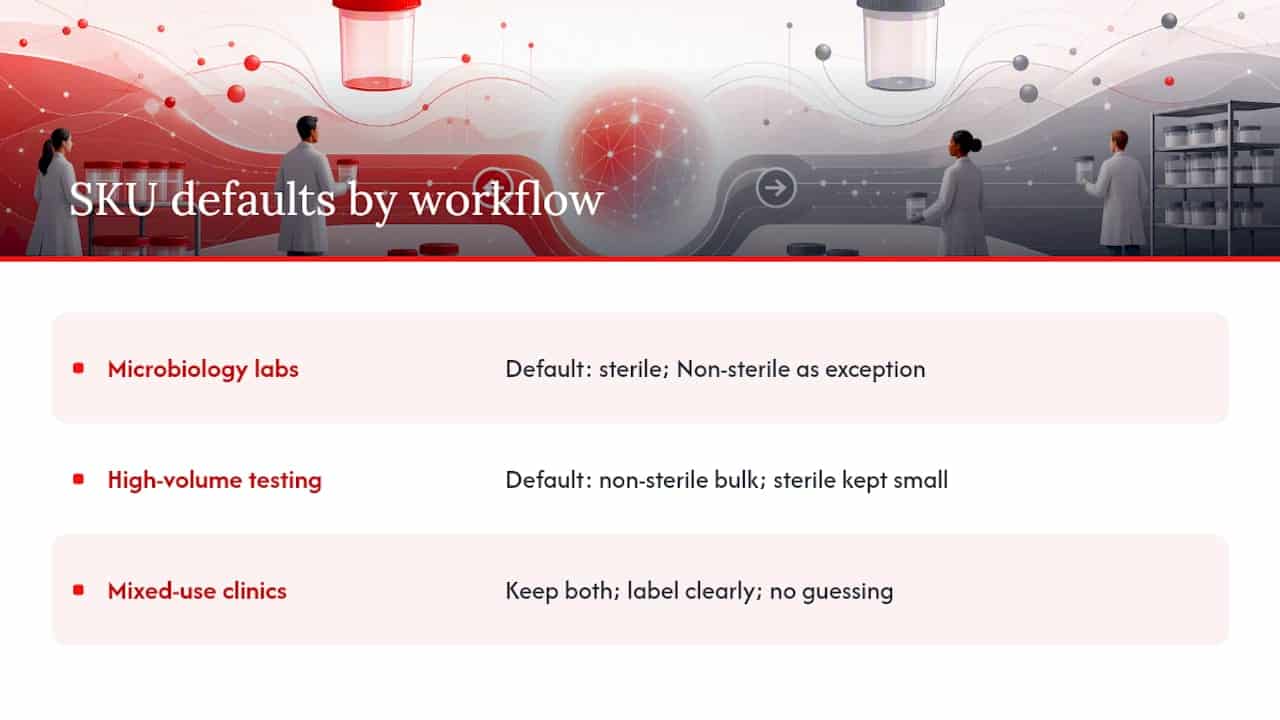
Rapidtestcup stocks both sides of this decision: individually wrapped sterile urine vacuum cups for culture and other microbiology-sensitive collections, and bulk non-sterile leak-proof cups, some with built-in temperature strips and tamper-evident seals, for routine drug screening and chemistry work.
Most clinics don’t need to standardize on one SKU. A microbiology-heavy lab should stock sterile cups as the default and treat non-sterile as the exception. A high-volume workplace testing program should do the opposite: bulk non-sterile leak-proof cups as the default, with a small sterile stock on hand for the rare culture order that comes through. Mixed-use clinics need both, labeled clearly enough that staff never have to guess at the collection window.
— Justin
How to Order Sterile and Non-Sterile Cups for Your Lab
Once you know which SKU your workflow needs, ordering shouldn’t be the hard part. Rapidtestcup’s full catalog of specimen collection supplies covers individually wrapped sterile cups, bulk non-sterile leak-proof options, and tamper-evident and temperature-strip variants side by side, with bulk pricing that scales for labs, clinics, and treatment programs ordering in volume.
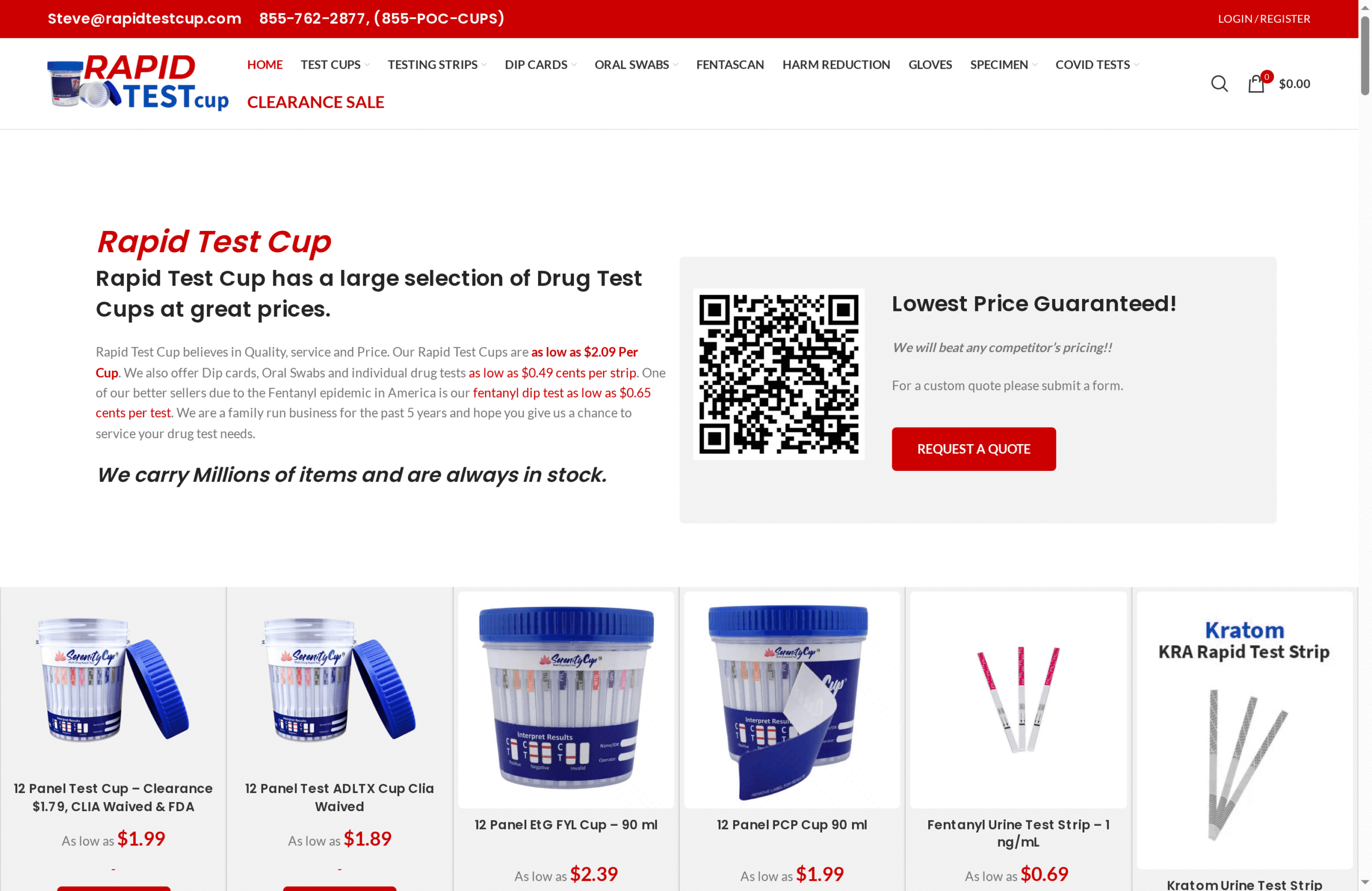
If your workflow is mostly drug screening rather than microbiology, the urine specimen cup category lets you compare panel counts and container features without digging through unrelated product lines. Lead times on standard SKUs run fast, with same-day shipping on in-stock inventory, and custom packaging or preservative-specific requests, boric acid tubes for 24-hour collections, forensic tamper-evident configurations, get handled through a direct quote. If you’re not sure which container fits a specific test your lab runs, reach out to Rapidtestcup’s sales team before you place a bulk order, not after a shipment gets flagged for the wrong SKU.
Sources
- ARUP specimen collection guidance — ARUP
- Specimen Collection Containers: Types & How to Choose — BostonMedSupply
- Specimen collection and handling: best practices and pitfalls — MLO-Online
- Needle
FAQ
Are Urine Specimen Cups Sterile?
Some are and some aren’t. Sterile, individually wrapped cups are required for urine culture and other microbiology testing, while non-sterile leak-proof cups are standard for routine urinalysis and drug screening.
What Are the Four Types of Urine Specimens?
The main categories are random (routine spot collection), first-morning, clean-catch midstream (used for culture), and timed or 24-hour collection, which often requires a preservative-loaded container.
Can You Reuse a Urine Specimen Cup?
No. Specimen cups, sterile or non-sterile, are single-use devices, and reusing one risks cross-contamination, inaccurate results, and infection control violations.
What Container Should I Use for a Urine Sample?
Use a sterile, wide-mouth container for a urine culture and a non-sterile, leak-proof cup for routine urinalysis or drug screening; Rapidtestcup’s urine specimen cup lineup covers both.
When Are Non-Sterile Specimen Cups Acceptable?
Non-sterile cups are acceptable for any test that isn’t sensitive to microbial contamination, including routine chemistry, hydration checks, and most drug screening panels, according to guidance on container use in urgent care settings.