Blog
6 Step Bathroom Setup Checklist for Collectors: DOT/SAMHSA Compliant


Secure the water, remove every adulterant, and check specimen temperature within minutes of handoff. That single sequence determines whether a collection holds up under scrutiny. Before a donor ever enters the room, three things need to be in place: a bluing agent or another way to secure toilet water, sealed specimen cups with built-in temperature strips, and completed chain-of-custody (CCF) forms, all consistent with DOT 49 CFR Part 40 and SAMHSA/HHS model guidelines.
TL;DR:
- Securing and verifying toilet water with blue dye or shut-off procedures is essential to prevent dilution or substitution with adulterant water.
- Collectors must check specimen temperature and appearance immediately after handoff to detect potential tampering or adulteration.
- Privacy during collection remains standard unless documented reasons for observation, with thorough documentation critical for legal defensibility.
- Handling automatic-flush toilets and donors unable to provide sufficient samples requires predefined procedures and prompt escalation.
- Using proper supplies like tamper-evident seals and CCF forms supports compliance and protects against sample tampering or disputes.
Table of Contents
- How Do You Set Up a Bathroom for Drug Testing?
- Security and Anti-Adulteration Controls Every Collector Needs
- What Are the Privacy Rules for Bathroom Drug Testing?
- Specimen Handling: Timing and Checks That Matter Most
- Handling Automatic-Flush Toilets and Donors Who Can’t Provide a Sample
- Equipment and Best Practices for Compliant Collections
- Designing a Collection Process That Respects Donors and Holds Up Under Review
- Where to Get the Right Supplies for a Compliant Bathroom Setup
- Sources
- FAQ
How Do You Set Up a Bathroom for Drug Testing?
A compliant bathroom setup for drug testing follows a fixed order: secure the site, brief the donor, collect the specimen, then verify it immediately. Skipping steps or doing them out of sequence is how programs end up with results that don’t survive a legal challenge.
Here’s the sequence collectors should run through every single time:
- Walk the site before the donor arrives. Add bluing agent to the toilet bowl and tank, or shut off the water supply if bluing isn’t an option. Remove soap, hand sanitizer, and any cleaning products from reach.
- Lock down hiding spots. Check behind the toilet tank, inside cabinets, and anywhere a donor could stash synthetic urine or a substitution device.
- Set up the stall itself. Post required signage, stage the sealed specimen cup and CCF paperwork within arm’s reach of the collector’s station, and confirm the temperature strip on the cup is intact and readable.
- Brief the donor. Explain the process, direct them to wash and dry their hands before entering the stall, and confirm the water source is secured before they go in.
- Handle the handoff. Take the sealed cup back from the donor, check the temperature strip immediately, and inspect the specimen visually for color, clarity, and any tint from bluing agent that shouldn’t be there.
- Document everything. Log the time of collection, the time of the temperature check, who secured the water, and whether the collection was monitored or unmonitored.
Federal guidance backs this order directly. Collectors are expected to remove any substances that could adulterate or substitute a sample, and donors typically wash their hands before providing a specimen, with the water source secured immediately after, according to Interior Business Center collection training materials.
A few details make or break this process:
- Bluing agent goes in both the bowl and the tank, not just one or the other.
- Soap dispensers get checked, not just emptied. Some are refillable and get used to hide contraband.
- The CCF should record a time stamp for water security, not just for specimen collection.
- Janitorial closets near the restroom need to be locked during collection windows.
Pro Tip: Keep a laminated site checklist taped inside the collector’s station. Reading through six line items from memory during a live collection is where mistakes happen. Reading them off a card takes ten seconds and removes the guesswork.
Security and Anti-Adulteration Controls Every Collector Needs
Bluing agent works because it turns any toilet water a visible color, so if a donor tries to dilute a specimen with bowl water, the tint immediately gives it away. It’s a low-cost, harmless additive. It doesn’t interact chemically with the test itself; it’s strictly a visual deterrent. Federal guidance treats bluing and secured water sources as required controls specifically for multi-stall restrooms, alongside the option of running the collection as a fully monitored procedure instead, per DOT Section 40.42.
When bluing isn’t practical, there are workable alternatives. Shutting off the water supply to the toilet and sink is the most common substitute. Where that’s not feasible, some sites cover sensors on automatic-flush units or flush and dry the bowl completely before each donor enters, removing any standing water to dilute with in the first place.
Hiding spots deserve their own pass, separate from the water check:
- Behind and underneath the toilet tank
- Inside soap and sanitizer dispensers
- Ventilation grates and exposed outlets
- Trash bins and paper towel dispensers
Secure or empty each one before the first donor of the day arrives, and keep janitorial supplies in a locked closet rather than under the sink where they’re an easy reach for anyone trying to tamper with a sample.
Pro Tip: Bluing catches diluted specimens, not synthetic urine or chemical masking agents. If a site has a documented history of substitution attempts, that’s the trigger to move to monitored collection rather than layering on more physical controls that a determined donor can work around.
What Are the Privacy Rules for Bathroom Drug Testing?
Private, unobserved collection is the standard for nearly every workplace test, and it stays that way unless there’s a documented reason to change it. Observation is permitted only under specific, recorded circumstances, such as a known history of tampering, reasonable suspicion raised during the process, or a specimen that comes back temperature-out-of-range, consistent with DOT 49 CFR Part 40 and SAMHSA/HHS model guidelines.
That documentation requirement isn’t a formality. If a program moves to observed collection, or determines a donor’s conduct amounts to a refusal to test, the collector needs a written record explaining exactly why. That record is what an MRO relies on when reviewing a confirmed positive or a suspected adulteration case, and it’s what protects the employer if a donor later disputes the outcome.
Model federal plans are explicit that collection personnel must be trained on written procedures and must document their reasoning for any observation or disciplinary referral, not just the outcome of the test itself, according to SAMHSA’s model drug-free workplace plan.
A few things worth logging every time, regardless of whether the collection was routine:
- The specific trigger that led to observed collection, if one was used.
- Who was present in the room and their role in the collection.
- The exact time water access was secured and when it was restored.
- Any statement the donor made about the process, especially objections.
None of this is about catching people out. Protecting donor dignity and maintaining a defensible chain of custody aren’t competing goals. A collector who documents clearly and follows the private-collection default by design ends up with a record that holds up, and a donor who was treated fairly throughout.
Specimen Handling: Timing and Checks That Matter Most
Temperature has to be checked within minutes of handoff, not at the end of the shift. Specimen temperature drops quickly once it leaves the body, so a legitimate sample should be checked promptly to ensure an accurate reading. Note the reading on the CCF as soon as you take it.
Visual inspection happens at the same moment. Look for:
- Unusual color or clarity
- Foaming that doesn’t settle
- A chemical or unusual odor
- Any blue tint if bluing agent was in use and shouldn’t be present in the specimen itself
If any of these show up, the response is the same every time: document what you observed, treat it as a suspected adulteration, and move to a re-collection under direct observation rather than trying to explain it away. Point-of-care adulterant test strips are useful here for a presumptive screen before the specimen ever leaves the building, letting a collector flag a problem before it becomes a lab’s problem hours later.
Once a specimen passes the immediate checks, seal it, label it according to your program’s chain-of-custody procedures, and complete the CCF in full before it ships to a SAMHSA-certified lab for confirmatory testing. Confirmed positives get reviewed by an MRO before any result is reported to an employer, a step required to keep the whole program legally sound, per NCBI’s overview of workplace drug testing.
Handling Automatic-Flush Toilets and Donors Who Can’t Provide a Sample
Site problems and donor problems both need pre-set rules, because improvising during a live collection is where programs get exposed.
- Automatic-flush toilets. Cover or disable the sensor if the unit allows it. If not, shut off the water supply entirely. If neither works, move the collection to monitored procedure rather than leaving the flush sensor active.
- Multi-stall restrooms. Either every bowl gets bluing agent and every water source gets secured, or the collection runs as a monitored, single-occupant procedure instead. Partial coverage across stalls isn’t a compliant middle ground.
- Donors who can’t provide enough specimen. Document the shortfall, follow your program’s supervised hydration protocol if one exists, and track the time elapsed. Extended inability to provide, without medical explanation, becomes a refusal-to-test determination under most program policies.
- Escalation. Any of the above situations gets logged and reported to program management or the MRO the same day, not batched up for a weekly review.
Equipment and Best Practices for Compliant Collections
A collector’s kit should include sealed specimen cups with built-in temperature strips, tamper-evident single-use seals, a bluing agent or water-disable tool, complete CCF forms, point-of-care adulterant strips, and locked storage for any cleaning supplies kept on site.
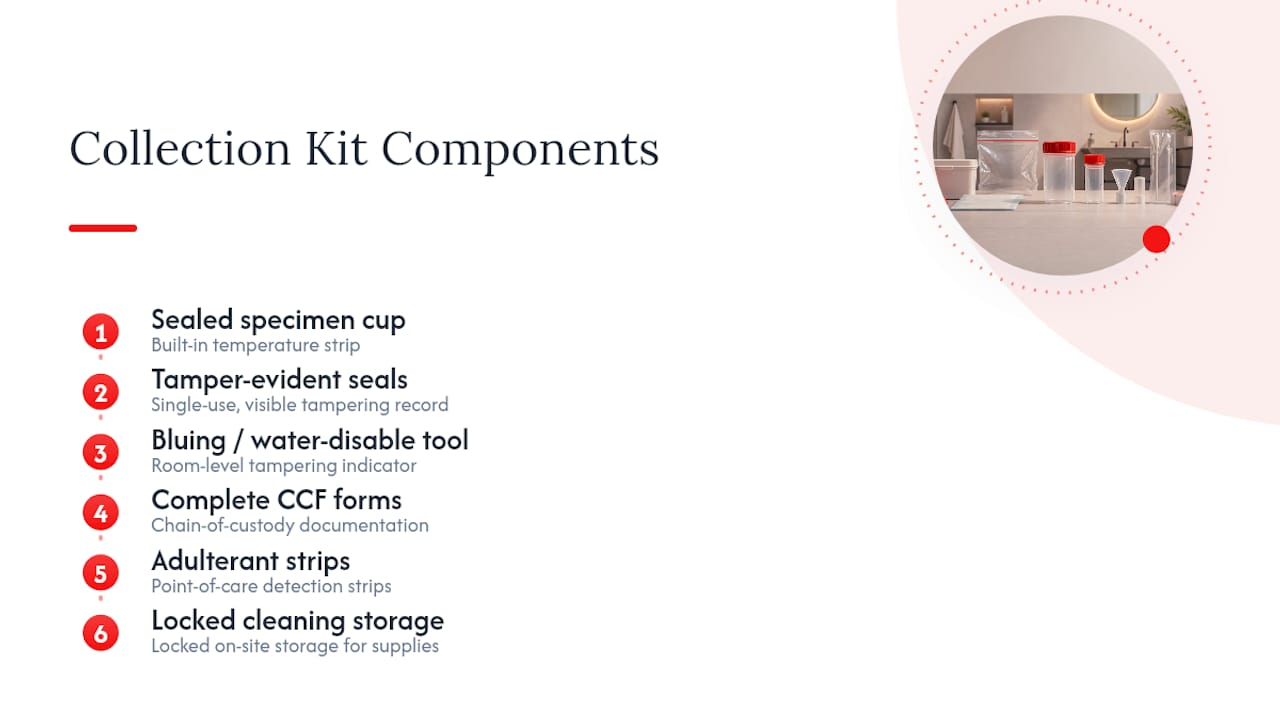
CLIA-waived and FDA-cleared products matter here for a specific reason: they carry documentation that supports the chain of custody if a result is ever challenged. Tamper-evident packaging does the same job at the product level that bluing does at the room level. It gives a visible, verifiable record that nothing was altered between manufacture and use.
Rotate stock so cups and strips don’t sit past their shelf life, and run new collectors through a written checklist before they handle a live collection alone. Programs that treat this as a one-time training session instead of a recurring refresher are the ones that drift on procedure over time.
Designing a Collection Process That Respects Donors and Holds Up Under Review
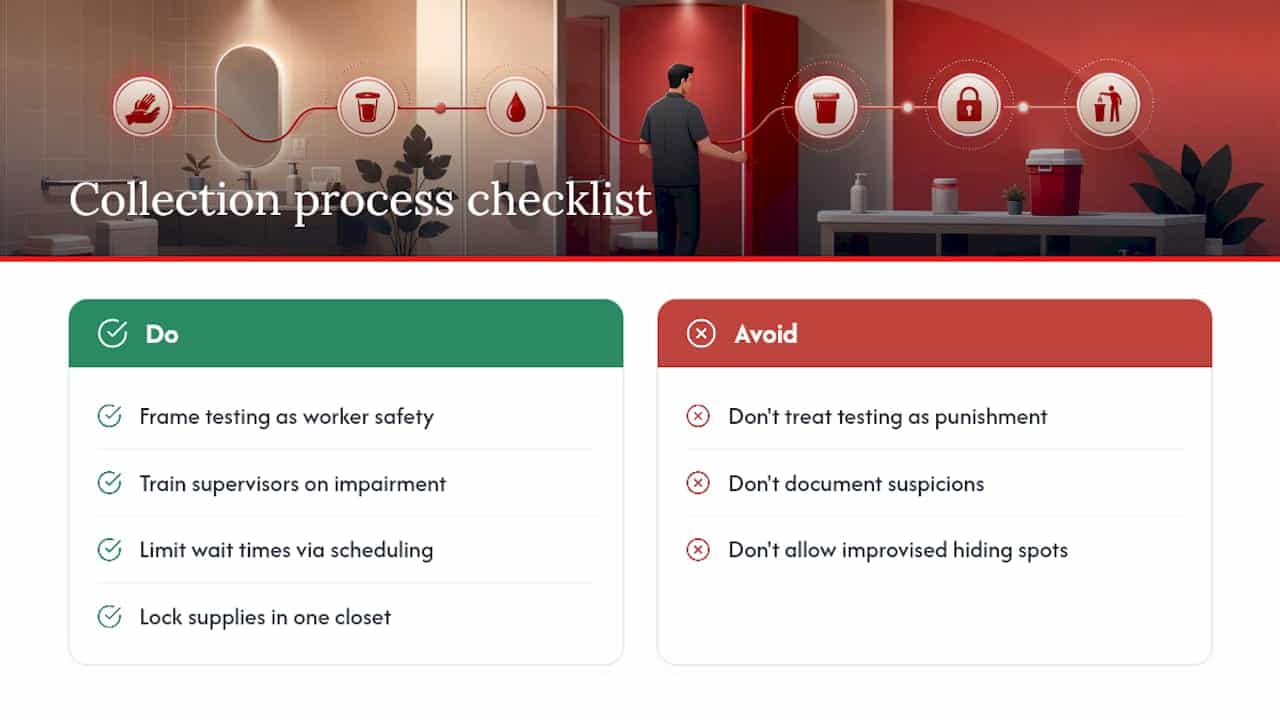
Programs that frame testing as part of a broader safety and health effort, rather than a punitive gate, see less friction and fewer disputes. Pairing bathroom controls with supervisor training on impairment recognition and clear access to recovery resources fits into a Total Worker Health approach that most donors respond to better than a purely enforcement-focused one.
The practical fix is often simple: scheduling that limits wait times, signage that’s unambiguous, and one locked closet for supplies so nothing improvised becomes a hiding spot. Train collectors to document what they observe, not what they suspect, and reserve observed collection strictly for the cases policy actually requires.
— Justin
Where to Get the Right Supplies for a Compliant Bathroom Setup
Getting the checklist right depends on having the right supplies on hand before the first donor walks in. Rapidtestcup stocks the specific items this article covers step by step: multi-panel test cups with built-in temperature strips, adulterant detection strips, tamper-evident seals, and CCF-ready collection supplies, with bulk pricing for programs onboarding multiple collectors at once.
If your program is building out adulterant coverage, prioritize cups that flag creatinine, pH, and oxidants alongside the standard panel, and pair them with dip card tests for a faster presumptive screen before specimens ship to a lab. Bulk kits also make sense for training new collectors, since everyone on a team ends up running the same product and the same procedure. Browse the full drug test cup and collection supply catalog to build a kit that matches your restroom setup checklist item for item.
This article is general information, not a substitute for advice from a qualified doctor. Consult a qualified healthcare professional about your own circumstances before acting on anything here.
Sources
- Drug Test Collection | IBC Customer Central
- DOT 49 CFR Part 40 — Section 40.42
- Drug Testing – StatPearls – NCBI Bookshelf
- Model drug-free workplace plan (SAMHSA) — March 2026
FAQ
Do Collectors Go Into the Bathroom With the Donor?
No. Standard collections are private and unobserved, with the donor alone in the stall. Observation only happens when there’s a documented reason, such as a known history of tampering or a specimen returning temperature-out-of-range, under DOT guidance.
Can Toilet Water Mess Up a Drug Test?
Yes. If toilet water is used to dilute or substitute a specimen, it can throw off lab results and trigger an adulteration flag. That’s exactly why bluing agent and secured water sources are required controls, so any toilet water added to a sample is visibly tinted and immediately obvious.
Is It Necessary to Put Blue Dye in the Toilet During a Drug Test?
It’s one of two accepted options. Federal guidance requires either bluing agent in the toilet with secured water sources, or a fully monitored collection procedure, particularly in multi-stall restrooms. Bluing itself doesn’t interfere with the test chemically; it’s a visible tamper indicator, not a chemical test.
Can a Lab Detect Fake Urine?
Labs run validity checks, including creatinine, pH, and specific gravity, that flag samples inconsistent with human urine. Point-of-care adulterant strips used at collection can catch many substitution attempts before a specimen even ships, and confirmatory lab testing adds another layer of scrutiny before an MRO reviews the result.